
Fact-checked by the Prime Rate editorial team
Quick Answer
A savings account bonus is a one-time cash incentive, typically $150 to $500, paid when you open a new account and meet specific deposit or activity requirements. To earn one, you’ll need to find a qualifying offer, open the account through the promotional link or code, fund it with the required minimum deposit, and keep the balance there for the hold period (usually 60 to 120 days). Taxes apply, so budget accordingly.
Earning a savings account bonus is one of the few genuinely low-effort ways to put $150 to $500 in your pocket without taking on investment risk. The process is straightforward: open a new account at a qualifying bank, meet the deposit and activity requirements, wait out the hold period, and collect the cash. According to a January 2025 WalletHub survey, 53% of Americans say they would switch bank accounts for higher interest rates, which means most people are already open to the idea of moving their money, they just need a clear reason to act.
That hesitation has a cost. The Bankrate 2025 Checking Account Survey found that U.S. adults keep the same primary checking account for an average of 19 years. Nineteen years at a bank paying 0.01% APY on savings is a lot of interest left on the table, and a sign that most people have simply never bothered to compare what else is out there.
This guide is for anyone who has thought about chasing a bank bonus but wasn’t sure whether the fine print would trip them up. By the end, you’ll know exactly which offers are worth pursuing in September 2025, how to qualify without forfeiting the bonus to fees or eligibility traps, and how to calculate whether switching actually makes financial sense after taxes.
Key Takeaways
- 53% of Americans say they’d switch banks for a better interest rate, per a 2025 WalletHub survey, making this a historically underused but widely appealing strategy.
- Top savings bonuses in September 2025 range from $150 to $2,000, depending on the bank and deposit tier; most require a minimum balance held for 60 to 120 days.
- A $200 bonus in the 22% federal tax bracket nets roughly $156 after federal income tax, state taxes reduce that further, so “earn $200” headlines are technically accurate but incomplete.
- Opening a savings or checking account almost never triggers a hard credit pull at major banks, per the FDIC’s GetBanked resource, but unpaid overdrafts or negative-balance closures can leave ChexSystems marks that block approvals for up to seven years.
- A $200 bonus on a $10,000 deposit held for 90 days equals roughly 0.8% annualized return, which evaporates if the new bank’s APY is one percentage point lower than your current account.
- Huntington enforces a rolling 24-month lookback window per customer; Wells Fargo disqualifies anyone who received a bonus in the prior 12 months, so checking your own history before applying is essential.
In This Guide
- What Is a Savings Account Bonus and How Does It Actually Work?
- The Best Savings Account Bonuses Available Right Now
- How to Qualify Without Losing the Bonus to Fees
- The Tax Bill Nobody Mentions: What the Bonus Really Costs You
- ChexSystems, Credit Scores, and the Hidden Risks of Opening Multiple Accounts
- How to Earn Your First $200+ Bonus: A Step-by-Step Process
- Is a Savings Account Bonus Worth Switching Banks For?
Step 1: What Is a Savings Account Bonus and How Does It Actually Work?
Most people think of a savings account bonus as some kind of promotional gimmick, when it’s actually a structured, contractual incentive with specific mechanics that determine whether you get paid or not. A savings account bonus is a one-time cash payment deposited into your account after you meet the bank’s qualifying criteria, and it’s entirely separate from the annual percentage yield (APY) the account earns on an ongoing basis.
The Three Main Bonus Structures
Banks generally use one of three formats. The first is a flat-cash offer: deposit a minimum amount, keep it there for a set period (commonly 60 to 120 days), and receive a fixed payment. The second is a tiered structure, where the reward scales with your deposit size. CIT Platinum Savings, for example, offers $225 for a $25,000 deposit and $300 for a $50,000 deposit when opened with promo code PS2025, meaning a larger commitment unlocks a larger return but also ties up more capital. The third structure is a bundled offer, you must open both a checking and savings account to unlock the full bonus, which effectively turns a savings incentive into a full account-switching decision.
None of these structures is inherently better than the others. Flat-cash offers are the simplest to track. Tiered offers reward larger deposits but require more capital to be liquid. Bundled offers can yield the highest dollar amounts but add complexity, you’re managing two new account relationships and two sets of requirements simultaneously.
What to Watch Out For
The distinction between APY and a bonus matters more than most articles acknowledge. APY is ongoing and compounds; a bonus is a one-time event. A bank advertising a 4.5% APY with no bonus offer may outperform a bank advertising a $200 bonus at 3.5% APY over a two-year horizon on a $10,000 balance. Running the math before committing, which Step 7 covers in detail, is the only way to know for sure.
Some aggregator platforms like Raisin allow depositors to earn up to $2,000 in bonuses by consolidating large balances across multiple partner banks through a single application, a category of offer that most comparison sites ignore entirely, but worth exploring for higher-balance savers.
Step 2: The Best Savings Account Bonuses Available Right Now
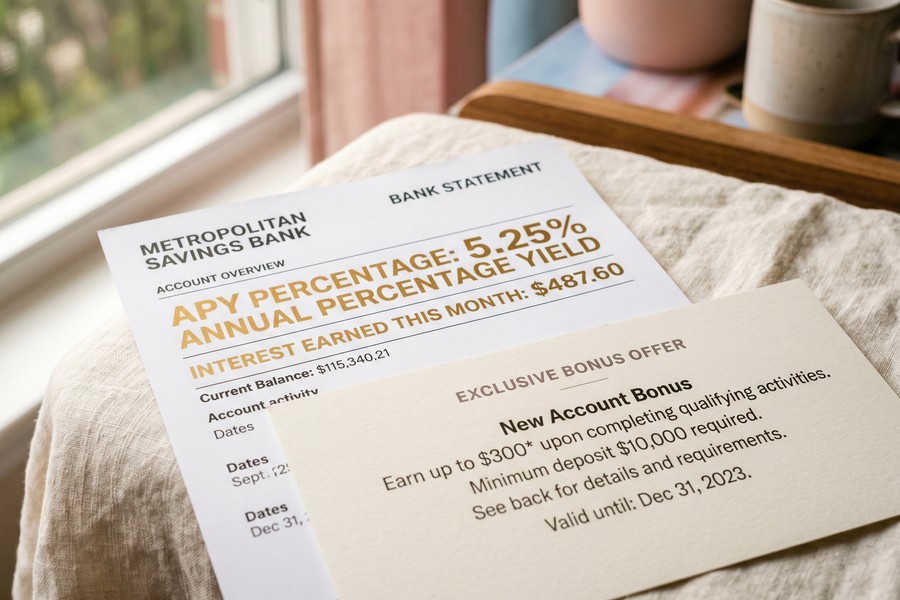
The best savings account bonus available to you depends almost entirely on how much you can deposit and how long you can leave it untouched. Several competitive offers are live in September 2025, but each comes with conditions that determine whether they’re genuinely accessible.
The table below breaks down four prominent offers with their actual requirements so you can assess fit at a glance. Check the best high-yield savings accounts for up-to-date APY comparisons alongside these bonuses, since the rate gap between your current bank and the bonus bank is what determines your true net gain.
| Bank / Platform | Bonus Amount | Min. Deposit Required | Hold Period | Key Restriction |
|---|---|---|---|---|
| CIT Platinum Savings | $225–$300 | $25,000–$50,000 | 90 days | Promo code PS2025 required at opening |
| Discover Online Savings | $150–$200 | $15,000 deposit within 30 days | 90 days after deposit | No monthly fee; new customers only |
| Capital One 360 Performance Savings | $150–$500 | $10,000–$50,000 | 90 days | Tiered; must use promotional link |
| TD Bank Savings | $200 | $10,000 | 90 days | Select states only; hard expiry date applies |
| Raisin (aggregator) | Up to $2,000 | $10,000+ | Varies by partner bank | Must consolidate across multiple partner banks; terms vary |
Geographic restrictions matter more than most listicles acknowledge. TD Bank’s offer is limited to states where it has a physical presence, concentrated in the Northeast and mid-Atlantic. Credit union savings bonuses, often $100 to $300 with lower deposit floors and no geographic delays, are worth checking through your state’s credit union league if none of the above fits your situation.
Always open the account through the bank’s specific promotional link or enter the promo code at the time of application. Missing this step is the single most common reason bonuses are not credited. There is typically no way to retroactively apply a promotional code after the account is already open.
Step 3: How to Qualify Without Losing the Bonus to Fees
Most people who miss their bonus don’t miss it because the offer was fraudulent. They miss it because they misread one line of fine print. Qualifying for a savings account bonus and actually receiving it are two different problems, and the gap between them is where the most money gets lost.
The Most Common Disqualifiers
The first trap is the minimum-balance measurement method. Some banks use your average daily balance over the hold period, not your balance on the final day. If you deposit $10,000 on day one but withdraw $2,000 on day 30, your average daily balance may fall below the threshold even if you restore it by the end. Read whether the offer specifies “average daily balance,” “minimum balance,” or “end-of-period balance”, these are not interchangeable.
The second trap is early closure. Most banks impose an early closure penalty of $5 to $50 if you close the account before a minimum open period, which is typically 90 to 180 days. More importantly, they may claw back the bonus itself. Closing even one day early can forfeit the entire reward.
Anti-churning lookback windows are embedded in the fine print of virtually every major bank’s bonus offer, and most readers don’t know to look for them. Huntington enforces a rolling 24-month limit per customer across all deposit account relationships. Wells Fargo disqualifies anyone who received a checking bonus in the prior 12 months. If you’ve chased bonuses before, check your own history carefully, keeping a simple spreadsheet of which banks you’ve used and when is worth the five minutes it takes to maintain.
What Counts as a Qualifying Direct Deposit
Bundled checking-plus-savings bonuses often require “qualifying direct deposit” to unlock the full reward, and this phrase has a specific meaning that catches many people off guard. Zelle transfers, Venmo payments, and standard bank-to-bank ACH transfers do not meet the direct deposit requirement at most major banks, including BMO and Huntington, which explicitly exclude peer-to-peer transfers in their terms. A qualifying direct deposit must generally originate from an employer’s payroll system, a government benefits agency, or a pension provider. The CFPB’s Regulation DD requires banks to disclose these terms before account opening, so they are findable, but you have to read them.
If you plan to satisfy a direct deposit requirement using a Zelle transfer or ACH bank-to-bank payment, confirm the bank’s definition in writing before opening the account. BMO, Huntington, and Wells Fargo explicitly exclude these transfers. Some banks, including Huntington, do accept Social Security and government benefits as qualifying direct deposits, but the terms vary, so verify individually.
Step 4: The Tax Bill Nobody Mentions: What the Bonus Really Costs You
The “earn $200 free” framing used in most bank bonus headlines is technically accurate and practically misleading at the same time. Every savings account bonus is taxable ordinary income in the year it is received, and the IRS is explicit about this.
How the Tax Treatment Works
The IRS Topic No. 403 states that taxpayers must report all taxable interest income, including bank account opening bonuses, on their federal return even if they do not receive a Form 1099-INT. Banks are only required to issue a 1099-INT for amounts of $600 or more in a calendar year, but smaller bonuses are still taxable; the IRS expects them reported regardless. Bonuses may appear on a 1099-MISC instead of a 1099-INT, depending on how the bank classifies the payment.
The arithmetic matters. A reader in the 22% federal tax bracket who earns a $200 bonus keeps roughly $156 after federal tax alone. In a state with a 5% income tax, that figure drops to approximately $146. The headline number overstates the actual take-home by 25% to 30% for most middle-income earners.
The Medicare IRMAA Risk for Older Savers
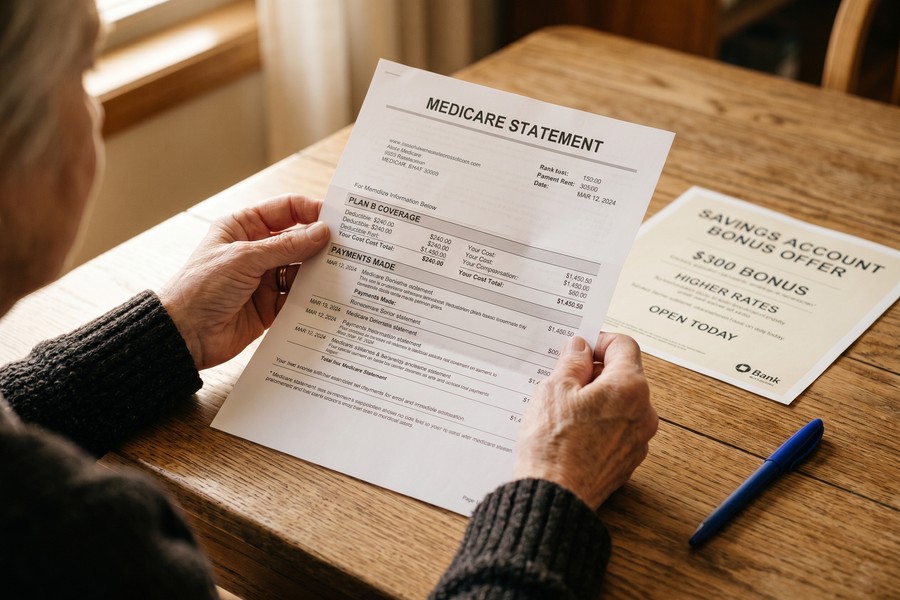
For readers aged 60 and older, the tax picture has an additional layer that no competitor article addresses. Bank bonus income is classified as unearned interest, which means it adds directly to Modified Adjusted Gross Income (MAGI). If that addition pushes your MAGI past a Medicare Income-Related Monthly Adjustment Amount (IRMAA) threshold, you’ll pay higher Medicare Part B and Part D premiums for the following year. In 2025, the first IRMAA surcharge kicks in at a MAGI of $106,000 for individuals and $212,000 for couples. A $300 or $500 bank bonus received in the same year as an IRA distribution, capital gain, or Roth conversion could be the marginal dollar that crosses the line, turning a modest cash reward into a net-negative outcome. If you’re near any of these thresholds, consult a tax advisor before pursuing large-deposit bonuses.
A $200 bonus in the 22% federal bracket nets $156 after federal tax. If your state imposes a 5% income tax, the after-tax value drops to roughly $146, about 27% less than the advertised amount. The bonus is still worth earning, but modeling the actual take-home prevents unpleasant surprises at tax time.
Step 5: ChexSystems, Credit Scores, and the Hidden Risks of Opening Multiple Accounts
The most common question people ask, “will opening a bank account hurt my credit score?”, is actually the wrong question. The right question is whether it will affect your ChexSystems report, which is an entirely separate consumer reporting system that most people have never heard of.
FICO vs. ChexSystems: What Actually Gets Checked
Opening a savings or checking account almost never triggers a hard credit inquiry. Chase, Capital One, and SoFi use soft pulls or no credit pull at all for deposit account applications, so your FICO score is largely unaffected. What banks do check is ChexSystems, a banking-specific consumer report maintained by Fiserv that logs account openings, inquiries, overdrafts, and account closures. The FDIC’s GetBanked resource advises consumers to check for monthly fees, overdraft policies, and account terms before opening any new bank account, solid advice that also applies to understanding what you’re consenting to in terms of ChexSystems access.
What actually triggers a ChexSystems problem is not inquiry volume alone. Unpaid overdrafts, accounts closed with a negative balance, and patterns that banks identify as systematic account-churning are what create negative marks. Those marks can remain on your ChexSystems report for up to seven years, and they can prevent account approvals entirely at banks that rely heavily on the system. Roughly 6 to 8 new accounts within 12 months can raise red flags at stricter institutions.
Banks That Skip ChexSystems
Capital One, SoFi, and Chime are among the banks that do not use ChexSystems for deposit account screening, making them practical starting points for readers with thin banking histories or past overdraft issues. Credit unions chartered under the NCUA’s Truth in Savings regulations also vary widely in their screening practices and are worth calling directly to ask. If your goal is to earn multiple bonuses over 12 months without creating a trail that blocks future approvals, spacing your applications by 60 to 90 days and maintaining all accounts in good standing is the most reliable approach.
You can request a free copy of your ChexSystems consumer disclosure report once every 12 months at no charge, similar to a credit report request. Reviewing it before you start applying for bonus accounts lets you address any negative marks proactively and confirms there are no errors preventing approvals.
Step 6: How to Earn Your First $200+ Bonus: A Step-by-Step Process
Readers who consistently earn bank bonuses without losing them to fine print aren’t doing anything complicated. They’re simply more deliberate about setup than average. The checklist below addresses the five points where most first-timers lose their reward.
The Five-Step Process
- Match the offer to your available deposit. Select a bonus where you can meet the minimum balance without needing that money for other purposes during the hold period. A $200 bonus requiring a $10,000 deposit held for 90 days ties up capital that you may need, and withdrawing early typically forfeits both the bonus and triggers an early closure fee.
- Confirm your eligibility before applying. Check whether you’ve held an account at this bank in the past 12 to 24 months and whether you’ve received a bonus from them before. Banks including Huntington and Wells Fargo maintain lookback windows and will deny the bonus even if the account is approved.
- Open through the exact promotional link or enter the promo code at application. This is the most common single point of failure. Navigating to the bank’s homepage and opening an account without the code or link removes you from the promotional pool entirely, and banks do not apply codes retroactively after account opening.
- Set a calendar reminder for the hold period end date. Mark both the date when you expect the bonus to post and the minimum account-open date before which you should not close the account. These may be different, some bonuses post on day 90 but require the account to remain open until day 120.
- Keep the account open past the minimum required period before closing. If you plan to close the account after collecting the bonus, wait until you are clearly past the stated minimum open requirement. Then verify that the full bonus amount has posted before initiating the closure.
For those without a traditional employer payroll, the direct deposit requirement is often still achievable. Social Security payments, pension distributions, and federal government benefits qualify as direct deposits at banks including Huntington and BMO. Confirm this in writing with the bank before opening the account, since the terms differ by institution. For broader context on building healthy savings habits around a strategy like this, the step-by-step emergency fund guide covers how to structure a savings target before you start moving money between institutions.
Keep a simple tracking spreadsheet with four columns: bank name, date opened, bonus amount and requirements, and minimum close date. You’ll know at a glance whether you’re still inside a lookback window and when it’s safe to close an account, both of which become essential if you pursue more than one bonus per year.

Step 7: Is a Savings Account Bonus Worth Switching Banks For?
The answer depends almost entirely on one number you have to calculate yourself: the after-tax annualized yield of the bonus relative to the APY gap between your current bank and the new one. Without that calculation, you’re making the decision on intuition, not math.
How to Run the Math
A $200 bonus on a $10,000 deposit held for 90 days is equivalent to roughly 0.8% annualized return on that capital (($200 ÷ $10,000) × (365 ÷ 90) ≈ 0.81%). After federal tax at 22%, the annualized after-tax return drops to approximately 0.63%. If the new bank’s APY is even one percentage point lower than your current account, the bonus advantage disappears before the year is out, and you’ve gone through the work of switching for a net-zero or net-negative result.
The case for switching becomes compelling when the new bank also offers a meaningfully higher ongoing APY. If you’re currently earning 0.5% APY at a traditional bank and the bonus bank offers 4.5% APY, you’re gaining both the one-time reward and a substantially better interest rate going forward. On a $10,000 balance, the APY improvement alone generates an additional $400 per year, and the $200 bonus is additive on top of that. Understanding how rate changes ripple through savings accounts is worth reading about separately: what happens to your savings when the prime rate rises gives useful context on why APY gaps open and close over time.
When to Wait Before Switching
There is one honest concession worth stating clearly. If you are within 6 to 12 months of a major credit application, a mortgage, car loan, or any financing that involves a lender reviewing your bank statements, opening multiple new accounts simultaneously is worth delaying. This isn’t about FICO score damage; savings accounts almost never trigger hard inquiries. The risk is on the lender-review side: underwriters who see frequent account-switching on bank statements sometimes interpret it as financial instability, even when it’s actually disciplined rate-shopping. For readers who want the bonus income but are also working to strengthen their financial profile, the monthly budget guide and the CD rates vs. high-yield savings comparison are both worth reviewing to ensure bonus-chasing fits into a coherent plan rather than replacing one.
The Bankrate finding that Americans stay with the same primary bank for an average of 19 years is, in its own way, an argument for at least evaluating your options. Loyalty to an institution that pays 0.01% APY isn’t loyalty, it’s inertia. A well-chosen bank bonus is a reasonable catalyst for doing a comparison you probably should have done years ago.
U.S. adults keep the same primary checking account for an average of 19 years, per the Bankrate 2025 Checking Account Survey. Over that same period, online banks and credit unions have routinely offered APYs 10 to 20 times higher than the national average at brick-and-mortar institutions, suggesting the typical American has paid a significant loyalty tax without realizing it.
Frequently Asked Questions
Can I use Zelle or Venmo to meet the direct deposit requirement for a savings account bonus?
In most cases, no. Zelle transfers, Venmo payments, and bank-to-bank ACH transfers do not qualify as “direct deposit” at the majority of major banks, including BMO, Huntington, and Wells Fargo, which explicitly exclude peer-to-peer transfers in their promotional terms. A qualifying direct deposit must generally originate from an employer’s payroll processor, a government benefits agency, or a pension provider. Check the specific bank’s terms before opening the account, since the definition varies.
How long do I have to keep my account open to receive the bonus?
Most offers require the account to remain open for a minimum of 90 to 180 days after the bonus posts, and some impose that requirement from the account opening date, not the bonus payment date. Closing early typically triggers an early closure fee of $5 to $50 and may result in a full claw-back of the bonus. Set a calendar reminder for both the expected bonus posting date and the minimum close date so you don’t act too soon.
What is ChexSystems and how does it affect my ability to open a bonus account?
ChexSystems is a consumer reporting agency, maintained by Fiserv, that tracks deposit account history including overdrafts, negative-balance closures, and account inquiries. Most banks check it when you apply for a new account. Unlike a hard credit inquiry, it doesn’t directly affect your FICO score, but a negative ChexSystems mark from an unpaid overdraft or account closed in bad standing can block approvals at participating banks for up to seven years. Capital One, SoFi, and Chime do not use ChexSystems and are accessible to applicants with troubled banking histories.
How much is a $200 savings account bonus actually worth after taxes?
In the 22% federal tax bracket, a $200 bonus is worth roughly $156 after federal income tax. State taxes reduce that further, in a state with a 5% income tax rate, the after-tax value drops to approximately $146. Banks are required to issue a Form 1099-INT or 1099-MISC for bonuses over $600, but the IRS requires you to report smaller amounts as well, even if you receive no form.
Can retirees or people on Medicare earn savings account bonuses without triggering higher premiums?
Potentially, but this deserves careful attention. Bank bonus income adds directly to Modified Adjusted Gross Income (MAGI), and if that pushes your MAGI past a Medicare IRMAA threshold, $106,000 for individuals in 2025, you’ll pay higher Part B and Part D premiums the following year. For retirees near those income thresholds, a $300 or $500 bonus received in a year that also includes IRA distributions or a Roth conversion could cost more in premium surcharges than it earns. Consulting a tax advisor before pursuing large-deposit bonuses is advisable for anyone in this situation.
What happens if I close my account before the bonus is paid?
Closing your account before the bonus posts will almost certainly forfeit the reward entirely. Most banks state explicitly that the account must be open and in good standing at the time the bonus is credited. You may also incur an early closure fee ranging from $5 to $50. If you’re unsure when the bonus will post, contact the bank directly and confirm the date before initiating any closure.
Are credit union savings bonuses better than big bank offers?
Credit union bonuses are often more accessible for smaller depositors: many offer $100 to $300 with lower deposit floors, no monthly maintenance fees, and shorter or no lookback windows compared to large banks. The tradeoff is that credit union membership requires meeting eligibility criteria, which may be geographic or employer-based. For readers who qualify, credit unions are worth evaluating alongside the headline bank offers, particularly if the big-bank bonuses require deposits above what you can comfortably lock up.
How many bank accounts can I open before it becomes a problem for ChexSystems?
There’s no universal hard limit, but roughly 6 to 8 new accounts within 12 months can raise flags at stricter institutions. The more consequential risk is behavioral: each account needs to be managed in good standing, with no overdrafts or negative balances, to avoid negative ChexSystems marks. Spreading applications over several months and maintaining a tracking log reduces the risk of errors that create lasting problems.
Should I pursue a savings account bonus if I’m also trying to build my credit?
Opening a savings account almost never affects your credit score, since most banks use soft pulls or no credit inquiry for deposit accounts. The two strategies can run in parallel without conflict for most people. If you’re actively working on building a credit profile, the step-by-step guide to building credit from scratch outlines how credit inquiries actually work and which account types affect FICO scoring, the savings account bonus process doesn’t interfere with those steps.
Is a $150 savings account bonus worth the hassle of switching banks?
Whether $150 clears the effort bar depends on your deposit size and the ongoing APY comparison. If the new bank also offers a higher interest rate than your current one, the bonus is additive on top of a better deal. If the new bank’s APY is lower, the bonus may be partially or fully offset by the interest you give up during the hold period. Running the quick annualized-yield calculation in Step 7 takes about two minutes and gives you a concrete answer rather than a feeling.
Sources
- IRS, Topic No. 403: Interest Received
- Consumer Financial Protection Bureau, Regulation DD (12 CFR Part 1030), Truth in Savings Act
- FDIC, Deposit Accounts Consumer Resource Center
- FDIC, GetBanked: How to Choose a Bank Account
- NCUA, Truth in Savings Act, Rules and Regulations Part 707
- LiveNOW from FOX / WalletHub, Banking Survey 2025: 53% Would Switch for Higher Rates
- Consumer Financial Protection Bureau, Bank Account Consumer Tools and Resources
- IRS, Publication 550: Investment Income and Expenses (Interest Income Reporting)