Fact-checked by the Prime Rate editorial team
Quick Answer
The prime rate vs federal funds rate centers on two linked benchmarks where the federal funds rate is currently 3.63% Federal Reserve Bank of St. Louis-06-01 and the prime rate is 6.75% Board of Governors of the Federal Reserve System-07-16. The Federal Reserve sets the federal funds rate to guide monetary policy while banks use the prime rate as the direct benchmark for variable-rate loans like credit cards and HELOCs.
Updated July 22, 2026
Prime Rate vs Federal Funds Rate: Which Matters More for Your Money?
The prime rate vs federal funds rate centers on the federal funds rate currently at 3.63% Federal Reserve Bank of St. Louis-06-01 which the Federal Reserve uses as its main monetary policy tool, while the prime rate at 6.75% Board of Governors of the Federal Reserve System-07-16 is set by banks and directly used for consumer products according to Board of Governors of the Federal Reserve System.
These rates affect everything from credit card debt to home equity lines and auto loans. This guide explains their definitions, how they connect, their impacts on your finances, and how to use this knowledge for better decisions on borrowing and saving. This is not financial advice.
Key Takeaways
- The federal funds rate stood at 3.63% Federal Reserve Bank of St. Louis-06-01.
- The prime rate is typically set 3 percentage points above the federal funds rate by major banks as reported by Board of Governors of the Federal Reserve System.
- With a prime rate of 6.75% Board of Governors of the Federal Reserve System-07-16, credit cards often charge prime plus 10% to 15% resulting in APRs around 16.75% to 21.75% per Federal Reserve.
- Major banks adjust their prime rates within days after the Federal Open Market Committee changes the federal funds rate according to Federal Reserve Bank of New York.
- The 30-year fixed mortgage average was 6.55% Federal Reserve Bank of St. Louis-07-16, influenced indirectly by the federal funds rate via Federal Reserve Bank of St. Louis.
In This Guide
What Is the Federal Funds Rate?
Commercial banks charge one another the federal funds rate on overnight loans using reserve balances at the Federal Reserve. This serves as the benchmark that the Federal Open Market Committee sets eight times a year in order to manage overall economic activity.
The FOMC establishes a target range rather than one fixed number.-06-01, the federal funds rate stood at 3.63% Federal Reserve Bank of St. Louis. The Federal Reserve maintains the rate within that band using tools such as interest on reserve balances and overnight reverse repurchase agreements. Federal Reserve Bank of New York
Adjustments to the federal funds rate allow the Fed to steer economic growth and pursue a 2% inflation target. Lower rates can encourage spending since borrowing becomes less costly, whereas higher rates tend to cool activity by raising the price of credit. As a foundational element, this rate affects consumer loans, savings accounts, money market accounts, and nearly every other interest rate across the economy. Federal Reserve
The federal funds rate influences consumer loan interest rates, savings accounts, money market accounts, and virtually all other interest rates in the economy.
What Is the Prime Rate?
Banks post the prime rate as the charge for short-term loans to their most creditworthy customers, often large corporations. This benchmark underpins many consumer products including credit cards and home equity lines of credit as well as personal and small business loans. The Federal Reserve does not set the prime rate. Instead, commercial banks establish their own, though convention leads most to set it about 3 percentage points above the federal funds rate.-07-16, the prime rate stands at 6.75% Board of Governors of the Federal Reserve System. The Wall Street Journal tracks this by surveying major banks and updates when a majority shift their rates. Loan contracts frequently tie terms to this figure, such as prime plus a margin, which is why borrowers see it often. Board of Governors of the Federal Reserve System
How the Federal Funds Rate Influences the Prime Rate
| Factor | Federal Funds Rate | Prime Rate |
|---|---|---|
| Best for | Understanding economic direction and timing big financial moves | Managing day-to-day borrowing costs |
| Who sets it | Federal Reserve (via the FOMC) | Individual banks and credit unions |
| Current rate | 3.63% (-06-01) Federal Reserve Bank of St. Louis | 6.75% (-07-16) Board of Governors of the Federal Reserve System |
| Direct impact | Bank-to-bank overnight lending and the broader financial system | Consumer loans, credit cards, lines of credit |
| Change frequency | 8 scheduled FOMC meetings per year | Adjusted within days of Fed rate changes |
| Who feels it first | Financial institutions and money markets | Individual borrowers and small business owners |
A consistent spread of about 3 percentage points links the two rates, so adjustments by the Federal Reserve to the federal funds rate typically lead banks to update the prime rate right away.
Through the Federal Open Market Committee, the Federal Reserve sets the federal funds rate at eight meetings annually after reviewing conditions like inflation, employment, and growth. The goal remains a 2% inflation target, and rate decisions help stabilize the economy. Banks feel the impact on their own borrowing costs first, which makes this the main channel for monetary policy to affect the wider system.
Private banks determine the prime rate. Although each could set its own, competitive forces and long practice result in major banks aligning closely, usually at the federal funds target upper bound plus around 3 percentage points. Following a Fed announcement, these banks commonly shift their prime rate the next business day. While smaller institutions might delay or differ slightly, large lenders tend to move in step. Federal Reserve
Review your loan agreements to see if they reference the prime rate, the federal funds rate, or another benchmark like SOFR.
How Quickly Banks Respond to Federal Reserve Decisions
Eight times each year the Federal Open Market Committee convenes according to a set calendar, issuing a statement after each session. Additional materials like projections, minutes, and governor speeches provide signals about future moves on the federal funds rate. Such openness can make upcoming changes easier to anticipate when data trends are clear.
In response, the prime rate shifts almost automatically after Fed announcements. Banks make the adjustment within days without their own separate process. This reactivity means the prime rate reflects recent actions but offers little advance notice on its own. Forecasters often miss the mark on rate paths, particularly amid uncertainty or surprise data. Federal Reserve
Effects of Rate Shifts on Everyday Borrowing
Bank funding costs respond to shifts in the federal funds rate, which in turn affects the prime rate. Cheaper overnight borrowing for banks when the Fed lowers rates often leads to lower prime rates. This connection ultimately shapes consumer borrowing costs in various lending areas.
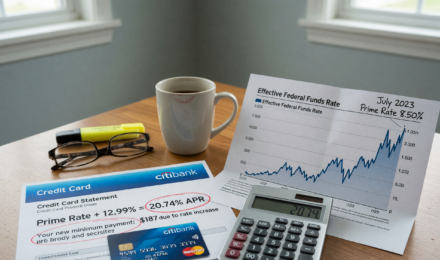
For individual borrowers, the prime rate drives costs on variable-rate products. Credit cards commonly add 10% to 15% to the prime rate for their APRs. At 6.75% Board of Governors of the Federal Reserve System-07-16 for the prime rate, a card priced at prime plus 12% would have an APR of 18.75%. A hypothetical 0.25 percentage point increase in the federal funds rate might lead banks to set prime at 7.00%, pushing that card’s APR to 19.00% and increasing costs on outstanding balances. Board of Governors of the Federal Reserve System
Variable-rate personal loans and small business loans also tie to the prime rate. Home equity lines of credit typically adjust soon after prime changes, often in the next one or two billing cycles. Fixed-rate loans such as mortgages or auto loans stay the same once locked in, regardless of later shifts in the federal funds rate or prime. Federal Reserve Bank of St. Louis
With the current prime rate of 6.75% Board of Governors of the Federal Reserve System-07-16, many variable rate products will see immediate cost changes when banks update their benchmarks.
Choosing Which Benchmark to Follow for Your Finances
If variable-rate debt forms part of your obligations, monitoring the prime rate makes sense. This includes products like credit cards and HELOCs where changes feed directly into payments, generally within one or two billing cycles. The current level helps in calculating obligations and planning budgets.
For those considering larger steps such as refinancing or securing new fixed-rate loans, the federal funds rate provides useful context. It helps shape longer-term rates through effects on Treasury yields and lender expectations. Savers can also watch it since it influences yields on savings accounts, money market accounts, and CDs.
Small business owners may benefit from watching both, since operating lines or loans often reference the prime rate for immediate costs while the federal funds rate informs forecasts for cash flow and financing choices. In daily decisions the prime rate offers direct visibility into current expenses. Yet the federal funds rate drives those changes through the consistent spread. Together they provide insight into present borrowing costs and potential directions ahead. Federal Reserve This information serves educational purposes and is not financial advice.
Frequently Asked Questions
Do all banks use the same prime rate?
Most major commercial banks set their prime rate at the federal funds rate plus 3%, so the Wall Street Journal prime rate – based on a survey of the largest banks – reflects what the vast majority of lenders charge. However, some smaller banks, credit unions, and other financial institutions may set a slightly different base rate depending on their funding costs, competitive positioning, and risk appetite. Always check your specific loan agreement to see which benchmark your lender uses – some products reference SOFR, Treasury yields, or other indices rather than prime.
How quickly do my loan rates change when the Fed cuts rates?
The timeline is fairly fast. Once the FOMC announces a rate change, banks typically adjust their prime rate within one to two business days. Your variable-rate loans – credit cards, HELOCs, adjustable rate mortgages – will usually reflect the new prime rate within one to two billing cycles. Fixed-rate loans you’ve already taken out are unaffected; only new loans originated after the change will carry the updated rate. Some loan contracts include caps, floors, or lag clauses that can slow the adjustment, so review your terms.
Is it smart to postpone borrowing while waiting for potential rate drops?
It depends on your financial situation and tolerance for risk. If you’re considering variable rate loans and credible forecasts suggest the Fed may cut the federal funds rate soon, waiting could save you money – but rate predictions are often wrong, and timing the market is difficult. If you need the funds now, borrowing at today’s rate and refinancing later may be more practical than delaying indefinitely. For fixed rate loans, remember that mortgage rates and personal loan rates are influenced by longer-term factors like Treasury yields and investor expectations, not just the current fed rate. Weigh the cost of waiting against the certainty of locking in a known rate today.
What does a change in these rates mean for credit card APRs?
Credit card APRs are usually prime plus a large margin, so when the prime rate changes due to shifts in the federal funds rate, your interest charges on balances adjust accordingly within a billing cycle or two.
What part does the Federal Open Market Committee play?
The Federal Open Market Committee sets the target for the federal funds rate at its eight annual meetings, which then influences banks to adjust the prime rate they charge customers.
Can changes in these rates impact savings accounts?
Yes, when the federal funds rate rises, yields on savings accounts and money market accounts often increase as banks pay more to attract deposits, though the effect may be smaller than on borrowing rates.
In what ways do fixed-rate and variable-rate loans react differently to movements in these rates?
Fixed rate loans lock in the interest rate at origination and do not change with the prime rate or federal funds rate, while variable rate loans adjust periodically based on the current prime rate.
Sources
- Board of Governors of the Federal Reserve System, H.15 Selected Interest Rates
- Federal Reserve Bank of St. Louis, FRED Economic Data
- Federal Reserve Bank of New York, The Federal Funds Rate
- Federal Reserve, Monetary Policy
- Federal Reserve Bank of St. Louis, Bank Prime Loan Rate
- Federal Reserve Bank of St. Louis, Federal Funds Effective Rate
- Federal Reserve, About the Fed
- Federal Reserve, Federal Open Market Committee