Fact-checked by the Prime Rate editorial team
Quick Answer
The U.S. prime rate currently stands at 7.50%, directly setting the floor for variable-rate home equity lines of credit (HELOCs). Fixed-rate home equity loans average 8.36% nationally for a 10-year term. In a stable or declining rate environment, variable HELOC rates typically cost less over time — but fixed loans eliminate payment risk entirely.
Understanding prime rate home equity costs starts with one fact: the prime rate is the benchmark lenders add a margin to when pricing HELOCs. According to Federal Reserve H.15 release data, the prime rate has held at 7.50% since the Federal Reserve’s last rate adjustment. That single number determines whether your HELOC payment rises or falls every month.
With home equity collectively exceeding $32 trillion nationally, millions of homeowners are actively choosing between fixed and variable structures right now. The wrong choice can cost thousands in avoidable interest.
Key Takeaways
- The U.S. prime rate is 7.50%, per Federal Reserve H.15 data, and directly determines the base cost of every variable-rate HELOC in the country.
- Fixed home equity loans currently average 8.36% for a 10-year term and 8.52% for a 15-year term, per Bankrate’s national rate survey.
- On a $50,000 balance over 10 years, a HELOC at prime + 0.50% saves roughly $1,300 in interest versus a fixed loan — but just two quarter-point Fed hikes erase that advantage entirely.
- Most lenders cap combined loan-to-value at 85% and require a minimum credit score of 620 to qualify, per Experian’s home equity lending research.
- Borrowers with FICO scores above 740 typically receive HELOC margins at or below prime + 0.50%, while scores under 680 can push margins to prime + 2.00% or higher.
- A 0.50 percentage point prime rate drop saves a borrower carrying a $75,000 HELOC balance approximately $375 per year, automatically and without refinancing, per Bankrate’s HELOC rate analysis.
How Does the Prime Rate Directly Affect HELOC Rates?
HELOC rates move in lockstep with the prime rate because lenders price them as prime + margin, where the margin typically ranges from 0% to 2% depending on your credit profile. When the Federal Reserve raises the federal funds rate, the prime rate rises by the same amount, and your HELOC rate adjusts within one to two billing cycles.
This pass-through mechanism is not discretionary. It is contractually embedded in virtually every HELOC agreement. The Consumer Financial Protection Bureau (CFPB) confirms that most HELOCs use the Wall Street Journal prime rate as their published index. A borrower with a prime + 0.5% HELOC today pays 8.00%, but that rate could change next quarter.
The Prime Rate Margin Structure
Lenders set your margin at origination based on your credit score, loan-to-value ratio, and debt-to-income ratio. Borrowers with FICO scores above 760 often qualify for margins at or below prime, while scores under 680 can push margins to prime + 2% or higher. That margin is fixed for the life of the line. Only the prime rate component floats.
Key Takeaway: HELOCs are priced at prime plus a fixed margin set at origination. With the prime rate at 7.50%, most HELOC borrowers are paying between 7.50% and 9.50% today, per Federal Reserve benchmark data. Your margin never changes — only the prime rate component moves.
Fixed vs. Variable: Which Prime Rate Home Equity Product Actually Costs Less?
Fixed home equity loans cost less in a rising rate environment; HELOCs cost less when rates fall or stay flat. This is not a matter of opinion. It is simple interest math over a defined loan term.
A fixed home equity loan locks your rate at origination. Bankrate’s national survey shows fixed home equity loan rates averaging 8.36% for a 10-year term and 8.52% for a 15-year term. A HELOC starting at prime + 0.5% (8.00%) is cheaper today, but if the Fed raises rates twice, that HELOC hits 8.50% and erases the savings.
A Real-Dollar Illustration
On a $50,000 draw over 10 years, a fixed loan at 8.36% produces a total interest cost of approximately $23,800. The same balance on a HELOC at 8.00% costs roughly $22,500 in interest, a $1,300 advantage. Two quarter-point Fed hikes flip that advantage entirely, adding over $1,600 in variable interest across the remaining term.
The core tension here is certainty versus cost. Fixed loans charge a premium for eliminating uncertainty. Whether that premium is worth paying depends almost entirely on where rates are headed — and on how much budget volatility you can absorb if they rise.
| Product | Current Avg. Rate | Rate Type | Best For | Total Interest on $50K / 10 Yr |
|---|---|---|---|---|
| HELOC | 8.00% (prime + 0.50%) | Variable | Flexible draws, falling rates | ~$22,500 (at constant rate) |
| Home Equity Loan (10-yr) | 8.36% | Fixed | Lump sum, budget certainty | ~$23,800 |
| Home Equity Loan (15-yr) | 8.52% | Fixed | Lower monthly payments | ~$37,200 |
| Cash-Out Refinance | 6.89% (30-yr fixed) | Fixed | Large amounts, replacing first mortgage | Depends on full loan balance |
Key Takeaway: At today’s rates, a HELOC saves roughly $1,300 in interest versus a fixed home equity loan on a $50,000 balance over 10 years, but just two Fed rate hikes eliminate that advantage entirely. See Bankrate’s current rate data for the latest national averages.
When Should You Choose a Fixed Home Equity Loan?
Choose a fixed home equity loan when you need a defined lump sum, want predictable monthly payments, or believe the prime rate will rise over your repayment timeline. Fixed loans eliminate rate risk entirely. Your payment on day one equals your payment on day 3,650.
Fixed home equity loans are especially practical for large home improvement projects with known costs: a roof replacement, HVAC system, or kitchen remodel where budget certainty matters most. They also work well for debt consolidation, where swapping high-rate credit card debt for a fixed 8.36% loan produces guaranteed monthly savings.
The Rate Direction Argument
The Federal Reserve’s Federal Open Market Committee (FOMC) holds eight scheduled meetings per year. Each meeting carries the potential to move the prime rate. Borrowers who lock a fixed rate today are essentially hedging against any upward surprises in that calendar.
If rates stay flat or drop, you pay a small premium for that insurance, typically 0.36 percentage points versus today’s best HELOC pricing. Many borrowers consider that a reasonable trade. For context on how prime rate movements ripple through your broader financial picture, our guide on how the prime rate affects your mortgage and home equity loan covers the full transmission mechanism in detail.
Fixed Loans and Debt Consolidation Math
The consolidation case for fixed home equity loans is straightforward. The average credit card rate has exceeded 20% in recent quarters. Replacing that balance with a fixed home equity loan at 8.36% produces a guaranteed spread of more than 11 percentage points on every dollar consolidated. Unlike a HELOC, a fixed loan also enforces repayment discipline: there is no revolving access to reborrow, which matters if overspending contributed to the original debt problem.
One practical note: closing costs on fixed home equity loans typically run between 2% and 5% of the loan amount. On a $50,000 loan, that is $1,000 to $2,500 in upfront fees. Factor those into your total cost comparison before assuming the lower rate wins automatically.
Key Takeaway: Fixed home equity loans currently average 8.36% for a 10-year term, offering complete payment certainty regardless of future Fed decisions. Borrowers consolidating debt or funding defined projects should strongly favor fixed structures, according to CFPB borrowing guidance.
When Does a HELOC Beat a Fixed Loan on Prime Rate Home Equity Costs?
A HELOC wins on cost when you draw funds gradually, repay quickly, or expect the prime rate to fall. Because you only pay interest on what you have drawn — not the full approved credit line — disciplined borrowers can hold total interest well below what a fixed loan would charge.
The Federal Reserve has signaled potential rate cuts in late 2025 and into 2026. If the prime rate drops by even 0.50 percentage points, a borrower on a $75,000 HELOC saves approximately $375 per year automatically, with no refinancing required. That same borrower with a fixed loan sees no benefit at all. As explored in our article on what happens to your savings when the prime rate rises, rate direction affects every variable-rate product simultaneously.
The Draw Period Advantage
Most HELOCs offer a 10-year draw period during which you can borrow, repay, and reborrow up to your credit limit. This revolving structure makes HELOCs ideal for ongoing renovation projects, college tuition spread over multiple semesters, or emergency reserves. A fixed home equity loan cannot be reused once repaid. The Federal Deposit Insurance Corporation (FDIC) advises consumers to match the loan structure to the borrowing pattern: lump sum needs warrant fixed loans, while ongoing needs favor lines of credit.
Managing a HELOC responsibly also requires solid budget discipline. Our guide on how to create a monthly budget that actually works can help you plan for variable payment swings during rate-volatile periods.
The Partial-Draw Scenario
Consider a homeowner approved for a $80,000 HELOC who only draws $25,000 for a bathroom remodel. Interest accrues only on the $25,000 outstanding balance. A fixed home equity loan for $80,000 at origination would charge interest on all $80,000 from day one, regardless of when or whether the remaining funds are used. Over a three-year payoff period, the HELOC borrower in this scenario could pay less than half the total interest of the fixed-loan borrower, simply by controlling the outstanding balance.
That math changes completely if you draw the full line and carry it. The HELOC advantage is a function of utilization discipline, not just rate levels.
Key Takeaway: HELOCs outperform fixed loans when borrowers use only a portion of the line and when the prime rate declines. A 0.50% rate drop saves a $75,000 HELOC borrower roughly $375 annually, automatically, per Bankrate’s HELOC rate analysis.
How the Current Rate Environment Should Shape Your Decision
The rate environment at the time you borrow matters as much as the rate itself. Borrowing at a variable rate near a cyclical peak is a very different proposition than borrowing at a variable rate near a cyclical trough.
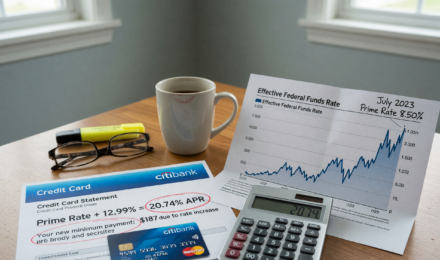
The prime rate reached 8.50% in mid-2023, its highest level in more than two decades, before the Federal Reserve began cutting in late 2024. At 7.50% today, rates have come down meaningfully but remain elevated by historical standards. The Fed’s stated intent to continue cutting — subject to inflation data — means the base case for variable-rate borrowers is modestly favorable heading into 2025 and 2026.
What Rate Forecasts Actually Mean for Borrowers
No forecast is guaranteed. The Fed’s own projections have been revised repeatedly over the past four years, and external shocks — supply disruptions, geopolitical events, sticky inflation — can delay or reverse rate trajectories that seemed certain. Borrowers who chose variable rates in 2021 expecting stability watched their HELOC costs nearly double by 2023.
The honest framing is this: variable rates offer a genuine cost advantage when rates fall, but they transfer all the risk of being wrong to the borrower. Fixed rates transfer that risk to the lender, at a price. Whether that price is worth paying is a personal judgment, not a mathematical one.
The Case for Splitting the Difference
Some lenders offer hybrid structures worth considering. A fixed-rate advance option lets HELOC borrowers lock a portion of their outstanding balance at a fixed rate while keeping the remainder variable. This approach lets you stabilize the bulk of your exposure while retaining flexibility on the rest. Not every lender offers it, and lock fees vary, but it is worth asking about if you are drawn to HELOCs but concerned about rate volatility.
For a broader look at how rate changes affect borrowing costs across product types, our article on how the prime rate affects personal loan rates provides a useful side-by-side comparison against unsecured alternatives.
What Credit and Equity Standards Determine Your Prime Rate Home Equity Rate?
Lenders require a minimum of 15% to 20% home equity and a credit score of at least 620 to qualify for most home equity products, but the best rates go to borrowers well above those floors. Your actual rate depends on four factors: credit score, combined loan-to-value (CLTV) ratio, debt-to-income (DTI) ratio, and the lender’s current prime rate margin.
According to Experian’s home equity lending data, borrowers with scores above 740 typically receive margins of prime minus 0.25% to prime plus 0.50% on HELOCs. Borrowers between 620 and 679 often face margins of prime plus 1.50% to 2.00%, adding $750 to $1,000 per year in extra interest on a $50,000 balance. Improving your credit profile before applying is one of the highest-return moves available. Our guide on how to build credit from scratch covers actionable steps even for thin-file borrowers.
CLTV and Equity Requirements
Most lenders cap CLTV at 85%, meaning your first mortgage plus the new home equity product cannot exceed 85% of your home’s appraised value. On a home worth $400,000 with a $280,000 mortgage balance, your maximum combined borrowing is $340,000, leaving $60,000 in potential home equity borrowing capacity. Lenders calculate this conservatively, and appraisal values matter significantly.
Debt-to-Income Ratio: The Underwriting Filter Most Borrowers Overlook
Credit score and equity get most of the attention, but DTI is often the actual bottleneck in home equity underwriting. Most lenders require a DTI below 43%, and many prefer 36% or lower for the best pricing. DTI is calculated by dividing your total monthly debt payments (including the proposed new payment) by your gross monthly income.
A borrower with a $5,000 monthly gross income, a $1,400 mortgage payment, $300 in car payments, and a proposed $350 HELOC payment carries a DTI of 41%. That clears most lenders’ minimums but likely triggers a higher margin than a borrower at 32% DTI. Paying down existing installment debt before applying can improve your DTI quickly, sometimes enough to move you into a better pricing tier.
Shopping Multiple Lenders Is Not Optional
Rate dispersion across lenders on home equity products is wider than most borrowers expect. On an identical borrower profile, margin offers can vary by 0.50 to 1.00 percentage point between lenders. On a $60,000 HELOC balance, a 0.75-point margin difference costs roughly $450 per year. Over a 10-year draw period, that compounds to well over $4,000 in avoidable interest. Getting at least three competing offers before committing is straightforward advice that most borrowers skip.
Key Takeaway: Borrowers with FICO scores above 740 can access HELOC margins near or below prime, while scores under 680 add up to 2.00 percentage points to the base rate. Maximizing your credit score before applying is the single most controllable way to lower prime rate home equity costs, per Experian’s lending research.
Tax Deductibility: A Factor That Can Shift the Math
Interest on home equity loans and HELOCs may be tax-deductible, but only under specific conditions established by the Tax Cuts and Jobs Act of 2017. The deduction applies when the loan proceeds are used to buy, build, or substantially improve the home securing the debt. Using a HELOC to pay off credit cards or fund a vacation does not qualify.
For borrowers who do qualify, the after-tax cost of a home equity loan drops meaningfully. A borrower in the 22% federal tax bracket paying 8.36% on a deductible home equity loan has an effective after-tax rate of approximately 6.52%. That changes the fixed-versus-variable comparison considerably, because the same deductibility applies to HELOC interest used for eligible purposes.
Consult a tax professional before treating any home equity interest as deductible. The rules around “substantially improve” are specific, and the deduction is only available to taxpayers who itemize rather than taking the standard deduction, which has been less common since 2018.
Frequently Asked Questions
What is the current prime rate for home equity loans?
The prime rate currently sits at 7.50%. This rate directly sets HELOC pricing, which is quoted as prime plus a lender margin. Fixed home equity loan rates are set independently by lenders and currently average 8.36% for a 10-year term nationally.
Is a HELOC always based on the prime rate?
Nearly all HELOCs in the United States use the Wall Street Journal prime rate as their variable index, as confirmed by the CFPB. A small number of lenders use the Secured Overnight Financing Rate (SOFR) as an alternative index, though this is uncommon. Always verify the index used in your loan agreement before signing.
Does a fixed home equity loan rate change over time?
No. A fixed home equity loan locks your interest rate at closing and does not change regardless of what the Federal Reserve does with the federal funds rate. Your monthly principal and interest payment remains identical from the first payment to the last.
How much home equity do I need to qualify for a HELOC?
Most lenders require at least 15% to 20% equity remaining after the HELOC is added, meaning your combined loan-to-value ratio cannot exceed 80% to 85%. On a $350,000 home, that means your mortgage balance plus the HELOC cannot exceed approximately $297,500.
What happens to my HELOC payment if the prime rate drops?
Your HELOC rate and minimum interest payment decrease automatically, typically within one to two billing cycles after the Federal Reserve cuts the federal funds rate. No refinancing or lender action is required. A 0.25% prime rate cut on a $60,000 outstanding HELOC balance saves approximately $150 per year.
Can I convert a HELOC to a fixed rate?
Many lenders offer a fixed-rate lock option that converts all or part of your HELOC balance to a fixed rate at your request. This feature, sometimes called a fixed-rate advance or rate-lock option, lets borrowers capture rate certainty without refinancing entirely. Check your specific HELOC agreement, as terms and fees vary by lender.
How does the prime rate affect my existing fixed home equity loan?
It does not. Once a fixed home equity loan closes, your interest rate is contractually set and does not respond to subsequent prime rate changes. This is precisely the trade-off borrowers accept: you forgo any benefit from future rate cuts in exchange for protection against future rate increases.
What is a cash-out refinance and when does it make more sense than a HELOC?
A cash-out refinance replaces your existing first mortgage with a new, larger mortgage, returning the difference to you in cash. At a current average of 6.89% on a 30-year fixed rate, it carries a lower rate than either a HELOC or a fixed home equity loan. The trade-off is that you reset your mortgage amortization clock and pay closing costs on your entire loan balance, not just the equity portion. Cash-out refinancing makes the most sense when you need a large sum, your existing mortgage rate is already close to current market rates, and you plan to stay in the home long enough to recover closing costs.