Fact-checked by the Prime Rate editorial team
If you’ve been carrying a variable-rate loan, a home equity line of credit, or a balance on a high-APR credit card, you already know the feeling: every time the Federal Reserve raised rates between 2022 and 2023, your minimum payment crept higher while your principal barely budged. That cycle — painful, grinding, and seemingly endless — is exactly why understanding the concept of falling prime rate refinance debt opportunities matters so much right now. When the prime rate drops, even by a fraction of a percentage point, it sends ripple effects through virtually every variable-rate product in America, and savvy borrowers know how to turn that shift into serious savings.
The scale of the problem is staggering. According to the Federal Reserve’s Consumer Credit Report, Americans collectively carry more than $1.13 trillion in revolving credit card debt alone. The average credit card interest rate hit a record 22.77% in late 2023, according to the Fed’s own data — a direct consequence of 11 consecutive rate hikes that pushed the federal funds rate to its highest level in over two decades. Add student loans, personal loans, auto financing, and home equity lines of credit, and the total variable-rate debt burden facing American households runs into the multiple trillions. For millions of people, the interest payments alone have become a second mortgage they never signed up for.
This guide cuts through the noise. You’ll learn precisely how the prime rate connects to your specific debt products, when a rate drop becomes large enough to justify a refinance, how to calculate your actual break-even point, and which debts deserve your attention first. By the time you finish reading, you’ll have a concrete, step-by-step framework for transforming a macroeconomic shift into a personal financial win — no economics degree required.
Key Takeaways
- The prime rate is typically set at the federal funds rate plus 3 percentage points, meaning a 0.25% Fed cut translates almost immediately into a 0.25% drop on most variable-rate products.
- The average credit card APR reached 22.77% in Q4 2023 — refinancing $10,000 at 14% instead saves roughly $870 in interest in the first year alone.
- Home equity lines of credit (HELOCs) are directly tied to the prime rate, with balances adjusting within one billing cycle of a rate change — often within 30 days.
- A refinance break-even point can often be reached in 18-36 months on mortgage products; on personal loans and credit cards, the payback period can be as short as 60-90 days.
- Between July 2023 and July 2025, the Federal Reserve cut rates multiple times; borrowers who acted within 60 days of the first cut in September 2024 locked in rates that were 75-100 basis points lower than the peak.
- Your credit score has a direct impact on refinance eligibility — borrowers with scores above 740 typically qualify for rates 1.5-2.0 percentage points lower than those with scores in the 620-679 range.
In This Guide
- What Is the Prime Rate and Why Does It Fall?
- Which Debt Products Are Most Affected by a Falling Prime Rate?
- How to Read the Rate-Drop Signal Before Everyone Else Does
- Calculating Your Actual Refinance Savings
- Refinancing Credit Card Debt When Rates Fall
- HELOCs and Home Equity Loans in a Falling Rate Environment
- Personal Loans and Student Loan Refinancing
- Mortgage Refinancing: When the Math Actually Works
- Getting Your Credit Score Refinance-Ready
- Timing Your Refinance for Maximum Impact
What Is the Prime Rate and Why Does It Fall?
The prime rate is the benchmark interest rate that U.S. commercial banks use as a starting point for many consumer and business loans. It is set by individual banks but almost universally pegged at 3 percentage points above the federal funds rate — the overnight lending rate controlled by the Federal Reserve’s Federal Open Market Committee (FOMC).
When the Fed lowers the federal funds rate, the prime rate follows almost instantly. That means a 25-basis-point (0.25%) cut by the Fed becomes a 25-basis-point cut in the prime rate within days. Major banks — JPMorgan Chase, Bank of America, Wells Fargo — typically announce their updated prime rates the same day the Fed acts.
Why the Fed Cuts Rates
The Fed lowers rates to stimulate economic activity. Lower borrowing costs encourage spending, investment, and hiring. Rate cuts typically occur during periods of slowing growth, rising unemployment, or declining inflation — all signals that the economy needs a boost.
The Fed’s rate-cutting cycle that began in September 2024 followed a period of historically aggressive rate hikes. Between March 2022 and July 2023, the FOMC raised rates 11 times, pushing the federal funds rate from near zero to a 22-year high of 5.25%-5.50%. The subsequent pivot downward created the first real falling prime rate refinance debt window in years.
How Fast Does the Prime Rate Move?
Variable-rate products typically reprice within one full billing cycle — usually 30 days. Fixed-rate products, like most mortgages and many personal loans, do not automatically adjust. For fixed-rate borrowers, refinancing is the only way to capture savings from a falling rate environment.
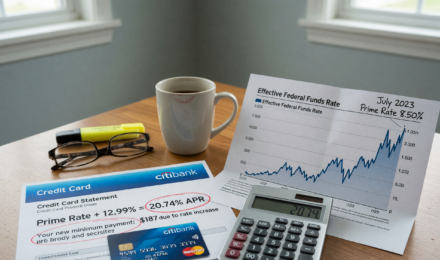
The prime rate has ranged from a historic low of 3.25% (set during the COVID-19 pandemic in 2020) to a peak of 8.50% in 2023 — a swing of 525 basis points that added hundreds of dollars per month to the cost of carrying variable-rate debt.
Understanding this mechanism is the foundation for every refinancing decision you’ll make. When rates fall, the question isn’t whether an opportunity exists — it’s how large that opportunity is, and how quickly you need to move to capture it.
Which Debt Products Are Most Affected by a Falling Prime Rate?
Not all debt responds equally to a prime rate change. Some products reprice automatically; others require active refinancing. Knowing which category your debt falls into determines your strategy and your urgency.
Variable-Rate vs. Fixed-Rate Debt
Variable-rate debt is directly tied to a benchmark — usually the prime rate or SOFR (Secured Overnight Financing Rate). These products automatically adjust when the prime rate changes. Fixed-rate debt locks in a rate for the life of the loan. It doesn’t change with the market, but it also doesn’t benefit from rate drops unless you refinance.
| Debt Type | Rate Type | Responds Automatically to Prime Rate Drop? | Refinance Required? |
|---|---|---|---|
| Credit Cards | Variable (Prime + margin) | Yes — within 1-2 billing cycles | Only if moving to fixed product |
| HELOCs | Variable (Prime + margin) | Yes — within 1 billing cycle | Only if converting to fixed loan |
| Adjustable-Rate Mortgages | Variable (Index + margin) | At next adjustment date | Optional — depends on cap structure |
| Fixed-Rate Mortgages | Fixed | No | Yes — only way to get lower rate |
| Personal Loans (fixed) | Fixed | No | Yes — new loan at lower rate |
| Federal Student Loans | Fixed (set annually) | Partially — new loans only | Private refinance possible |
The Margin Factor
Every variable-rate product has two components: the index (the prime rate) and the margin — the lender’s markup. Your credit card might be priced at “Prime + 14.99%.” When the prime rate was 8.50%, that meant a 23.49% APR. With the prime at 7.50%, it drops to 22.49% — a full percentage point reduction, automatically.
The margin itself doesn’t change. Only the index does. That’s why your refinancing strategy should focus on finding lower-margin products, not just lower index rates.
The average HELOC margin above prime is 0.50%-2.00%, according to Bankrate data. On a $75,000 HELOC balance, a 1.00% rate drop saves approximately $750 per year in interest — without any action required from the borrower.
How to Read the Rate-Drop Signal Before Everyone Else Does
The prime rate doesn’t fall without warning. The Federal Reserve telegraphs its intentions months in advance through public statements, FOMC meeting minutes, and economic projections. Savvy borrowers learn to read these signals early — before rates actually drop and lenders tighten their promotional offers.
The Fed’s Dot Plot and Forward Guidance
The FOMC releases a Summary of Economic Projections — colloquially called the “dot plot” — four times per year. Each dot represents a committee member’s projection for where interest rates will be at year-end. When the median dot shifts downward, it’s a reliable signal that rate cuts are coming.
The Fed also issues explicit forward guidance. Phrases like “data-dependent” and “appropriate to begin dialing back policy restriction” are code for impending cuts. Investors, banks, and mortgage lenders all begin repricing in anticipation — sometimes weeks before an official cut occurs.
Watching the CME FedWatch Tool
The CME FedWatch Tool aggregates futures market data to show the probability of a rate cut at each upcoming FOMC meeting. When the probability of a cut exceeds 70-80%, lenders often begin preemptively offering lower rates to attract refinance applications.
Checking this tool monthly takes less than two minutes. It gives you a probabilistic view of the rate environment three to six months out — more than enough lead time to prepare your finances for a refinance application.
“The market is almost always ahead of the Fed. By the time the Fed cuts rates, mortgage-backed securities markets have already priced in the move. Borrowers who wait for the official announcement often miss the best window by 30 to 60 days.”
Tracking the 10-Year Treasury Yield
For mortgage refinancing specifically, the 10-year Treasury yield matters more than the prime rate itself. Thirty-year fixed mortgage rates track the 10-year Treasury closely, typically with a 1.5-2.0 percentage point spread. When the 10-year yield falls, mortgage rates tend to follow within days.
Understanding both benchmarks — the prime rate for variable consumer debt, and the Treasury yield for fixed mortgage products — gives you a complete picture of the refinancing landscape.
Calculating Your Actual Refinance Savings
Knowing a rate dropped is only half the picture. You need cold, hard numbers to determine whether refinancing makes financial sense for your specific situation. The calculation involves more than just comparing interest rates.
The Break-Even Analysis
For any loan with closing costs or fees, the break-even point is the number of months it takes for your monthly savings to exceed the upfront cost. The formula is straightforward: divide total closing costs by monthly payment savings.
Example: If you pay $3,000 in closing costs and save $120 per month, your break-even is 25 months. If you plan to keep the loan longer than 25 months, refinancing makes sense. If you might sell the house or pay off the loan sooner, it may not.
| Loan Type | Typical Closing Costs | Monthly Savings (1% rate drop) | Approximate Break-Even |
|---|---|---|---|
| $300,000 Mortgage | $6,000-$9,000 | $150-$175 | 34-60 months |
| $50,000 Personal Loan | $500-$1,000 | $40-$50 | 10-25 months |
| $20,000 Auto Loan | $0-$300 | $20-$30 | 0-15 months |
| $10,000 Credit Card Balance | $0-$300 (balance transfer fee) | $70-$90 | 0-4 months |
Total Interest Paid Comparison
Beyond monthly savings, calculate total interest paid over the remaining life of the loan. A refinance that lowers your monthly payment but resets the amortization clock to a new 30-year term can actually cost more in total interest — even at a lower rate.
Always compare: (a) total interest remaining on the current loan, vs. (b) total interest on the new loan plus closing costs. Use a mortgage calculator from the Consumer Financial Protection Bureau to run these numbers accurately before signing anything.
When refinancing a mortgage, consider a shorter term rather than resetting to 30 years. Refinancing a 30-year loan with 22 years remaining into a 15-year loan at a lower rate often produces dramatically lower total interest costs — sometimes saving $50,000 or more on a $300,000 balance.
The True Cost of Doing Nothing
Inaction has a cost too. If your credit card is charging 22.77% and a balance transfer card offers 0% for 18 months on a $5,000 balance, waiting three months to apply costs you roughly $284 in avoidable interest. On larger loan balances, the opportunity cost of hesitation compounds quickly.

Refinancing Credit Card Debt When Rates Fall
Credit card debt is where many Americans feel the prime rate most acutely — and where a falling rate creates some of the fastest and most accessible refinancing opportunities. If you understand how prime rate affects your credit card interest rates, you can act decisively.
Balance Transfer Cards: The Zero-Interest Window
A balance transfer card allows you to move existing high-interest balances to a new card offering 0% APR for an introductory period — typically 12-21 months. The catch is a one-time balance transfer fee, usually 3-5% of the transferred amount.
On a $7,500 balance at 22.77% APR, you’d pay approximately $1,708 in interest over 12 months with minimum payments. A balance transfer with a 3% fee ($225) and 0% APR for 15 months saves you roughly $1,483 — net savings of $1,258 after the fee. That’s not theoretical; that’s real money back in your pocket.
According to LendingTree data, the average approved balance transfer offer in 2024 carried a 0% introductory APR lasting 15 months. Consumers who successfully transferred and paid off $5,000 in that window saved an average of $835 compared to making minimum payments at their existing rate.
The key is using the introductory window to aggressively pay down the principal — not to spend more. Divide your balance by the number of months in the promotional period and pay that amount every month without fail.
Personal Loans to Consolidate Credit Card Debt
A personal loan at a fixed rate is another powerful tool for credit card refinancing. Because personal loan rates are typically 10-15% lower than credit card rates for borrowers with good credit, consolidating multiple card balances into one fixed-payment loan can reduce both your interest cost and your cognitive load.
For a deeper look at systematic debt elimination strategies, see our guide on how to pay off debt fast using the snowball vs. avalanche method — especially useful once you’ve locked in a lower refinance rate.
“A falling rate environment is the single best time for consumers with good credit to go on offense against credit card debt. The window for 0% transfer offers and sub-10% personal loans doesn’t stay open indefinitely — it follows the rate cycle.”
HELOCs and Home Equity Loans in a Falling Rate Environment
If you own a home and have built equity, you’re sitting on one of the most powerful refinancing tools available: the ability to borrow against your home at relatively low rates. Understanding how the prime rate affects your mortgage and home equity loan is essential before making any moves.
How HELOCs Reprice Automatically
A HELOC (Home Equity Line of Credit) is almost always a variable-rate product pegged directly to the prime rate. When the prime rate falls 0.50%, your HELOC rate falls 0.50% — automatically, within one billing cycle.
On a $100,000 HELOC balance, a 0.50% rate drop saves $500 per year, or about $42 per month. That’s meaningful — but it’s also automatic. Your action item with a HELOC in a falling rate environment is simply to stay aware and potentially use the line more aggressively for debt consolidation if rates fall far enough.
Converting a HELOC to a Fixed Home Equity Loan
When rates are expected to rise again, or when you want payment certainty, converting your HELOC balance to a fixed-rate home equity loan locks in current low rates for the term of the loan. This is a strategic move — not automatic, but powerful if timed correctly.
Using home equity to pay off unsecured debt (like credit cards) converts that debt to secured debt — meaning your home is now collateral. If you default on a home equity loan, you risk foreclosure. This strategy only makes sense if you have the discipline to stop accumulating new unsecured debt simultaneously.
Using Home Equity to Refinance High-Interest Debt
Some homeowners use a cash-out refinance or home equity loan to pay off high-interest credit card or personal loan debt. The math can be compelling: trading 22% credit card debt for 7-8% home equity debt eliminates thousands in annual interest.
But the risk is real. This strategy requires rock-solid financial discipline and ideally a budget framework — our guide on how to create a monthly budget that actually works is a good complement to any debt consolidation plan.

Personal Loans and Student Loan Refinancing
Beyond credit cards and home equity products, personal loans and student loans represent two major categories where a falling prime rate opens meaningful refinancing doors — though the mechanics differ significantly between them.
Refinancing Personal Loans
If you took out a personal loan at a fixed rate during the 2022-2023 high-rate environment, you may have locked in a rate of 15-20% or higher. In a falling rate environment, lenders compete aggressively for creditworthy borrowers, often posting personal loan APRs in the 8-12% range for those with credit scores above 720.
The refinancing process for personal loans is generally straightforward: apply for a new loan at the lower rate, use the proceeds to pay off the existing loan, and begin repaying the new loan. Watch for prepayment penalties on your existing loan — some lenders charge 1-2% of the remaining balance for early payoff. Factor this into your break-even calculation.
According to the Federal Reserve’s G.19 report, the average 24-month personal loan rate at commercial banks reached 12.33% in Q3 2023. Borrowers who refinanced in early 2025 after two rounds of Fed cuts were finding rates as low as 9.5-10.5% for the same loan profile — saving hundreds per year.
Private Student Loan Refinancing
Private student loans can often be refinanced to capture lower rates when the prime rate falls. Federal student loans, however, carry significant protections — income-driven repayment, Public Service Loan Forgiveness, forbearance options — that are permanently lost upon refinancing into a private loan.
The decision to refinance federal student loans should never be made solely based on interest rate savings. The value of lost protections must be weighed carefully against the annual interest savings. As a general rule, refinancing federal loans only makes sense if your income is stable, your employment is not in a qualifying public service field, and the rate difference exceeds 2.0 percentage points.
For borrowers with private student loans, the calculus is simpler. A falling rate environment can reduce private student loan rates significantly. Lenders like SoFi, Earnest, and Laurel Road frequently offer promotional rates during rate-cut cycles. Compare at least three offers before committing, and pay attention to whether the new rate is fixed or variable.
Mortgage Refinancing: When the Math Actually Works
Mortgage refinancing is the highest-stakes and potentially highest-reward category for most homeowners. The numbers are large enough that even a 0.50% rate reduction can produce tens of thousands of dollars in lifetime savings — but the upfront costs are also significant.
The 1% Rule and Its Limitations
The old “refinance when rates drop 1%” rule of thumb is a starting point, not a finish line. On a $400,000 mortgage, a 1.00% rate drop reduces your monthly payment by approximately $225-$250, which is substantial. But with $8,000-$12,000 in closing costs, your break-even stretches to 36-53 months.
The rule needs personalization. A borrower planning to stay in the home for 10+ years can justify a refinance at a smaller rate drop. A borrower selling in three years may not be able to justify even a 1.5% improvement in rate.
| Loan Balance | Rate Drop | Monthly Savings | Est. Closing Costs | Break-Even Point |
|---|---|---|---|---|
| $200,000 | 0.50% | $58 | $4,000-$6,000 | 69-103 months |
| $300,000 | 0.75% | $130 | $6,000-$9,000 | 46-69 months |
| $400,000 | 1.00% | $225 | $8,000-$12,000 | 36-53 months |
| $500,000 | 1.25% | $350 | $10,000-$15,000 | 29-43 months |
No-Closing-Cost Refinances
A no-closing-cost refinance rolls closing costs into the loan balance or accepts a slightly higher interest rate in exchange for zero upfront fees. These products eliminate the break-even problem entirely — any monthly savings are immediate gains.
The trade-off is a higher rate or larger balance over the life of the loan. For borrowers uncertain about how long they’ll stay in the home, no-closing-cost refinances can be the mathematically superior choice even when they appear more expensive on paper.
Cash-Out Refinancing to Retire High-Interest Debt
A cash-out refinance replaces your existing mortgage with a larger one, with the difference paid to you in cash. If you have $150,000 in equity and take out $30,000 cash, you now have a $330,000 mortgage instead of a $300,000 mortgage — but you can use that $30,000 to retire high-interest debt at a dramatically lower effective rate.
This strategy works best when the rate difference between your credit card debt (22%+) and your mortgage rate (6-7%) is large enough to justify both the additional principal and the closing costs involved.
The Federal Housing Finance Agency reports that cash-out refinances accounted for nearly 60% of all refinance activity during the 2020-2021 low-rate period. Homeowners extracted over $275 billion in equity — much of it used to pay down higher-cost debt.
Getting Your Credit Score Refinance-Ready
The prime rate may fall, but your credit score determines whether lenders offer you the rates being advertised. The gap between what a 580 credit score borrower and a 750 credit score borrower pay on the same loan can be 3-5 percentage points — the equivalent of the prime rate moving dramatically in the wrong direction.
Credit Score Thresholds That Matter
Lenders use tiered pricing based on credit score ranges. Understanding these thresholds helps you know exactly what score you’re aiming for — and whether improving your score by even 20-30 points could move you into a significantly better rate tier.
| Credit Score Range | Borrower Tier | Typical Personal Loan APR | Typical 30-Year Mortgage Rate (Add-on) |
|---|---|---|---|
| 760-850 | Super Prime | 7.00-10.50% | Best available rate |
| 720-759 | Prime | 10.50-14.00% | +0.25-0.50% |
| 680-719 | Near Prime | 14.00-18.00% | +0.50-1.00% |
| 620-679 | Subprime | 18.00-25.00% | +1.00-2.00% |
| Below 620 | Deep Subprime | 25.00%+ | Limited options, FHA required |
Quick Credit Score Improvements Before Applying
Several credit score improvements can be made relatively quickly — within 30-90 days — before submitting a refinance application. The most impactful: paying down revolving credit card balances to below 30% of the credit limit (ideally below 10%), disputing any inaccurate negative items on your credit report, and avoiding new credit applications in the 60 days before applying.
For borrowers building credit from a lower baseline, our guide on how to build credit from scratch walks through the full process. And if you need clarity on where you currently stand, understanding what constitutes a good credit score is the essential first step.
Multiple hard credit inquiries within a short window can temporarily lower your credit score by 5-10 points. However, mortgage and auto loan rate shopping is typically treated as a single inquiry if done within a 14-45 day window (depending on the scoring model). Apply to multiple lenders within that window to compare rates without extra score damage.
Timing Your Refinance for Maximum Impact
Even when the conditions for falling prime rate refinance debt opportunities align, timing your application correctly can mean the difference between a good rate and a great one. The refinance market has patterns — and understanding them gives you an edge.
The Rate Lock Decision
Once you’ve applied and received a rate offer, you’ll typically have the option to lock the rate for 30, 45, or 60 days at no additional cost (or a small fee for longer locks). Locking protects you if rates rise before closing. But if rates are actively falling, locking early could mean missing out on a lower rate.
A float-down option — available from some lenders for an additional fee — lets you lock a rate but also capture any lower rates that emerge before closing. This is worth the fee when the rate environment is actively declining. Ask your lender explicitly whether this option is available.
Seasonal Timing Advantages
Refinance application volume traditionally spikes in spring and summer. Lenders process more applications, staff can be stretched, and turnaround times lengthen. Applying in October through January typically means faster processing, more attentive loan officers, and occasionally more competitive rates as lenders compete for slower-season volume.
When thinking about the broader financial picture — especially how falling rates affect savings products you might be holding — it’s worth reviewing our analysis of what happens to your savings when the prime rate shifts. A complete picture requires understanding both sides of the rate equation.
“Borrowers who refinance in the early stages of a rate-cutting cycle — the first or second cut — consistently outperform those who wait for rates to ‘bottom out.’ By the time the bottom is confirmed, rates have usually already started climbing again.”
Stacking Multiple Refinancing Moves
The most financially sophisticated borrowers don’t make one refinancing decision — they sequence multiple moves across different debt products over the rate cycle. Start with the highest-interest, easiest-to-refinance debt first (credit cards via balance transfer). Then move to personal loans. Then evaluate mortgage refinancing as rates fall further.
This staged approach minimizes total interest costs while spreading out the application effort and credit inquiries across a manageable timeline. It’s the same logic as the debt avalanche method applied to refinancing decisions.

Real-World Example: How Maria Saved $14,200 by Moving Fast on Falling Rates
Maria is a 38-year-old marketing manager in Columbus, Ohio, with a household income of $87,000. In early 2024, she was carrying $8,400 in credit card debt at an average APR of 23.1%, a $22,000 personal loan at 16.5% she’d taken out in 2022, and a $285,000 fixed-rate mortgage at 7.25% with 28 years remaining. Her total monthly debt service was $2,847. She heard the Fed was beginning to cut rates but wasn’t sure whether or how to act.
Maria’s first move — made within 30 days of the Fed’s September 2024 rate cut — was a balance transfer of her $8,400 credit card balance to a card offering 0% APR for 18 months with a 3% transfer fee ($252). She then set up automatic payments of $467 per month to zero out the balance before the promotional period ended. Total cost: $252. Total interest saved versus staying at 23.1%: approximately $1,940. Next, she refinanced her personal loan in November 2024, replacing the 16.5% loan (with $17,600 remaining) with a new 36-month loan at 9.75% from her credit union. Her monthly payment dropped from $549 to $512, but more importantly, her total interest paid dropped from $3,400 to $1,870 — a savings of $1,530.
Maria held off on the mortgage until February 2025, when 30-year fixed rates in her market had fallen to 6.40%. She refinanced the $285,000 balance to a 20-year term at 6.25% — not the longest or shortest available, but the term that balanced monthly payment with total interest paid. Her monthly payment actually increased slightly from $1,941 to $2,108, but her total interest over the remaining loan life dropped from approximately $252,000 to $189,000 — a $63,000 reduction in total interest cost, offset by $7,200 in closing costs. Net lifetime savings: $55,800. Her combined moves — credit card transfer, personal loan refi, and mortgage refi — produced total savings of approximately $59,270 over the life of her debts.
What made the difference wasn’t luck. Maria monitored the CME FedWatch Tool monthly starting in mid-2024 and had her credit score polished to 748 before the cycle began. She understood the break-even math and moved decisively at each stage. The total time she invested: roughly four hours of research and application work spread across six months. The payoff: more than $14,000 in first-year interest savings and nearly $60,000 in lifetime savings across all three debt products.
Your Action Plan
-
Audit every debt you carry today
List each debt with its current balance, interest rate, rate type (fixed or variable), and remaining term. This single document becomes your refinancing roadmap. Include credit cards, car loans, student loans, personal loans, and your mortgage. Most people discover their total interest burden is significantly larger than they realized when they see it all in one place.
-
Check your credit score now — before applying anywhere
Pull your credit report from AnnualCreditReport.com (the only government-authorized free report site) and your credit score from your bank or card issuer. Identify and dispute any errors. If your score is below 720, spend 60-90 days paying down revolving balances before applying for any refinance products.
-
Set up rate monitoring with the CME FedWatch Tool
Bookmark the CME FedWatch Tool and check it monthly. Set a Google Alert for “Federal Reserve rate decision” to catch any breaking news between scheduled FOMC meetings. Also subscribe to Bankrate’s weekly rate newsletter — it tracks prime rate movements and consumer lending rates in one convenient digest.
-
Target your highest-rate debt first
Begin with credit card balances. Research the best 0% balance transfer offers currently available and calculate your break-even after the transfer fee. Apply for the best offer you qualify for based on your credit score. Set up autopay for the amount needed to pay off the full balance before the promotional period expires — treat this as a non-negotiable monthly obligation.
-
Get pre-qualified for a personal loan or HELOC
Pre-qualification uses a soft credit pull and won’t affect your score. Use it to understand what rates you actually qualify for — not what’s advertised. Compare at least three lenders side-by-side. Credit unions frequently offer rates 1-2 percentage points lower than traditional banks for personal loan products. If you have home equity, get a HELOC quote as a benchmark even if you’re not sure you’ll use it.
-
Run the mortgage break-even calculation with your specific numbers
Use the CFPB’s loan explorer or a mortgage amortization calculator to model the exact savings from refinancing your current mortgage at currently available rates. Factor in realistic closing costs — get a Loan Estimate from at least two lenders, which is required by law within three business days of your application. Compare break-even points with your realistic timeline for staying in the home.
-
Sequence your applications strategically
Apply for credit card balance transfers first (soft pull, no impact on score). Wait 30 days, then apply for a personal loan if applicable (hard pull, small temporary score impact). Wait another 45-60 days before submitting a mortgage application. This sequencing minimizes the score impact of multiple hard inquiries while capturing savings at each level in order of urgency.
-
Redirect every dollar saved toward remaining debt or an emergency fund
The savings from refinancing are only valuable if you keep them working. Redirect any reduction in monthly payments directly to either the remaining high-interest debt balance or your emergency fund — whichever is more underfunded. Our guide on paying off $10,000 in credit card debt walks through a step-by-step payoff plan you can overlay on top of any refinancing move you make.
Frequently Asked Questions
How quickly does the prime rate drop after the Fed cuts rates?
Major banks typically announce updated prime rates the same day the Federal Reserve announces a rate cut. The prime rate change is effective immediately for new loans and takes effect on variable-rate products (like HELOCs and credit cards) at the start of the next billing cycle — usually within 30 days of the Fed’s announcement.
Is a 0.25% rate drop enough to justify refinancing a mortgage?
For most mortgages, a 0.25% rate drop alone is unlikely to justify the $5,000-$12,000 in closing costs. The break-even period would stretch well beyond 10 years for most loan balances. However, if this is the first in a series of expected cuts, locking in the rate before it rises again may have strategic value. The general threshold for mortgage refinancing to make financial sense is a rate reduction of at least 0.75%-1.00%, combined with a plan to remain in the home for at least 3-5 years.
Does refinancing hurt my credit score?
Yes — temporarily. A hard credit inquiry for a refinance application typically reduces your score by 5-10 points for about 12 months. Additionally, if you close the old loan account, it may shorten your credit history and increase your credit utilization ratio. However, the long-term savings from a well-timed refinance far outweigh a temporary score dip for most borrowers.
Can I refinance if I’m currently behind on payments?
Refinancing is significantly more difficult — and often impossible — if you have recent late payments or are currently in delinquency. Most refinance programs require no late payments in the past 12 months, and mortgage refinancing often requires 24 months of on-time payment history. If you’re behind, contact your current lender about a loan modification first — this is a different process that doesn’t require a new credit application.
What’s the difference between refinancing and loan modification?
Refinancing replaces your existing loan with an entirely new loan from any lender — typically at better terms. Loan modification adjusts the terms of your existing loan without replacing it, and is generally only offered to borrowers experiencing documented financial hardship. Modifications don’t require a credit application but typically don’t produce as favorable terms as refinancing.
Should I refinance into a fixed or variable rate when the prime rate is falling?
If rates are actively falling, a variable-rate product will continue to drop along with the prime rate — potentially advantageous in the short term. However, rates will eventually reverse. Fixed rates provide certainty and protection against future increases. For debt you plan to hold for 5+ years, a fixed rate is generally the more prudent choice even if the initial rate is slightly higher than a variable option.
How does debt-to-income ratio affect my refinancing eligibility?
Your debt-to-income ratio (DTI) — total monthly debt payments divided by gross monthly income — is a critical factor for mortgage and personal loan refinancing. Most mortgage refinances require a DTI below 43%, and the best rates are typically offered at DTI ratios below 36%. If your DTI is too high, paying down some existing debt before applying can open better refinancing options.
Is a falling prime rate a good time to refinance student loans?
For private student loans, yes — a falling rate environment means private lenders compete more aggressively, offering better terms. For federal student loans, the decision is more complex. Federal loan rates are fixed at origination and adjusted annually for new loans. Refinancing federal loans into a private loan eliminates income-driven repayment options, forgiveness programs, and deferment rights permanently. This trade-off is rarely worth it unless the rate savings are substantial and your financial situation is extremely stable.
What fees should I expect when refinancing a personal loan?
Common fees include an origination fee (typically 1-8% of the loan amount), a prepayment penalty on the existing loan (1-2% of remaining balance, if applicable), and sometimes an application fee ($25-$50). Credit union personal loans often carry lower origination fees — or none at all — compared to online lenders. Always calculate the all-in cost, not just the new interest rate.
How does the falling prime rate refinance debt opportunity interact with my savings strategy?
When the prime rate falls, high-yield savings accounts and CDs also see rate reductions — often before official Fed cuts, as banks anticipate the change. This creates a window where aggressively paying down variable-rate debt produces a better guaranteed return than keeping cash in a savings account. The math is simple: eliminating 22% credit card debt is equivalent to a 22% guaranteed, tax-free return. No savings product comes close to that.
Sources
- Federal Reserve — Consumer Credit Report (G.19)
- Federal Reserve — Selected Interest Rates (H.15)
- CME Group — FedWatch Tool
- Consumer Financial Protection Bureau — Explore Interest Rates Tool
- AnnualCreditReport.com — Free Credit Reports (Government Authorized)
- Bankrate — Average Interest Rates Tracker
- LendingTree — Personal Loan Statistics and Trends
- Federal Housing Finance Agency — National Mortgage Database Aggregate Statistics
- Federal Reserve — Federal Open Market Committee Meeting Statements
- Consumer Financial Protection Bureau — Credit Card Debt Resources
- Bankrate — Current Mortgage Refinance Rates
- myFICO — Credit Score Education and Rate Impact
- National Association of Realtors — Housing Statistics and Research