
Fact-checked by the Prime Rate editorial team
In 2024, a staggering 36% of mortgage denials were pinned on one factor alone: a debt-to-income ratio that spiked too high for underwriting. For a first-generation homebuyer, that number is a direct threat because there is no family equity to absorb an unexpected denial, no co-signer waiting in the wings. When every dollar of personal credit card debt mortgage qualification hinges on your own paycheck, even a few thousand dollars in balances can transform a pre-approval handshake into a rejection letter.
The Federal Reserve Bank of New York reported a 7.18% transition rate into serious credit card delinquency, 90 days past due, in the fourth quarter of 2024. That kind of missed-payment spiral can shred a credit score within months, bumping a buyer out of first-generation assistance programs that demand a minimum 620 FICO. Meanwhile, total credit card balances across the country keep swelling, and for buyers whose parents never owned a home, there’s simply no inherited wealth to clean up the mess before an application.
By the time you finish this guide, you’ll have a concrete, 6-month pre-application plan that aligns credit card payoff with mortgage underwriting windows. You’ll know exactly how lenders treat your revolving balances, which first-gen programs accept what level of debt, and, most important, when to pause aggressive payoff so you don’t accidentally crater your score right before closing.
Key Takeaways
- 36% of 2024 mortgage denials were caused by a high debt-to-income ratio, the #1 factor lenders flag when credit card minimum payments eat into qualifying capacity.
- Reducing DTI by just 5 to 10 percentage points can shave 0.25% to 0.5% off your mortgage rate, saving roughly $100 per month on a $300,000 loan.
- Paying off a large credit card balance too close to application (within 1‑2 months) can trigger a 10‑30 point score drop due to shifting credit mix and utilization history.
- Most first-generation down payment assistance programs still require DTI under 43% and a credit score of 620 or higher, the primary mortgage must stand on its own.
- A balance transfer or debt consolidation loan must be completed at least 6 months before you apply, or underwriters may view the new account as a red flag.
- Carrying some debt while preserving cash for the 1% borrower contribution many programs demand can be smarter than zeroing out every card if you’d otherwise lack reserves.
In This Guide
- Why Credit Card Debt Hits First-Generation Buyers Harder
- How Mortgage Lenders See Your Credit Card Balances
- Map Your Debt-to-Income Ratio: A Step-by-Step Calculation
- Proven Payoff Strategies That Won’t Sabotage Your Application Timeline
- First-Generation Assistance Programs: Debt Still Matters
- Your 6‑Month Pre‑Application Blueprint
- When to Carry Some Credit Card Debt, and When to Delay Buying
- Balance Transfers, Personal Loans, and Their Impact on Your Timeline
- Partnering with a Lender Who Understands First‑Gen Challenges
Why Credit Card Debt Hits First‑Generation Buyers Harder
First‑generation status means neither of your parents owned a home in recent years, the definition Fannie Mae and many state programs use, and that gap ripples through every part of a mortgage application. Without parental equity, a seasoned co‑signer, or even someone to walk you through the process, you absorb the full brunt of a lopsided debt-to-income ratio. The Consumer Financial Protection Bureau describes DTI as the percentage of your gross monthly income that goes toward monthly debts, including the minimum payment on each credit card, and it is one of the key numbers a mortgage lender uses to gauge your ability to handle the new loan.
A buyer from a homeowning family might get a gift to wipe out a $7,000 balance three months before pre‑approval. You, on the other hand, have to fund the same payoff out of your own savings while also building a down payment and keeping an emergency cushion. That squeeze shows up in the data. NerdWallet’s analysis of 2024 HMDA data found that 36% of denials cited DTI as the primary reason, a wall hit far more often by first‑gen buyers who can’t tap family cash to flatten those ratios.
36% of mortgage denials in 2024 listed debt‑to‑income ratio as the primary culprit, a full‑stop barrier that disproportionately affects applicants without a family financial backstop.
The invisible cost of no safety net
When a credit card balance pushes your utilization above 30%, your score drops, and the interest rate you’re offered on a mortgage ticks up. But for a first‑gen buyer, that rate increase isn’t just a number on paper, it’s the difference between qualifying and not qualifying at all. Because you have no parental home equity to pledge as a compensating factor, every basis point of credit card debt mortgage friction lands squarely on your application.
Consider the math: on a $300,000 fixed‑rate loan, a 0.5% rate jump from 6.5% to 7.0% adds about $95 to your monthly payment and nearly $35,000 in extra interest over three decades. That same 0.5% penalty can spring directly from a DTI that’s too high because you carried a few thousand dollars in revolving balances. For a buyer whose parents own property, that scenario might trigger a phone call asking for a bridge loan. For you, it’s a problem you have to solve alone, methodically, and on a timeline that aligns with underwriting rules.

Score recovery takes longer than you think
Many first‑gen buyers assume that paying off a card triggers an instant score boost, then submit their mortgage application two weeks later. That’s a dangerous assumption. Credit scoring models react to sudden drops in utilization, but they also weigh credit mix and history length. Shifting a card from high utilization to zero can, in some cases, cause a temporary score dip of 10‑30 points for 60 to 90 days. If your application happens to land inside that window, you’re now being priced based on a lower score, even though you just paid down thousands in debt. That’s why a true 6‑month stabilization period before application is critical.
Paying a large balance down to zero within one or two months of applying for a mortgage can drop your score 10‑30 points temporarily. Build a buffer so the payoff has at least six months to season.
How Mortgage Lenders See Your Credit Card Balances
Lenders don’t just glance at your total credit card debt, they feed the minimum monthly payment on each account into your back‑end DTI, the ratio that compares all recurring debts to gross monthly income. A card with a $5,000 balance and a $150 minimum payment adds exactly $150 to your monthly obligations, not $5,000. That nuance matters because even a moderate balance can produce a manageable minimum, while a maxed‑out card can spike the payment fast.
For conventional loans backed by Fannie Mae and Freddie Mac, the rules are stricter: Fannie Mae’s guidelines treat revolving charge accounts and unsecured lines of credit, including credit cards, as long‑term debts. The minimum payment must be counted in DTI regardless of whether you intend to pay the balance off soon. They also look at credit utilization, the percentage of your available credit you’re using, and a utilization above 30% often triggers manual underwriting scrutiny, even if your score is comfortably above 620.
According to the Consumer Financial Protection Bureau, your DTI ratio, which includes monthly credit card debt payments divided by gross monthly income, is one of the primary ways mortgage lenders measure your ability to manage new loan payments. Paying off or paying down credit card debt before buying a home lowers that ratio, strengthens your credit score, and helps you qualify for a mortgage at a lower interest rate.
FHA and USDA loans: slightly more flexible, still watching
Government‑backed loans tend to be a little more forgiving. FHA guidelines allow a back‑end DTI up to 43% and sometimes higher with strong compensating factors, while USDA direct loans typically cap at 41%. Yet both programs still require the same DTI math: minimum credit card payments are factored in. If you carry balances on several cards, those minimums aggregate quickly. A trio of cards with $50, $75, and $100 minimums totals $225 per month, enough to consume 4.5% of a $5,000 gross monthly income, right out of the gate.
| Loan Type | Typical Max DTI | How Credit Card Minimums Are Treated |
|---|---|---|
| Conventional (Fannie/Freddie) | 36‑45% | Minimum payment counted as recurring debt; utilization >30% may trigger manual underwriting |
| FHA | 43% (can go higher with compensating factors) | Same treatment; DTI calculation includes all revolving minimums |
| USDA | 41% | Must include credit card minimums; zero‑down program still has strict DTI cap |
| VA | No formal cap, uses residual income | Minimum payment included, but residual income analysis provides more flexibility |
Why paying to zero right before pre‑approval can backfire
It sounds counterintuitive, but zeroing out every card three weeks before you ask for a pre‑approval can raise underwriter eyebrows. A credit report that suddenly shifts from high usage to all‑zero balances can signal credit cycling or a recent lump‑sum deposit from an unknown source. Underwriters may ask for a paper trail, bank statements, gift letters, and source‑of‑funds documentation, which can delay closing or produce a denial if the origin of the payoff can’t be verified. Keep your balance reduction gradual and well‑documented so the history tells a clean story.
Map Your Debt‑to‑Income Ratio: A Step‑by‑Step Calculation
Before you commit to any payoff strategy, draw a hard line around your current numbers. Grab your most recent pay stubs and at least two months of credit card statements. The formula lenders use is straightforward: add up all recurring monthly debt payments, including the minimum payment on each credit card, any car loan, student loan, and personal loan, then divide by your gross monthly income.
Use only the minimum required payment on each credit card for your DTI calculation, not the total balance, and not the amount you actually pay. Underwriters care about the minimum because that’s the legal obligation that stays on your credit profile month after month.
A worked example
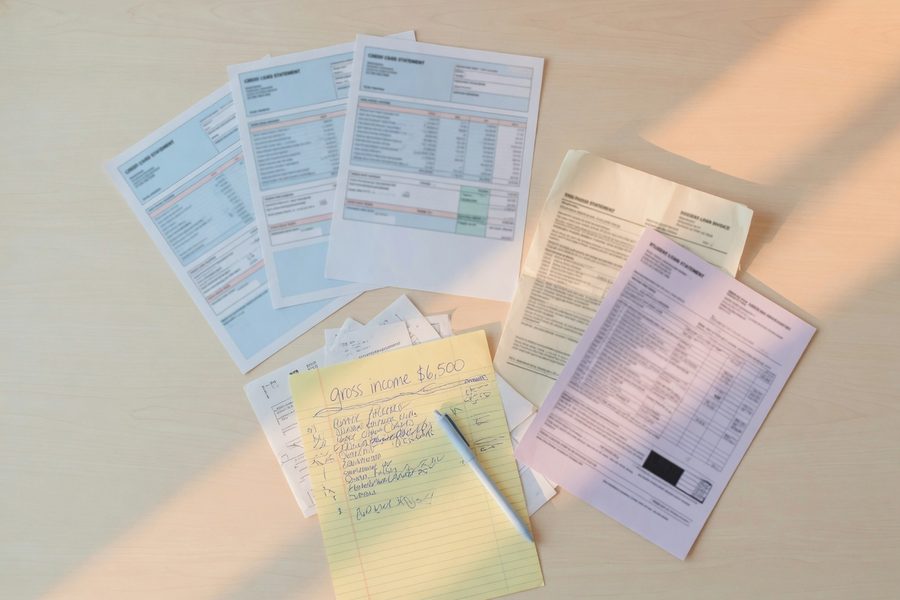
Say you earn $6,500 gross per month. You have one car payment of $400, a student loan payment of $250, and three credit cards with minimums of $60, $90, and $130, a total of $280 in revolving minimums. Your total monthly debt is $400 + $250 + $280 = $930. Divide by $6,500 and your back‑end DTI is 14.3%, plus the future mortgage payment. If the proposed mortgage payment including taxes and insurance is $1,800, your total DTI becomes ($930 + $1,800) / $6,500 = 42%. That’s right at the edge of many first‑gen program limits.
Now, if you manage to pay off the highest‑minimum card entirely, wiping out the $130 obligation, your non‑mortgage debt drops to $800. The new total DTI with the same mortgage slides down to ($800 + $1,800) / $6,500 = 40%, giving you two percentage points of breathing room. That small shift can be the difference between an automated underwriting approval and a manual review that demands extra documentation.
Target ranges first‑gen programs actually accept
Most state‑based first‑generation down payment assistance programs piggyback on the primary mortgage’s underwriting standards. For conventional loans, that usually means a back‑end DTI at or below 43%, though some lenders cap it at 36% for the best rates. FHA‑backed assistance loans commonly top out at 43% but can stretch to 50% with strong compensating factors, like sizable savings reserves. However, because you’re a first‑gen buyer with no family equity safety net, you’ll want to aim for 38% or lower. That gives you negotiating room if rates shift and your projected mortgage payment ticks up by $50‑$100 between pre‑approval and closing.
Reducing DTI by just 5 percentage points can improve your mortgage rate by 0.25% to 0.5%, saving upwards of $30,000 over a 30‑year term on a $300,000 loan. That’s a direct return on paying down a few thousand in credit card balances.
Proven Payoff Strategies That Won’t Sabotage Your Application Timeline
There are two well‑trodden paths, the debt avalanche and snowball methods, and both need to be calibrated to your mortgage calendar. The avalanche approach targets the card with the highest interest rate first, which saves the most in finance charges over time. The snowball method attacks the smallest balance first, delivering quick psychological wins. For first‑gen buyers staring down a pre‑approval date, avalanche often wins because it frees up cash flow faster by reducing the total interest you pay each month, which indirectly lowers the risk of carrying forward balances that inflate minimums.
| Strategy | Best For | Mortgage‑Timeline Caveat |
|---|---|---|
| Debt Avalanche | Those who can sustain a 6‑month payoff window without emotional burnout | Avoid opening new consolidation loans within 6 months of application; the inquiry can ding your score |
| Debt Snowball | Those who need frequent motivational wins to stay on track | Closing old accounts after payoff shortens credit history length, which can lower your score temporarily, leave accounts open |
When to pause aggressive payoff to protect your emergency fund
Throwing every spare dollar at credit card debt feels righteous, but if that leaves you with less than a month’s worth of reserves, you’re trading one underwriting risk for another. Many first‑gen down payment assistance programs require the buyer to contribute at least 1% of the purchase price from their own funds. If all your cash is funneled into card payments, you can’t meet that requirement. Set a floor: keep at least $2,000 in a high‑yield savings account untouched while you pay down cards, and consider a budget that carves out both goals.
Use the 6‑month buffer to stabilize your score
Every loan officer who works with first‑time buyers will tell you the same thing: let large payoff transactions season. Credit bureaus need 30‑60 days to update account balances, and FICO models need another cycle or two to reflect the new utilization in your score without any negative volatility. That’s why the 6‑month rule is standard. If you plan to apply for a mortgage in April 2026, wrap up your major debt payoffs by October 2025, then coast with on‑time minimum payments and no new credit inquiries. This period is also the ideal time to build credit from scratch if you have thin files, by adding a low‑limit secured card or becoming an authorized user on a trusted friend’s card, as long as the account is opened early enough to age.
Don’t close your oldest credit card after paying it off. Closing an account reduces your total available credit and can hike your utilization ratio overnight. Keep it open, charge a single small recurring payment, and set autopay to cover it in full each month.
First‑Generation Assistance Programs: Debt Still Matters
Down payment assistance (DPA) programs sound like a magic wand, but for first‑gen buyers carrying credit card debt, the fine print is sobering. Most programs, whether forgivable, deferred, or repayable, sit as a subordinate lien behind the first mortgage. The primary lender still underwrites that first mortgage to standard agency guidelines. That means your DTI, credit score, and credit card debt mortgage metrics must pass muster without any special grace.
State housing finance agencies (HFAs) typically structure their first‑gen grants or silent seconds with income limits and purchase‑price caps, and they often require a minimum credit score of 620‑640. Some, like the CalHFA MyHome Assistance program or the Florida Hometown Heroes program, explicitly state that the borrower must meet the first‑mortgage lender’s DTI requirements. Your credit card balances are not forgiven, and your minimum payments are not excluded, they’re plugged into the DTI formula exactly as they would be for a non‑assisted loan.
Documentation you’ll need for card balances when pairing with DPA
Because DPA programs are often layered on top of a conventional or FHA loan, the underwriter will request two months of bank statements and the most recent credit card statements. If you’ve paid down a large balance during that window, they’ll want to see where the money came from, a payroll deposit trace, a gift letter, or a documented side‑income stream. Anything that smells like a borrowed payoff (for instance, a cash advance from another card) can halt the file. Keep records of your payoff source and, if family does contribute, get a formal gift letter notarized.
Cash preservation vs. payoff: a real trade‑off
Let’s say you have $8,000 in credit card debt with a monthly minimum of $240, and you’ve managed to save $10,000 for a down payment and closing costs. If you use $8,000 to wipe the debt, you’re left with $2,000, but many DPA programs require a minimum 1% buyer contribution on a $250,000 home, which is $2,500. You’d be $500 short and potentially disqualified. In that scenario, it may be smarter to pay down only part of the debt, say $3,000, to lower the minimum payment to $150, preserve $7,000 in the bank, and still meet the contribution threshold. That’s the kind of nuanced decision a mortgage broker familiar with first‑gen files can help you model.
Your 6‑Month Pre‑Application Blueprint
This month‑by‑month plan aligns your credit card debt mortgage readiness with what an underwriter expects to see. It assumes you’re targeting a conventional or FHA loan with a first‑gen DPA layer.
| Month | Focus | Critical Rule |
|---|---|---|
| Month 1 | Pull all three credit reports (Equifax, Experian, TransUnion) and dispute any errors immediately. | Errors like a misapplied late payment can artificially deflate your score by 50‑100 points; fix them before you pay a dime more. |
| Month 2 | Calculate your true DTI using minimum card payments; identify the card(s) that will be paid off or paid down. | Do not close any accounts; just reduce balances. |
| Month 3 | Begin aggressive payoff using the avalanche method. If you need to open a balance transfer card, do it now so the account ages 6+ months. | The new inquiry will briefly ding your score; allow full recovery time. |
| Month 4 | Continue payoff; keep all payments on remaining cards current. Open a high‑yield savings account for your 1% contribution buffer. | No large, unexplained deposits, document everything. |
| Month 5 | Wrap up payoff. Re‑assess DTI; if you’re below 38%, lock it in. Automate all minimums to avoid a late‑payment accident. | Request credit score updates via a free service; watch for sudden drops as balances change. |
| Month 6 | Apply for pre‑approval with a lender who has handled first‑gen DPA files. Have two years of tax returns, pay stubs, and bank statements ready. | No new credit inquiries, no large purchases, and no job changes. |

What to do if a large payoff drops your score temporarily
If your score dips 15 points after a big paydown, don’t panic, and don’t apply. FICO models sometimes penalize a sudden shift to zero utilization on a previously heavily‑used account because it changes your credit‑mix behavior. Wait it out. In most cases, the score rebounds within 60‑90 days as the new, lower balance reports consistently. You can accelerate this by charging a small $5‑$10 recurring subscription to the card and paying it in full each month, which keeps the account active without building interest.
7.18%, the transition rate into serious credit card delinquency (90+ days past due) in Q4 2024. A single late payment can chop 100+ points off a FICO score, so automating at least the minimum payment is non‑negotiable.
When to Carry Some Credit Card Debt, and When to Delay Buying
Not all credit card debt is a mortgage killer. If your DTI sits comfortably below 36% and your score is solid, carrying a manageable balance with a low minimum payment won’t typically block approval, especially if you have a stable job history and strong reserves. But if your DTI is hovering at 42% and you’d need to drain every dollar of savings to pay it down, postponing the home purchase by 6‑12 months makes far more sense than hoping an underwriter will look the other way.
A buyer with zero credit card debt but no cash reserves can actually look riskier to an underwriter than someone with a small balance and a fully‑funded emergency account. Lenders price for worst‑case scenarios, and reserves signal you can survive an income disruption.
Balance Transfers, Personal Loans, and Their Impact on Your Timeline
A 0% APR balance transfer offer can turbocharge your payoff, but it’s a double‑edged sword for mortgage applicants. Underwriters see a new account, a hard inquiry, and potentially a large initial balance transfer as a red flag if they’re less than six months old. The new transfer doesn’t erase the debt; it simply moves it, and the account opening date is now brand‑new on your credit file. To use this tool safely, open the transfer card at least seven months before you plan to apply. That allows time for the inquiry to fade, for the account to age past six months, and for you to pay down the balance aggressively before your credit report shows a high utilization on the new card.
Personal loans used to consolidate credit cards function similarly. A fixed‑rate installment loan might lower your monthly minimums, but it also adds a new tradeline. As with balance transfers, the loan must be at least six months old before you reach underwriting. Some first‑gen borrowers find that a personal loan reduces their DTI because the installment payment is smaller than the aggregated credit card minimums, but the trade‑off is a fresh hard inquiry and a shorter account history. Run the numbers with a loan officer before you commit.
How lenders view consolidation when you have no family homeownership history
First‑gen applicants can’t fall back on a co‑signer with a long, thick credit file, so underwriters scrutinize new accounts more closely. A one‑year‑old consolidation loan with a flawless payment record looks like a responsible move; a three‑month‑old account with a balance that’s still high looks like a debt shuffle. If you go the consolidation route, do it early and make at least six on‑time payments before you seek pre‑approval.
Partnering with a Lender Who Understands First‑Gen Challenges
Not all loan officers are fluent in first‑gen programs. Ask a broker directly: “How many first‑generation DPA files have you closed in the last year?” The answer should be a specific number, not a vague reassurance. A reputable broker will walk you through the credit card debt mortgage interaction, showing you exactly how each card’s minimum payment changes your DTI projection and what payoff scenario unlocks the best rate.
Look for a lender who can run a “what‑if” simulator: what happens if you pay off Card A but not Card B? How does your DTI change if you transfer $5,000 to a 0% card now versus six months from now? They should also know the documentation quirks of your state’s first‑gen DPA program, for instance, whether a gift from a sibling will be accepted even though neither parent has home equity to gift.
The CFPB logged 4,103 credit card complaints in a recent 30‑day window, far outpacing mortgage complaints at 1,515. Many of those card complaints involve billing errors and misreported balances, errors that can taint a mortgage application if not corrected early.
When to loop in a housing counselor
If your credit card balances are complex or your score is below 620, work with a HUD‑approved housing counselor before approaching a lender. These counselors can help you build a realistic timeline, connect you to local first‑gen programs, and, provide a letter of homebuyer education that some DPA programs require. Their services are often free or low‑cost, and they add a layer of credibility to your file.
Real‑World Example: Maria’s 6‑Month Turnaround
Consider an illustrative example: Maria, a first‑generation buyer, earns $78,000 per year ($6,500 gross monthly). She carries three credit cards: a $7,200 balance at 24% APR with a $180 minimum, a $4,500 balance at 21% APR with a $125 minimum, and a $1,800 balance at 18% APR with a $55 minimum. Her non‑mortgage debt includes a $330 car payment and a $200 student loan payment, bringing total monthly obligations to $890. With a projected mortgage payment of $1,850, her back‑end DTI sits at ($890 + $1,850) / $6,500 = 42.2%, just above many conventional cutoffs.
Maria decided to attack the highest‑APR card first using the avalanche method. She stopped dining out and redirected $500 per month to that $7,200 balance, plus a one‑time bonus of $1,200. Within four months, she cleared the card and freed up $180 of monthly minimums. By month five, her non‑mortgage debt payments dropped to $710, shifting her DTI to ($710 + $1,850) / $6,500 = 39.4%. She let the payoff season for one more month, then applied for a conventional loan with a state first‑gen DPA grant. She locked in a 6.5% rate, 0.25% lower than the quote she’d received when her DTI was above 42%, saving $78 per month and over $28,000 across 30 years.
Maria’s outcome wasn’t luck. It was a deliberate sequence: aggressive payoff, six‑month seasoning, and a lender who knew exactly when her file was ready. She kept her oldest card open and her emergency fund at $4,000 throughout, which also satisfied the DPA program’s required borrower contribution.
Your Action Plan
-
Pull and scrub your credit reports
Request free copies from annualcreditreport.com. Highlight any late payment errors, incorrect balances, or accounts that aren’t yours. Dispute them immediately, a 50‑point score correction can change your whole rate picture.
-
Calculate your true DTI
List every monthly debt obligation, using only the minimum required payment for credit cards. Divide by your gross monthly income. This number is your starting point; track it monthly as you pay down balances.
-
Pick a payoff strategy and a deadline
Choose the avalanche method if your mortgage timeline allows a full six months of focused payoff. Determine which cards get paid first and how much you’ll allocate each month. Keep all accounts open after they reach zero.
-
Time any balance transfers or consolidation wisely
If a 0% offer or personal loan makes sense, open it now, at least 7 months before your target application date. Pay the transferred balance down aggressively and document all payments.
-
Preserve a cash cushion for the 1% contribution
Even the most generous first‑gen DPA programs usually require a token borrower contribution. Keep at least $2,500 in a dedicated savings account untouched while you pay down cards, so you never miss that threshold.
-
Apply for pre‑approval with a first‑gen‑savvy lender
Interview lenders about their experience with first‑generation DPA files. Ask for a “what‑if” analysis that models how different payoff scenarios change your rate. Submit your paperwork only after your credit score has stabilized and your DTI is comfortably below 40%.
Frequently Asked Questions
Can I buy a home if I still have credit card debt?
Yes, as long as your total debt‑to‑income ratio, including the minimum credit card payments, stays within the lender’s limit, typically 43% or lower for most first‑gen programs. The key is to keep the minimum payment obligations small enough that they don’t inflate your DTI past the qualifying threshold.
Does paying off all my credit cards guarantee a better mortgage rate?
Not automatically. While lowering DTI and utilization can improve your rate, paying off every card right before applying can backfire if large balance reductions temporarily lower your credit score. A graduated payoff that ends six months before application is safer.
How long after paying off credit card debt should I wait to apply for a mortgage?
Wait at least six months. This allows the credit bureaus to update your balances, your FICO score to stabilize after any temporary dips, and underwriters to see a clean, consistent payment history without recent large payoffs that need source verification.
What DTI do mortgage lenders want for a first‑time homebuyer?
Most conventional lenders prefer a back‑end DTI at or below 36%, though 43% is a common ceiling. First‑gen down payment assistance programs often mirror these limits. Aim for 38% or less to give yourself breathing room if your projected mortgage payment rises before closing.
Will a balance transfer hurt my mortgage application?
It can, if the new account is less than six months old. Underwriters view a fresh account and its hard inquiry as a risk. Open a balance transfer card at least seven months before applying, and pay down the balance aggressively so utilization stays low.
How do student loans and credit card debt interact on my mortgage application?
Both student loan payments and credit card minimums are included in your DTI calculation. Federal student loans on an income‑driven repayment plan may use the actual payment amount; private student loan debts are counted as the required monthly payment. Credit card minimums add on top, so the combined burden can quickly push DTI too high.
Is it smarter to pay down credit cards or save for a bigger down payment?
It depends on your DTI. If your DTI is already above 40%, paying down cards to reduce minimum payments usually yields a faster approval and a better rate. But if your DTI is low and you’d need to drain your down payment savings entirely, consider a partial payoff that keeps your 1% contribution intact. Run both scenarios with your lender.
What if I have a high credit card balance but a low minimum payment?
A high balance paired with a low minimum payment, common on newer cards with promotional terms, may not spike your DTI much, but high utilization can still signal risk to underwriters and lead to manual review. Aim to bring balances below 30% of the credit limit before application, even if minimums stay modest.
Do first‑generation assistance programs forgive credit card debt?
No. First‑gen down payment assistance programs help with the upfront purchase cost but do not eliminate or restructure your personal credit card debt. Your debt remains yours, and the primary mortgage underwriter still evaluates your full financial picture exactly as they would without the assistance.
Sources
Sources
- Experian, “Should You Pay Off Credit Card Debt Before Buying a Home?”
- Consumer Financial Protection Bureau, “What is a debt-to-income ratio?”
- Fannie Mae, “Monthly Debt Obligations”
- Federal Reserve Bank of New York, “Quarterly Report on Household Debt and Credit, Q4 2024”
- NerdWallet, “2024 HMDA Denial Data Analysis”
- Federal Reserve Bank of St. Louis (FRED), “30-Year Fixed Rate Mortgage Average in the United States”
- U.S. Department of Veterans Affairs, “VA Home Loan Information”
- National Association of Realtors, “Profile of Home Buyers and Sellers”
- myFICO, “What’s in Your Credit Score?”
- Consumer Financial Protection Bureau, “Consumer Complaint Database”