Fact-checked by the Prime Rate editorial team
The Verdict
A fixed-rate business line of credit is usually worth it if you expect to carry a balance for 12 months or longer and need predictable monthly payments for cash-flow planning. It is not if you draw and repay quickly, or if the Fed is likely to cut rates by more than 1% within your draw window, in which case a variable rate will almost certainly cost you less.
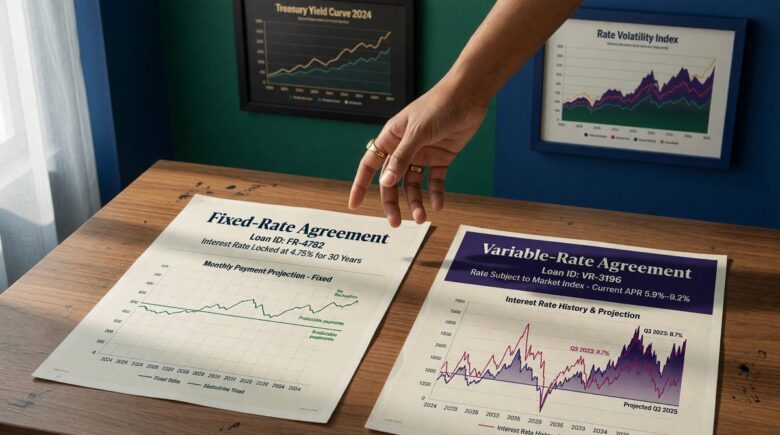
Here is the question most small-business owners ask backwards: they assume variable rates are always cheaper at the start, so they take one without considering whether the savings survive their actual draw pattern. In mid-2026, that assumption has a real flaw. According to the Federal Reserve Bank of Kansas City’s Q4 2025 small-business lending survey, surveyed bank fixed-rate lines of credit averaged between 6.99% and 7.38%, while variable-rate lines averaged 7.63% to 7.91%, meaning fixed was actually the lower starting rate. That reversal changes the entire fixed vs variable business line of credit calculation.
Why does it matter now? The Federal Reserve has been in a pause-or-cut posture heading into mid-2026, but rate cuts are measured and uncertain. Businesses locking in today may be giving up future savings, or protecting against a reversal no one can predict with confidence.
| Factor | Reasons to Choose Fixed Rate | Reasons to Choose Variable Rate |
|---|---|---|
| Starting rate | Currently lower at surveyed banks: 6.99–7.38% average | Currently higher at 7.63–7.91% at surveyed banks; may be lower at online lenders |
| Payment predictability | Same payment every cycle; easy to model in a monthly budget | Payment changes when the benchmark rate moves |
| Rate-cut benefit | None; you stay locked at the original rate | If the Fed cuts 1–2%, your cost drops automatically |
| Rate-hike risk | Fully protected; your rate cannot rise | Exposed unless the product includes a rate cap |
| Product availability | Less common; most traditional bank LOCs default to variable | Dominant structure, roughly 91% of bank LOC balances are variable |
| Best draw duration | Longer-term or sustained draws of 12+ months | Short draws repaid within 90–180 days |
| Cash-flow planning | Reduces budgeting stress, especially for owner-operators | Requires monthly recalculation if rate moves |
Key Takeaways
- Your typical outstanding balance on the line is $20,000 or more and you expect to carry it for at least 12 months.
- You need cash-flow certainty because the business is your primary household income source.
- The fixed rate offered is within 0.5 percentage points of the variable rate, or lower, as in the current bank environment.
- You cannot absorb a rate increase of 1.5% or more without risking a cash-flow shortfall.
- You draw and repay the line in cycles longer than 6 months rather than clearing it each month.
- Your FICO Score is 700 or above, which is typically required to qualify for fixed-rate LOC products at traditional banks.
- You have reviewed the variable-rate product’s cap structure and the cap still represents an unacceptable worst-case payment.
What Do Fixed and Variable Rates Actually Look Like Right Now?
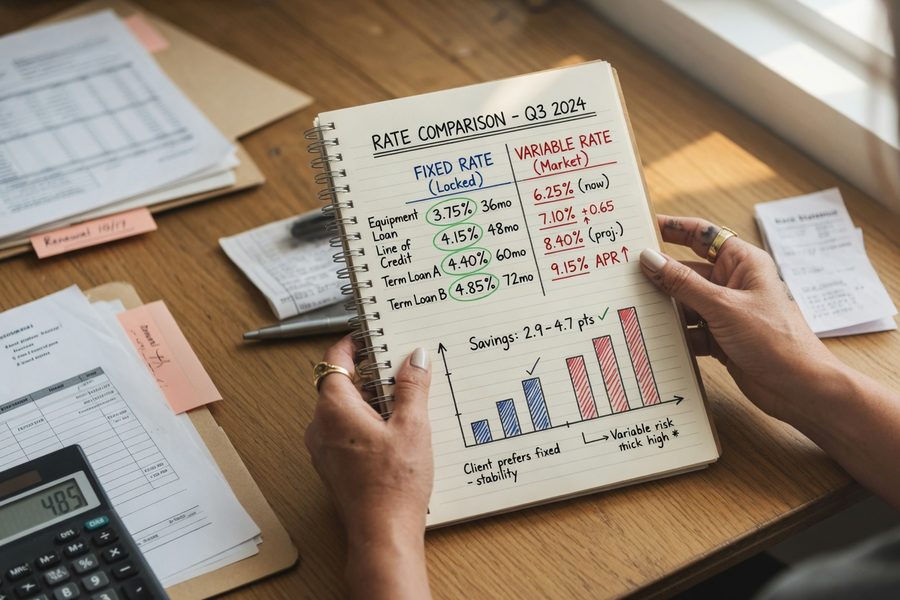
Fixed-rate business lines of credit are cheaper than variable ones at most surveyed banks as of mid-2026, a reversal that surprises most borrowers. The Federal Reserve Bank of Kansas City data cited above shows bank variable-rate LOCs running roughly 0.5 to 0.9 percentage points higher than fixed-rate products at the same institutions. That gap matters when you model real dollars.
Consider a straightforward example. Suppose your business carries a steady $30,000 balance on a line of credit for 12 months. At a fixed rate of 7.2%, annual interest comes to roughly $2,160. At a variable rate of 7.8%, you pay approximately $2,340, a difference of $180 per year in the base case. That gap widens if the variable rate climbs by 1%; it narrows or reverses if the Fed cuts by 1%. For a $50,000 balance, the same spread produces a roughly $300 annual difference before any rate movement. These are not transformational figures, but they are real and they compound with time.
Online lenders such as SoFi often price differently, sometimes offering variable APRs below the bank average because they carry less overhead. If you are comparing a Chase or Wells Fargo fixed rate against an online lender’s variable product, the starting-rate advantage can flip. Understanding how the prime rate flows through to loan and line pricing helps you decode why two lenders quoting on the same day can land 100 basis points apart.
Does Payment Stability Actually Change Business Decisions?
For owner-operators who depend on the business for household expenses, yes, the behavioral value of a fixed payment is real, even if the total interest paid ends up slightly higher. A variable payment that jumps unexpectedly can force conservative draw decisions at exactly the moment a business needs capital most.
The U.S. Small Business Administration’s 7(a) loan program guidance makes the core distinction clear: fixed-rate loans carry consistent payments throughout the term, while variable-rate loans require different payment amounts whenever the interest rate changes. That sounds obvious, but the implication for a seasonal business is significant. A landscaping company that draws heavily in spring and repays through summer does not want its cost of capital changing mid-draw based on a Federal Reserve meeting it cannot predict.
The catch is availability. True fixed-rate revolving lines of credit are less common than fixed-rate term loans. Most traditional banks, including large institutions like Chase and Bank of America, structure revolving products as variable by design, because the revolving draw mechanism creates repricing complexity on a fixed book. If a lender offers you a “fixed” LOC, verify whether the rate is fixed for the full draw period or only for an initial promotional window. The Consumer Financial Protection Bureau (CFPB) recommends reviewing the full rate terms in any credit agreement before signing, and that advice applies directly here. Good credit-building habits, like those covered in this guide to building credit from scratch, can help you qualify for the better fixed-rate products that do exist.
Variable Rates: The Upside Is Real, but So Is the Volatility
Variable rates on business lines of credit are benchmarked to an index, most commonly the Wall Street Journal prime rate or SOFR (the Secured Overnight Financing Rate), plus a spread negotiated with your lender. When the Federal Reserve cuts its federal funds target, the prime rate typically follows within days, and your payment drops automatically. That is the genuine appeal.
The SBA notes that variable rates on 7(a) CAPLines, its revolving line-of-credit product, are set at prime plus a spread that varies by loan size and term, with the payment adjusting when the base rate changes. In a Fed cutting cycle, a 1% reduction in prime translates directly to a lower monthly interest charge. On a $30,000 balance, that 1% cut saves roughly $300 per year; a 2% cut saves around $600.
But variable products can move against you, too. A business that drew $40,000 in early 2022 at a variable rate below 4% watched its effective rate nearly triple by late 2023 as the Federal Reserve hiked aggressively. Many variable-rate LOC products now include rate caps, ceilings above which the APR cannot rise regardless of benchmark movement, and those caps matter enormously. Ask any lender offering a variable line to specify the cap in writing before you sign. Without a cap, stress-test your payment at 2 percentage points above today’s rate; if that number causes a cash-flow problem, the variable product is the wrong tool. For broader context on how rate changes ripple through business finances, the piece on what happens to savings and costs when the prime rate rises is worth reading alongside this decision.
Credit Score and Personal Guarantee: The Hidden Gating Factor
Your FICO Score does not just affect the rate you get, it often determines whether a fixed-rate LOC is offered to you at all. Most traditional bank lenders reserve fixed-rate revolving products for borrowers with FICO Scores of 700 or above, with some FDIC-insured institutional lenders requiring 720+ for the most competitive terms. Below those thresholds, the menu narrows to variable-rate products, often with wider spreads.
Experian data consistently shows that small-business owners with scores below 680 face materially higher spreads even on variable products, which is why knowing where your credit stands before shopping is time well spent. Personal guarantees compound this further. Nearly all small-business lines of credit under $250,000 require a personal guarantee, meaning the business owner’s personal creditworthiness, including their debt-to-income ratio (DTI), is evaluated alongside the company’s financials. A business with strong revenue but an owner carrying a high DTI or a 680 FICO Score may qualify for a variable line but find fixed-rate options unavailable or priced at a premium that eliminates the stability benefit. If your personal credit needs work, understanding what a good credit score unlocks in lending is a practical starting point before shopping LOC products.
Annual revenue and time in business are equally important. Most bank lenders want to see at least two years of operating history and $250,000 or more in annual revenue for a secured fixed-rate line. Online lenders such as SoFi often accept less history, but they typically price variable products, and their spreads above prime can run 3 to 6 percentage points, far wider than bank margins. The fixed vs variable business line of credit question looks very different for a two-year-old LLC with $180,000 in revenue than it does for an established S-corp with a decade of bank relationships.

Who Should and Who Should Not
Good candidates
Fixed-rate lines make the most sense for businesses where predictability has operational value beyond the interest cost itself.
- A seasonal business, construction, agriculture, retail, that draws heavily for 4 to 6 months and needs stable carrying costs during the off-season repayment period.
- An owner-operator whose personal household budget is tightly coupled to the business; a fixed payment removes one variable from an already complex monthly cash-flow picture.
- A business that consistently carries a balance above $25,000 for 12+ months, where even a modest rate advantage on the fixed side compounds meaningfully.
- Any borrower who has reviewed the cap on a variable-rate offer and found the worst-case APR produces a payment that exceeds their debt-service coverage comfort.
Who should skip it
Variable-rate lines are better suited to businesses with flexible cash flow and short draw cycles.
- A business that uses its line of credit tactically, drawing $10,000 to $15,000 for 30 to 60 days and repaying fully each cycle, where the rate type matters far less than the availability and cost of the draw fee.
- A borrower with a FICO Score below 700 who cannot access competitive fixed-rate products and would end up paying a fixed-rate premium without the usual stability benefit.
- A business that genuinely expects two or more Federal Reserve rate cuts within the next 12 months and has the cash-flow cushion to absorb short-term payment fluctuation in exchange for the savings.
- Companies already managing cash flow with a structured monthly budget that can absorb modest payment variation without disrupting operations.
Related reading: 0.5% prime rate increase affects.
Frequently Asked Questions
Is a fixed or variable rate better for a business line of credit right now?
Fixed-rate lines are actually starting lower than variable ones at most surveyed banks in mid-2026, which flips the usual calculus. If you carry a balance for 12 months or longer, fixed is likely the better deal unless the Federal Reserve cuts rates by more than 1% during your draw period.
How does the prime rate affect my variable business line of credit?
Most variable LOCs are priced as prime plus a fixed spread, for example, prime plus 2%. When the Federal Reserve adjusts the federal funds target, the Wall Street Journal prime rate follows almost immediately, and your rate and payment adjust on the next billing cycle. A 0.5% Fed cut on a $30,000 balance saves roughly $150 per year; a 1% cut saves approximately $300.
Can I convert a variable rate business line of credit to a fixed rate?
Some lenders allow rate conversion or a hybrid option where you can lock a drawn portion at a fixed rate while keeping the rest variable, but this is not standard. You generally need to negotiate this term before signing, or refinance into a new fixed-rate product, which may trigger fees and a new credit inquiry. The CFPB recommends comparing the full APR, not just the stated rate, when evaluating any refinance offer.
Do most business lines of credit come with a fixed or variable rate?
Variable-rate products dominate. The Federal Reserve Bank of Kansas City found that 91% of business line of credit balances at surveyed banks in Q4 2025 were variable-rate. Fixed-rate revolving lines exist but are less common, and they require stronger FICO Scores and financial profiles to access.
Sources
- Federal Reserve Bank of Kansas City, Small Business Lending Survey Q4 2025
- U.S. Small Business Administration, 7(a) Loans Program Overview
- U.S. Small Business Administration, 7(a) Loan Terms, Conditions, and Eligibility
- Federal Reserve, Selected Interest Rates (H.15 Release)
- The Wall Street Journal, Money Rates (Prime Rate)