Fact-checked by the Prime Rate editorial team
Quick Answer
Most small business credit cards carry variable APRs set at the prime rate plus a margin of 12–22%. As of July 2025, the federal funds rate target range sits at 4.25%–4.50%, making the prime rate 7.50%. Understanding this relationship helps owners choose the right card, minimize interest costs, and time large purchases strategically.
If you carry a balance on a small business credit card, the prime rate directly controls a large portion of what you pay in interest every month. Prime rate business credit cards are variable-rate products tied to the U.S. prime rate — currently 7.50% as tracked by the Federal Reserve’s H.15 statistical release — meaning your effective APR shifts every time the Federal Open Market Committee changes the federal funds rate. As of July 2025, most business credit card APRs range from roughly 19.49% to 29.99% depending on creditworthiness and card issuer.
This matters more right now than it has in years. After the most aggressive rate-hiking cycle since the 1980s, the Fed held rates steady through early 2025, and market expectations point toward possible cuts later this year. For small business owners, that timing affects the true cost of revolving credit in a meaningful way. Understanding how prime rate business credit cards work — and how to manage them — can translate directly to lower borrowing costs and stronger cash flow.
This guide is written for small business owners who use or are considering business credit cards and want a clear, practical understanding of how the prime rate shapes their interest expenses. By the end, you will know how rates are calculated, how to compare cards, when to carry a balance versus pay in full, and how to protect your business finances when rates climb.
Key Takeaways
- The U.S. prime rate is currently 7.50% (July 2025), set at 3 percentage points above the federal funds rate target, according to Federal Reserve H.15 data.
- Most small business credit cards charge the prime rate plus a margin, resulting in variable APRs that typically range from 19.49% to 29.99%, per CreditCards.com business card surveys.
- A 1 percentage point increase in the prime rate adds roughly $100 per year in interest for every $10,000 carried as a revolving balance, making rate awareness a direct cash-flow issue.
- The Card Act of 2009 does not fully apply to business credit cards, meaning issuers can raise rates on existing balances with as little as 45 days’ notice, according to the Consumer Financial Protection Bureau.
- Business owners who pay their statement balance in full each month pay 0% effective interest regardless of the prime rate, turning the APR discussion into a risk-management exercise rather than a daily cost.
- Cards with 0% introductory APR periods of 12–15 months can save hundreds of dollars on large equipment or inventory purchases made when the prime rate is elevated.
In This Guide
- How does the prime rate actually affect my business credit card APR?
- How do I read my card agreement to find my real interest rate?
- How do I compare prime rate business credit cards to find the best deal?
- Should I carry a balance on my business credit card or pay it off every month?
- How can I reduce interest costs on my business card when the prime rate is high?
- How does using a business credit card affect my credit score and borrowing ability?
- Frequently Asked Questions
Step 1: How Does the Prime Rate Actually Affect My Business Credit Card APR?
Your business credit card APR is almost certainly a variable rate calculated as the prime rate plus a fixed margin set by your card issuer. When the prime rate rises, your APR rises by exactly the same number of percentage points — automatically, with no additional action required by the bank.
How the Calculation Works
Here is the standard formula every major issuer uses: APR = Prime Rate + Margin. If your card agreement states “Prime + 14.74%,” and the prime rate is 7.50%, your current APR is 22.24%. If the Fed cuts rates by 0.25%, your APR drops to 21.99% on the very next billing cycle.
The prime rate itself is not set by Congress or a government agency directly. It is a conventional rate that major U.S. banks apply to their most creditworthy corporate customers, and it historically tracks at exactly 3 percentage points above the federal funds rate target. When the Federal Open Market Committee raises or lowers the federal funds rate, the prime rate follows the same day.
What to Watch Out For
Many business owners assume their rate only changes when they miss a payment or their credit score drops. In reality, rate changes are triggered by Fed policy decisions — events entirely outside your control. A single 0.25% rate hike adds roughly $25 per year for every $10,000 you carry as a revolving balance, which compounds quickly across multiple billing cycles.
The prime rate has changed more than 11 times since March 2022, moving from 3.25% to a peak of 8.50% before settling at its current 7.50%. Business owners who carried balances throughout that cycle saw their effective APR climb by more than 5 percentage points over just 18 months.
Understanding how the prime rate affects your credit card interest rates in precise dollar terms is the first step toward making intentional borrowing decisions rather than reactive ones.
Step 2: How Do I Read My Card Agreement to Find My Real Interest Rate?
Your card agreement’s Schumer Box — the standardized rate disclosure table required by the Truth in Lending Act — is the single most important document for understanding your actual borrowing cost. Find it in your original welcome package, your issuer’s online account portal, or by requesting it directly from customer service.
How to Read the Schumer Box
Look for the row labeled “Purchase APR” or “Variable APR for Purchases.” It will read something like: “22.24% to 30.24%, based on your creditworthiness. This APR will vary with the market based on the Prime Rate.” The lower end of that range applies to applicants with excellent business credit; the higher end applies to those with fair credit histories.
Next, locate the “Penalty APR” row. On many business cards, this rate — which can reach 29.99% or higher — kicks in automatically after one or two late payments. Unlike consumer cards governed fully by the Credit CARD Act of 2009, business card issuers face fewer restrictions on applying penalty rates to your existing balance, not just new purchases.
What to Watch Out For
Business card agreements often contain language permitting the issuer to change your margin — not just the prime rate component — with 45 days’ written notice. This means your APR can increase even when the Fed holds rates steady. The CFPB confirms that the full consumer protections of the CARD Act do not extend to most business credit accounts.
If your card agreement includes a “Universal Default” clause, a late payment to an entirely different creditor — your auto loan, utility bill, or another card — could trigger a rate increase on your business card. Read the fine print for this language before you apply.
Step 3: How Do I Compare Prime Rate Business Credit Cards to Find the Best Deal?
The best prime rate business credit cards balance the lowest possible margin over prime with rewards or features that match your actual spending patterns. The right card depends on whether you plan to carry a balance, what categories dominate your expenses, and what your business credit profile looks like today.
How to Compare Cards Side by Side
Start with the margin over prime — the lower that number, the less you pay in interest regardless of where the prime rate moves. Then evaluate the annual fee against your estimated rewards earn rate. A card with a $695 annual fee only makes sense if you generate enough in travel credits, rewards points, or statement credits to offset it — typically requiring $50,000 or more in annual spend.
Use tools like CreditCards.com’s business card comparison tool to filter by APR range, annual fee, and rewards category. Sort results by the lowest purchase APR, then layer in rewards value as a secondary filter.
| Card / Feature | Variable APR Range | Annual Fee | Best For | Intro APR Offer |
|---|---|---|---|---|
| Chase Ink Business Cash | 18.49%–24.49% | $0 | Office supplies, internet, phone | 0% for 12 months on purchases |
| American Express Blue Business Cash | 18.49%–26.49% | $0 | Flat-rate 2% cash back on all purchases | 0% for 12 months on purchases |
| Capital One Spark Cash Plus | N/A (charge card, pay in full) | $150 | High-volume spenders wanting unlimited 2% back | No revolving balance allowed |
| U.S. Bank Business Triple Cash Rewards | 19.24%–28.24% | $0 | Gas, office supplies, cell phone | 0% for 15 months on purchases |
| Bank of America Business Advantage Customized Cash | 18.49%–28.49% | $0 | Flexible category selection | 0% for 9 billing cycles |
Note that charge cards like the Capital One Spark Cash Plus eliminate the APR question entirely because balances must be paid monthly. If cash flow is predictable enough to pay in full, a charge card can be a structurally smarter choice when prime rate business credit cards carry elevated margins.
If your business credit profile is still developing, look for cards that report to the major business credit bureaus — Dun & Bradstreet, Experian Business, and Equifax Business. Responsible use builds a separate business credit file that can unlock lower-rate financing down the road. Learn more about how to build credit from scratch if you are starting a new business.

Step 4: Should I Carry a Balance on My Business Credit Card or Pay It Off Every Month?
The financially optimal strategy in nearly every scenario is to pay your statement balance in full each month. Doing so eliminates interest charges entirely, meaning the prime rate becomes irrelevant to your daily cost — it only matters as a risk metric if your cash flow ever forces you to revolve a balance.
When Carrying a Balance Makes Sense
There are limited circumstances where carrying a short-term balance is rational. These include utilizing a 0% introductory APR period for a planned capital purchase — equipment, inventory, or software — that you know will be paid off before the promotional period ends. In that case, you are effectively getting an interest-free short-term loan.
Outside of 0% promotions, the math rarely favors revolving. If your card charges 22.24% APR and you carry a $5,000 balance for 12 months, you will pay approximately $1,112 in interest — money that could fund payroll, marketing, or equipment instead. Comparing that against the cost of a lower-rate personal or business term loan almost always favors the loan.
What to Watch Out For
Business owners sometimes rationalize carrying a balance as “using other people’s money.” That is only true during a grace period — typically 21–25 days after your statement closes. Once interest begins accruing, the cost compounds daily using the daily periodic rate (APR divided by 365), making the effective cost higher than the stated annual rate suggests.
“The most expensive money a small business can borrow is revolving credit card debt. At current prime-plus margins, a business carrying a $10,000 balance is paying the equivalent of a high-risk personal loan — often above 20%. The discipline to pay in full is the single highest-return financial habit a small business owner can develop.”
According to the Federal Reserve’s G.19 Consumer Credit report, revolving credit outstanding for small businesses reached over $500 billion in 2024. At an average APR of 21%, that represents more than $100 billion in annual interest payments across the sector — a figure that drops dramatically when balances are paid in full.
Step 5: How Can I Reduce Interest Costs on My Business Card When the Prime Rate Is High?
When the prime rate is elevated — as it has been since 2022 — business owners have several concrete tools to reduce interest costs on existing balances and new purchases. The most effective strategies involve either shifting debt to lower-rate instruments or restructuring spending habits to minimize revolving balances entirely.
Concrete Strategies to Lower Your Effective Rate
- Balance transfer to a 0% intro APR business card: Several issuers offer 0% on transferred balances for 12–15 months. Even with a 3%–5% transfer fee, moving a $10,000 balance from a 22% card saves roughly $1,800 in interest over 12 months.
- SBA Microloan or term loan refinancing: The U.S. Small Business Administration’s Microloan program offers loans up to $50,000 at rates typically ranging from 8%–13% — well below most business card APRs. Visit SBA.gov’s Microloan page to find approved intermediary lenders.
- Business line of credit: A secured business line of credit through a bank or credit union often carries APRs of 10%–18%, meaningfully below the typical business card margin.
- Negotiate your margin directly: Call your card issuer and ask for a rate reduction. Cardholders with strong payment history and revenue growth have a surprisingly good success rate — industry surveys suggest 70% of those who ask receive at least a partial reduction.
- Accelerate payoff using the avalanche method: Allocate every available dollar toward the highest-APR card first while making minimum payments on others. This approach, detailed in our guide on how to pay off debt using the avalanche method, minimizes total interest paid.
What to Watch Out For
Balance transfer offers on business cards are less common than on consumer cards, and the terms are often shorter. Always confirm whether the 0% period applies to transferred balances, new purchases, or both — many cards charge full APR on new purchases even during a balance transfer promotion.
If you are planning a large equipment purchase and the prime rate is elevated, time it to coincide with a card’s introductory 0% APR period. A 15-month 0% window on a $15,000 purchase lets you spread payments interest-free — effectively beating the prime rate entirely for that transaction. Pair this strategy with a solid monthly budget to ensure you clear the balance before the promotional period expires.

Step 6: How Does Using a Business Credit Card Affect My Credit Score and Borrowing Ability?
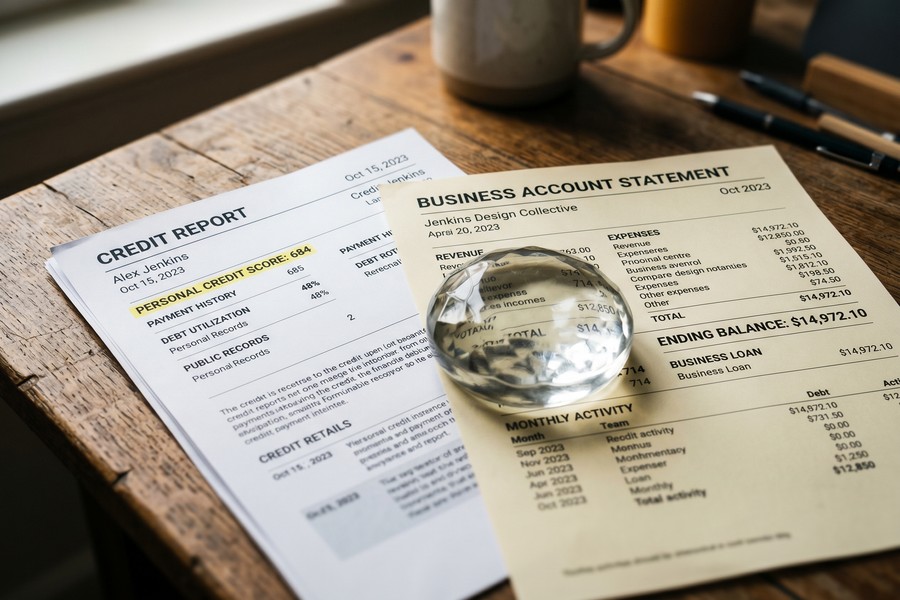
Business credit cards affect both your personal credit score and your business credit profile, depending on how the issuer reports account activity. Understanding which bureaus receive your data determines how your card use influences your future access to financing.
Personal vs. Business Credit Reporting
Most major business card issuers — including Chase, American Express, and Capital One — do not report regular on-time payments to consumer bureaus like Experian, Equifax, or TransUnion. However, they typically do report delinquencies and defaults, creating an asymmetric relationship: bad behavior hurts your personal credit, while good behavior may not help it.
Business credit bureaus — primarily Dun & Bradstreet (PAYDEX score), Experian Business, and Equifax Business — maintain separate files for your business entity. Cards that report to these bureaus build your business creditworthiness independently, which matters enormously when you apply for an SBA loan, commercial lease, or vendor trade credit.
What to Watch Out For
Your personal credit utilization ratio can be affected if an issuer reports your business card balance to consumer bureaus. A high balance on a business card that appears on your personal credit report can reduce your personal credit score, affecting mortgage applications or personal loan rates. Understanding what constitutes a good credit score and monitoring both your personal and business profiles is essential for maintaining broad financing access.
“Small business owners often conflate personal and business credit without realizing the downstream consequences. Building a strong, separate business credit profile — with consistent on-time payments, low utilization, and accurate bureau reporting — can be the difference between qualifying for a $250,000 SBA loan and being declined.”
Also note that the personal guarantee attached to virtually every small business credit card means your personal assets remain on the hook if the business defaults. This guarantee also means the issuer will check your personal credit when you apply, resulting in a hard inquiry on your personal credit report regardless of how strong your business credit file is.
Keeping your business card utilization below 30% of your credit limit is a standard guideline for maintaining strong scores at both Dun & Bradstreet and Experian Business. High utilization signals cash-flow stress to lenders evaluating your creditworthiness for future financing.
Frequently Asked Questions
What is the current prime rate for business credit cards in 2025?
The U.S. prime rate is 7.50% as of July 2025, according to Federal Reserve H.15 data. This rate is set at 3 percentage points above the federal funds rate target of 4.25%–4.50%. Your card’s actual APR equals this prime rate plus the margin stated in your card agreement — typically an additional 12–22 percentage points depending on your creditworthiness.
How much does my business credit card APR go up when the Fed raises rates?
Your APR increases by the exact same amount as the Fed’s rate hike — if the Fed raises the federal funds rate by 0.25%, your business card APR rises by 0.25% automatically. Most issuers apply the new rate starting from the first day of the billing cycle that begins after the Fed’s announcement. On a $10,000 balance, a 0.25% increase adds approximately $25 per year in interest charges.
Can I negotiate a lower interest rate on my business credit card?
Yes, and it works more often than most business owners expect. Call the number on the back of your card, ask to speak with a retention specialist, and cite your on-time payment history, revenue growth, or competing offers. Industry data suggests roughly 70% of cardholders who request a rate reduction receive some concession. A reduction of even 2–3 percentage points on a $10,000 balance saves $200–$300 per year in interest.
What credit score do I need to qualify for a business credit card with a low APR?
Most business cards offering APRs at the lower end of their stated range require a personal FICO score of 740 or higher. Cards from Chase, American Express, and Capital One typically require good-to-excellent credit (FICO 670+) just to be approved, with the best rates reserved for scores above 740. If your score is below 670, secured business cards or credit-builder products are a more realistic starting point before pursuing premium prime rate business credit cards.
Are business credit cards subject to the Credit CARD Act of 2009?
No — not fully. The Credit CARD Act of 2009 applies specifically to consumer credit accounts and offers limited protection for most business cards. Issuers can raise rates on existing balances with as little as 45 days’ notice, apply penalty rates retroactively, and change terms more freely than they can on personal cards. The CFPB provides detailed guidance on these distinctions.
Should I get a business charge card or a business credit card if I want to avoid prime rate interest?
A business charge card is the structurally cleanest way to eliminate prime rate interest — because balances must be paid in full each month, there is no revolving debt and therefore no APR applies. Cards like the American Express Business Platinum or Capital One Spark Cash Plus operate this way. The tradeoff is that you lose the option to finance purchases over time, which can constrain cash flow during slow revenue months.
How does carrying a balance on a business credit card affect my taxes?
Interest paid on a business credit card is fully tax-deductible as a business expense under IRS rules, as long as the card is used exclusively or primarily for business purposes. If you mix personal and business charges on the same card, you must track the business-use percentage and can only deduct the proportional interest. Consult a CPA or tax advisor to ensure proper documentation, especially if you face an IRS audit.
What happens to my business credit card rate if the Fed cuts rates in 2025?
If the Federal Reserve cuts the federal funds rate, the prime rate drops by the same amount, and your variable business card APR falls automatically on the next billing cycle. Market expectations as of mid-2025 suggest one or two possible 0.25% cuts before year-end, which would lower the prime rate to between 7.00% and 7.25%. To understand how rate movements affect your overall business finances, see our analysis of what happens to your savings when the prime rate rises.
Is it better to use a business credit card or a business line of credit for short-term financing?
For amounts under $25,000 and short payback windows, a business credit card with a 0% introductory APR often wins on cost. For larger amounts or longer payback periods, a business line of credit typically carries a lower ongoing APR — often 10%–18% versus the 19%–30% range on most business credit cards. Lines of credit also avoid the personal credit impact that comes with high business card utilization.
How do I know if my business credit card rewards are worth the higher APR?
Rewards are only worth the APR premium if you pay your balance in full every month. If you carry a revolving balance, interest charges erase rewards value almost immediately — a 2% cash-back card loses its entire reward at a 22% APR the moment you pay interest. Calculate your break-even: if your annual rewards earnings exceed the annual fee and any interest paid, the card is net-positive; otherwise, a no-fee, lower-APR card is the better financial choice.
Sources
- Federal Reserve — H.15 Selected Interest Rates (Prime Rate)
- Federal Reserve — Federal Open Market Committee (FOMC) Meeting Information
- Consumer Financial Protection Bureau — Credit CARD Act Rights Explained
- Federal Reserve — G.19 Consumer Credit Statistical Release
- U.S. Small Business Administration — Microloan Program
- CreditCards.com — Small Business Credit Card Comparison and Surveys
- Federal Reserve — G.19 Historical Data on Revolving Consumer Credit
- IRS — Tax Topic 505: Interest Expense Deductions
- Dun & Bradstreet — Understanding Your Business Credit Score (PAYDEX)
- Nav — How Business Credit Cards Affect Your Credit Score