Fact-checked by the Prime Rate editorial team
Quick Answer
Prime rate volatility is manageable for self-employed borrowers with the right strategy. In July 2025, the U.S. prime rate stands at 7.50%, making variable-rate debt expensive and unpredictable. To minimize risk, lock in fixed-rate loans where possible, build a 6-month cash reserve, diversify income streams, and monitor Fed policy signals closely. Most borrowers can complete these steps within 60–90 days.
If you’re self-employed and carrying variable-rate debt, you already know that self-employed borrowers prime rate fluctuations hit harder than they do for salaried workers. Unlike W-2 employees, freelancers, independent contractors, and small business owners face income variability at the same time their borrowing costs shift, a double squeeze that can destabilize even well-run finances., the Federal Reserve’s benchmark federal funds rate keeps the prime rate at 7.50%, the highest sustained level in over two decades.
The challenge is intensifying. The Fed has signaled a cautious, data-dependent path forward, meaning rate cuts are possible but not guaranteed in the near term. According to the Federal Open Market Committee’s 2025 meeting schedule, markets face at least four more policy decision points before year-end, each capable of moving prime rate up or down. For self-employed borrowers, that ambiguity is a financial planning problem.
This guide is for freelancers, sole proprietors, LLC owners, and gig workers who hold or plan to take on debt, including HELOCs, business lines of credit, personal loans, or variable-rate mortgages. By the end, you’ll have a concrete, step-by-step plan to protect your cash flow, reduce rate exposure, and position yourself to borrow wisely no matter what the Fed decides next.
Key Takeaways
- The U.S. prime rate is currently 7.50% (July 2025), directly affecting HELOCs, business lines of credit, and variable-rate personal loans, according to Federal Reserve H.15 data.
- Self-employed borrowers are 37% more likely to be denied a conventional mortgage than salaried applicants with comparable credit scores, per Urban Institute housing research.
- A 6-month emergency fund covering both personal and business expenses is the single most effective buffer against rate spikes, according to financial planning guidance from the CFP Board.
- Refinancing a variable-rate HELOC into a fixed-rate home equity loan can save $3,000–$8,000 over five years on a $100,000 balance in a rising-rate environment, based on data from Bankrate’s home equity loan analysis.
- The average self-employed borrower holds 1.8x more revolving debt than the average salaried worker, making rate sensitivity disproportionately high, according to Experian’s consumer credit research.
- Fixed-rate SBA 7(a) loans currently carry interest rates between 10.5% and 13%, providing rate certainty for business borrowing compared to variable-rate alternatives, per SBA loan program data.
In This Guide
- Step 1: How Does the Prime Rate Actually Affect Self-Employed Borrowers?
- Step 2: How Do I Identify Which of My Debts Are Exposed to Prime Rate Changes?
- Step 3: Should I Refinance to a Fixed Rate Now or Wait for the Fed to Cut?
- Step 4: How Much Cash Reserve Do Self-Employed Borrowers Need to Survive a Rate Spike?
- Step 5: How Can I Qualify for Better Loan Terms as a Self-Employed Borrower?
- Step 6: What Hedging Strategies Can Self-Employed Borrowers Use Against Prime Rate Volatility?
- Frequently Asked Questions
Step 1: How Does the Prime Rate Actually Affect Self-Employed Borrowers?
The prime rate is the benchmark interest rate that major U.S. banks use to set rates on consumer and business loans. It moves in lockstep with the federal funds rate and directly controls the cost of variable-rate products like HELOCs, business lines of credit, and adjustable-rate personal loans.
How Prime Rate Feeds Into Your Borrowing Costs
Most variable-rate products are priced as “prime plus a margin.” For example, a business line of credit priced at “prime + 2%” would carry a rate of 9.50% at today’s prime rate of 7.50%. If the Fed raises rates by 0.50%, your payment on a $50,000 balance increases by roughly $250 per year, automatically, with no lender action required.
Freelancers and independent contractors face a compounded risk here. Their income can drop in the same quarter that rates rise, which is exactly when variable debt becomes most burdensome. Understanding how the prime rate affects personal loan rates is the foundation for every other step in this guide.
What to Watch Out For
Many people working for themselves underestimate how many of their debts are variable-rate. Business credit cards, SBA lines of credit, and HELOCs are all typically tied to prime. Review your loan agreements carefully, the rate index used is disclosed in the promissory note or credit agreement.
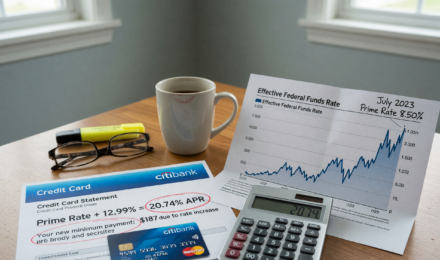
The prime rate has moved 11 times since March 2022, rising from 3.25% to a peak of 8.50% before settling at 7.50% in July 2025. That 5.25-percentage-point swing added thousands of dollars in annual interest costs to any variable-rate balance above $50,000.
Step 2: How Do I Identify Which of My Debts Are Exposed to Prime Rate Changes?
Start by auditing every debt you carry and categorizing each as fixed-rate or variable-rate. This single exercise reveals your true rate exposure and sets the priority order for the steps that follow.
How to Do This
Pull your most recent statements for every open account: mortgage, HELOC, business line of credit, personal loans, and credit cards. For each one, locate the “interest rate type” field or call your lender directly. Use this checklist to classify each debt:
- Variable-rate (high priority): HELOCs, business lines of credit, adjustable-rate mortgages (ARMs), business credit cards, variable personal loans
- Fixed-rate (lower priority): Conventional 30-year mortgages, fixed-rate personal loans, fixed SBA loans, auto loans originated with fixed terms
- Hybrid (review carefully): SBA 7(a) loans with variable components, some equipment financing with periodic rate resets
Once categorized, calculate your total variable-rate balance. Multiply that balance by 0.01 to estimate the additional annual interest cost for every 1-percentage-point rate increase. This is your “rate risk number.”
What to Watch Out For
Credit card debt is often overlooked in this audit because it feels like short-term debt. However, prime rate changes directly affect credit card APRs, and the average business credit card rate now exceeds 20% according to Federal Reserve consumer credit data. Carry any revolving balance on a business card and you have meaningful prime-rate exposure.

According to Federal Reserve G.19 data, the average revolving credit card APR for accounts charged interest reached 21.76% in Q1 2025, the highest level recorded since tracking began in 1994.
Step 3: Should I Refinance to a Fixed Rate Now or Wait for the Fed to Cut?
For most borrowers with significant variable-rate balances, refinancing to a fixed rate now makes more sense than waiting for rate cuts that may not arrive on a predictable schedule. The cost of waiting is concrete; the savings from anticipated cuts are speculative.
How to Do This
The most impactful refinancing moves for self-employed borrowers prime rate risk reduction are, in order of typical impact:
- HELOC to fixed home equity loan: If you carry a balance on a HELOC, converting it to a fixed-rate home equity loan eliminates prime-rate exposure entirely. Current fixed home equity loan rates average 8.35% for 10-year terms according to Bankrate’s current rate survey.
- Variable business line to fixed SBA 7(a) loan: The SBA 7(a) loan program offers fixed-rate options between 10.5% and 13%. While rates are higher than the prime rate itself, the predictability has a real economic value for cash-flow planning.
- Balance transfer to fixed personal loan: High-rate business credit card debt can sometimes be consolidated into a fixed personal loan. Review strategies for paying off credit card debt to determine whether a fixed consolidation loan fits your situation.
What to Watch Out For
Refinancing involves closing costs, origination fees, and sometimes prepayment penalties on the existing debt. Always calculate the break-even period before committing. If closing costs total $3,000 and you save $100 per month, your break-even is 30 months, only worthwhile if you plan to hold the new loan that long.
Payment certainty has real value for variable-income earners, even when it comes at a modest premium over the current variable rate. Waiting for the ideal rate environment before locking in fixed-rate debt is a common mistake; there is rarely a moment that feels perfect, and the uncertainty itself has a cost. The CFP Board’s financial planning guidance consistently identifies predictable fixed obligations as a core tool for borrowers whose income fluctuates, precisely because it removes one variable from an already unpredictable cash flow picture. That said, if you are within 12 months of paying off a variable-rate balance, the math rarely favors paying closing costs to refinance.
| Debt Type | Typical Variable Rate (July 2025) | Fixed-Rate Alternative | Break-Even Period |
|---|---|---|---|
| HELOC ($100k balance) | 9.00%–9.50% | 8.35% fixed home equity loan | 18–24 months |
| Business Line of Credit ($75k) | 9.50%–11.00% | 10.50%–13% fixed SBA 7(a) | 24–36 months |
| Business Credit Card ($15k) | 20%–25% | 12%–17% fixed personal loan | 6–12 months |
| ARM Mortgage ($300k) | 7.50%–8.25% | 6.75%–7.25% fixed 30-year | 36–48 months |
| Variable Personal Loan ($25k) | 12%–16% | 10%–14% fixed personal loan | 12–18 months |
If you have both a HELOC and high-rate credit card debt, prioritize refinancing the credit card debt first. The rate differential, often 10+ percentage points between credit cards and a fixed personal loan, produces far greater monthly savings per dollar refinanced than converting a HELOC alone.
Step 4: How Much Cash Reserve Do Self-Employed Borrowers Need to Survive a Rate Spike?
Anyone running their own business needs a cash reserve that covers both personal living expenses and business operating costs for at least 6 months, double the 3-month standard typically recommended for salaried employees. This dual-layer reserve is your primary defense against a rate spike coinciding with a slow revenue period.
How to Do This
Calculate your reserve target using this formula: (Monthly personal expenses + Monthly fixed business costs) x 6. For example, if personal expenses are $4,000 per month and business overhead is $2,000 per month, your target reserve is $36,000.
Park this reserve in a vehicle that earns a competitive yield while remaining liquid. A high-yield savings account currently offers APYs between 4.50% and 5.00%, allowing your reserve to partially offset inflation while staying accessible. For amounts above your 6-month target, consider a CD ladder strategy to capture higher yields without locking up your entire safety net.
What to Watch Out For
Many people who work for themselves commingle business and personal funds, which makes it nearly impossible to accurately calculate a true reserve target. Maintain separate business and personal accounts, and build reserves for each independently.

Do not count your business credit line as part of your emergency reserve. A line of credit can be frozen, reduced, or repriced by your lender during a recession, precisely the moment you need it most. Only liquid, unrestricted cash qualifies as a genuine reserve.
Step 5: How Can I Qualify for Better Loan Terms as a Self-Employed Borrower?
Rate risk is only part of the problem, the other half is qualifying for competitive rates in the first place. Lenders apply tighter scrutiny to self-employed income, which often means higher rates and stricter terms unless you proactively strengthen your borrowing profile.
How to Do This
Four factors most directly affect the loan terms offered to self-employed borrowers:
- Credit score: A score above 760 opens the best rate tiers at most lenders. Review your report at AnnualCreditReport.com and dispute any errors before applying. For a complete roadmap, see this guide on building credit from scratch.
- Debt-to-income ratio (DTI): Most lenders want a DTI below 43% for qualified mortgage products, per CFPB qualified mortgage guidelines. Pay down variable-rate revolving balances first, as they carry the highest rates and reduce DTI most efficiently.
- Two-year tax return history: Lenders typically average two years of Schedule C or K-1 net income to qualify self-employed borrowers. If year two income is significantly higher than year one, consider waiting until you have two strong years before applying for a major loan.
- Business documentation: Maintain organized profit-and-loss statements, bank statements going back 24 months, and business licenses. Lenders who specialize in bank statement loans, which use 12–24 months of deposits instead of tax returns, are increasingly available and can offer more flexible qualification criteria.
What to Watch Out For
Aggressive tax deductions that minimize net income on your Schedule C will reduce the qualifying income lenders use. There is a direct tradeoff between tax efficiency and borrowing power for self-employed borrowers. A dollar of deductions that saves $0.30 in taxes could cost you thousands in higher borrowing costs or a loan denial. Work with both your CPA and your lender before filing a return in any year when you anticipate needing to borrow.
If your credit score is between 680 and 740, paying down a single high-utilization credit card to below 30% of its limit can raise your score by 20–40 points within 30–60 days, sometimes enough to move you into a better rate tier before your loan application is submitted.
Step 6: What Hedging Strategies Can Self-Employed Borrowers Use Against Prime Rate Volatility?
Beyond refinancing and reserves, you can reduce prime rate risk further through proactive tactics at both the income and debt levels. These strategies smooth out the impact of rate changes before they damage cash flow.
How to Do This
Practical hedging strategies for borrowers running their own businesses include:
- Income diversification: Add revenue streams with different interest-rate sensitivity. Service income is not directly rate-sensitive; rental income and investment returns are. A diversified income mix makes any single rate shock less damaging. Building a structured monthly budget helps you track which income sources are holding up when rates shift.
- Interest rate floors in contracts: If you lend money to clients (e.g., invoice financing, vendor contracts with payment terms), include escalation clauses that tie your receivables rate to prime rate movements. This partially offsets higher borrowing costs on your own debt.
- Fixed-income ladder for reserves: Rather than holding all reserves in a savings account, deploy excess capital into a short-term CD ladder. Locking in today’s rates on 3-month and 6-month CDs insulates a portion of your capital if rates drop while you’re still paying variable-rate debt. Review the best CD rates available in 2025 to find competitive options.
- Retire variable debt during high-revenue quarters: Self-employed income is rarely linear. Use strong-revenue quarters to make lump-sum principal payments on variable-rate balances. A $10,000 principal reduction on a 9.50% line of credit saves $950 per year in interest, regardless of future rate movements.
What to Watch Out For
Interest rate swaps and derivatives, common hedging tools for corporations, are not practical for most individual self-employed borrowers due to minimum notional amounts and complexity. Stick to structural debt management and liquidity strategies rather than derivative instruments.

Self-employed workers represent approximately 10.1% of the U.S. workforce, roughly 16 million people, according to Bureau of Labor Statistics Current Population Survey data. That population collectively holds hundreds of billions in variable-rate debt, making prime rate volatility a systemic personal finance issue, not just an individual one.
Frequently Asked Questions
How does the prime rate affect self-employed borrowers differently than salaried workers?
Self-employed borrowers face a double exposure that salaried workers do not: their income can decline at the same time their variable-rate debt costs rise. A salaried worker with a variable HELOC has stable income to absorb a rate increase; a freelancer may face a revenue slowdown and a higher debt payment simultaneously. This makes rate-sensitive debt management significantly more urgent for the self-employed.
What credit score do I need to get a low rate as a self-employed borrower?
Most lenders reserve their best rate tiers for borrowers with scores above 760. Scores between 700 and 759 still qualify for competitive rates, but the premium above prime is typically 0.5–1.5 percentage points higher. Scores below 680 often push self-employed applicants into non-QM or bank statement loan products at significantly higher rates. You can learn more about what a good credit score means for your borrowing power.
Should I pay off my HELOC or my business credit card first if rates stay high?
Pay off the business credit card first. Business credit card rates typically run 15–25%, while HELOC rates are currently in the 8.50%–9.50% range. Eliminating the highest-rate balance first, the avalanche method, produces maximum interest savings over time. The snowball vs avalanche debt payoff comparison can help you choose the right approach based on your specific balances.
Can I get a fixed-rate mortgage as a self-employed borrower if I write off a lot of expenses?
Yes, but your qualifying income will be based on your net income after deductions, not your gross revenue. If two years of Schedule C show net income of $60,000 and $70,000, lenders will average those to $65,000 for qualification purposes, even if your gross revenue is $200,000. Bank statement loans offer an alternative, using 12–24 months of deposits at a 50%–80% income factor, though rates are typically 0.50–1.50% higher than conventional products.
What happens to my variable-rate business line of credit if the Fed cuts rates?
If the Fed cuts the federal funds rate, the prime rate decreases by the same amount, and your variable-rate business line of credit adjusts downward on the next billing cycle, no action required. A 0.25-percentage-point cut saves $250 per year per $100,000 in outstanding balance. Understanding how prime rate changes affect all your financial accounts helps you anticipate both the risks and the benefits of Fed moves.
How do I qualify for an SBA loan as a self-employed borrower with inconsistent income?
The SBA evaluates self-employed borrowers using a combination of personal credit score (typically minimum 650), two years of personal and business tax returns, and a demonstrated ability to service the debt from business cash flow. Inconsistent income is not automatically disqualifying, the SBA and its lenders look at trends and business viability. A year-over-year revenue increase, even with some monthly variation, generally strengthens your application. Apply through an SBA-approved lender for the most direct process.
Is a home equity loan or a HELOC better for a self-employed borrower in today’s rate environment?
For most self-employed borrowers in a high and uncertain rate environment, a fixed-rate home equity loan is superior to a HELOC. A HELOC’s variable rate means your payment can increase at any time, which is difficult to absorb when income fluctuates. A fixed home equity loan locks your rate and payment for the full term. The tradeoff is flexibility, a HELOC allows you to draw and repay repeatedly, whereas a home equity loan is a one-time lump sum. See the detailed comparison of how prime rate affects mortgage and home equity loan costs.
What is a bank statement loan and is it worth it for self-employed borrowers?
A bank statement loan qualifies self-employed borrowers using 12–24 months of bank deposits rather than tax returns, making it accessible to those with high deductions that suppress net income on paper. The tradeoff is cost, bank statement loans typically carry rates 0.50%–1.50% higher than conventional mortgages and may require larger down payments (10–20%). They are worth it when conventional qualification is not possible and the property purchase or refinance has strong financial logic despite the rate premium.
How do I protect my cash flow if prime rate rises another 0.50% this year?
Reduce your variable-rate balance before any additional rate increases occur. Every dollar of variable-rate principal you eliminate removes future rate exposure permanently. A secondary step is increasing your liquid cash reserve to at least 6 months of combined personal and business expenses, which provides a buffer if a rate increase coincides with a slow revenue period. Building that reserve systematically is covered in detail in this guide on building a 6-month emergency fund.
What documents do I need to apply for a refinance as a self-employed borrower?
Most lenders require two years of personal tax returns (including all schedules), two years of business tax returns, year-to-date profit-and-loss statement, 2–3 months of personal and business bank statements, current business license or formation documents, and a list of all assets and liabilities. Having these documents organized in advance can reduce your closing timeline by 1–2 weeks and avoids delays that could cause you to miss a favorable rate lock window.
How does aggressive tax deduction strategy affect my ability to borrow?
Every dollar you deduct from business income reduces what lenders count as qualifying income. A freelancer showing $45,000 net income after deductions on a $120,000 gross revenue year will be evaluated on the $45,000 figure. This can make the difference between qualifying for a conventional loan and being pushed into a bank statement product at a higher rate. The fix is coordination: talk to your lender before your CPA files, so you understand the income threshold you need to hit and can make informed decisions about which deductions to take.
Sources
- Federal Reserve, H.15 Selected Interest Rates (Prime Rate Data)
- Federal Reserve, FOMC Meeting Calendar 2025
- Federal Reserve, G.19 Consumer Credit Statistical Release
- Consumer Financial Protection Bureau, Debt-to-Income Ratio and Qualified Mortgage Guidelines
- Bureau of Labor Statistics, Current Population Survey: Self-Employed Workers
- Bankrate, Current Home Equity Loan Rates Survey
- AnnualCreditReport.com, Free Annual Credit Reports
- CFP Board, Financial Planning Standards and Guidance