Fact-checked by the Prime Rate editorial team
Quick Answer
The prime rate directly influences variable-rate private student loans, which are typically priced at prime plus a margin of 1%–5%. The U.S. prime rate stands at 7.50%, meaning borrowers with variable-rate private loans may carry rates ranging from roughly 8.5% to 12.5% or higher, depending on creditworthiness and lender terms.
The connection between the prime rate and your monthly student loan payment is more direct than most borrowers realize. The U.S. prime rate sits at 7.50%, set at exactly 3 percentage points above the Federal Reserve’s federal funds rate target, a level that has held since the Fed’s rate-cutting cycle began in late 2024. Every student borrower with a variable-rate private loan is exposed to this benchmark, because lenders use it as the floor upon which they build their pricing.
According to the U.S. Department of Education’s Federal Student Aid office, federal student loans carry fixed rates set annually by Congress and are NOT tied to the prime rate. Private student loans, which accounted for approximately $131 billion in outstanding balances as of 2023 according to the Consumer Financial Protection Bureau (CFPB), frequently use variable rates indexed to either the prime rate or the Secured Overnight Financing Rate (SOFR).
This guide explains exactly how the prime rate affects different types of student loans, what rate environments mean for your repayment strategy, and the specific steps you can take right now to minimize interest costs, whether you are still in school, in repayment, or considering refinancing.
Key Takeaways
- The U.S. prime rate is currently 7.50% (Federal Reserve, July 2025), which serves as the benchmark for most variable-rate private student loans and directly affects monthly payments for millions of borrowers.
- Federal student loan rates for 2024–2025 are fixed at 6.53% for undergraduates and 8.08% for graduate Direct Unsubsidized Loans (U.S. Department of Education, 2024), and are entirely unaffected by prime rate movements.
- Private student loans carry variable rates that typically range from prime + 1% to prime + 5%, translating to roughly 8.50%–12.50% in the current rate environment (CFPB, 2024).
- Outstanding private student loan balances reached approximately $131 billion in 2023 (CFPB, 2023), representing about 8% of all $1.73 trillion in total U.S. student debt.
- Refinancing a variable-rate private student loan to a fixed rate can lock in predictable payments, average fixed refinance rates from top private lenders range from 5.49% to 9.99% as of mid-2025 (NerdWallet, 2025).
- A 1 percentage point increase in the prime rate raises the monthly payment on a $30,000 variable-rate loan (10-year term) by approximately $15–$17, or $1,800 over the loan’s life (Federal Reserve Bank of St. Louis calculation methodology, 2024).
In This Guide
- What Is the Prime Rate and How Is It Set?
- How Does the Prime Rate Affect Student Loans?
- Federal vs. Private Student Loans: Which Are Affected by the Prime Rate?
- What Are Current Student Loan Interest Rates in 2025?
- Should You Choose a Variable or Fixed Rate Student Loan?
- When Does It Make Sense to Refinance Your Student Loans?
- How Should a Rising or Falling Prime Rate Change Your Repayment Strategy?
- How Do Top Private Student Loan Lenders Price Their Rates?
- How Does Your Credit Score Affect the Prime Rate Margin on Your Student Loan?
- What Is the Prime Rate Outlook for Student Loan Borrowers in 2025–2026?
What Is the Prime Rate and How Is It Set?
The prime rate is a benchmark lending rate used by U.S. commercial banks, currently set at 7.50%. It is calculated as the federal funds rate target plus exactly 3 percentage points, a relationship that has held consistently since the 1990s.
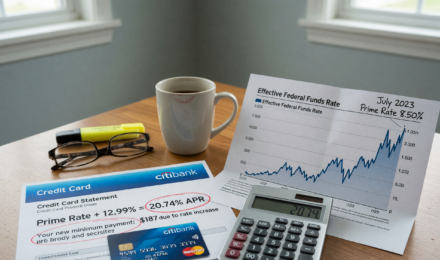
The Federal Open Market Committee (FOMC) meets eight times per year to set the federal funds rate, which is the rate at which banks lend overnight reserves to one another. When the FOMC raises or lowers that target, the prime rate moves in lockstep, typically within 24 hours. According to the Federal Reserve’s H.15 Selected Interest Rates release, the prime rate moved from a pandemic-era low of 3.25% in March 2020 to a peak of 8.50% in July 2023, before the Fed began cutting rates in September 2024.
Why the Prime Rate Matters for Borrowers
Banks and lenders use the prime rate as a reference point when pricing consumer lending products, including private student loans, home equity lines of credit (HELOCs), and credit cards. Understanding how the prime rate works is foundational to understanding how the prime rate affects your interest rates across all types of variable-rate debt.
A lender will price a variable-rate loan as “prime plus a margin.” At a margin of 2.50% and a prime rate of 7.50%, that loan carries a rate of 10.00%. If the prime rate drops to 6.50%, the same loan automatically reprices to 9.00%, lowering your payment without any action on your part.
The prime rate has changed 27 times since 2000, ranging from a historic low of 3.25% during the 2008 financial crisis and again in 2020, to a 22-year high of 8.50% in 2023. Each change directly reprices millions of variable-rate loans within days.
How Does the Prime Rate Affect Student Loans?
The prime rate affects private student loans with variable interest rates directly and immediately. When the prime rate rises, your interest rate rises by the same amount, increasing your monthly payment. Federal student loans are completely insulated from prime rate changes because their rates are fixed by law at disbursement.
For variable-rate private student loans, the loan agreement specifies an index (usually prime or SOFR, the Secured Overnight Financing Rate, which has largely replaced LIBOR) and a fixed margin. The margin reflects the lender’s risk assessment of your creditworthiness and does not change over the life of the loan. Only the index portion fluctuates.
The Mechanics of Rate Adjustments
Most variable-rate private student loans adjust either monthly or quarterly. When the prime rate changes, your lender recalculates your rate on the next adjustment date. This means there can be a brief lag between an FOMC decision and your loan’s repricing.
Consider this example: A borrower has a $40,000 private student loan at prime + 3.00%, which works out to an 8.50% rate when prime is 5.50%. If the prime rate rises to 7.50%, that loan reprices to 10.50%, increasing monthly payments on a 10-year term by approximately $48 per month, or $5,760 over the remaining loan life.
Total U.S. student loan debt reached $1.73 trillion as of Q1 2025, according to the Federal Reserve Bank of New York’s Household Debt and Credit Report. Private student loans account for approximately $131 billion, or roughly 7.6% of that total.
Federal vs. Private Student Loans: Which Are Affected by the Prime Rate?
Federal student loans are never affected by the prime rate. Their rates are fixed at disbursement and set annually by Congress under a formula tied to the 10-year Treasury note yield, not the prime rate. Only private student loans with variable rate structures are directly tied to prime rate movements.
Federal Student Loan Rate Structure
Under the Bipartisan Student Loan Certainty Act of 2013, federal student loan rates are reset each July 1 based on the high yield of the 10-year Treasury note at the May auction, plus a fixed add-on percentage. Once you borrow, that rate is locked for the life of that loan. The Federal Student Aid interest rate table confirms that no existing federal borrower’s rate will change due to a Fed rate decision.
The following table compares the rate structures for federal versus private student loans:
| Loan Type | Rate Type | Index Used | 2024-2025 Rate Range | Prime Rate Impact |
|---|---|---|---|---|
| Direct Subsidized (Undergrad) | Fixed | 10-Year Treasury | 6.53% | None |
| Direct Unsubsidized (Undergrad) | Fixed | 10-Year Treasury | 6.53% | None |
| Direct Unsubsidized (Graduate) | Fixed | 10-Year Treasury | 8.08% | None |
| Direct PLUS (Parent/Grad) | Fixed | 10-Year Treasury | 9.08% | None |
| Private Variable-Rate | Variable | Prime or SOFR | 7.50%–14.00%+ | Direct and Immediate |
| Private Fixed-Rate | Fixed | None (set at origination) | 5.49%–13.99% | None |
When Private Loans Make Sense, and When They Don’t
Private student loans are typically a last resort after exhausting federal loan options, grants, and scholarships. The CFPB recommends borrowing federal loans first because they offer protections like income-driven repayment (IDR) plans and Public Service Loan Forgiveness (PSLF), which are unavailable from private lenders.
That said, borrowers with excellent credit (FICO scores above 750) may find private fixed-rate loans priced below current federal graduate or PLUS loan rates, making them worth comparing in certain circumstances.

What Are Current Student Loan Interest Rates in 2025?
Current federal student loan rates for the 2024–2025 academic year range from 6.53% for undergraduates to 9.08% for PLUS loan borrowers. Private student loan rates in mid-2025 span a much wider range: from approximately 5.49% for highly creditworthy borrowers with fixed-rate loans to 14% or higher for variable-rate products at the current prime rate of 7.50%.
Private Lender Rate Ranges as of Mid-2025
According to NerdWallet’s student loan rate tracker, the most competitive private lenders for undergraduate borrowers with a creditworthy cosigner are currently pricing variable rates starting around 5.99% and fixed rates starting around 4.99%. These floor rates assume top-tier credit and a qualified cosigner. The average approved borrower sees materially higher rates.
Variable-rate loans carry real risk in an elevated-rate environment. A borrower who takes out a prime-indexed loan today is essentially betting that rates will fall far enough, and fast enough, to offset the uncertainty of payments that could rise again if inflation rebounds. That bet may pay off. It may not. The honest assessment is that the outcome depends on Fed policy decisions that no one can reliably predict over a 10-year horizon.
How Rates Have Trended Since 2020
The prime rate’s cycle from 3.25% in 2020–2021 to 8.50% in 2023–2024 created enormous payment volatility for variable-rate borrowers. A variable-rate loan originated at prime + 2.50% in 2021, when prime was 3.25%, carried a rate of 5.75%. By mid-2023, that same loan’s rate had jumped to 11.00%, a near-doubling of the interest rate in under three years.
Between March 2022 and July 2023, the Federal Reserve raised the federal funds rate by a cumulative 525 basis points, the fastest rate-hiking cycle in four decades. This directly increased variable prime rate student loan payments for millions of private borrowers over that 16-month period.
Should You Choose a Variable or Fixed Rate Student Loan?
For most student borrowers, a fixed-rate private student loan is the safer and more predictable choice, especially in an environment where the prime rate remains elevated and future Fed decisions are uncertain. Variable rates only make mathematical sense if rates are expected to fall significantly and the loan term is short enough to capture the benefit before rates potentially rise again.
Arguments for a Variable Rate
Variable-rate loans typically start with lower initial rates than fixed-rate equivalents from the same lender, often by 1%–2%. If the prime rate falls by, say, 150 basis points over your repayment period, the total interest paid on a variable loan could be meaningfully less than on a fixed loan. This scenario favors borrowers with shorter loan terms (5 years or fewer) in a declining rate environment.
Arguments for a Fixed Rate
Fixed-rate loans eliminate interest rate risk entirely, making budgeting straightforward. The prime rate reached a 22-year high of 8.50% in 2023, and the trajectory of future Fed policy is genuinely uncertain. Locking in a fixed rate today provides insurance against a scenario where rates stay elevated or climb again. For borrowers with 10-year or 15-year repayment horizons, the stability benefit typically outweighs the initial rate differential.
Understanding the broader picture of how rate environment changes affect debt is useful here. Much like understanding how the prime rate affects personal loan rates can inform your overall borrowing strategy, the same framework applies to student loans.
If your variable-rate private student loan has a rate cap (often set at 18%–25% in the fine print), check it carefully. While rate caps protect against extreme scenarios, even reaching the cap could double your payment. Always model the worst-case payment using the cap rate before choosing variable over fixed.
When Does It Make Sense to Refinance Your Student Loans?
Refinancing makes the most sense when you can secure a meaningfully lower interest rate (at least 0.50%–1.00% lower), you have strong credit to qualify for competitive terms, and you do not need access to federal loan protections like income-driven repayment or Public Service Loan Forgiveness.
The Prime Rate and Refinancing Timing
Prime rate dynamics make timing a critical factor in refinancing decisions. If you currently hold a variable-rate private loan at prime + 3.50% (currently 11.00%), refinancing to a fixed rate in the 7.00%–8.00% range could produce meaningful savings while eliminating rate risk. Refinancing a federal loan into a private loan solely for a rate reduction is a different calculation entirely, it could cost you thousands in lost benefits if you later need income-driven repayment.
The following table shows the potential monthly payment savings from refinancing a $35,000 loan over 10 years at various rate differentials:
| Current Rate | Refinanced Rate | Rate Reduction | Monthly Savings | 10-Year Total Savings |
|---|---|---|---|---|
| 11.00% | 8.00% | 3.00% | $58 | $6,960 |
| 10.50% | 7.50% | 3.00% | $55 | $6,600 |
| 9.50% | 7.00% | 2.50% | $46 | $5,520 |
| 8.50% | 7.00% | 1.50% | $28 | $3,360 |
| 8.08% | 7.50% | 0.58% | $11 | $1,320 |
What to Watch Out for When Refinancing
Refinancing federal loans with a private lender permanently converts them to private loans. You permanently forfeit access to income-driven repayment (IDR), Public Service Loan Forgiveness, federal deferment options, and any future federal loan forgiveness programs. The CFPB explicitly warns borrowers to weigh these costs before refinancing federal debt.
Betsy Mayotte, President and Founder of The Institute of Student Loan Advisors (TISLA), has consistently counseled borrowers to think carefully before refinancing federal loans, noting that income-driven repayment protections alone can be worth tens of thousands of dollars over a career, particularly for borrowers in lower-income fields or those anticipating financial volatility. The income-driven repayment safeguard is not a theoretical benefit. For borrowers whose earnings fluctuate or who work in public service, it can be the difference between a manageable debt load and a financial crisis.

How Should a Rising or Falling Prime Rate Change Your Repayment Strategy?
When the prime rate is rising, variable-rate private student loan borrowers should prioritize paying down principal faster, consider refinancing to a fixed rate, and review their budget for the higher payment impact. When the prime rate is falling, variable-rate borrowers may benefit from holding their current loan structure as payments naturally decrease.
Strategy in a Rising Rate Environment
In a rising-rate environment, every dollar of principal you pay down reduces the base on which the higher rate accrues. Making extra payments specifically toward principal, not just your regular monthly payment, has an outsized impact on total interest paid. For a $40,000 loan at 10.50%, paying an extra $200 per month in principal reduces total interest paid by approximately $8,400 and cuts the payoff timeline by nearly 3 years (based on standard amortization calculations).
Reviewing your overall debt load and using the debt avalanche method to prioritize your highest-rate loans is particularly effective when prime-indexed rates are elevated.
Strategy in a Falling Rate Environment
When the prime rate is falling, variable-rate borrowers experience an automatic payment reduction, a genuine benefit of their loan structure. In this environment, it may make sense to maintain minimum payments and redirect surplus cash to higher-yield savings vehicles or retirement contributions. Borrowers should still monitor rates closely to decide whether to lock in a fixed refinance before rates reverse course.
Extending your loan term during a refinance to reduce monthly payments can dramatically increase total interest paid. Refinancing a $35,000 loan from a 7-year to a 15-year term, even at a lower rate, could cost you an additional $8,000–$14,000 in total interest over the life of the loan. Always compare total cost, not just monthly payment.
How Do Top Private Student Loan Lenders Price Their Rates?
Top private student loan lenders, including SoFi, College Ave, Sallie Mae, Earnest, and Discover, price their variable rates as a spread above a benchmark index. Most commonly that index is the one-month or three-month SOFR rate, which closely tracks the federal funds rate and, by extension, the prime rate. Fixed rates are set at origination based on creditworthiness and are not linked to any ongoing benchmark.
How Your Application Is Evaluated
Lenders evaluate private student loan applications using a combination of FICO Score, debt-to-income (DTI) ratio, enrollment status, school selectivity, and in many cases, the creditworthiness of a cosigner. According to the CFPB’s private student loan guidance, borrowers with scores above 750 and a qualified cosigner routinely access rates near the published minimums, while borrowers without a cosigner or with scores below 670 may be denied or quoted rates at or above the maximum range.
Having a strong credit profile is one of the most powerful tools a student borrower has. If you are building credit for the first time, reviewing a step-by-step guide on how to build credit from scratch before applying for private loans can make a meaningful difference in the rate you qualify for.
Autopay Discounts and Other Rate Reductions
Most private lenders offer an autopay discount of 0.25% for enrolling in automatic monthly payments. Some lenders, including SoFi and Earnest, offer additional discounts for loyalty or multi-product relationships. While seemingly small, a 0.25% rate reduction on a $40,000 loan over 10 years saves approximately $560 in total interest, a straightforward win with no downside.
Approximately 92% of undergraduate private student loan volume is cosigned, according to The Institute for College Access and Success (TICAS). Borrowers with cosigners qualify for rates that are, on average, 2–4 percentage points lower than those approved without a cosigner.
How Does Your Credit Score Affect the Prime Rate Margin on Your Student Loan?
Your credit score is the primary driver of the margin your lender charges above the prime rate benchmark. Borrowers with excellent credit (FICO Score of 750 or above) may qualify for margins as low as 1.00%–2.00% above prime, while borrowers with fair credit (scores in the 580–669 range) typically face margins of 4.00%–6.00% or higher, if they qualify at all.
FICO Score Ranges and Typical Margins
The spread between the best and worst rates available on prime rate student loans at current market levels is significant. A borrower with a 780 FICO Score might pay prime + 1.50% = 9.00% today. A borrower with a 620 score, if approved, might pay prime + 5.50% = 13.00%. On a $30,000 loan over 10 years, this 4.00% rate difference translates to a total interest cost difference of approximately $7,200.
Understanding what constitutes a good credit score and what benefits it unlocks is directly relevant for any student borrower navigating private loan options.
How to Improve Your Rate Before Borrowing
If your credit is below the threshold for competitive rates, take these steps before applying: pay down revolving credit card balances to below 30% utilization, correct any errors on your credit report through Equifax, TransUnion, or Experian (all three provide free weekly reports at AnnualCreditReport.com), and add a creditworthy cosigner to your private loan application.

What Is the Prime Rate Outlook for Student Loan Borrowers in 2025–2026?
The Federal Reserve has cut the federal funds rate by a cumulative 100 basis points from its 2023 peak, bringing the prime rate from 8.50% to 7.50%. Most market forecasts suggest additional cuts are possible in late 2025 and into 2026, though the pace and magnitude remain uncertain and data-dependent.
What Rate Cuts Mean for Variable-Rate Borrowers
If the Fed cuts rates by another 75–100 basis points by mid-2026, a scenario reflected in current CME FedWatch Tool projections, the prime rate would fall to approximately 6.50%–6.75%. For a borrower with a $35,000 variable loan at prime + 3.00%, this would reduce their rate from 10.50% to 9.50%–9.75%, cutting monthly payments by roughly $22–$27 and saving approximately $2,700 over a 10-year term.
Scenario Planning for Student Borrowers
Borrowers should model three scenarios: rates fall as projected (variable loans benefit), rates stay flat (fixed and variable are comparable), and rates rise again due to renewed inflation (fixed loans outperform). Given the genuine uncertainty of the macro environment, borrowers with large balances and long remaining terms generally benefit most from fixing their rate now rather than speculating on the direction of prime-indexed rates over the next decade.
Understanding how prime rate movements ripple through your broader financial picture, including savings rates, is also valuable. For more on this, see what happens to your savings when the prime rate rises.
Real-World Example: Variable vs. Fixed Decision in a Rate-Uncertain Environment
Jordan, 26, graduated with a Master’s degree in May 2023 and took out $52,000 in private student loans: $32,000 at a variable rate of prime + 2.75% (totaling 8.25% at origination, when prime was 5.50%) and $20,000 in federal Direct Unsubsidized Loans at a fixed rate of 6.54%.
By August 2023, the prime rate reached 8.50%, pushing Jordan’s variable loan rate to 11.25%. Monthly payment on the variable loan jumped from $392 to $442, a $50 monthly increase that Jordan had not budgeted for. Total payment increase over the remaining 9-year term: approximately $5,400.
In January 2025, with a FICO Score of 748 and 18 months of on-time payments, Jordan refinanced the $32,000 variable loan to a 10-year fixed rate of 7.99% through a private lender. Monthly payment stabilized at $388, below the original payment despite refinancing at a still-elevated rate. Jordan accepted a modest reduction in savings versus waiting for rates to fall further, in exchange for complete payment certainty through 2035.
Projected total interest saved versus staying on the variable loan (assuming prime stays at 7.50% for the remainder of the term): approximately $9,800. Jordan also enrolled in autopay, capturing an additional 0.25% rate discount and saving another $430 over the loan’s life.
Your Action Plan
-
Identify every loan you hold and its rate type
Log into your federal loan servicer account at StudentAid.gov to see all federal loans, rates, and servicer information. Contact your private lender directly or check your original loan documents to confirm whether your rate is fixed or variable and which index it tracks.
-
Monitor the prime rate on an ongoing basis
Bookmark the Federal Reserve’s H.15 interest rate release, which is updated weekly and shows the current prime rate. Set a calendar alert for each FOMC meeting date (eight per year) so you know when rate changes may occur.
-
Pull your credit reports and FICO Score for free
Visit AnnualCreditReport.com to access free weekly reports from Equifax, TransUnion, and Experian. Many credit cards also provide free FICO Score monitoring. Your score determines the margin above prime you will be offered, improving it before borrowing or refinancing can save thousands of dollars.
-
Run a refinancing comparison using actual rate quotes
Get pre-qualified (soft credit pull, no score impact) through at least three private lenders, SoFi, Earnest, and College Ave are good starting points. Compare both fixed and variable options. Use the lender’s loan calculator to model total interest paid under each scenario, not just monthly payment.
-
Model your current variable loan under multiple prime rate scenarios
Use the Consumer Financial Protection Bureau’s (CFPB) student loan calculator at consumerfinance.gov to model what your payments would look like if prime rises by 1%, 2%, or stays flat. This exercise reveals your true interest rate risk before you decide whether to refinance or hold.
-
Enroll in autopay immediately on all private loans
Contact your private lender or log into your account online to enroll in automatic payments. The standard autopay discount is 0.25%, applied immediately to your rate. This requires no credit check, no refinancing, and takes less than 10 minutes, it is the easiest rate reduction available to you.
-
Create a debt payoff strategy using a structured method
If you carry multiple private loans at different rates, apply the debt avalanche method, directing any extra monthly payments to the highest-rate balance first. Review a detailed comparison of the snowball vs. avalanche methods to choose the strategy that fits your financial psychology and cash flow.
-
Build a budget that accounts for payment volatility
If you have variable-rate loans, your payments will change as the prime rate changes. Use a monthly budgeting framework that includes a “rate buffer,” an extra 10%–15% in your student loan line item, to absorb potential payment increases without disrupting other financial goals. Revisit your budget every time the FOMC meets.
Frequently Asked Questions
Does the prime rate affect federal student loans?
No. Federal student loans have fixed interest rates set annually by Congress and are not linked to the prime rate in any way. Once you borrow a federal loan, its rate is locked for the life of that loan regardless of what happens to the prime rate or the Federal Reserve’s policy decisions.
How much does a 1% increase in the prime rate increase my private student loan payment?
A 1 percentage point increase in the prime rate raises the monthly payment on a $30,000 variable-rate student loan (10-year term) by approximately $15–$17 per month, or roughly $1,800 over the remaining loan life. The exact impact depends on your current balance, remaining term, and the timing of your loan’s rate adjustment period.
Should I refinance my private student loans right now?
Refinancing makes sense if you can lower your rate by at least 0.50%–1.00%, you have good-to-excellent credit (FICO Score above 700), and you do not have federal loans in the mix that you might need to protect. Compare at least three lenders and model total cost, not just monthly payment, before deciding. With the prime rate at 7.50%, borrowers with variable loans at 10%+ are often strong refinancing candidates.
What is the difference between a prime rate loan and a SOFR-indexed loan?
Both prime rate and SOFR (Secured Overnight Financing Rate) are benchmark indexes used to price variable-rate private student loans, and they move closely together because both are influenced by the Federal Reserve’s federal funds rate. SOFR has largely replaced LIBOR as the preferred benchmark since 2023. Functionally, the distinction matters less than the margin your lender charges above whichever index your loan uses.
Can I switch from a variable rate to a fixed rate without refinancing?
No. Switching from a variable to a fixed interest rate requires refinancing into a new loan. Your original loan terms, including whether the rate is fixed or variable, are set at origination and cannot be changed by request. Refinancing involves a new credit application and a new loan contract with a new lender (or sometimes your existing lender).
How does the prime rate affect student loan refinancing rates?
The prime rate influences both the variable-rate options available when refinancing and, indirectly, fixed refinance rates, since fixed rates are priced partly based on the current yield curve, which reflects expectations for future Fed policy. When the prime rate is high, fixed refinance rates tend to be higher than they would be in a low-rate environment. Refinancing from a variable rate at prime + 3.50% to any competitive fixed rate may still produce savings and eliminate rate risk.
Are there income-driven repayment plans for private student loans?
No. Income-driven repayment (IDR) plans, including SAVE, PAYE, IBR, and ICR, are exclusively available for federal student loans. Private student loans do not offer income-based payment options, though some private lenders offer hardship deferment or forbearance on a case-by-case basis. This is a critical reason the CFPB recommends exhausting federal loan options before turning to private loans.
What credit score do I need to refinance student loans at a competitive rate?
Most lenders offering competitive refinancing rates require a FICO Score of at least 670, though the best rates (near a lender’s published minimum APR) are typically available only to borrowers with scores of 750 or above. Borrowers below 670 may still qualify with a creditworthy cosigner. Checking your score through a free monitoring service before applying helps you know what rate band to expect.
Is it ever a good idea to take a variable-rate student loan?
A variable-rate student loan can be advantageous if the loan term is short (5 years or fewer), the current prime rate is near a cyclical peak and expected to fall, and the initial rate is meaningfully lower than available fixed options. In a declining rate environment with a short payoff timeline, the total interest savings from a variable rate can outperform a fixed rate. This requires disciplined modeling and a tolerance for payment uncertainty.
What happens to my private student loan payments if the Federal Reserve cuts rates?
If the Fed cuts the federal funds rate, the prime rate falls by the same amount, and your variable-rate private student loan reprices downward at your next adjustment date (usually monthly or quarterly). A 50-basis-point (0.50%) cut would reduce the rate on a prime-indexed loan by exactly 0.50%, lowering the monthly payment on a $40,000, 10-year loan by approximately $11 per month.
Our Methodology
This article was researched and written using primary data from the Federal Reserve, the U.S. Department of Education’s Federal Student Aid office, and the Consumer Financial Protection Bureau. Student loan rate ranges were cross-referenced against published APR tables from major private lenders including SoFi, College Ave, Earnest, Sallie Mae, and Discover as of July 2025. Federal loan rates reflect the official 2024–2025 academic year rates published by the Department of Education. Payment calculations were derived using standard amortization formulas applied to representative loan balances and terms. Prime rate historical data was sourced from the Federal Reserve’s H.15 release. This article is reviewed and updated whenever the prime rate changes or new federal student loan rates are published (annually each July).
Sources
- Federal Reserve, H.15 Selected Interest Rates (Prime Rate Data)
- Federal Reserve Bank of New York, Household Debt and Credit Report
- The Institute for College Access and Success (TICAS), Private Student Loans: Facts and Trends
- NerdWallet, Student Loan Interest Rates Tracker
- Consumer Financial Protection Bureau, Repay Student Debt Tool
- AnnualCreditReport.com, Free Credit Reports from Equifax, TransUnion, and Experian
- Federal Reserve, Open Market Operations and FOMC Meeting Schedule
- The Wall Street Journal, Money Rates (Prime Rate Reference)