Fact-checked by the Prime Rate editorial team
Quick Answer
The prime rate matters even without debt because it directly shapes the interest you earn on savings, money market accounts, and CDs, not just what you owe., the U.S. prime rate sits at 7.50%, influencing returns across virtually every deposit account in America.
Understanding why prime rate matters starts with recognizing that it is not just a borrowing benchmark. Set at 300 basis points above the Federal Reserve’s federal funds rate, it acts as the central pricing signal for the entire U.S. financial system, including the yields savers collect. According to the Federal Reserve’s H.15 statistical release, the prime rate currently stands at 7.50%, a level that is reshaping deposit returns, investment valuations, and consumer purchasing power simultaneously.
Even if you carry zero debt, it is quietly influencing your net worth right now. That is why understanding it is a core personal finance skill, not just a concern for borrowers.
Key Takeaways
- The U.S. prime rate stands at 7.50%, set at 300 basis points above the federal funds rate. Source: Federal Reserve H.15
- Savings account APYs climbed from under 0.10% in 2021 to over 4.50% by 2023, a direct result of prime rate increases. Source: FDIC 2023 Statistical Guide
- A 1 percentage point rise in interest rates has historically compressed equity price-to-earnings multiples by 10–15%, affecting every stock portfolio regardless of debt. Source: NBER Working Paper 26801
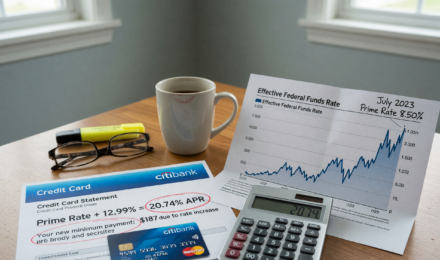
- The Fed raised the prime rate from 3.25% to 8.50% between March 2022 and July 2023 to combat 9.1% peak inflation. Source: Bureau of Labor Statistics CPI
- FDIC-insured money market accounts briefly reached 5.00% APY during the 2023 prime rate peak, offering near-zero-risk income comparable to historical equity returns. Source: FDIC 2023 Statistical Guide
- FOMC rate signals typically precede formal rate changes by 2–6 weeks, giving attentive savers a window to lock in higher yields before markets fully reprice. Source: Federal Reserve FOMC Calendar
How Does the Prime Rate Affect Your Savings and Deposit Accounts?
Deposit yields do not move randomly. When the prime rate rises, banks compete harder for deposits and push APYs higher. When it falls, those yields compress, even if you never touch a loan product.
High-yield savings accounts tracked by the FDIC’s national rate data show that the average savings account APY moved from under 0.10% in 2021 to over 4.50% at the peak of the 2023 rate cycle. That shift was a direct result of prime rate increases driven by Federal Reserve tightening. Savers who understood this connection moved cash into higher-yielding vehicles and captured real purchasing-power gains. Those who did not left money sitting in accounts still paying the 2021 floor.
Money Market Accounts and CDs
Money market accounts and certificates of deposit are especially sensitive to rate shifts. As our guide to what happens to your savings when the prime rate rises explains, these accounts often reprice within days of a Fed rate decision. Locking in a CD before a rate cut can protect your yield for months, which is why tracking rate direction is a genuine savings strategy rather than a borrower concern.
There is an important asymmetry worth naming directly. Variable-rate accounts like money market funds respond almost immediately to rate cuts. Fixed-term CDs do not. CD holders get a real advantage when rates are falling: the yield locked in at purchase keeps paying out until maturity, regardless of what the Fed does next. The trade-off is reduced liquidity, which is a genuine constraint if you need access to cash on short notice. For savers comparing options right now, our analysis of CD rates versus high-yield savings accounts breaks down which vehicle captures more prime rate upside depending on your timeline.
Key Takeaway: Savings APYs swung from below 0.10% to above 4.50% between 2021 and 2023 as rates shifted, a gap that compounded to thousands of dollars in lost or gained interest for everyday savers. See current rates at the FDIC’s statistical guide.
Why Does the Prime Rate Matter for Investments and Portfolio Value?
Asset valuations shift with the prime rate, even for investors who hold only stocks, bonds, or index funds. Higher rates increase the discount rate used to value future corporate earnings, which mechanically reduces the present value of growth stocks, often before a single economic datapoint changes.
According to research published by the National Bureau of Economic Research, a 1 percentage point rise in interest rates has historically reduced the price-to-earnings multiple on equities by roughly 10–15%, all else equal. That means a debt-free investor whose entire wealth is in an index fund is materially affected by prime rate movement. Their portfolio reprices in real time.
The mechanism is straightforward. Investors deciding between stocks and risk-free assets (such as Treasury bonds or insured savings accounts) constantly weigh relative returns. When rates rise and safe deposits pay 5.00% APY, equities have to offer a more compelling return to justify their risk. That demand shift pushes equity prices down even when corporate earnings hold steady. The math works the same way in reverse: when safe yields are near zero, almost any expected equity return looks attractive by comparison, which pulls money into stocks and inflates multiples.
Bond Prices and Fixed-Income Holdings
Bond prices move inversely to interest rates. When prevailing rates rise, newly issued bonds offer higher coupons, making existing lower-yield bonds less attractive and pushing their market prices down. A 10-year Treasury bond with a fixed coupon can lose several percentage points of market value for every full percentage point increase in prevailing rates. The SEC’s investor education bulletin on interest rate risk details this relationship clearly and is worth reading in full if you hold any fixed-income positions.
For investors close to retirement with significant bond allocations, this dynamic is not theoretical. The 2022 rate cycle produced the worst calendar-year return for the U.S. bond market in decades, largely because prices had to adjust rapidly to a rate environment no one had seen in a generation. Understanding that connection before it happens is the difference between a planned rebalance and a surprised reaction.
Rate research shows the relationship between rates and asset prices is consistent over long historical periods: low rates elevate asset prices broadly, and high rates compress them. This applies to equities, bonds, real estate, and virtually every other long-duration asset. A debt-free investor is not insulated from this dynamic. They are fully inside it.
Key Takeaway: A 1 percentage point rate increase can reduce equity valuations by 10–15% through compressed price-to-earnings multiples, according to NBER research. Every portfolio holder, not just borrowers, has a direct financial stake in prime rate direction.
| Financial Product | How Prime Rate Affects It | Typical Response Time |
|---|---|---|
| High-Yield Savings Account | APY rises or falls with prime rate; currently averaging 4.50%–5.00% | Days to 2 weeks |
| Money Market Account | Yields track prime closely; top accounts near 5.00% APY in 2024 | Days to 2 weeks |
| Certificate of Deposit (CD) | Rates locked at issuance; 1-year CDs peaked near 5.50% in 2023 | Immediate at purchase; locked thereafter |
| Stock Portfolio (Equities) | Higher prime rate compresses P/E multiples by 10–15% per 1% rate rise | Immediate (market repricing) |
| Bond / Fixed-Income Fund | Price falls as rates rise; 10-year duration bond loses ~10% per 1% rate increase | Immediate (market repricing) |
| Employer 401(k) / Retirement Account | Underlying assets reprice; bond allocations especially affected | Daily NAV updates |
How Does the Prime Rate Shape Purchasing Power and the Cost of Living?
Beyond your accounts, rate levels directly influence inflation and therefore how far every dollar in your wallet stretches. The Federal Reserve raises the prime rate’s foundation (the federal funds rate) specifically to reduce consumer spending and cool price growth, a cause-and-effect chain that reaches every grocery trip and utility bill.
The Bureau of Labor Statistics Consumer Price Index peaked at 9.1% in June 2022. The Fed’s subsequent rate increases, which pushed the prime rate from 3.25% to 8.50% between March 2022 and July 2023, were the primary tool used to bring that inflation rate back below 3.5% by mid-2024. Without understanding the prime rate, it is impossible to understand why your cost of living behaved the way it did during that period.
Higher rates slow inflation through several overlapping channels. Borrowing becomes more expensive for businesses, which pulls back expansion and hiring. Consumer credit gets costlier, reducing discretionary spending. The dollar tends to strengthen as foreign capital seeks higher U.S. yields, which lowers the cost of imported goods. Each of these effects reduces aggregate demand, and reduced demand takes pressure off prices. The transmission is not instant, but the historical record is consistent.
This connection also explains why rate direction signals future price stability. If the Fed signals rate cuts, inflation risk may re-emerge. If it holds rates high, purchasing power tends to stabilize, but savings yields also eventually compress. Building a fully funded emergency reserve during high-rate environments is one of the more durable responses to this dynamic, because it captures elevated yields while they last and provides a buffer if conditions shift.
Moving from 3.25% to 8.50% in under 18 months to combat 9.1% peak inflation, the Fed’s rate cycle directly affected the purchasing power of every American regardless of whether they held debt. Source: Bureau of Labor Statistics CPI data.
How the Prime Rate Affects Housing Costs Even for Non-Borrowers
Most coverage of interest rates and housing focuses on mortgage holders. The effect on renters and prospective buyers who have not yet borrowed deserves equal attention.
Sharp rate increases create a lock-in effect among existing homeowners. Trading a 3% mortgage for a 7% one is financially painful, so fewer owners refinance or sell. Reduced inventory, even when demand has cooled, keeps home prices from falling as much as rising rates would otherwise imply. Renters planning to buy find themselves facing both higher mortgage rates and stubbornly high purchase prices if and when they do enter the market.
For current renters, the effect arrives through a different route. Landlords carrying variable-rate commercial loans, or who need to refinance existing debt during high-rate periods, face higher carrying costs. Those costs frequently translate into rent increases at lease renewal. Rent price data from 2022 to 2024 showed sustained increases even as the broader inflation rate declined, partly because housing supply constraints interacted with elevated borrowing costs for property owners. That is not a coincidence.
None of this means high rates are unambiguously bad for non-borrowers. Someone saving aggressively toward a home purchase is earning a meaningful return on that down payment fund during a high-rate environment. The calculus differs significantly from someone who needs to buy immediately.
Why Does the Prime Rate Matter for Retirement and Long-Term Planning?
Retirement planning gets reshaped by the prime rate in two distinct ways: it changes what your retirement assets are worth today, and it changes what you can safely earn on conservative income-producing holdings going forward. Both effects matter for anyone planning retirement, not just active borrowers.
When rates are high, retirees and near-retirees can access genuinely competitive yields on low-risk vehicles. A 5.00% APY on an FDIC-insured money market account, the kind available during the 2023 rate peak, represents real, risk-free income that was simply unavailable when the prime rate sat near 3.25%. Understanding this cycle is essential for deciding when to shift allocations, lock in CD rates, or rebalance between equities and fixed income.
The sequencing of returns matters more in retirement than it does during accumulation. A retiree drawing down a portfolio in a high-rate environment faces a genuine choice: hold more in cash and fixed-income instruments paying 4–5% and reduce equity exposure, or maintain equity exposure and accept valuation risk. There is no universally correct answer. The decision cannot be made well without knowing where rates are, where they are likely heading, and how each asset class responds to rate changes.
Maximizing tax-advantaged accounts during high-rate environments amplifies these gains. Our breakdown of IRA contribution limits for 2026 explains exactly how much you can shelter from taxes while capturing today’s elevated yields. Knowing your 401(k) contribution limits for 2026 ensures you are not leaving tax-deferred compounding on the table during a historically favorable rate environment.
High rate environments create genuine income opportunities for debt-free savers. FDIC-insured accounts briefly yielded 5.00% APY in 2023, rivaling historical stock returns with near-zero risk. Learn how to capture these gains through the best high-yield savings accounts for 2026.
How the Prime Rate Reaches Workers and Small Business Owners
Employment levels and wage growth are not immune to rate shifts. Companies fund expansion, hiring, and capital investment partly through borrowing. When business credit becomes more expensive, some of that planned growth gets deferred or canceled.
This effect is most visible in small businesses, which typically rely more heavily on variable-rate credit lines tied directly to the prime rate. A small manufacturer or retailer whose line of credit reprices from 6% to 9% is facing a meaningful increase in operating costs, with no corresponding revenue gain to offset it. The rational response is often to slow hiring, cut discretionary spending, or raise prices, each of which ripples outward to employees and customers.
Large corporations have more tools to manage rate exposure, including fixed-rate long-term debt, interest rate swaps, and access to capital markets that small businesses lack. That creates an uneven playing field during tightening cycles: large firms absorb the cost more easily, while small businesses and their employees feel the pressure more directly.
For workers who are not business owners, this connection explains why a Federal Reserve rate decision can affect job security, even for someone with no personal debt and no direct financial relationship with the prime rate. The transmission runs from rate hike, to higher business borrowing costs, to slower hiring, to slower wage growth or reduced hours.
How to Use Prime Rate Trends for Better Financial Decisions
Tracking the Fed’s rate signals gives you a forward-looking tool for financial decision-making, not just a way to explain the past. Federal Open Market Committee (FOMC) statements typically telegraph rate intentions weeks in advance, letting you act before markets fully reprice.
Concrete actions include locking in longer-term CDs before an anticipated rate cut, shifting cash from variable-rate money market accounts to fixed-term instruments, and rebalancing equity exposure ahead of rate-driven multiple compression. Our CD rates forecast for 2026 translates current Fed guidance into actionable yield projections for savers.
The window between an FOMC signal and a formal rate decision is real but short. Banks and bond markets typically begin repricing within days of a Fed statement, which means savers who wait for the official announcement may find the best CD rates already gone. The Wall Street Journal Prime Rate, published the day after each Fed decision (tracked at WSJ Money Rates), is the standard commercial benchmark, but forward guidance in FOMC statements is more actionable for savers trying to get ahead of changes.
Budgeting also becomes more precise with this awareness. Inflation expectations embedded in FOMC language tell you whether fixed monthly expenses, such as rent, utilities, and groceries, are likely to rise or stabilize over your planning horizon. Our guide on how to create a monthly budget that actually works incorporates this macro-awareness into practical household planning.
Reading the FOMC Calendar Like a Saver
The Federal Reserve publishes its FOMC meeting calendar months in advance. Each scheduled meeting is an opportunity to assess whether a rate change is likely, based on recent economic data and Fed communication. Savers who review the calendar before each meeting and compare it against the current prime rate can make informed decisions about whether to lock in fixed yields or keep funds in variable-rate accounts.
This is not active trading. It is simply reading publicly available information before the market finishes reacting to it, which is well within reach for any attentive saver. The discipline of checking the FOMC calendar quarterly and adjusting savings strategy accordingly is one of the lowest-effort, highest-return habits in personal finance.
FOMC rate signals typically precede market repricing by 2–6 weeks, giving informed savers a window to lock in higher CD yields or rebalance portfolios before the prime rate formally changes. Monitor Fed guidance at the Federal Reserve’s FOMC calendar to stay ahead of rate moves.
Frequently Asked Questions
Does the prime rate affect me if I have no credit cards or loans?
Yes. It affects the interest you earn on savings accounts, money market accounts, CDs, and the value of bonds or bond funds in your portfolio. Even a debt-free individual with only a savings account and a retirement fund is directly impacted by every prime rate change the Fed drives.
What is the current U.S. prime rate?
, the U.S. prime rate is 7.50%, set at 300 basis points above the federal funds rate target of 4.25%–4.50%. It is published daily by the Federal Reserve in its H.15 statistical release and updated whenever the FOMC changes its benchmark rate.
How does the prime rate affect high-yield savings account rates?
Banks use the prime rate as a reference when setting deposit yields. When the prime rate rises, competitive pressure pushes high-yield savings APYs higher. When it falls, those APYs typically decline within days to two weeks as banks reduce their cost of attracting deposits.
Why does the prime rate matter for stock market investors?
It sets the discount rate used to value future corporate earnings. Higher rates reduce the present value of those earnings, compressing price-to-earnings multiples. This effect is immediate: stocks reprice as soon as rate expectations shift, even before any official Fed announcement.
Can the prime rate affect my retirement savings if I only invest in index funds?
Yes. Index funds hold both equities and bonds, both of which reprice when the prime rate changes. Rising rates compress equity multiples and reduce bond prices simultaneously, which can lower the net asset value of a diversified index fund in the short term, even with no leverage or debt involved.
How do I track prime rate changes so I can act before my savings yield drops?
Monitor the Federal Reserve’s FOMC meeting calendar, which is published months in advance and includes forward guidance on rate direction. Rate decisions are also instantly reflected in the Wall Street Journal Prime Rate, which is the standard commercial benchmark published the day after each Fed decision.
When is the best time to lock in a CD rate relative to a Fed decision?
Before the official announcement, not after. Banks begin adjusting CD rates as soon as FOMC forward guidance shifts, often days before the formal vote. Once a rate cut is announced, the best CD offers are frequently already gone. Reviewing FOMC statements between meetings is the most reliable early-warning system available to individual savers.
Does the prime rate affect rent prices?
Indirectly, yes. Landlords who carry variable-rate commercial loans or who refinance during high-rate periods face higher carrying costs, and those costs often pass through to tenants at lease renewal. Rent data from 2022 to 2024 showed persistent increases even as broader inflation fell, partly for this reason.
How does the prime rate affect the job market for people without debt?
Higher rates raise borrowing costs for businesses, particularly small businesses with variable-rate credit lines. When those costs climb, companies tend to slow hiring or reduce hours. Workers with no personal debt can still feel the effect through reduced job security or slower wage growth, because the rate increase hits their employer rather than their own balance sheet.
Is a high prime rate ever good for someone with no debt?
Frequently. High prime rate environments produce competitive yields on FDIC-insured accounts, meaning debt-free savers can earn 4–5% on cash with essentially no risk. That changes the math on holding cash, building emergency reserves, and positioning conservative retirement allocations. The downside is that the same rate environment can depress equity and bond valuations, so the benefit is concentrated in liquid savings rather than investment portfolios.