Fact-checked by the Prime Rate editorial team
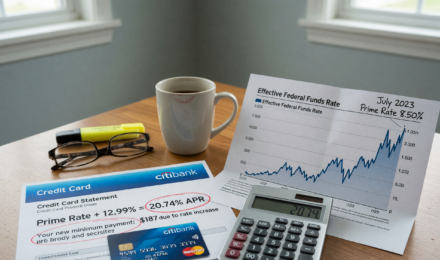
You check your credit card statement and notice your minimum payment crept up — again. No new purchases, no missed payments, just the quiet, invisible force of a rising prime rate reshaping your finances without warning. Millions of Americans experience this exact moment every time the Federal Reserve adjusts its benchmark rate, and most have no system to track prime rate changes before the damage shows up in their bank account.
The numbers tell a brutal story. Between March 2022 and July 2023, the Fed raised its federal funds rate 11 times — a cumulative 525 basis points — pushing the U.S. prime rate from 3.25% to 8.50%, its highest level since 2001. According to the Federal Reserve’s H.15 Statistical Release, that shift translated into hundreds of dollars in added annual interest costs for the average household carrying variable-rate debt. Credit card balances alone hit a record $1.13 trillion in late 2023, per the New York Fed’s Household Debt and Credit Report.
This guide gives you a complete, step-by-step system to monitor Federal Reserve signals, decode rate-setting language, and take concrete financial action before a prime rate shift hits your wallet. You will learn which tools to use, which debt products are most vulnerable, and exactly how to restructure your finances to stay ahead of the curve — not react after the damage is done.
Key Takeaways
- The U.S. prime rate moved from 3.25% to 8.50% in just 16 months (March 2022 – July 2023), a 525 basis point increase that added hundreds of dollars to variable-rate debt payments.
- Credit card APRs are directly tied to the prime rate — when prime rises 0.25%, the average credit card rate rises the same amount, often within one billing cycle (30 days).
- The Federal Reserve holds 8 FOMC meetings per year; each meeting is a potential rate-change event that can ripple through your mortgage, HELOC, credit card, and personal loan within weeks.
- Home equity lines of credit (HELOCs) typically reset within 30–60 days of a prime rate change, meaning a $50,000 HELOC balance can cost $125 more per year for every 0.25% rate increase.
- Households that locked fixed-rate products before July 2023 saved an estimated $2,000–$4,000 per year compared to those on equivalent variable-rate instruments at the peak prime rate of 8.50%.
- Free tools — including the CME FedWatch Tool, Fed FOMC calendars, and Google Alerts — can give you 30–90 days of advance warning before most rate changes officially take effect.
In This Guide
- What Is the Prime Rate and Why Does It Move?
- The Best Tools to Track Prime Rate Changes in Real Time
- How to Read Federal Reserve Signals Before a Rate Decision
- Which Debt Products Are Most Vulnerable to Prime Rate Shifts
- How Rising and Falling Rates Affect Your Savings and Investments
- How to Track Prime Rate Changes and Adjust Your Budget Proactively
- When and How to Lock In Fixed Rates Before a Hike
- Refinancing and Debt Strategy Around Rate Cycles
- How to Capitalize When the Prime Rate Falls
What Is the Prime Rate and Why Does It Move?
The prime rate is a benchmark lending rate used by U.S. commercial banks. It is almost universally set at 3 percentage points above the federal funds rate target established by the Federal Open Market Committee (FOMC). When the Fed raises or cuts rates, the prime rate follows automatically — typically within 24 hours of the FOMC announcement.
The federal funds rate itself is the interest rate at which banks lend reserve balances to each other overnight. The Fed uses it as its primary tool to control inflation and stimulate or cool the economy. That single policy lever cascades through virtually every consumer lending product in America.
The Prime Rate’s Historical Range
Understanding the historical range of the prime rate gives you crucial context for evaluating risk. The prime rate hit an all-time high of 21.50% in December 1980 during the Volcker-era inflation fight. It dropped to a historic low of 3.25% between 2009 and 2015, and again from March 2020 through February 2022 during the COVID-19 emergency. That 3.25% floor is not a permanent baseline — it is an emergency setting.
The average prime rate over the past 40 years sits closer to 6%–7%. Anyone who borrowed heavily during the 2020–2022 low-rate era on variable terms was exposed to enormous interest rate risk. Recognizing where the rate is in its historical cycle is the first step in any smart tracking strategy.
The prime rate has never moved independently of the federal funds rate in modern history. It has tracked the fed funds rate at a consistent +3% spread since the 1990s, making Fed decisions the single most reliable predictor of prime rate changes.
Who Sets the Prime Rate?
No single authority “sets” the prime rate — each bank sets its own. However, major banks like JPMorgan Chase, Bank of America, and Wells Fargo move in lockstep, and the Wall Street Journal publishes the consensus prime rate when at least 23 of the 30 largest U.S. banks have changed their posted rate. That published figure is the one used in most loan agreements and financial reporting.
| Rate Type | Who Controls It | How Quickly It Changes |
|---|---|---|
| Federal Funds Rate | Federal Reserve FOMC | At each FOMC meeting (8 per year) |
| Prime Rate | Major commercial banks | Within 24 hours of Fed decision |
| Credit Card APR | Card issuers | Within 1–2 billing cycles (30–60 days) |
| HELOC Rate | Mortgage lenders | Within 30–60 days of prime change |
| Personal Loan Rate | Banks and fintech lenders | Varies; typically 30–90 days for existing loans |
The Best Tools to Track Prime Rate Changes in Real Time
You do not need a Bloomberg terminal or a finance degree to track prime rate changes effectively. A handful of free, publicly available tools give you real-time data, probability forecasts, and advance signals — everything you need to make proactive financial decisions.
The CME FedWatch Tool
The CME FedWatch Tool is the gold standard for retail investors and financial professionals alike. It uses federal funds futures contracts — instruments traded in real time by institutional investors — to calculate the market-implied probability of a rate hike, cut, or hold at the next FOMC meeting. When the tool shows a 75% probability of a 0.25% hike, that signal is backed by billions of dollars in market bets, not just pundit opinion.
Check the FedWatch Tool at least once per week in the lead-up to each FOMC meeting. Probabilities can shift dramatically after key economic data releases like the Consumer Price Index (CPI) or the monthly jobs report. A probability that moves from 30% to 70% in a single week is a strong signal to take defensive action.
Bookmark the CME FedWatch Tool and the Federal Reserve’s official FOMC meeting calendar. Set a calendar reminder 10 days before each meeting — that is your window to review variable-rate debt and savings positioning before any decision lands.
Google Alerts and News Monitoring
Set up Google Alerts for the terms “federal funds rate,” “FOMC decision,” and “prime rate change.” Free alerts deliver relevant news directly to your inbox within hours of publication. Pair this with alerts for “CPI report” and “Fed Chair speech” — both are leading indicators of rate direction that often telegraph decisions weeks in advance.
Financial news platforms like The Wall Street Journal, Bloomberg, and CNBC provide dedicated Fed coverage. The key is not to consume everything — it is to identify the two or three pre-meeting data points (CPI, jobs report, Fed Chair press conference) that historically move the needle most.
Your Own Bank Statements and Loan Agreements
One underused tracking tool is your own loan agreement. Most variable-rate loan contracts specify the exact index they use (usually the Wall Street Journal Prime Rate), the adjustment frequency, and the rate cap (if any). Read your credit card agreement’s “How We Calculate Your APR” section — it typically reads “Prime Rate + X%.” Knowing your margin gives you the ability to calculate your exact new payment before the bill arrives.

The CME FedWatch Tool has accurately predicted FOMC rate decisions within one 25-basis-point increment more than 80% of the time when checked 30 days before a meeting, according to historical back-testing of fed funds futures pricing.
How to Read Federal Reserve Signals Before a Rate Decision
The Federal Reserve communicates its intentions through a deliberate, multi-layered system of public statements. Learning to read this system gives you a 30–90 day head start on most rate changes. This is not speculation — it is informed pattern recognition based on publicly available data.
The FOMC Statement and Minutes
After each of the 8 annual FOMC meetings, the committee publishes a policy statement. Three weeks later, it releases detailed minutes from that meeting. The statement language is parsed obsessively by markets for “hawkish” signals (favoring rate hikes) or “dovish” signals (favoring cuts or holds). Key phrases like “ongoing increases will be appropriate” versus “the extent of any additional firming” signal very different trajectories.
The minutes provide granular insight into committee members’ thinking, including dissenting views. When minutes show significant disagreement among members, rate decisions in subsequent meetings are more uncertain — and your preparation window may be shorter.
Fed Chair Press Conferences and Speeches
The Fed Chair holds a press conference after every FOMC meeting, and individual members give speeches throughout the year. These speeches are categorized by markets as either hardening or softening future rate expectations. A single speech by the Fed Chair at the Jackson Hole Economic Symposium in August 2022 — where Jerome Powell warned of “some pain” ahead — correctly telegraphed months of aggressive hikes.
“The Fed does not like to surprise markets. When they say they are data-dependent and then the data comes in hot, they will move. Watch the CPI releases, not just the Fed statements — the data leads the decision.”
Key Economic Indicators to Watch
Three data releases carry the most predictive weight for prime rate direction. The monthly Consumer Price Index (CPI) report measures inflation. The monthly jobs report (non-farm payrolls) measures employment. The Personal Consumption Expenditures (PCE) price index is the Fed’s preferred inflation gauge. When all three are running hot, rate hikes become near-certain. When they cool simultaneously, rate cuts follow.
| Economic Indicator | Release Frequency | Impact on Prime Rate |
|---|---|---|
| CPI Report | Monthly (mid-month) | High — above-target inflation signals hikes |
| Non-Farm Payrolls | Monthly (first Friday) | High — strong jobs data delays cuts |
| PCE Price Index | Monthly (end of month) | Very High — Fed’s preferred inflation metric |
| GDP Growth Rate | Quarterly | Moderate — weak GDP accelerates cut timeline |
| FOMC Meeting Minutes | 3 weeks after meeting | Moderate — reveals member sentiment for next meeting |
Which Debt Products Are Most Vulnerable to Prime Rate Shifts
Not all debt is equally exposed to rate changes. Understanding which products move with the prime rate — and how quickly — lets you prioritize which balances need attention first when you track prime rate changes and spot an incoming hike.
Credit Cards: The Fastest-Moving Target
Credit cards are the most immediately vulnerable consumer debt product. Nearly all variable-rate credit cards are indexed directly to the prime rate plus a fixed margin (typically 11%–20% above prime). When the prime rate rises 0.25%, your credit card APR rises 0.25% within one to two billing cycles. On a $10,000 balance, that adds roughly $25 per year in interest — but the 525 basis point increase from 2022–2023 added approximately $525 per year to the same balance.
Understanding how the prime rate affects your credit card interest rates is the foundation of any rate-tracking strategy. If you carry a balance, credit card debt should be your first line of defense when rates are rising.
HELOCs: The Silent Budget Threat
A home equity line of credit (HELOC) is a variable-rate product indexed to the prime rate. On a $75,000 HELOC balance, a 0.25% rate increase adds roughly $187.50 per year. The 525 basis point run-up from 2022 to 2023 added approximately $3,937 annually to that same balance. Many homeowners who tapped their equity during the low-rate era were blindsided by these payment increases.
If you are considering how the prime rate affects your mortgage and home equity loan, be aware that fixed-rate first mortgages are shielded from prime rate changes, but HELOCs and adjustable-rate mortgages (ARMs) are fully exposed. Know which type you hold before rates move.
Many HELOC agreements have rate caps of 18%–21%, but no floor. If your HELOC is in the draw period, a rate spike can increase your minimum payment significantly — even if your balance has not changed. Check your loan documents for the exact cap and adjustment schedule before the next FOMC meeting.
Personal Loans and Auto Loans
Variable-rate personal loans also follow the prime rate. However, many personal loans — particularly installment loans — have fixed rates, which means existing borrowers are insulated. The exposure arrives when you apply for a new loan during a high-rate environment. How the prime rate affects personal loan rates matters most at the point of origination, not necessarily for existing fixed-rate borrowers.
Auto loans are primarily fixed-rate, but new auto loan rates are heavily influenced by the broader interest rate environment. When prime is high, dealers pass those costs through. The average new car loan rate was approximately 7.1% in early 2024, compared to 4.1% in early 2022 — a direct consequence of the rate hiking cycle.
According to the Federal Reserve Bank of New York, the average credit card interest rate reached 21.47% in November 2023 — the highest level recorded since the Fed began tracking the data in 1994 — driven almost entirely by the prime rate hiking cycle.
How Rising and Falling Rates Affect Your Savings and Investments
The prime rate story is not all bad news. Rising rates are a genuine windfall for savers and conservative investors — if you know where to park your money. The key is understanding which savings vehicles respond to rate changes and how quickly.
High-Yield Savings Accounts and Money Market Accounts
When the prime rate rises, the yields on high-yield savings accounts (HYSAs) and money market accounts follow — typically within weeks, not months. Online banks and credit unions tend to pass rate increases through faster than traditional brick-and-mortar banks. In 2023, some online HYSAs were paying over 5.00% APY — more than 12 times the national average savings rate of 0.42% at traditional banks.
Understanding what happens to your savings when the prime rate rises can help you make the most of a hiking cycle. Moving idle cash from a 0.01% checking account to a 5.00% HYSA during the 2022–2023 cycle generated real, meaningful returns on emergency fund balances.
CDs and Fixed-Income Investments
Certificates of deposit (CDs) offer a way to lock in high rates before they fall. When prime rate cuts are on the horizon, the window to lock a competitive CD rate can close quickly — often within days of a rate cut announcement. The CD rates forecast for 2026 suggests that rates will trend lower as the Fed continues its easing cycle, making the current window for locking competitive CD yields time-sensitive.
A CD ladder strategy is particularly powerful in transitional rate environments. By spreading deposits across multiple CD maturities (e.g., 3-month, 6-month, 12-month, 18-month), you gain both liquidity and the ability to capture higher rates if they persist longer than expected.
“In a rising rate environment, the worst place to be is in long-duration bonds or locked into low-rate products. The best place is in short-duration, floating-rate assets. But when cuts start, you want to lock in duration quickly — the window is narrow.”

How to Track Prime Rate Changes and Adjust Your Budget Proactively
The most underrated skill in personal finance is building a budget that accounts for rate variability. Most people budget for fixed costs. Variable-rate debt payments are not fixed — and failing to model rate sensitivity into your monthly plan is how a rate hike becomes a budget crisis.
Building a Rate-Sensitive Budget Model
Start by listing every variable-rate debt you carry. For each one, note the current APR, the index it tracks (usually prime), and your margin above that index. Then model two scenarios: a 0.50% rate increase and a 1.00% rate increase. Calculate the dollar impact on each monthly payment. This stress test takes about 30 minutes and gives you a clear picture of your financial vulnerability.
To create a monthly budget that actually works in an interest-rate-volatile environment, build a dedicated “rate adjustment” line item. Allocate a small monthly buffer — even $50–$100 — specifically for absorbing rate-driven payment increases. This prevents a 0.25% rate hike from derailing an otherwise solid budget.
Automating Rate Change Notifications
Many credit card issuers and banks send email or app notifications when your APR changes. Enable every alert your financial institutions offer. Set up a quarterly calendar reminder to log into each loan servicer’s portal and check your current rate. Do not rely on spotting rate changes on your statement — by then, you have already paid the higher rate.
Consider using a personal finance app like Mint, YNAB, or Personal Capital to centralize your debt tracking. When you track prime rate changes through these platforms alongside your balances, you can model payment changes automatically and adjust your savings rate accordingly.
Some credit card issuers use a “60-day change notice” provision for rate increases unrelated to the prime rate (such as penalty rate increases). However, for index-linked rate changes tied to prime, most issuers are NOT required to provide advance notice — the rate simply adjusts per your cardholder agreement.
When and How to Lock In Fixed Rates Before a Hike
Timing the conversion from variable to fixed rates is one of the highest-value financial decisions you can make. Done correctly, it can save thousands of dollars over the life of a loan. Done too late, it just locks in a high rate with no protective benefit.
The 60-Day Rule
As a practical guideline, begin exploring fixed-rate alternatives when the CME FedWatch Tool shows a 50% or greater probability of a rate hike at the next FOMC meeting. The loan origination and closing process typically takes 30–60 days for mortgages and HELOCs, and 1–7 days for personal loans. Starting 60 days before an expected rate hike gives you enough runway to close before the change takes effect.
For credit card debt, the “lock-in” mechanism is a balance transfer to a 0% APR introductory offer or a fixed-rate personal loan. Both options effectively freeze your interest cost at a defined rate regardless of future prime rate moves. Compare total costs carefully — balance transfer fees (typically 3%–5%) reduce but rarely eliminate the savings.
Balance Transfer and Debt Consolidation Timing
When rates are rising, transferring variable-rate credit card balances to a fixed-rate personal loan is a textbook defensive move. When rates are falling, it may make more sense to hold variable-rate debt and wait for natural rate relief. Understanding the cycle direction is what makes the difference between a smart consolidation and a costly one.
| Conversion Strategy | Best Timing | Typical Cost | Savings Potential |
|---|---|---|---|
| Balance Transfer (0% APR) | Before rate hikes; strong credit required | 3%–5% transfer fee | High if paid off in promo period |
| Fixed Personal Loan | Early in hiking cycle | Origination fee 1%–6% | Moderate — locks rate, longer term |
| HELOC to Fixed-Rate HELOAN | Before hikes; requires equity | Closing costs $500–$2,000 | High on large balances |
| ARM to Fixed Mortgage Refinance | Early cycle; before spread widens | 2%–3% of loan amount | Very high on large mortgages |
Refinancing and Debt Strategy Around Rate Cycles
Refinancing is not just a tactic for falling rates. In a rising rate environment, refinancing existing variable-rate debt into fixed-rate products is a defensive strategy that can preserve thousands of dollars annually. The key is acting early in the cycle, not at the peak.
Identifying the Right Refinance Window
The optimal refinancing window for defensive purposes (variable to fixed) is when rates have risen 100–150 basis points from their cycle low and the Fed has signaled multiple additional hikes. At that point, the cost of locking in a fixed rate is still manageable, but the protection value is substantial. Waiting until the Fed has already completed 300–400 basis points of hikes means locking in a much higher fixed rate — the protection arrives too late.
For opportunistic refinancing (refinancing into a lower rate during a cutting cycle), the conventional “2% rule” — refinance when you can lower your rate by 2% — is outdated. A better framework: calculate break-even in months by dividing total closing costs by your monthly payment savings. If the break-even is under 24 months and you plan to stay in the loan that long, refinance.
Student Loan Refinancing Considerations
Federal student loans carry fixed rates and are not directly affected by prime rate changes. However, private student loan rates are often variable and indexed to the prime rate or LIBOR/SOFR. Borrowers with variable-rate private student loans should treat their debt exactly like variable-rate credit card debt during a hiking cycle — a fixed-rate refinance should be evaluated urgently.
If you are working to pay off debt fast using the snowball or avalanche method, factor in rate sensitivity when prioritizing balances. During a hiking cycle, the avalanche method (highest-rate first) has an additional advantage: the highest-rate debts are often the most rate-sensitive, meaning eliminating them removes a source of future payment volatility, not just current interest cost.
The average American household paid approximately $1,380 more in annual interest costs in 2023 compared to 2021 on equivalent variable-rate debt levels, according to estimates based on Federal Reserve consumer credit data and average balance figures from the American Bankers Association.
How to Capitalize When the Prime Rate Falls
Rate cuts present a mirror-image opportunity to the risks of rate hikes. Just as rising rates punish variable-rate borrowers, falling rates reward them — but only if you position your finances to capture the benefit rather than lock it away at a declining rate.
Positioning Savings Ahead of Rate Cuts
When CME FedWatch probabilities shift toward cuts, act quickly on the savings side. Lock CD rates before they fall. The best CD rates available during the 2023 peak (5.50%+ on 12-month CDs) began disappearing within weeks of the first Fed rate cut in September 2024. Savers who missed that window lost hundreds of dollars in annual yield on every $10,000 deposited.
Review the best CD rates for 2026 and compare them against high-yield savings account rates. If CD rates are still significantly higher than HYSAs — and you can afford to lock the funds — a multi-year CD may preserve higher yields well into a cutting cycle.
Variable-Rate Debt Becomes an Asset in Rate Cuts
When rates fall, variable-rate debt automatically gets cheaper. A borrower with a $50,000 HELOC at prime + 0.50% sees their rate drop with every Fed cut — no action required. Do not rush to refinance variable-rate debt into fixed-rate products at the beginning of a cutting cycle. The calculus flips: variable-rate borrowers benefit from further cuts, while fixed-rate borrowers are locked into a rate that may soon look above-market.
The Federal Reserve cut rates three times in the final four months of 2024, reducing the federal funds rate by 100 basis points from its 5.25%–5.50% peak. Each 25 basis point cut reduced annual interest costs by approximately $250 on a $100,000 variable-rate HELOC balance.
When the Fed cuts rates, credit card APRs fall at the same pace they rose — but card issuers have more discretion about timing. Some issuers implement cuts immediately; others take 1–2 billing cycles. Monitor your statements closely during cutting cycles to confirm your rate is actually declining.
Investing During Rate Transitions
Rate cuts are historically bullish for stocks — particularly growth stocks and real estate investment trusts (REITs) — and bullish for long-term bonds. As rates fall, bond prices rise, rewarding investors who extended duration. Meanwhile, lower borrowing costs can boost corporate earnings and consumer spending, supporting equity markets. Repositioning even a portion of a conservative portfolio toward these assets during early cutting cycles has historically delivered strong returns over 12–24 month horizons.

| Rate Environment | Best Debt Strategy | Best Savings Strategy | Best Investment Move |
|---|---|---|---|
| Rising Rates | Lock fixed rates; pay down variable debt fast | Move to HYSA; avoid long CDs | Short-duration bonds; avoid rate-sensitive sectors |
| Peak Rates | Lock longest-term fixed rate available | Lock long-term CDs immediately | Begin extending bond duration; add REITs selectively |
| Falling Rates | Hold variable-rate debt; defer new fixed-rate loans | Hold existing CDs; compare HYSA rates regularly | Growth stocks, long-duration bonds, REITs |
| Rate Trough | Lock fixed rates before next cycle begins | Avoid locking long CDs at low rates | Rebalance toward value; reduce bond duration |
“Most consumers react to rate changes rather than anticipate them. The ones who come out ahead are those who treat the FOMC calendar like a financial planning deadline — not a news event to read about after the fact.”
Real-World Example: How Marcus and Priya Stayed Ahead of the 2022-2023 Rate Cycle
In January 2022, Marcus and Priya were a dual-income household in Chicago with $18,000 in credit card debt at an average APR of 17.50% (prime 3.25% + 14.25% margin), a $65,000 HELOC balance at prime + 0.50% (then 3.75%), and $12,000 in a savings account earning 0.05% APY. Their monthly variable-rate interest costs totaled approximately $467. They had never actively tracked Fed rate decisions and did not know what the CME FedWatch Tool was.
In February 2022, after reading about the Fed’s signaled rate path, Priya spent two hours setting up a rate monitoring system: CME FedWatch bookmarked, Google Alerts for “FOMC decision” and “prime rate change,” and a calendar reminder for each of the 8 FOMC meetings that year. The FedWatch Tool already showed a 95% probability of a March 2022 hike. She and Marcus immediately applied for a 0% balance transfer card (with a 3% transfer fee on the $18,000 — a one-time cost of $540) and locked their HELOC into a fixed-rate home equity loan at 4.75% over 10 years.
By the time the prime rate peaked at 8.50% in July 2023, their credit card debt had been paid down to $9,200 on the 0% promo card (versus a potential APR of 22.75% at the peak), and their former HELOC was locked at 4.75% fixed — saving them an estimated $3,900 per year compared to staying variable. Priya also moved their $12,000 emergency fund to a high-yield savings account in March 2022, capturing rates that climbed from 0.50% to over 5.00% by late 2023 — generating approximately $550 in additional interest income that year alone.
Their total financial advantage from proactive tracking and action: an estimated $4,450 in annual savings on interest costs plus $550 in incremental savings yield — roughly $5,000 per year. Over the 18-month peak rate period, that compounded to over $7,500 in preserved household wealth, all from a two-hour setup and a consistent habit of checking one website before each FOMC meeting.
Your Action Plan
-
Build Your Rate Monitoring Dashboard
Bookmark the CME FedWatch Tool, the Federal Reserve’s official FOMC meeting calendar, and the Wall Street Journal Prime Rate page. Set Google Alerts for “prime rate change,” “FOMC decision,” and “CPI report.” This takes 20 minutes and creates an early warning system that will serve you through every rate cycle.
-
Audit Every Variable-Rate Debt You Hold
Pull out your loan agreements and credit card terms. Identify every debt indexed to the prime rate. Note your current APR, your margin above prime, your balance, and your minimum payment. This inventory is your rate-sensitivity map — you cannot manage what you have not measured.
-
Stress-Test Your Budget for Rate Increases
Using your debt inventory, calculate the monthly payment impact of a 0.50% and 1.00% rate increase on each variable-rate balance. If a 1.00% increase would raise your monthly obligations by more than $100, you have meaningful rate risk that needs a mitigation plan. Use a monthly budget framework that includes a rate adjustment buffer line item of at least $75–$150 per month.
-
Prioritize Aggressive Paydown of Variable-Rate Debt When Rates Are Rising
In a hiking cycle, every dollar applied to variable-rate principal eliminates future interest at an increasingly expensive rate. Focus extra payments on the highest-rate variable balances first. Even $200 per month in additional principal payments on a $10,000 credit card balance at 22% APR saves over $1,400 in interest over 24 months.
-
Evaluate Fixed-Rate Conversion Options Before Each FOMC Meeting
When FedWatch probabilities exceed 50% for a rate hike, formally evaluate whether a balance transfer, personal loan consolidation, or HELOC-to-fixed conversion makes financial sense. Run the break-even calculation: total cost of conversion divided by monthly savings equals break-even months. If break-even is under 24 months, act.
-
Optimize Your Savings for the Current Rate Environment
During rising rate periods, move all non-invested savings to high-yield savings accounts or money market accounts that pass rate increases through quickly. When rates peak and cuts are signaled, lock a portion of savings into CDs to preserve the high-yield environment for longer. Compare options using the best high-yield savings accounts and best CD rates available.
-
Set a Quarterly Rate Review Date
Put a recurring quarterly calendar appointment in your phone or calendar titled “Rate Review.” On that date, check your current APRs against your loan documents, review the FedWatch Tool’s forward probability, and update your budget stress test. This 30-minute habit is the difference between reacting to rate changes and managing them proactively.
-
Rebalance Your Investment Strategy at Rate Inflection Points
When the Fed signals a clear shift from hiking to holding, or from holding to cutting, revisit your investment allocation. Rising rate environments favor short-duration bonds and cash equivalents. Falling rate environments favor long-duration bonds, growth equities, and REITs. You do not need to make dramatic changes — a 10%–15% portfolio rebalance around inflection points has historically meaningfully improved risk-adjusted returns.
Frequently Asked Questions
How quickly does the prime rate change after a Federal Reserve decision?
The prime rate typically changes within 24 hours of an FOMC rate decision. Major banks like JPMorgan Chase and Bank of America update their posted prime rates the same day or the following business day. The Wall Street Journal publishes the consensus prime rate once at least 23 of the 30 largest U.S. banks have moved their rates.
How often does the Federal Reserve meet to make rate decisions?
The Federal Open Market Committee meets 8 times per year, roughly every 6–8 weeks. The meeting dates are published a year in advance on the Federal Reserve’s website. Not every meeting results in a rate change — the Fed can hold rates steady — but each meeting is a potential trigger for prime rate movement and should be treated as a financial planning checkpoint.
Does the prime rate affect fixed-rate mortgages?
No. Fixed-rate mortgages lock in your interest rate at origination and are not affected by subsequent prime rate changes. However, new fixed-rate mortgage rates are influenced by the broader interest rate environment, particularly the yield on 10-year U.S. Treasury bonds, which tends to rise alongside the federal funds rate during hiking cycles. If you already have a fixed-rate mortgage, prime rate hikes do not change your monthly payment.
What is the difference between the prime rate and the federal funds rate?
The federal funds rate is the overnight lending rate set by the Federal Reserve for transactions between banks. The prime rate is the rate banks charge their most creditworthy commercial customers, and it has been set at exactly 3 percentage points above the federal funds rate target for decades. When the fed funds rate is 5.50%, the prime rate is 8.50%. The prime rate is the index most consumer loans reference.
How do I know if my loan is indexed to the prime rate?
Check your loan agreement or cardholder agreement. Look for language that says “your APR will vary with the market based on the U.S. Prime Rate” or “Prime Rate as published in The Wall Street Journal.” Most credit cards and HELOCs use this language. Fixed-rate personal loans, auto loans, and mortgages will not reference an index at all — they will simply state a fixed APR.
Is there a free tool that tells me when to expect a rate change?
Yes — the CME FedWatch Tool is the industry standard and completely free. It displays the market-implied probability of a rate hike, cut, or hold at each upcoming FOMC meeting, updated in real time as economic data is released and futures contracts trade. Checking it once per week in the 30 days before each FOMC meeting gives you actionable advance warning.
What should I do with my savings when the prime rate starts falling?
When rate cuts are signaled, lock a portion of your savings into CDs before rates fall. High-yield savings accounts will quickly reduce their APYs in response to cuts, but CDs lock in the current rate for the full term. A practical approach is to move 50%–60% of liquid savings into 12-to-24-month CDs when the first cut is announced, keeping the remainder in a HYSA for liquidity. See our breakdown of CD rates vs. high-yield savings to compare the tradeoffs.
Can I negotiate my credit card rate with my issuer?
Yes, and it works more often than most people expect. Customers with a history of on-time payments and a credit score above 720 have a meaningful chance of negotiating a lower margin above prime with their card issuer. Call the number on the back of your card and ask specifically for a “rate reduction.” Some issuers have dedicated retention teams with authority to lower your rate by 2%–5%. A strong credit score is your most powerful negotiating tool.
How does the prime rate affect student loans?
Federal student loans have fixed rates set at origination and are completely insulated from prime rate changes. Private student loans may be variable-rate and indexed to the prime rate or SOFR (Secured Overnight Financing Rate). If you have variable-rate private student loans, treat them like variable-rate credit card debt — during hiking cycles, explore refinancing to a fixed rate to lock in your payment.
What is the historical average prime rate?
The prime rate has averaged approximately 6.5%–7.0% over the past four decades, though this figure is heavily skewed by the extreme rates of the early 1980s (above 20%) and the prolonged near-zero rate environments of 2009–2015 and 2020–2022. A more practical planning range for the modern era is 4.5%–8.5%, with the post-COVID cycle demonstrating that rapid moves from trough to peak can occur within 12–18 months.
Sources
- Federal Reserve — H.15 Selected Interest Rates Statistical Release
- Federal Reserve — FOMC Meeting Calendars, Statements, and Minutes
- Federal Reserve Bank of New York — Household Debt and Credit Report
- CME Group — FedWatch Tool: FOMC Rate Decision Probabilities
- Federal Reserve — Federal Open Market Committee (FOMC) Overview
- U.S. Bureau of Labor Statistics — Consumer Price Index (CPI) Data
- U.S. Bureau of Economic Analysis — Personal Consumption Expenditures Price Index
- Consumer Financial Protection Bureau — Credit Card Interest Rate and Originations Data
- Bankrate — Average Credit Card Interest Rate in America
- Federal Reserve Bank of St. Louis FRED — Bank Prime Loan Rate Historical Data
- The Wall Street Journal — Money Rates: Prime Rate and Key Benchmarks
- Urban Institute — Housing Finance Policy Center Research
- Moody’s Analytics — Impact of Fed Rate Hikes on Consumer Credit Markets
- FDIC — National Rate and Rate Cap Data for Deposit Accounts
- American Bankers Association — Credit Card Market Monitor Reports