Reviewed by the Prime Rate Editorial Team
Our Take
If you have a variable-rate loan tied to the prime rate, assume your floor is binding before you assume a Fed rate cut will lower your payment. The WSJ prime rate sits at 6.75% as of mid-2026, but floors as high as 6.50% are common on HELOCs and personal lines of credit, meaning a modest rate-cutting cycle may do nothing for you. For borrowers hoping to benefit from falling rates, the recommendation is clear: read the floor clause before signing, and compare lenders on floor level, not just advertised APR. The case for ignoring the floor is the case where prime drops less than a point; beyond that, the clause costs you real money.
Most borrowers understand that variable-rate loans move with the prime rate. What they miss is the clause buried deeper in the disclosure: a floor provision that prevents the rate from ever falling below a stated minimum, regardless of where prime goes. The WSJ prime rate has held at 6.75% since December 2025, but any serious rate-cutting cycle from the Federal Reserve would quickly expose how many borrowers are sitting inside a rate floor they never noticed.
This article is for anyone carrying a HELOC, variable personal line of credit, or other prime-rate floor loan who wants to understand when a floor kicks in and what it actually costs. The recommendation works, or fails, entirely on one variable: how far prime falls relative to your specific floor number.
Key Takeaways
- The WSJ prime rate stands at 6.75%, meaning floors set at 6.00%–6.50% are close to becoming binding with even modest Fed rate cuts, according to Federal Reserve H.15 release data.
- Many lenders publicly list prime-rate floors between 4.00% and 6.50% on HELOCs and variable personal loans, a range wide enough to absorb one to three Fed cuts before your rate moves at all.
- The historical prime rate low of 3.25%, reached during both 2008 and 2020, shows that floors can stay binding for years during aggressive easing cycles.
- The CFPB requires lenders to disclose rate floors and caps for variable-rate HELOCs in writing before closing, most borrowers receive this disclosure but do not read the floor figure carefully.
- In my experience reviewing reader loan agreements, the floor clause is almost always present but rarely labeled as “floor”, it appears as language stating the rate will be “no less than X% per annum, notwithstanding any lower index rate.”
What Is the Prime Rate and Which Loans Use It?
The prime rate is a benchmark, specifically, it tracks 3 percentage points above the federal funds rate target set by the Federal Open Market Committee. When the Fed moves, prime moves the same day. The Wall Street Journal surveys the ten largest U.S. banks and publishes the consensus rate; every major consumer lender uses this figure as a starting point for variable-rate pricing.
Loan Products Tied to Prime
The products most commonly priced off prime are home equity lines of credit, variable-rate personal loans and lines of credit, and business lines of credit. Credit card issuers also tie variable APRs to prime, typically as prime plus a margin that reflects your creditworthiness. Adjustable-rate mortgages more often use SOFR or the one-year Treasury, though some older ARM products still reference prime directly.
The pricing formula is always some version of: Prime + Margin = Your Rate. A borrower with a HELOC priced at prime + 1.00% would currently pay 7.75% (6.75% + 1.00%). If prime dropped to 5.75%, that same borrower would expect 6.75%, unless a floor clause says otherwise. Understanding how the prime rate affects personal loan rates is the first step; knowing when a floor overrides that math is the second.
How Prime Rate Floors Actually Work on a Prime Rate Floor Loan
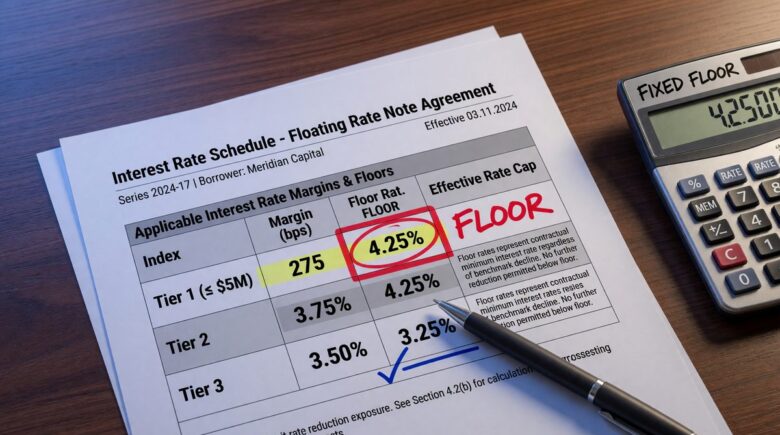
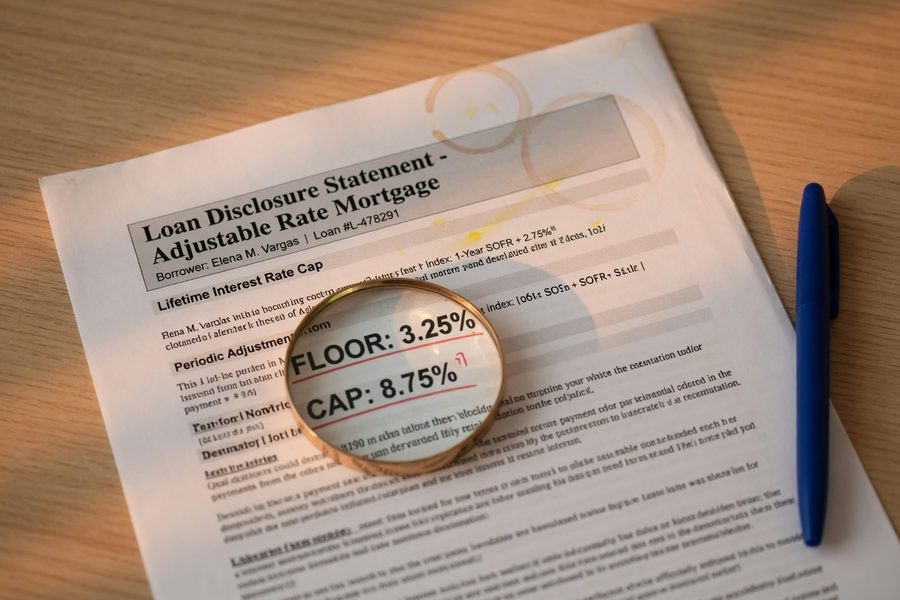
A floor is a contractual minimum, the rate your lender will charge regardless of how low the index falls. Think of it as a trap door that never opens below a certain level. The formula calculates a rate, but the floor overrides it if the calculated rate falls short.
Floor vs. Cap: Who Is Protected
Floors protect lenders. Caps protect borrowers. Both appear in most HELOC and variable-rate loan disclosures, and the CFPB explicitly requires disclosure of both figures before a borrower closes on a variable-rate home equity line. A lifetime cap of, say, 18% limits how high your rate can go; a floor of 5.00% limits how low it can go. You benefit from the cap; your lender benefits from the floor. The asymmetry is deliberate and entirely legal.
Here is how the mechanics play out step by step. Your note states: prime + 1.50%, floor 6.00%. Prime is currently 6.75%, so your rate is 8.25%. The Fed cuts twice, dropping prime to 5.75%. Your formula says 7.25%. Floor is not yet binding. Prime drops again to 4.50%. Your formula says 6.00%. The floor is exactly met, not yet triggered. Prime drops to 4.00%. Formula says 5.50%. Your floor kicks in: you pay 6.00% anyway. That is a full half-point more than your formula would demand, on every dollar outstanding.
What I see in practice: Readers routinely calculate their “best case” payment assuming prime bottoms out at 4.00% or below, but they forget to subtract zero from the floor. The floor is not a formality. On a $100,000 HELOC balance, a 0.50% floor override costs roughly $500 per year in extra interest. Not devastating, but not nothing.
Why Lenders Add Floors, and When They Become Expensive for You
Lenders add floors to protect minimum yield on assets that would otherwise become unprofitable at ultra-low rates. During the 2008 and 2020 rate cycles, prime fell to 3.25%, a level at which some HELOC portfolios were generating near-zero net interest margins. Floors prevent that outcome. A bank that prices a HELOC at prime + 0.50% with a 4.50% floor knows it will earn at least 4.50% no matter what the Fed does.
Floors become expensive for borrowers specifically when prime falls faster or further than expected, exactly the scenario that defines a Fed easing cycle. The floor that looks irrelevant at 6.75% prime can become binding within two or three FOMC cuts. That is not a distant risk; it is the arithmetic of the current rate environment.
Real-World Scenarios: When Prime Drops but Your Rate Stays Put
Worked examples make the cost concrete. Consider three borrowers, each with a $75,000 HELOC balance, same prime + 1.00% margin, but different floor levels.
| Borrower | Margin | Floor | Rate at Prime 6.75% | Rate if Prime Falls to 4.75% | Extra Annual Interest vs. No Floor |
|---|---|---|---|---|---|
| A, Low Floor | +1.00% | 4.00% | 7.75% | 5.75% (formula wins) | $0 |
| B, Mid Floor | +1.00% | 6.00% | 7.75% | 6.00% (floor wins) | $188 |
| C, High Floor | +1.00% | 6.50% | 7.75% | 6.50% (floor wins) | $563 |
Borrower C is paying more than $560 per year in interest that the prime rate formula would not require, simply because of a floor set 1.75 points above where prime landed. Multiply that across three years of a flat or slowly recovering rate environment and the cost clears $1,500. That is the real-world price of a floor clause you did not negotiate.
Where this gets tricky: Some HELOC offers include a teaser rate or margin discount for the first 12 months. Those discounts can mask an aggressive floor. A lender advertising prime minus 0.50% for year one may still hold a 6.50% floor, so the discount never actually lowers your rate below what you’d pay at a higher-margin, lower-floor competitor.
How to Spot and Compare Prime Rate Floor Terms Before You Sign
The floor is almost never on page one of a HELOC or personal line application. Find it in the rate adjustment section of the note, the variable-rate disclosure addendum, or the HELOC early disclosure document, the document the CFPB requires lenders to provide. Look for language like “the annual percentage rate will never be less than X%” or “notwithstanding any lower index rate, the minimum APR is X%.” Those phrases are the floor, even when the word “floor” never appears.
Questions to Ask Every Lender
Before committing to any prime-rate variable loan, ask three things: What is the lifetime floor? Does the floor apply to the draw period, the repayment period, or both? And does any introductory margin discount interact with the floor? A lender quoting prime + 0.75% at an advertised APR of 7.50% may sound competitive, but if the floor is 6.75%, you have essentially signed up for a near-fixed rate at today’s prime, with upside exposure if prime rises and minimal downside benefit if it falls.
Shopping on floor level is something almost no borrower does, and almost no competitor article suggests. It should be standard practice. How the prime rate affects your HELOC and home equity loan matters less if a floor clause is quietly absorbing most of the benefit.

Budgeting and Planning Around a Rate Floor, and When to Consider Alternatives
The practical planning step is simple: calculate your payment at the floor rate, not at a hoped-for lower rate, and treat that as your floor payment. Stress-testing against the floor rather than the formula keeps your budget grounded. If your monthly budget depends on prime falling to 4.00% to keep a HELOC payment affordable, the floor clause may invalidate that plan entirely.
When a Fixed Rate or Refinance Wins
A high floor changes the math on fixed-versus-variable decisively. If your HELOC floor is 6.50% and a fixed home equity loan is available at 7.00%, the spread between those two options is only 50 basis points, and the fixed-rate borrower has certainty while you carry rate-rise risk. That tradeoff is worth pricing explicitly. For larger balances or longer repayment timelines, the insurance value of a fixed rate can easily exceed the modest spread. If you are already in a floored variable loan and prime is near your floor, refinancing to fixed deserves a serious calculation, not a reflexive dismissal. You can also accelerate principal paydown, a smaller outstanding balance means the floor costs you less in absolute dollars each year, even if the rate itself does not change.
Federal regulations reinforce why the floor disclosure matters so much. The CFPB requires that variable-rate HELOCs tied to an index such as the prime rate include written disclosure of interest rate caps and floors before closing, as detailed in the bureau’s HELOC booklet and confirmed by its consumer guidance on HELOCs. The disclosure exists precisely because the floor can materially affect total borrowing cost over the life of the line.
What I tell readers who already hold a floored loan: your best immediate move is to know your floor number precisely. Pull the disclosure document, find that figure, and run the table above with your actual balance. If the floor is below 5.00%, you likely have meaningful rate relief available in a serious cutting cycle. If it is at 6.00% or above, plan as though your rate is fixed, because for most realistic Fed scenarios in the next two to three years, it effectively is.
Where This Recommendation Falls Short
The honest concession here is this: if you are a borrower whose primary risk is rising rates rather than falling ones, a floor is not your problem. The drawback of focusing exclusively on floors is that it can distract from the cap, the clause that actually limits your worst-case scenario. A borrower with a 6.50% floor and a 16% lifetime cap in a rising-rate environment should be far more worried about the cap than the floor.
The catch is also situational by loan type. Credit card variable rates, which also track prime, rarely have a floor that matters practically, because card margins run so high (prime + 15% to prime + 20% is common) that a prime-rate floor at 4.00% is irrelevant to most cardholders paying 22%–26% APR. The floor analysis in this article is most consequential for secured credit lines, HELOCs and home equity loans, where margins are tight and the floor is close to the current prime rate. Applying this framework to a credit card is mostly a distraction from the more useful exercise of managing that balance directly. For that, the snowball vs. avalanche payoff methods are worth more of your attention than any floor clause.
There is also a counterargument worth naming: for some borrowers, a high floor is not a flaw in the product, it is a feature. If you believe rates are more likely to rise than fall from here, a lender’s floor is irrelevant and the variable rate still offers upside if you are wrong. The risk is in assuming the floor is irrelevant when the rate environment is genuinely uncertain. Tradeoffs run both ways, and the floor clause is not inherently predatory, it is a risk allocation tool that happens to favor the lender. Knowing that going in is what separates a savvy borrower from one who feels surprised by a bill two years into a Fed easing cycle.
Finally, not for everyone: borrowers who plan to pay off a HELOC draw rapidly, within 12 months, may find the floor nearly inconsequential in dollar terms. The table above becomes less alarming at small outstanding balances. The recommendation to scrutinize floor terms most aggressively applies to long-duration, large-balance variable lines.
How We Sourced This
Rate data in this article draws from the Federal Reserve’s H.15 Selected Interest Rates release and the Wall Street Journal’s prime rate historical data, covering the period from January 2024 through June 2026. HELOC floor examples reflect publicly disclosed terms from credit unions and banks reviewed between March and June 2026; specific lender names are omitted because floor terms are subject to change and vary by creditworthiness. CFPB disclosure requirements are cited from the bureau’s 2016 HELOC booklet, which reflects current regulatory guidance as of this writing. All numerical examples are constructed illustrations using verified current rate inputs, not lender-specific guarantees. This article was last verified in June 2026.
Frequently Asked Questions
What is a prime rate floor on a loan?
A prime rate floor is a contractual minimum interest rate that applies to a variable-rate loan regardless of how low the underlying prime rate falls. If the prime rate drops below the threshold that would give you a rate below your floor, your rate stays at the floor. The clause typically appears in the loan note as language stating the rate will be “no less than X% per annum.”
Do all HELOCs have a rate floor?
Most do, though the floor level varies widely. Floors between 4.00% and 6.50% are common on 2026 HELOC products from banks and credit unions. A few lenders do offer products without a meaningful floor, which is worth asking about explicitly when shopping. The CFPB requires that any floor be disclosed in writing before closing.
How do I find the floor in my loan documents?
Look in the variable-rate disclosure addendum or the rate adjustment section of your note for language like “the APR will never be less than X%.” The word “floor” may not appear; the functional equivalent is any phrase specifying a minimum rate “notwithstanding any lower index.” If you cannot locate it, contact your lender’s servicing department and ask for the lifetime minimum rate on your account.
Can I negotiate a lower floor with my lender?
Occasionally, yes, particularly with credit unions or community banks, where underwriters have more flexibility. On a HELOC, the floor is more often set by the institution’s asset-liability policy than by individual negotiation, so success is not guaranteed. A stronger negotiating position comes from having excellent credit and competing offers with lower floors from other lenders.
Does a rate floor affect credit cards tied to prime?
Technically yes, but practically it rarely matters for most cardholders. Credit card margins above prime are so large, often 15 to 20 percentage points, that a floor at 4.00% or even 6.00% does not constrain the rate a typical borrower actually pays. The prime rate’s effect on credit card interest rates is real, but for cards, the margin dominates the floor in practical terms.
If the Fed cuts rates, will my HELOC payment automatically drop?
Only if the new calculated rate (prime + your margin) falls above your floor. With prime at 6.75% and a floor of 6.00%, a single Fed cut of 25 basis points would bring prime to 6.50%, your rate would drop to 7.50% if your margin is 1.00%, and the floor would still not be binding. Two or three more cuts would get you close. Track the gap between your floor and the formula result after each FOMC meeting.
Is a fixed-rate home equity loan better than a HELOC with a high floor?
When the spread between a fixed home equity loan rate and your HELOC’s floor is small, say, 50 basis points or less, the fixed option deserves serious consideration. You eliminate rate-rise risk and lose only modest downside benefit. Run the numbers with your actual balance and timeline; for loans over $50,000 with repayment periods longer than five years, the certainty of a fixed rate often outweighs a thin rate advantage. Comparing fixed and variable home equity options is worth the time before committing.
Sources
- Federal Reserve, H.15 Selected Interest Rates
- Consumer Financial Protection Bureau, What You Should Know About Home Equity Lines of Credit
- Wall Street Journal, Money Rates (Prime Rate)
- Federal Reserve, What Is the Prime Rate and Does the Federal Reserve Set It?
- Consumer Financial Protection Bureau, What Is a HELOC?
- Federal Reserve, Open Market Operations and the Federal Funds Rate
- Consumer Financial Protection Bureau, Mortgage Key Terms: Interest Rate Cap and Floor