Reviewed by the Prime Rate Editorial Team
Our Take
For buyers with a credit score above 760 financing a new or near-new boat on a fixed-rate loan with a 10-year or shorter term, a boat loan at today’s rates is defensible, the current prime rate of 6.75% translates to real-world APRs starting near 7%–8% for well-qualified borrowers. The case against it: on a 20-year term at the average 8.40% APR, total interest on a $55,842 loan exceeds the original principal. Anyone financing a used boat over 10-plus years, or anyone banking on imminent Fed cuts to bail them out, should either shorten the term aggressively or wait until their credit profile improves, not wait for the Fed.
The U.S. recreational boating market generated $55.6 billion in retail expenditures in 2024, according to the National Marine Manufacturers Association’s 2024 industry data, and the vast majority of those purchases were financed. What most buyers never asked before signing was how the Federal Reserve’s benchmark rate got baked into their monthly payment, and what happens to their total cost when that number moves.
This article is for prospective boat buyers who want to understand prime rate boat loans before sitting across from a marine lender or dealer finance office. The recommendation works when borrowers enter the process with a strong credit profile and a realistic term; it breaks down fast when the term stretches, the boat is old, or the buyer is waiting on Fed relief that current data does not support.
Key Takeaways
- The U.S. prime rate stands at 6.75%, having fallen 1.75 percentage points from its 8.50% peak through five Fed cuts, per Federal Reserve H.15 data via PrimeRates.com.
- The average boat loan APR on the LendingTree marketplace was 8.40% in Q4 2025, on an average financed amount of $55,842, and at that rate over 20 years, total interest exceeds the original loan balance.
- On a $200,000 boat loan, the gap between excellent-credit pricing (6.25%) and fair-credit pricing (9.0%) over 20 years exceeds $81,000 in total interest, a figure that dwarfs any savings from waiting six months for a quarter-point Fed cut.
- Boats depreciate 20%–30% in the first three to five years while most lenders offer terms of 10–20 years, creating a near-certain window of negative equity that most buyer guides do not disclose.
- In my experience reviewing marine financing structures, the single most damaging decision buyers make is choosing the longest available term to minimize the monthly payment, without ever calculating what the total interest bill will be at payoff.
What the Prime Rate Actually Is, and Why Most Boat Buyers Never Ask
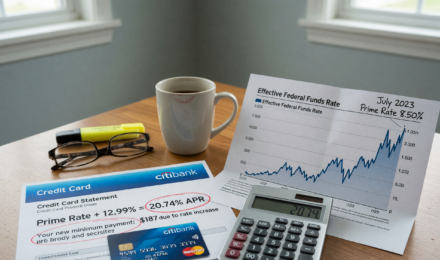
The prime rate is not mysterious. It is a mechanical formula: the federal funds rate upper bound plus exactly 3.00 percentage points, published daily by the Wall Street Journal and tracked by the Federal Reserve., with the federal funds upper bound at 3.75%, the prime rate sits at 6.75%. When the Fed moves, prime moves the same day.
Context matters here. The prime rate peaked at 8.50% in mid-2024 and held there for well over a year before the Fed began cutting in September 2024. Five cuts later, it has come down 1.75 percentage points, per Federal Reserve H.15 data. That easing cycle is real progress, but prime is still well above the 3.25% floor that defined the post-2008 and pandemic eras. Buyers using that floor as their mental benchmark are working from the wrong reference point.
The Terminology Trap Most Buyers Fall Into
There is a second meaning of “prime rate” you will see in lender marketing, and it has nothing to do with the Fed. Dealers and lenders often use “prime” to mean a borrower credit tier, as in “prime borrower” versus “subprime borrower.” These are completely different concepts. When a dealer tells you that you qualified for “prime financing,” confirm whether they mean the WSJ benchmark-indexed product or simply their top credit tier. Your loan documents, governed by Regulation Z as enforced by the CFPB, must disclose whether your rate is index-linked or set at the lender’s discretion, read that section before signing.
How the Prime Rate Gets Built Into Your Boat Loan Rate
Your quoted rate is not arbitrary. It is prime plus a margin, and that margin is driven by credit score, loan-to-value ratio, boat age, and loan term. A buyer with a 780 credit score, a 20% down payment, financing a new boat for 10 years will get a margin well below what a 660-score buyer financing a 15-year-old vessel will see.
To give you a practical benchmark: home equity lines of credit (HELOCs) typically price at prime plus 0.5% to 2% for well-qualified borrowers. Boat loans for the same borrower quality run prime plus 0.5% to 3%, and that spread widens considerably for used or older boats. At the current prime rate of 6.75%, a well-qualified buyer on a new boat might see a starting APR in the 7%–8% range; a borrower with middling credit on a 12-year-old hull should expect 10% or higher, and some lenders will not finance the boat at all.
Fixed vs. Variable: The Distinction That Determines Your Rate Risk
Most marine loans are fixed-rate products, which means the prime rate at your closing date is what you locked in, you get no benefit from future Fed cuts unless you refinance, and you bear no additional cost from future hikes. Variable-rate boat loans do exist, and for those, the Federal Reserve’s G.19 Consumer Credit release confirms that boat loans are classified as nonrevolving consumer credit, repricing in lockstep with benchmark rate changes. A variable-rate borrower who locked in when prime was 8.50% and is now at 6.75% has already seen meaningful payment relief, but also took real risk during the high period.
What I see in practice: Buyers almost never ask whether their boat loan is fixed or variable at the point of application. They ask about the monthly payment. The lender answers the question asked. By the time the distinction matters, usually when rates move, the paperwork has been signed for months.

What Boat Loan Rates Actually Look Like in May 2026
The most honest number available comes from actual borrower offer data: LendingTree’s Q4 2025 boat loan rate report shows an average APR of 8.40% on an average financed amount of $55,842. That is the middle of the market, not the best case, not the worst.
The advertised “as low as” rate from any lender is nearly irrelevant for most buyers. Those rates are reserved for borrowers with scores above 800, substantial down payments, short terms on new boats. A buyer with a 720 credit score financing a used boat for 15 years should expect to land 2–3 percentage points above the lender’s headline rate. That gap is not disclosed prominently; you have to ask for the tier pricing schedule or get a formal pre-qualification to see your actual number.
| Credit Score Tier | Typical APR Range (New Boat) | Typical APR Range (Used Boat, 10+ yrs) | Max Term Available |
|---|---|---|---|
| 760+ (Excellent) | 7.00%–8.00% | 8.50%–10.00% | 20 years |
| 720–759 (Good) | 8.25%–9.50% | 10.00%–11.50% | 15 years |
| 680–719 (Fair-Good) | 9.75%–11.00% | 11.50%–13.00% | 10–12 years |
| Below 680 (Fair) | 11.00%–14.00%+ | Often declined | 7 years max |
Note that boat loan rates run structurally higher than comparable auto loan rates. Boats carry longer terms, larger loan amounts, and are considered riskier collateral because they depreciate faster and are harder to repossess. This is not a temporary anomaly driven by the current rate environment, it is a permanent feature of marine lending.
The Loan Term Trap: How a Low Monthly Payment Quietly Doubles Your Total Cost
This is the central personal finance insight most marine financing guides skip, and the math is genuinely sobering. At the average figures from LendingTree, $55,842 financed at 8.40% over 20 years, total interest paid comes to roughly $58,000. The buyer who chose that term to keep the monthly payment manageable ends up paying nearly twice the principal.
Scale up and the numbers are harder to look at. On a $200,000 loan, the difference between locking a 6.25% rate (excellent credit) and a 9.0% rate (fair credit) over 20 years exceeds $81,000 in total interest. That is not a marginal variance. It is a material financial outcome driven entirely by credit score, not by whether the Fed cuts rates in the next six months.
The Depreciation Problem That Makes Long Terms Dangerous
Boats lose 20%–30% of their value in the first three to five years. A buyer who finances a $60,000 boat over 20 years and holds it for four years before selling is almost certain to owe more than the boat is worth at the point of sale. Unlike a mortgage, where the underlying asset generally appreciates over time, boat financing is consumer debt secured by a depreciating asset, the math is closer to a car loan than a home loan, but stretched over a much longer timeline.
The prime rate connection here is direct: a buyer who took a variable-rate loan or is refinancing when the prime rate is elevated pays a compounding penalty on every additional dollar of interest, across a term that may outlast the boat’s useful life for many recreational users. What we tell readers in this situation is to treat the 20-year term as a last resort, not a default, and to model the total interest cost before accepting any lender’s offer.
Where this gets tricky: Buyers focus on whether they can afford the payment. The right question is whether they can afford the total loan. On a 20-year marine loan, the difference between a 10-year and a 20-year term on $55,000 at 8.40% is roughly $22,000 in extra interest, real money most buyers have never seen presented to them before closing.
The Fees Sitting on Top of Your Rate That Most Buyers Miss
The interest rate on your loan documents is not your true cost of borrowing. APR is, and the gap between the two on marine loans is often larger than buyers expect. Origination fees and documentation fees on boat loans range from a few hundred to several thousand dollars depending on lender and loan size. Required marine insurance typically runs 1%–2% of the boat’s value annually, which on a $55,000 vessel means $550–$1,100 per year that never shows up in the loan APR but is an unavoidable carrying cost of financing.
Prepayment penalties deserve specific attention because they are more common in marine lending than in auto or mortgage financing. A buyer who finances for 15 years and sells the boat after three or four years, which is close to the industry’s typical hold pattern, may face an early payoff fee that wipes out any rate advantage they negotiated. Read the prepayment clause in any marine loan contract before signing. This is not boilerplate; it is a cost that can run into thousands of dollars.
Dealer-Arranged Financing: A Specific Risk Zone
Marine dealers, like car dealers, can mark up the rate above what the wholesale lender actually requires and pocket the spread. The rate the dealership presents is not necessarily the rate the lender requires for your credit profile, it is the rate the dealer chose to offer. Buyers who obtain a pre-qualification from a bank, credit union, or marine-specialist lender before visiting a dealership remove this markup opportunity entirely. Understanding how the prime rate affects personal loan and consumer loan pricing gives you a baseline for evaluating whether a dealer’s quoted rate is reasonable or inflated.

What the May 2026 Rate Environment Actually Means for Your Decision
The prime rate is at 6.75% today, down from its 8.50% peak, but still more than 3 percentage points above its pandemic-era floor. Buyers who are mentally comparing today’s rates to the 3%–4% boat financing of 2021 are setting themselves up for disappointment. That era reflected emergency-level monetary policy. It was the exception, not the baseline.
The “wait for rates to drop” logic deserves an honest answer. The April 2026 FOMC meeting produced an 8-4 vote to hold rates, the most divided Fed decision since October 1992. The current dot plot projects only one additional rate cut in 2026. Core PCE inflation has not returned to the Fed’s 2% target. There is no reliable near-term catalyst for a significant rate reduction, and even if one arrives, fixed-rate boat loan borrowers get none of the benefit unless they refinance.
The practical framework is this: for fixed-rate loans, credit preparation beats rate timing every time. A buyer who raises their FICO score by 50 points before applying will likely save more over the life of the loan than a buyer who waits six months hoping for a 25-basis-point cut that may not materialize. For a deeper look at how Fed moves flow through to borrowing costs generally, see our breakdown of how the prime rate affects mortgage and home equity loan pricing.
What clients often miss: The NMMA has documented that elevated financing costs were a primary driver of the year-over-year decline in new powerboat sales in 2024, per NMMA’s industry data summaries. Buyers waiting for rates to fall are competing with others doing the same, when rates do drop, demand returns and dealer pricing power increases.
How to Get a Rate That Reflects Your Risk Profile, Not the Lender’s Margin
There are three levers borrowers actually control, and they matter far more than Fed timing. Credit score is the largest single variable: the difference between an 800 score and a 720 score can mean 1–2 percentage points on your APR, translating to tens of thousands of dollars over a 15-to-20-year loan. If your score is borderline, spending three to six months paying down revolving debt before applying is almost certainly worth more than waiting for a Fed cut. Our guide on what constitutes a good credit score and what it unlocks in borrowing terms gives you the full tier breakdown.
Down payment size is the second lever. The standard marine lending expectation is 10%–20% down, and putting down more directly reduces your loan-to-value ratio, which lenders price. A 30% down payment on a used boat can sometimes move a borrower from a “used-boat” pricing tier to near “new-boat” pricing at the same lender.
Loan term is the third lever, and it works in both directions. Shorter terms get lower rates and far lower total interest. They also come with higher monthly payments, that is the honest tradeoff. But if your budget allows a 10-year term instead of 20, you will save materially on both the rate and the total interest, and you will reduce your negative equity exposure substantially.
Where to Shop Beyond the Dealership
Marine-specialist lenders and credit unions deserve serious consideration alongside big banks. Specialist lenders work with networks of 50 or more banks, accessing tiered pricing that a single bank application cannot replicate. Credit unions frequently post rates measurably below bank competitors. Getting pre-qualified from at least two sources before entering a dealership is the single highest-leverage step most buyers skip. For context on how lender competition drives rate differences across consumer loan products, see our coverage of how the prime rate flows through to different consumer credit products.
Where This Recommendation Falls Short
The advice in this article, fix your credit, shorten your term, pre-qualify independently, and treat the prime rate as a floor rather than a ceiling, is sound for a specific type of buyer. It is not universal, and the tradeoffs are real.
The biggest drawback of the “fix credit and move forward” approach is that it assumes the buyer’s primary goal is financial optimization. For a buyer who genuinely values time on the water with family and has a stable income to support the payments, the opportunity cost calculation is different. Fifteen or twenty years of deferred enjoyment has a cost that a spreadsheet does not capture. I am not dismissing that consideration, I am saying most financial guides ignore it entirely, which is its own distortion.
The catch with recommending shorter loan terms is that shorter terms mean higher monthly payments, and for buyers near their budget ceiling, the math simply does not work at 10 years. Pushing a buyer toward a term they cannot sustain is worse than a long-term loan they can. The right answer in that situation is often to buy a less expensive boat, not to force a term that strains cash flow. A sound monthly budget framework should establish the maximum sustainable payment before the buyer ever looks at boat prices.
The recommendation to pre-qualify before visiting a dealer also falls short for buyers in highly specialized segments, certain luxury yacht purchases, vintage vessels, or liveaboard configurations that require specialist underwriting. In those cases, dealer-arranged financing through a specialist underwriter may genuinely be the best available option, not a markup scheme. Know which category you are in.
There is also the question of what “wait for rates to drop” actually costs in real terms versus what it might save. The risk is that a buyer who delays 12 months, hoping for a 50-basis-point improvement, may face higher boat prices if demand returns, higher insurance premiums if the model year ages into “used” pricing, or simply loses 12 months of use. The tradeoff between a slightly lower rate and delayed access to the asset is not always in favor of waiting, especially on a depreciating good where the buyer also delays the depreciation clock.
Finally, this article focuses on standard marine loan products. Buyers considering home equity loans or HELOCs as an alternative financing vehicle face a completely different risk structure, one where the collateral is their home, not the boat. That choice is not covered here and deserves separate, careful analysis.
How We Sourced This
Rate data in this article comes primarily from two sources: the Federal Reserve’s H.15 Selected Interest Rates release as reported through PrimeRates.com (current prime rate of 6.75%, effective December 11, 2025), and LendingTree’s Q4 2025 Boat Loan Rate Report based on actual borrower offer data from the LendingTree marketplace. Industry sales and expenditure figures draw from the National Marine Manufacturers Association’s 2024 U.S. Recreational Boating Statistical Abstract, published in 2025 and covering full-year 2024 data. Regulatory disclosures reference the Consumer Financial Protection Bureau’s Regulation Z (12 CFR 1026.18) and the Federal Reserve’s G.19 Consumer Credit release methodology page. Rate tier estimates in the comparison table reflect publicly available lender rate schedules and marine-specialist lender disclosures reviewed in April and May 2026; individual rates vary and should be verified directly with lenders at time of application. This article was last verified in May 2026.
Frequently Asked Questions
Does the prime rate directly affect my boat loan interest rate?
Yes, but the mechanism depends on whether your loan is fixed or variable. Fixed-rate boat loans, the majority of marine financing, lock in a rate at origination that reflects the prime rate at signing but does not move afterward. Variable-rate boat loans reprice when the prime rate changes, directly and by the same amount, typically within one business day of a Fed decision.
What is a good interest rate on a boat loan in 2026?
For a well-qualified borrower with a credit score above 760, a good rate on a new boat loan in May 2026 falls in the 7.00%–8.00% APR range. The LendingTree marketplace showed an average of 8.40% across all borrowers in Q4 2025, which means anything meaningfully below that average represents above-average credit positioning. Rates on used boats run 1.5–2.5 percentage points higher for comparable credit profiles.
How much does the prime rate affect total interest paid on a boat loan?
On a long-term loan, the effect compounds significantly. On a $55,842 boat loan at 8.40% over 20 years, total interest exceeds the original principal. A 1-percentage-point rate difference on a $75,000 loan over 20 years adds roughly $8,000–$10,000 in total interest. Credit score has a larger impact on your rate than waiting for Fed cuts, which for fixed-rate loans only matter if you refinance.
Should I wait for the Fed to cut rates before financing a boat?
Probably not, for two reasons. First, the April 2026 FOMC vote was 8-4 to hold rates, and the current projections show only one additional cut in 2026, meaningful rate relief is not imminent. Second, fixed-rate boat loans do not benefit from future cuts unless you refinance, which carries its own costs and potential prepayment penalties. Improving your credit score before applying will likely save more than waiting six months for a quarter-point move.
Are boat loan rates higher than auto loan rates?
Yes, structurally and consistently. Boat loans carry higher rates than comparable auto loans because boats depreciate faster, terms are longer, and lenders view marine collateral as riskier to repossess and resell. This premium is not a temporary feature of the current environment, it persists across rate cycles. Buyers who use auto loan rates as a benchmark for evaluating boat loan quotes will routinely misjudge what is a competitive offer.
What credit score do I need for the best boat loan rates?
Most marine lenders reserve their lowest advertised rates for borrowers with FICO scores of 760 or above, combined with a 20% or larger down payment on a new vessel. A score in the 720–759 range typically places you one or two tiers below the headline rate. Our guide on credit score ranges and what they unlock in lending terms covers the full tier breakdown with practical improvement strategies.
Can I refinance a boat loan if rates drop?
Yes, boat loans can be refinanced, but the process carries real costs. Watch for prepayment penalties on your current loan, these are more common in marine financing than in auto or mortgage lending, and they can offset the savings from a lower rate entirely. Factor the prepayment fee, any origination costs on the new loan, and the remaining term before treating a refinance as an automatic win.
Sources
- Federal Reserve Bank of St. Louis (FRED), Bank Prime Loan Rate (DPRIME)
- Federal Reserve Board, G.19 Consumer Credit Release Methodology
- Consumer Financial Protection Bureau, Regulation Z, Section 1026.18
- National Marine Manufacturers Association, 2024 U.S. Recreational Boating Statistical Abstract
- National Marine Manufacturers Association, Recreational Boating Industry Data, Interest Rate Impact
- LendingTree, Boat Loan Rates and Q4 2025 Rate Report
- PrimeRates.com, Current U.S. Prime Rate (Federal Reserve H.15 Data)
- LendingTree, Boat Loan Calculator and Average Financed Amount Data