Fact-checked by the Prime Rate editorial team
Quick Answer
Banks use the prime rate, currently 7.50% as of July 2025, as a baseline to price credit cards, HELOCs, personal loans, and savings products. Most credit cards charge prime plus a margin of 10–15 percentage points. When the Federal Reserve adjusts its federal funds rate, the prime rate moves in lockstep, and consumer borrowing costs shift within one to two billing cycles.
Understanding how banks price consumer products begins with one core mechanism: the prime rate is the reference index that financial institutions add a margin to when setting the annual percentage rate (APR) on variable-rate products. According to the Federal Reserve’s H.15 statistical release, the prime rate has historically tracked 3 percentage points above the federal funds target rate, a spread maintained consistently since the 1990s. That single relationship governs hundreds of billions of dollars in outstanding consumer debt.
When the Federal Open Market Committee raises or cuts rates, your credit card APR, home equity line of credit, and even some auto loans reprice almost immediately. This guide explains exactly how banks price each major consumer product using the prime rate, what margins lenders add on top, and how to use that knowledge to reduce your borrowing costs.
Key Takeaways
- The prime rate sits at 7.50% as of July 2025, set at exactly 3 percentage points above the federal funds rate target (Federal Reserve H.15).
- The average credit card APR reached 20.09% in early 2025, reflecting prime plus a lender margin typically between 10 and 15 points (Federal Reserve G.19 Consumer Credit Report).
- Home equity lines of credit (HELOCs) are almost universally variable-rate products priced at prime plus a spread that averaged 0.50–2.00 percentage points for well-qualified borrowers in 2024 (Consumer Financial Protection Bureau).
- Variable-rate personal loan APRs averaged 12.35% for 24-month loans at commercial banks in Q1 2025 (Federal Reserve G.19).
- High-yield savings account APYs at online banks reached 4.50–5.00% at their 2024 peak but began declining as rate-cut expectations increased (FDIC National Rate Caps).
In This Guide
- What Is the Prime Rate and How Is It Set?
- How Do Banks Use Prime Rate to Price Credit Cards?
- How Does Prime Rate Affect HELOCs and Home Equity Loans?
- How Is Prime Rate Used to Price Personal and Auto Loans?
- How Does Prime Rate Influence Savings and Deposit Rates?
- How Do Banks Determine the Margin They Add to Prime?
- How Can Consumers Use This Knowledge to Save Money?
What Is the Prime Rate and How Is It Set?
A benchmark lending rate published by major U.S. commercial banks, the prime rate is set at 3 percentage points above the Federal Reserve’s federal funds rate target. It is not mandated by law, it is a market convention, but one followed so uniformly that it functions as a standardized index.
The Federal Reserve Connection
The Federal Open Market Committee (FOMC) meets roughly eight times per year to set the federal funds rate target. Within hours of each FOMC decision, major banks including JPMorgan Chase, Bank of America, and Wells Fargo announce identical prime rate adjustments. The Wall Street Journal Prime Rate, the most widely cited version, reflects the rate charged by at least 70% of the ten largest U.S. banks.
This automatic transmission mechanism is why grasping how banks use the prime rate matters so much to personal finance. One FOMC vote can instantly change the cost of your HELOC, your credit card minimum payment, and the APY on your savings account.
The prime rate has moved in lockstep with the federal funds rate for over three decades. Between March 2022 and July 2023, the FOMC raised rates 11 consecutive times, pushing the prime rate from 3.25% to 8.50%, the fastest tightening cycle since the 1980s.
How Do Banks Use Prime Rate to Price Credit Cards?
Banks price credit cards by adding a fixed margin, called the spread, to the prime rate to arrive at your variable APR. This formula appears directly in every credit card agreement under the “How We Calculate Your Rate” disclosure required by the Truth in Lending Act (TILA).
The Prime-Plus Formula in Practice
A typical credit card contract might read: “Your APR is the Prime Rate plus 19.99%.” With prime at 7.50%, that produces an APR of 27.49%. The margin banks charge varies by product tier: rewards cards carry higher margins, while secured cards for credit-building consumers can carry margins exceeding 20 percentage points.
The average credit card interest rate hit 20.09% for accounts assessed interest in early 2025, according to Federal Reserve G.19 consumer credit data. That figure represents the effective combination of the prevailing prime rate and the margin each lender charges. To understand your own exposure, read our guide on how the prime rate affects your credit card interest rates.
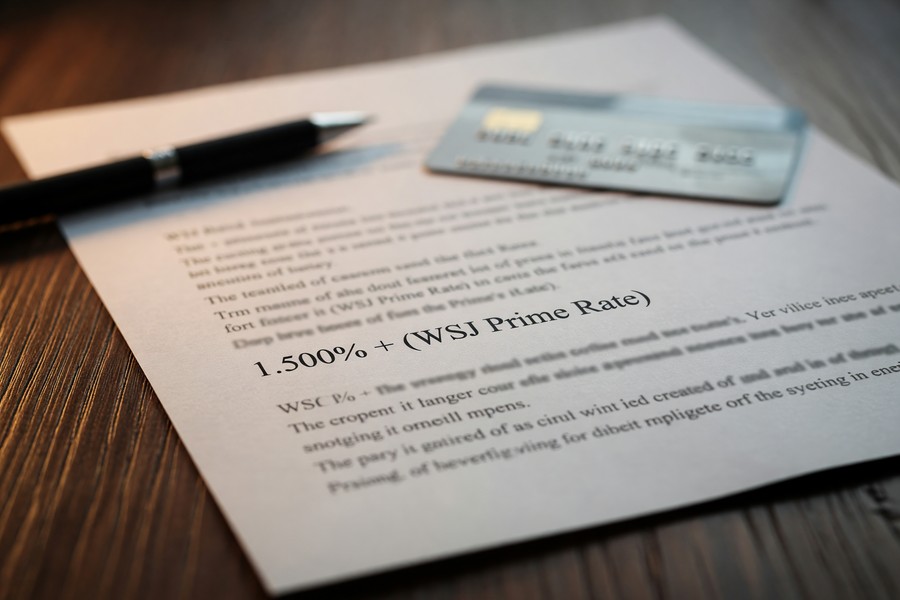
One trade-off worth naming: because the margin is fixed in your cardholder agreement and the prime rate component is set by the Fed, cardholders have no way to reduce the index portion of their APR on their own. The only lever available is the margin, which requires either improving your credit profile to qualify for a better product or negotiating directly with your issuer.
When Does the Rate Change?
Under Regulation Z, which implements TILA, issuers must apply a prime rate increase starting with the first billing cycle that begins 45 days or more after the rate change. In practice, most major issuers adjust balances within one to two billing cycles. There is no such delay required for rate decreases, and issuers often move more slowly when rates fall.
How Does Prime Rate Affect HELOCs and Home Equity Loans?
HELOCs are the consumer product most directly and immediately tied to the prime rate. Nearly all HELOCs are variable-rate instruments priced at prime plus a spread, meaning every FOMC rate decision reprices your outstanding balance. Fixed-rate home equity loans, by contrast, are priced off longer-term Treasury yields rather than prime.
HELOC Pricing Structure
For well-qualified borrowers with credit scores above 740, HELOC margins typically range from prime minus 0.50% to prime plus 2.00%, according to CFPB data. With prime at 7.50%, that translates to an effective rate of 7.00% to 9.50% for qualified applicants. Borrowers with lower credit scores or higher combined loan-to-value ratios pay steeper margins.
The Consumer Financial Protection Bureau (CFPB) requires HELOC lenders to disclose the index used, the margin, and the maximum possible APR, which by law cannot exceed 18% for most federally chartered institutions. For a deeper look at how rate changes affect home equity products, see our article on how the prime rate affects your mortgage and home equity loan.
Outstanding home equity revolving credit in the U.S. totaled approximately $387 billion as of Q1 2025, according to Federal Reserve flow-of-funds data. Nearly all of this balance carries a variable rate tied directly to the prime rate.
How Is Prime Rate Used to Price Personal and Auto Loans?
Variable-rate personal loans are priced using the same prime-plus-margin structure as credit cards, though many personal loans are issued at fixed rates that reflect market conditions at origination. Auto loans are predominantly fixed-rate but are indirectly influenced by prime through banks’ overall cost of funds.
Personal Loan Rate Structure
Variable-rate personal loans at commercial banks averaged 12.35% for 24-month terms in Q1 2025, per Federal Reserve G.19 data. Online lenders and credit unions frequently price variable personal loans at prime plus 3.00% to 8.00%, depending on borrower creditworthiness as assessed by credit bureaus like Equifax, Experian, and TransUnion.
Your credit score plays a direct role in the margin a bank assigns. A borrower with an excellent score (760+) might receive prime plus 3%, while a borrower with a fair score (640–699) may see prime plus 10% or more. Learn more about what constitutes a good credit score and how it affects your borrowing costs.
Auto Loan Indirect Connection
New-vehicle loan rates at commercial banks averaged 7.54% for 60-month terms in early 2025, according to Federal Reserve G.19 data. While most auto loans are fixed at origination, banks set their fixed-rate offerings based on their internal cost of funds, which itself rises and falls with the prime rate and broader Fed policy.
To understand how the prime rate more broadly affects personal borrowing costs, our guide on how the prime rate affects personal loan rates covers the full picture.
| Consumer Product | Rate Structure | Typical Spread Over Prime (2025) | Example APR at Prime 7.50% |
|---|---|---|---|
| Credit Card (Rewards) | Variable, Prime + Margin | +13.00% to +20.00% | 20.50% – 27.50% |
| HELOC | Variable, Prime + Margin | -0.50% to +2.00% | 7.00% – 9.50% |
| Variable Personal Loan | Variable, Prime + Margin | +3.00% to +10.00% | 10.50% – 17.50% |
| Auto Loan (60-mo, new) | Fixed at origination | Prime-influenced pricing | 6.50% – 8.50% |
| Business Line of Credit | Variable, Prime + Margin | +1.00% to +5.00% | 8.50% – 12.50% |
| High-Yield Savings (Online) | Variable, Discretionary | Prime minus 3.00% to 4.50% | 3.00% – 4.50% APY |
How Does Prime Rate Influence Savings and Deposit Rates?
Banks use the prime rate indirectly to set deposit rates. Savings accounts, money market accounts, and CDs are priced based on competitive pressures and each bank’s cost-of-funds calculations, which move with Fed policy. Unlike loans, there is no contractual prime-plus formula for deposit products.
Savings Accounts and Money Market Accounts
Online banks and credit unions tend to pass rate increases to savers more quickly than large traditional banks. During the 2022–2023 tightening cycle, Ally Bank, Marcus by Goldman Sachs, and other online institutions raised high-yield savings APYs to 4.50%–5.00%, while the national average savings rate at brick-and-mortar banks remained well below 1.00%, according to FDIC national rate data.
For savers, understanding how the prime rate environment affects deposit yields is critical to maximizing returns. Our analysis of what happens to your savings when the prime rate rises explains the lag dynamics in detail. You can also compare current offerings in our roundup of the best high-yield savings accounts for 2026.
Certificates of Deposit
CD rates are priced off Treasury yields rather than the prime rate directly, but both move in response to Fed policy. When banks anticipate rate cuts, they often reduce long-term CD rates before the FOMC actually acts. This is why locking in a CD rate during a peak-rate environment can significantly benefit savers. See our CD rates forecast for 2026 for current projections.
Large national banks like JPMorgan Chase and Bank of America held standard savings account rates at 0.01% APY even as the prime rate exceeded 8.00% in 2023. This spread between what banks charge borrowers and pay depositors is a primary driver of net interest income.
How Do Banks Determine the Margin They Add to Prime?
Banks set the margin above prime based on a combination of risk factors, competitive positioning, and their internal cost-of-funds calculations. The margin is the bank’s profit component and risk premium, it does not move with the prime rate, but it is reviewed periodically.
Credit Risk and Borrower Profile
The largest driver of an individual borrower’s margin is credit risk. Lenders use FICO Scores, the scoring model developed by Fair Isaac Corporation, along with debt-to-income ratios and payment history from the three major credit bureaus to assign a risk tier. Each tier corresponds to a specific margin above prime.
Institutional factors also matter. A bank with high deposit funding costs may charge wider margins than a competitor with cheaper funding. Regulatory capital requirements set by the Office of the Comptroller of the Currency (OCC) and the Federal Deposit Insurance Corporation (FDIC) also influence how aggressively banks can price credit products.
Competitive Market Dynamics
In competitive markets (particularly for mortgages and auto loans) margins compress as lenders compete for volume. In concentrated markets, such as credit cards for near-prime borrowers, margins remain persistently wide. A CFPB credit card market report found that credit card profitability remained high even as the prime rate climbed, because lenders raised rates faster than their own cost of funds increased.

How Can Consumers Use This Knowledge to Save Money?
Knowing how banks use the prime rate gives consumers a direct playbook for reducing borrowing costs and maximizing deposit returns. Your APR has two components, the prime rate and the margin, and only one of them is negotiable.
Strategies for Borrowers
Set by the Fed, the prime rate component cannot be influenced by individual action. The margin, however, is a function of your credit profile and the lender’s competitive appetite. Improving your FICO Score, particularly by reducing credit utilization below 30% and eliminating late payments, can move you into a lower risk tier and reduce your margin. See our guide on how to build credit from scratch for a step-by-step approach.
For existing variable-rate debt, periods of rising prime rates are the time to prioritize accelerated payoff. Reducing your HELOC or credit card balance before the next FOMC increase cuts the principal on which future rate increases apply. Our article on how to pay off debt fast using the Snowball vs. Avalanche method outlines tactical approaches.
Strategies for Savers
When the prime rate is elevated, savers benefit most from online high-yield savings accounts and short-to-medium-term CDs that lock in prevailing rates before the FOMC begins cutting. Rate-cut cycles historically compress deposit yields faster than loan rates, so the window to act is shorter than it appears. Moving savings to higher-yield accounts before a cutting cycle begins is one of the most direct ways to benefit from understanding how banks use the prime rate.
Before accepting a credit card rate increase tied to a prime rate hike, call your issuer and request a rate review. Card issuers have discretion to hold your margin steady for loyal, on-time customers, especially if you have competing offers in hand. This does not change the prime rate component, but it can reduce your total APR.
It is worth being honest about the limits here. Negotiating your margin works best for customers with long, clean payment histories at a single issuer. Borrowers who carry revolving balances month to month, or who have had any recent late payments, will generally find issuers less willing to accommodate a rate request. The strategy is real, but it is not available to everyone equally.
Frequently Asked Questions
How often do banks change consumer rates when the prime rate moves?
Variable-rate credit cards reprice within one to two billing cycles after a prime rate adjustment, as required under Regulation Z. HELOCs typically reprice within the same billing cycle. Fixed-rate products, such as fixed personal loans and most mortgages, are not affected by prime rate changes after origination.
Does the prime rate affect fixed-rate mortgage rates?
No. Fixed mortgage rates are priced primarily off 10-year U.S. Treasury yields, not the prime rate. Adjustable-rate mortgages (ARMs) often use different indices such as SOFR (Secured Overnight Financing Rate) or the 1-year Treasury rather than prime. Only HELOCs routinely use the prime rate as their index.
Why do banks charge so much more than the prime rate on credit cards?
The margin above prime on credit cards compensates for credit risk, fraud losses, regulatory compliance costs, and rewards program expenses. Credit card lending is unsecured, there is no collateral, so lenders price in a significantly higher default risk compared to collateralized products like HELOCs or auto loans. This is the primary reason margins of 10–20 percentage points above prime are standard.
Can I lock in a fixed rate to avoid prime rate fluctuations on my HELOC?
Many lenders offer a fixed-rate lock option on HELOC balances, allowing you to convert a portion or all of your outstanding draw to a fixed rate. This rate will typically be higher than the current variable rate but provides certainty if you expect the prime rate to rise. Check your HELOC agreement or contact your lender directly, as not all products include this feature.
How does the prime rate affect savings account rates at big banks vs. online banks?
Large traditional banks tend to hold savings rates near their floors (often 0.01%–0.50%) even during high prime rate environments, as their branch infrastructure gives them a funding advantage. Online banks with lower overhead compete aggressively on deposit rates and typically pass through a higher share of prime rate increases to savers. The gap between the two can exceed 4 percentage points during peak-rate periods.
Do all variable-rate loans use the prime rate as their index?
No. While prime is the most common index for consumer credit cards and HELOCs, other indices are widely used. Student loans originated under the Federal Direct Loan program use 10-year Treasury yields. Many adjustable-rate mortgages now use SOFR following the phase-out of LIBOR. Business loans may use prime, SOFR, or the Federal Home Loan Bank advance rate depending on the institution and product structure.
How is the prime rate different from the federal funds rate?
The federal funds rate is the rate at which banks lend reserve balances to each other overnight, it is set by the Federal Reserve’s FOMC. The prime rate is a commercial lending rate that banks charge their most creditworthy business customers, historically maintained at 3 percentage points above the federal funds target. Consumers do not borrow at the prime rate directly; they borrow at prime plus a margin.
What happens to my credit card APR if the Fed cuts rates?
Your variable APR will decrease by the same amount as the prime rate cut, applied within one to two billing cycles. A 0.25 percentage point cut reduces a 27.49% APR to 27.24%. The margin your issuer charges does not change automatically. The savings on minimum payments are real but modest unless you carry a large balance, which is reason enough to pay down variable-rate debt during high-rate periods rather than waiting for cuts to do the work.
Is the prime rate the same at every bank?
In practice, yes. While no law requires it, virtually every major U.S. bank sets its prime rate at exactly 3 percentage points above the federal funds target. The Wall Street Journal Prime Rate confirms this consensus by reporting the rate charged by at least 70% of the ten largest U.S. banks. A bank quoting a different prime rate would be an outlier and would typically note that in its product disclosures.
Should I choose a variable-rate or fixed-rate product when rates are high?
When rates are near cycle peaks, fixed-rate products offer protection against further increases and let you lock in current costs. Variable-rate products become more attractive when rates are expected to fall, since your APR will decline automatically without refinancing. The honest caveat: rate forecasting is unreliable, and locking in a fixed rate always involves paying a premium for that certainty. If rates fall faster than expected, the fixed-rate borrower ends up paying more than the variable-rate borrower would have.
Sources
- Federal Reserve, H.15 Selected Interest Rates (Prime Rate Historical Data)
- Federal Reserve, G.19 Consumer Credit Statistical Release
- The Wall Street Journal, Money Rates (WSJ Prime Rate)
- Bankrate, Current Credit Card Interest Rate Report
- Federal Reserve, Federal Open Market Committee Meeting Decisions