Fact-checked by the Prime Rate editorial team
You worked hard for four years, walked across that stage, and landed your first real job — only to open your loan servicer’s app and see a balance that makes your stomach drop. The average federal student loan borrower graduates with $37,853 in debt, according to the Education Data Initiative, and monthly payments under a standard 10-year repayment plan can easily hit $350 to $400 per month. Meanwhile, your entry-level salary is already stretched thin by rent, groceries, and health insurance premiums you’ve never had to pay before. The idea of opening a high yield savings student loans strategy at the same time feels almost laughable — until you do the math.
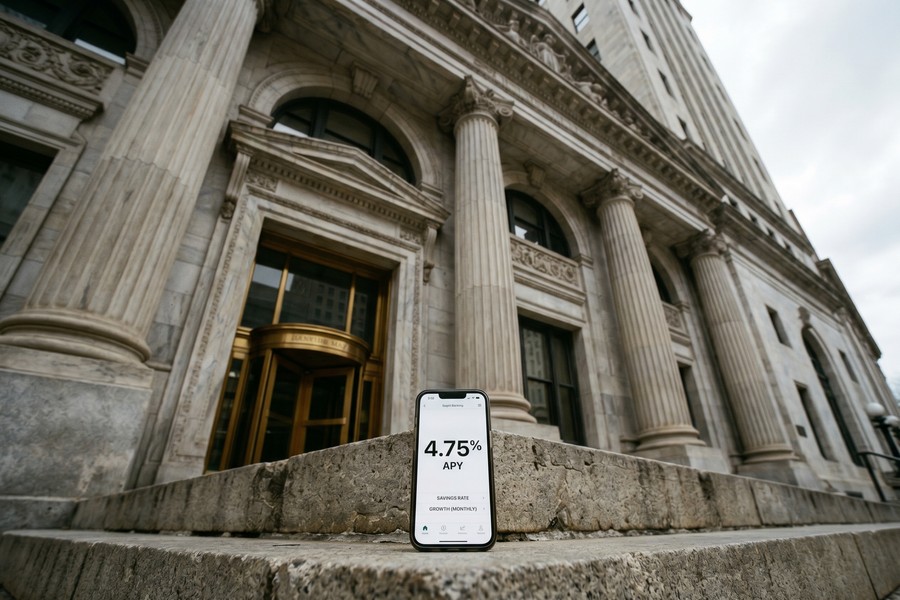
Here’s what makes this moment uniquely painful: the Federal Student Aid data center reports that Americans collectively hold over $1.6 trillion in federal student loan debt, with borrowers aged 25 to 34 carrying the largest share. At the same time, the Federal Reserve’s interest rate cycle has pushed high-yield savings account (HYSA) APYs to their highest levels in over 15 years — some accounts are offering 4.50% to 5.00% APY. That gap between what you owe on loans and what you could be earning on savings is not negligible. For someone with $5,000 in a HYSA at 4.75% APY, that’s nearly $238 in interest earned in a single year, completely passively.
This guide gives you a concrete, data-driven framework for doing both at once: managing student loan repayment and building a high-yield savings cushion that actually grows. You’ll learn exactly how to prioritize, what account features to look for, how to allocate your paycheck down to the dollar, and why opening a HYSA now — even with debt — is often the mathematically smarter move. No vague advice. No generic budgeting pep talks. Just the numbers and the steps.
Key Takeaways
- The average new graduate carries $37,853 in student loan debt, but top high-yield savings accounts currently offer APYs of 4.50%–5.00%, making simultaneous saving mathematically viable.
- Federal student loans have fixed interest rates ranging from 5.50% (undergraduate subsidized) to 8.05% (graduate PLUS loans) for loans disbursed in 2023–2024 — meaning a HYSA earning 4.75% APY can nearly match or exceed some loan rates.
- Income-Driven Repayment (IDR) plans like SAVE can reduce monthly payments to $0 for borrowers earning under roughly $32,800 per year, freeing up cash that can go directly into a high-yield savings account.
- A $3,000 emergency fund in a HYSA earning 4.75% APY earns approximately $142.50 in the first year — protecting you from the credit card debt trap that derails most new graduates.
- Most online HYSAs have no minimum balance requirement and no monthly fees, making them accessible even on a starting salary of $35,000–$45,000 per year.
- Borrowers who enroll in auto-pay on federal loans receive a 0.25% interest rate reduction, effectively lowering the cost of their debt while freeing up mental bandwidth to focus on growing savings.
In This Guide
- Why a High-Yield Savings Account Still Makes Sense With Student Loans
- Understanding Your Loan Interest Rates First
- Using Income-Driven Repayment to Free Up Cash
- How to Choose the Right High-Yield Savings Account
- Top High-Yield Savings Accounts Compared
- How to Allocate Your Paycheck as a New Grad
- Emergency Fund vs. Extra Loan Payments: The Math
- Tax Implications of High-Yield Savings Interest
- Avoiding Common Mistakes New Grads Make
Why a High-Yield Savings Account Still Makes Sense With Student Loans
Many new graduates assume they should throw every spare dollar at their student loans before saving a single cent. That instinct is understandable, but it can leave you financially vulnerable. Without a liquid emergency fund, one unexpected car repair or medical bill forces you onto a credit card — and the average credit card APR is now above 21% according to the Federal Reserve’s G.19 consumer credit report. That’s far worse than any student loan rate you’re carrying.
The core argument for high yield savings with student loans is about liquidity versus interest rate arbitrage. Your student loans are fixed obligations — they don’t disappear whether you save or not. But a HYSA gives you a financial buffer that prevents you from taking on higher-cost debt in an emergency. That buffer has a real dollar value that most financial calculators ignore.
The Hidden Cost of Having No Savings Buffer
Consider this: if you skip building a savings buffer and then charge $2,000 to a credit card at 22% APR, you’d pay roughly $440 in interest over 12 months just to carry that balance. That cost easily exceeds the interest you would have “saved” by putting that $2,000 toward a student loan at 5.50%. The HYSA acts as insurance against that scenario.
Additionally, the psychological benefit of having liquid savings is well-documented. A Global Financial Literacy Excellence Center (GFLEC) study found that financially stressed individuals are less likely to make optimal long-term financial decisions, creating a compounding disadvantage. Savings accounts reduce that stress and improve decision-making quality over time.
A high-yield savings account earning 4.75% APY grows $5,000 into $5,237 in just one year — that’s $237 in completely passive income that costs you zero effort after the initial deposit.
When Saving Beats Extra Loan Payments
If your student loan interest rate is lower than your HYSA’s APY, every dollar you park in savings is mathematically earning more than it would save you in loan interest. For subsidized undergraduate loans at 5.50% versus a HYSA at 4.75%, the gap is narrow — but when you factor in the liquidity benefit and the emergency fund insurance effect, saving first wins. For loans above 7%, the calculus shifts and you should prioritize paydown more aggressively.
Learn more about the best high-yield savings accounts for 2026 to see current APY leaders and which features matter most for new grads.
Understanding Your Loan Interest Rates First
Before you can make smart decisions about high yield savings and student loans simultaneously, you need to know exactly what you’re paying on each loan. Federal student loan rates are set annually by Congress and vary by loan type. Most borrowers have a mix of loan types at different rates, which makes the picture more complicated than a single number.
Private student loans are a different story — they can carry variable rates that have surged as the Fed raised rates, sometimes reaching 12% to 14% APR. If you have private loans at those rates, aggressive paydown should take clear priority over savings beyond a minimal emergency fund.
Federal Loan Rates by Type (2023–2024 Academic Year)
| Loan Type | Fixed Interest Rate | Who Qualifies |
|---|---|---|
| Direct Subsidized | 5.50% | Undergrads with financial need |
| Direct Unsubsidized (UG) | 5.50% | All undergraduates |
| Direct Unsubsidized (Grad) | 7.05% | Graduate students |
| Direct PLUS (Grad/Parent) | 8.05% | Graduate students, parents |
| Private Loans (Variable) | 5%–14%+ | Varies by lender and creditworthiness |
Knowing your exact rate on each loan lets you apply a simple rule: if your loan rate is below your HYSA APY, save first. If your loan rate is above your HYSA APY by more than 1%, pay down debt first (beyond your emergency fund). This framework keeps your strategy grounded in math rather than emotion.
Federal student loan borrowers with undergraduate debt at 5.50% who open a HYSA at 4.75% APY face just a 0.75% gap — small enough that the liquidity benefit of savings outweighs the interest cost difference for most new graduates.
The Auto-Pay Rate Reduction You Shouldn’t Miss
Federal loan servicers offer a 0.25% interest rate reduction when you enroll in automatic payments. On a $30,000 balance at 5.50%, that drops your rate to 5.25% and saves roughly $75 per year. It’s a minor but real reduction that nudges the math even further in favor of simultaneously saving. Always enroll in auto-pay on federal loans — it’s one of the simplest wins available.
Private lenders also frequently offer auto-pay discounts of 0.25% to 0.50%. Check your servicer’s website or call them directly to confirm eligibility.
Using Income-Driven Repayment to Free Up Cash
Income-Driven Repayment (IDR) plans are one of the most powerful and underused tools available to new graduates. They cap your monthly loan payment at a percentage of your discretionary income, which is defined as the difference between your adjusted gross income and a multiple of the federal poverty guideline for your family size. For many entry-level earners, this means dramatically lower payments — sometimes as low as $0 per month.
The SAVE plan (Saving on a Valuable Education), which replaced the REPAYE plan, is particularly favorable. Under SAVE, undergraduate loans are capped at 5% of discretionary income. A single borrower earning $40,000 per year and living in the contiguous U.S. would have monthly payments of approximately $70 to $100 under SAVE — compared to $350 to $400 under the Standard 10-Year Plan.
“Income-driven repayment is not a loophole — it’s a feature of federal student loan policy designed to keep borrowers solvent during the early years of their careers. Using it while building savings is financially responsible, not irresponsible.”
IDR Plans Compared: Which Saves You the Most Cash Monthly?
| IDR Plan | Payment Cap | Forgiveness Timeline | Best For |
|---|---|---|---|
| SAVE | 5% of discretionary income (UG loans) | 10–25 years | Most new grads with federal UG debt |
| IBR (New) | 10% of discretionary income | 20 years | Borrowers who don’t qualify for SAVE |
| PAYE | 10% of discretionary income | 20 years | Pre-2012 borrowers |
| ICR | 20% of discretionary income | 25 years | Parent PLUS loan holders |
The freed-up cash from enrolling in an IDR plan can go directly into a high-yield savings account. If switching from Standard Repayment to SAVE drops your payment from $380 to $100, that’s $280 per month you can redirect to a HYSA. Over 12 months, that’s $3,360 saved — plus the interest it earns. For guidance on paying down debt efficiently alongside savings, see our breakdown of the snowball vs. avalanche debt payoff methods.
Enrolling in an IDR Plan: The Process
You can apply for any IDR plan at StudentAid.gov using the Loan Simulator tool. The application takes about 15 minutes and requires your most recent tax return or pay stubs. Recertification is required annually. Keep in mind that IDR plans do not reduce your total debt — interest continues to accrue — but under SAVE, unpaid interest no longer capitalizes onto your principal if your payment covers the interest, which is a significant protection.
How to Choose the Right High-Yield Savings Account
Not all high-yield savings accounts are created equal. As a new graduate with limited cash, the wrong account can quietly erode your returns through monthly fees, minimum balance penalties, or rate bait-and-switch tactics. Knowing what to look for protects your money from the start.
The first filter is FDIC insurance. Every HYSA you consider should be FDIC-insured (or NCUA-insured for credit unions) up to $250,000 per depositor, per institution. This is non-negotiable. Never park savings in an uninsured account chasing a higher rate.
Key Features to Evaluate
APY is the headline number, but it’s not the only one that matters. Look at whether the APY applies to all balances or only balances above a threshold. Some accounts pay 4.75% only on balances above $1,000 — below that, the rate drops sharply. For a new grad building from scratch, a flat-rate account with no minimums is almost always better.
Use a dedicated HYSA at a separate bank from your checking account. The slight friction of transferring money between institutions discourages impulse spending — a behavioral finance trick that measurably increases savings rates.
Also check the transfer speed between your HYSA and checking account. Some online banks take 2 to 3 business days to move funds. In a true emergency, that delay matters. Look for accounts that offer same-day or next-day ACH transfers, or keep a small $500 “spillover” buffer in your checking account to bridge any gap.
Online Banks vs. Traditional Banks for HYSAs
Traditional brick-and-mortar banks almost universally offer savings account APYs below 0.50% — often as low as 0.01%. Online-only banks, by contrast, have lower overhead costs and pass those savings to depositors in the form of higher rates. The difference is dramatic: a $10,000 deposit earns $1 per year at 0.01% versus $475 per year at 4.75% APY. That’s a $474 annual gap for doing nothing more than picking the right institution.
Top High-Yield Savings Accounts Compared
The HYSA market is competitive and rates change frequently. The table below reflects rates available in early 2025 and is meant to illustrate the landscape rather than serve as a definitive current ranking. Always verify current APYs directly with the institution before opening an account. Our detailed rundown of the best high-yield savings accounts for 2026 is updated regularly and is a good companion resource.
| Institution | APY (Approx.) | Min. Balance | Monthly Fee | FDIC Insured |
|---|---|---|---|---|
| SoFi Bank | 4.60% | $0 | None | Yes |
| Ally Bank | 4.20% | $0 | None | Yes |
| Marcus by Goldman Sachs | 4.40% | $0 | None | Yes |
| American Express HYSA | 4.35% | $0 | None | Yes |
| Discover Online Savings | 4.25% | $0 | None | Yes |
| UFB Direct | 4.83% | $0 | None | Yes |
Notice that every account listed has a $0 minimum balance requirement and no monthly fee. This is the minimum standard you should accept as a new grad. Any HYSA that charges a monthly maintenance fee or requires a minimum balance that you don’t currently have is not worth your time — the fees will eat your interest earnings.
You can open multiple high-yield savings accounts and use them as separate “buckets” — one for your emergency fund, one for a car fund, one for travel — all earning the same high APY. This psychological separation makes saving for multiple goals simultaneously much easier.
If you want to compare HYSAs against other short-term saving vehicles, our analysis of CD rates vs. high-yield savings breaks down exactly when a CD ladder might earn you more — and when the liquidity of a HYSA wins.
How to Allocate Your Paycheck as a New Grad
Knowing you should save is one thing. Knowing exactly how to split each paycheck is another. A clear allocation framework removes the decision fatigue that causes most people to spend first and “save whatever is left” — which is usually nothing. The framework below is built specifically for new graduates juggling student loan payments, living expenses, and savings goals simultaneously.
The starting point is your net monthly take-home pay — what actually hits your bank account after taxes, health insurance premiums, and any 401(k) contributions. For someone earning $45,000 per year gross, that’s roughly $3,000 to $3,200 per month in take-home pay, depending on state taxes and benefits elections.
A Paycheck Allocation Model for New Grads With Loans
| Category | Recommended % | Dollar Amount (on $3,000/mo net) | Priority |
|---|---|---|---|
| Housing (rent + utilities) | 30% | $900 | Fixed |
| Food + Transportation | 15% | $450 | Fixed/Variable |
| Student Loan Payment (IDR) | 5% | $150 | Fixed |
| Emergency Fund (HYSA) | 10% | $300 | High Priority |
| Retirement (401k up to match) | 5% | $150 | High Priority |
| Discretionary Spending | 25% | $750 | Variable |
| Extra Loan Payments / Goals | 10% | $300 | Variable |
Notice that the 401(k) contribution line appears before extra loan payments. That’s intentional. If your employer offers a match — say, 3% of salary — you should always contribute at least enough to capture the full match before making extra loan payments. Failing to get the match is leaving free money on the table. See our guide on how to maximize your 401(k) employer match for details on how this works.
Automating the Allocation
The most reliable way to follow an allocation plan is automation. Set up direct deposit splits through your payroll provider or your bank so that money flows to designated accounts before you can spend it. Most online banks allow you to specify a fixed dollar amount or percentage to route to savings automatically on each pay cycle. This removes willpower from the equation entirely.
Building a realistic monthly budget is the foundation of any allocation strategy. Our guide on how to create a monthly budget that actually works walks through the process step by step for first-time earners.
Emergency Fund vs. Extra Loan Payments: The Math
This is the central question for most new graduates: should extra dollars go toward student loan principal or into a high-yield savings account? The answer depends on your loan rate, your HYSA rate, and how much of an emergency fund you currently have. There is a clear logical sequence to follow.
Phase 1 is building a $1,000 starter emergency fund. This takes priority over everything except your minimum loan payment and 401(k) match. A $1,000 buffer prevents the most common financial emergencies — a car breakdown, an urgent doctor visit — from becoming credit card debt. At 4.75% APY, that $1,000 earns about $47.50 in its first year sitting in a HYSA.
“The emergency fund is not about earning interest — it’s about preventing the far more expensive outcome of carrying high-interest credit card debt. Every dollar you have to put on a credit card at 22% APR is a dollar working against you far harder than any student loan.”
Phase 2: Full Emergency Fund vs. Accelerated Paydown
Phase 2 is the tension zone — building a full 3- to 6-month emergency fund (roughly $6,000 to $12,000 for most entry-level earners) while your student loans accrue interest. The math here favors building the full emergency fund first if your loan rate is below 7%. Here’s why: a 5.50% student loan rate costs you $275 per year on a $5,000 balance. But having no emergency fund and being forced to charge $5,000 to a credit card at 22% APR costs you $1,100 per year. The downside protection is worth four times the loan interest cost.
Once your emergency fund is fully funded in a HYSA, Phase 3 begins: directing surplus cash toward extra loan payments, particularly any loans above 7% APR, while keeping your HYSA intact and growing.
Do not drain your HYSA to make a large lump-sum loan payment and then immediately need to borrow on a credit card. This is one of the most common financial mistakes new graduates make — it feels productive but can leave you worse off within 30 days.
The 5-Year Projection: Saving vs. Extra Payments
Imagine two new graduates, both with $30,000 in federal loans at 5.50% and $500 per month to deploy beyond minimum payments. Graduate A puts all $500 toward extra loan payments. Graduate B puts $300 into a HYSA at 4.75% and $200 toward extra payments. After five years, Graduate A has paid off roughly $6,500 more principal. Graduate B has $18,000 in liquid savings earning interest and has paid off about $5,200 more principal — and hasn’t had to touch a credit card once in five years. The difference in total interest paid is modest. The difference in financial resilience is enormous.

Tax Implications of High-Yield Savings Interest
HYSA interest is not free money from a tax perspective. The IRS treats interest income as ordinary income, meaning it’s taxed at your marginal income tax rate. If you’re in the 22% federal tax bracket, every $100 in HYSA interest costs you $22 at tax time. This is an important factor when comparing the after-tax return of your HYSA to the after-tax cost of your student loan interest.
Your bank or credit union will issue a Form 1099-INT at the end of the year if you earned more than $10 in interest. You must report this income even if you don’t receive a 1099-INT. For a new grad with a modest balance, the tax hit is usually small — but it’s still real and worth planning for.
The Student Loan Interest Deduction
On the other side of the ledger, you may be able to deduct up to $2,500 per year in student loan interest payments on your federal income tax return, subject to income phase-outs. For single filers, the deduction begins phasing out at $75,000 in MAGI and disappears entirely at $90,000. This deduction effectively reduces the real after-tax cost of your student loan interest, which further narrows the gap between your loan rate and your HYSA earnings.
A new grad in the 22% tax bracket who earns $475 in HYSA interest on a $10,000 balance owes approximately $104.50 in federal taxes on that interest — bringing the effective after-tax APY from 4.75% down to about 3.71%. Still higher than many traditional savings accounts, but worth factoring into your comparisons.
State Taxes and HYSA Interest
Most states also tax interest income at their standard income tax rates. A handful of states — including Florida, Texas, and Washington — have no state income tax, which makes the effective yield of a HYSA meaningfully higher for residents there. Factor your state’s rate into your calculations if you’re trying to compare exact after-tax returns with precision.
Avoiding Common Mistakes New Grads Make
The theory of balancing high yield savings with student loans is straightforward. The execution is where most people stumble. Knowing the common failure modes in advance lets you sidestep them before they cost you real money.
Mistake 1: Waiting Until You’re “Comfortable” to Start Saving
New graduates frequently tell themselves they’ll open a HYSA once they have a few thousand dollars “to make it worth it.” But compound interest works on any balance from day one. A $500 deposit in a 4.75% APY account earns $23.75 in the first year — not life-changing, but it establishes the habit and account infrastructure that makes scaling up effortless. Starting late is almost always more costly than starting small.
A new grad who opens a HYSA at age 22 with $50 per month and earns 4.75% APY will have approximately $7,860 saved by age 35 — with $2,360 of that being pure interest earned. Waiting just 5 years to start reduces that total to $4,380.
Mistake 2: Ignoring the Loan Grace Period
Most federal student loans include a six-month grace period after graduation before your first payment is due. This window is a golden opportunity to build your starter emergency fund in a HYSA before your loan payments begin. A new grad who saves $300 per month during a 6-month grace period arrives at their first payment due date with $1,800 already in savings — enough to cover the first five months of IDR payments and then some. Don’t squander this runway.
Interest accrues on unsubsidized federal loans and PLUS loans during the grace period even though payments are not yet required. If you have unsubsidized loans, consider making small interest-only payments during the grace period to prevent interest from capitalizing onto your principal balance.
Mistake 3: Chasing Promotional Rates
Some banks offer introductory “teaser” APYs — for example, 6.00% for the first three months — before reverting to a much lower standard rate. Always look at the ongoing rate, not the promotional one. A 6.00% teaser that drops to 2.50% after 90 days is worse over 12 months than a steady 4.75% APY from day one. Read the fine print on any rate you’re considering.
“The biggest financial mistake I see young graduates make is treating savings and debt repayment as mutually exclusive. They are not. The most resilient financial plans address both simultaneously, even if the amounts are small at first.”
Mistake 4: Not Revisiting Your Strategy After Rate Changes
HYSA rates are variable and move with the federal funds rate. As the Fed adjusts rates, your HYSA APY will change — sometimes significantly. When the Fed cuts rates, HYSA APYs typically fall within weeks. At that point, you may want to reconsider whether locking some savings into a CD ladder strategy makes sense to preserve your current yield. Stay actively informed about rate trends rather than setting your strategy once and forgetting it.
Real-World Example: How Jordan Built $8,400 in Savings While Repaying $41,000 in Student Loans
Jordan graduated with a degree in communications in May 2023 with $41,200 in federal student loans — a mix of subsidized and unsubsidized direct loans at 4.99% to 5.50%. Jordan’s first job as a content coordinator paid $42,000 per year gross, or about $2,850 per month net after taxes and benefits. The standard 10-year repayment plan quoted a monthly payment of $437 — nearly 15% of take-home pay.
Jordan’s first move was applying for the SAVE plan through StudentAid.gov. Based on a $42,000 income and single-filer status, SAVE reduced the monthly payment to $87 — a $350 reduction. Jordan immediately set up automatic transfers of $250 per month to a UFB Direct HYSA earning 4.83% APY and directed $100 per month to extra loan principal payments. During the 6-month grace period (June through November 2023), Jordan had saved $1,500 before the first payment was even due.
By December 2024 — 18 months after graduation — Jordan’s HYSA balance had grown to $4,875, including $127 in accumulated interest. Jordan then received a promotion and a $5,000 raise, bringing the monthly transfer to $350. By June 2025 — exactly two years post-graduation — the HYSA balance reached $8,412. Jordan had also paid down $3,200 in extra principal on the loans, reducing the total balance to $36,640. Meanwhile, the emergency fund covered one car repair ($800) and one urgent dental procedure ($600) without a single dollar charged to a credit card.
The transformation: Jordan went from zero savings and $437 monthly payments to $8,412 in a HYSA, reduced loan payments under $90/month via IDR, and a debt balance trending down — all within 24 months of graduation. The strategy required discipline, but no heroic sacrifice. The SAVE plan and a well-chosen HYSA did the heavy lifting.
Your Action Plan
-
Pull your complete loan picture from StudentAid.gov
Log in to StudentAid.gov and review every federal loan you have: the balance, interest rate, loan type, and servicer. List them in a spreadsheet ordered by interest rate. This is your decision-making foundation. If you have private loans, log into your private servicer’s portal and gather the same data. You cannot optimize what you cannot see clearly.
-
Enroll in auto-pay immediately to lock in your 0.25% rate reduction
Contact your federal loan servicer or log into their portal to set up automatic payments. This instantly reduces your interest rate by 0.25% at no cost. On a $35,000 balance, this saves approximately $87.50 per year. Do the same for any private loans that offer an auto-pay discount.
-
Apply for the SAVE plan (or your best IDR option) to reduce monthly payments
Use the Loan Simulator at StudentAid.gov to see your estimated payment under each IDR plan. Apply for the plan with the lowest payment that fits your situation — for most new grads with undergraduate federal debt, that’s SAVE. The application takes about 15 minutes and can reduce your payment by $200 to $350 per month, which is capital you can redirect to savings.
-
Open a no-fee HYSA with at least 4.25% APY and $0 minimum balance
Choose an FDIC-insured online bank from the comparison table in this article or check our updated rankings. Open the account online — the process typically takes 5 to 10 minutes and requires your Social Security number and a small opening deposit, often as little as $1. Link it to your checking account and verify the trial deposits within 2 to 3 business days.
-
Build your $1,000 starter emergency fund before anything else
Set a specific target date for hitting $1,000 in your HYSA. If you can save $200 per month, you’ll reach this milestone in 5 months. If you got a cash gift at graduation, deploy it here immediately. This $1,000 is not an investment — it’s insurance. Do not touch it except for genuine emergencies.
-
Automate your paycheck allocation using direct deposit splits
Set up automatic transfers so a fixed dollar amount or percentage of every paycheck goes to your HYSA before you can spend it. Most banks let you configure this through their app or online portal. Start with whatever you can afford — even $50 per paycheck — and increase it with every raise. Automation is the single most reliable predictor of savings success.
-
Scale to a full 3-to-6-month emergency fund once your starter fund is complete
Calculate your monthly essential expenses: rent, utilities, food, transportation, insurance, and minimum loan payment. Multiply by three for a minimum emergency fund, or by six if your income is variable or your field has high layoff risk. Continue directing savings to your HYSA until you reach this target. Once you hit it, evaluate whether to start making extra loan payments or pursue other financial goals.
-
Revisit your strategy every 6 months as rates and income change
Set a recurring calendar reminder every January and July to review your HYSA APY, your loan balance, your income, and your IDR payment. If the Fed has cut rates and your HYSA is now earning 2.50%, consider whether a CD or other vehicle makes more sense for a portion of your savings. If you received a raise, update your savings automation to reflect a higher contribution amount immediately — before lifestyle inflation claims the difference.
Frequently Asked Questions
Is it smart to open a high-yield savings account if I have student loans?
Yes, in most cases it is smart — especially for federal student loan borrowers whose rates are at or below 7%. The combination of liquidity protection, interest earnings, and emergency fund insurance makes a HYSA valuable even when you’re carrying debt. The key is not to let the savings account become a reason to avoid making your minimum loan payments or taking advantage of IDR plans.
The high yield savings and student loans strategy works best when you treat the HYSA as a separate financial layer that coexists with — rather than competes with — your debt repayment obligations.
What if my student loan interest rate is higher than my HYSA’s APY?
If your loan rate significantly exceeds your HYSA APY — say, a private loan at 10% versus a HYSA at 4.75% — you should prioritize paying down that high-rate debt beyond your emergency fund. The math is clear: eliminating a 10% debt is equivalent to earning a 10% guaranteed return. Still build a $1,000 starter emergency fund first, but direct surplus cash toward the high-rate loan until it’s gone.
How much should I keep in my high-yield savings account as a new grad?
The standard guidance is 3 to 6 months of essential living expenses. For a new graduate spending roughly $2,200 per month on essentials (rent, food, transportation, insurance, minimum loan payment), that’s a target of $6,600 to $13,200. Start with $1,000 as your first milestone, then build systematically toward the full target over 12 to 24 months depending on your savings rate.
Can I use a money market account instead of a high-yield savings account?
Money market accounts (MMAs) are a legitimate alternative. They often offer similar or slightly higher APYs, may come with check-writing privileges, and are FDIC-insured. The main difference is that MMAs sometimes require higher minimum balances. If you can meet the minimum and the rate is competitive, an MMA can work just as well. Our guide to what a money market account is and whether it’s worth it explains the differences in detail.
Does opening a HYSA affect my student loan repayment options?
No. Having money in a HYSA does not affect your eligibility for Income-Driven Repayment plans, which are based solely on your income and family size — not your assets. Your HYSA balance is an asset, but IDR plans do not count assets in their payment calculations. You can have a fully funded HYSA and still qualify for $0 monthly payments under SAVE if your income is low enough.
Should I pay off my student loans before investing in a Roth IRA?
The general guidance is to capture your full 401(k) employer match first, then build your emergency fund, then consider a Roth IRA — all while making at least minimum loan payments. A Roth IRA offers tax-free growth, which is extraordinarily powerful for a 22- or 23-year-old in a low tax bracket. For most new grads, contributing $50 to $100 per month to a Roth IRA alongside their HYSA and loan payments is the optimal balanced approach. See our breakdown of Roth IRA vs. Traditional IRA to understand which account type suits your current tax situation.
Will HYSA interest earnings disqualify me from the student loan interest deduction?
No. HYSA interest income and the student loan interest deduction are completely separate tax items. HYSA interest is reported as ordinary income on your return. The student loan interest deduction reduces your adjusted gross income by up to $2,500, subject to income limits. Having HYSA income does not affect your eligibility for the deduction, nor does the deduction affect how your HYSA interest is taxed.
What happens to my HYSA rate if the Federal Reserve cuts interest rates?
HYSA rates are variable and will generally fall when the Fed cuts the federal funds rate. Online banks typically adjust rates within days to weeks of a Fed move. This is a key risk of HYSAs relative to fixed-rate products like CDs. If you’re concerned about rate cuts eroding your yield, consider laddering a portion of your savings into CDs to lock in current rates. Our CD rates forecast for 2026 covers what to expect from the rate environment in the near term.
How many high-yield savings accounts can I have?
There is no legal limit on the number of HYSA accounts you can open. Many personal finance experts recommend using 2 to 4 separate accounts as “buckets” — one for your emergency fund, one for a car replacement fund, one for travel or irregular expenses, and so on. Each account earns the same APY, and the separation helps you track progress toward distinct goals without mentally merging them into one undifferentiated pool of cash.
Is my high-yield savings account money protected if the bank fails?
Yes — as long as your account is held at an FDIC-insured bank (or NCUA-insured credit union) and your balance is within the $250,000 per depositor, per institution limit. In the event of a bank failure, the FDIC steps in to make depositors whole, typically within a few business days. You never need to worry about FDIC-insured accounts losing value due to institutional failure. This protection is a key reason to always verify FDIC coverage before opening any savings account.
The FDIC has maintained a 100% track record of protecting insured deposits since its founding in 1933 — covering over $9 trillion in insured deposits across more than 4,500 U.S. institutions as of 2024.
Sources
- Education Data Initiative — Average Student Loan Debt Statistics
- Federal Student Aid — Student Loan Portfolio Data Center
- Federal Reserve — G.19 Consumer Credit Statistical Release
- Federal Student Aid — SAVE Plan Overview and Eligibility
- Federal Student Aid — Loan Simulator Tool
- IRS — Tax Topic 505: Interest Expense (Student Loan Deduction)
- FDIC — Deposit Insurance Coverage: What’s Covered
- Global Financial Literacy Excellence Center (GFLEC) — Financial Literacy Research
- Consumer Financial Protection Bureau — Student Loan Resources
- Federal Student Aid — Income-Driven Repayment Plans Overview
- Federal Reserve — H.15 Selected Interest Rates (Historical)
- IRS Publication 970 — Tax Benefits for Education
- Federal Student Aid — Federal Student Loan Interest Rates