Reviewed by the Prime Rate Editorial Team
Our Take
For first-time homebuyers tracking prime rate headlines to time a mortgage, stop, you are watching the wrong number. The 6.75% prime rate (effective December 2025) has almost no direct bearing on a 30-year fixed mortgage, which is priced against 10-year Treasury yields and mortgage-backed securities. First-timers in 2026 should focus on their credit score tier, loan-to-value ratio, and lender spread instead. The one situation where prime rate matters: if you ever tap a HELOC or consider an ARM, that benchmark becomes directly relevant and the payment risk is real.
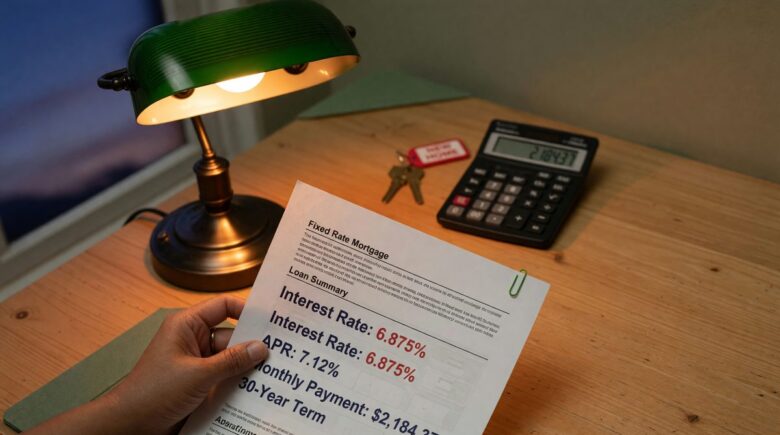
Most first-time homebuyers hear the Federal Reserve announcement, watch the prime rate move, and assume their mortgage quote will follow. That assumption is costing buyers real money, not because rates are high, but because they are shopping for the wrong signal. The 30-year fixed-rate mortgage averaged 6.52% as of June 11, 2026, a figure shaped almost entirely by bond market dynamics that have little to do with what the Fed does to its benchmark overnight rate.
This article is for the first-time homebuyer who has done their homework on prime rate and still cannot figure out why lender quotes look nothing like the number in the headline. What makes the recommendation work is understanding exactly which rates connect to which benchmarks, and where your personal financial profile overrides all of them.
Key Takeaways
- The Bank Prime Loan Rate sits at 6.75%, according to the Federal Reserve’s FRED database, but this benchmark drives ARMs and HELOCs, not 30-year fixed mortgages.
- Nearly 60% of the 50.8 million active mortgages carry rates below 4%, per CFPB research, which explains why so few existing owners are refinancing and why inventory remains constrained for buyers.
- Only 14.3% of mortgages have rates at or above 6%, according to the same CFPB data spotlight, meaning most purchase mortgages issued since 2022 sit in a narrow band that prime rate moves alone did not create.
- The median monthly mortgage payment reached $1,500 in 2024, per the Federal Reserve’s 2025 Economic Well-Being of U.S. Households report, a figure first-time buyers should use as a sanity check against their own lender quotes.
- In my experience reviewing mortgage scenarios with readers, the single most controllable variable is credit score tier. Two buyers with identical prime rate knowledge can receive quotes that differ by half a percentage point or more, purely based on where they fall in a lender’s scoring bands.
Why Prime Rate Headlines Mislead First-Time Buyers on Their Actual Mortgage Quote
The headline problem is simple: financial media covers Fed moves as if they translate directly into mortgage rates. They do not. When the Fed adjusts the federal funds rate, the prime rate follows almost immediately, banks typically set prime at the federal funds target rate plus 3 percentage points. But a 30-year fixed mortgage is a different animal entirely.
Fixed mortgages are priced off 10-year Treasury yields and the secondary market for mortgage-backed securities (MBS). Those markets move on inflation expectations, employment data, and global bond demand. A Fed rate cut can actually push mortgage rates up if bond traders interpret it as a signal that inflation is returning. That counterintuitive dynamic trips up buyers every rate cycle.
What I see in practice: Readers frequently arrive at lender appointments expecting a quote close to whatever rate they saw on a financial news site the morning of. The gap between that mental anchor and the actual quote, adjusted for their credit score and down payment, is often 0.5% to 1%. That gap can mean hundreds of dollars per month.
There is also the personalization layer that media coverage ignores. The rate you read about is typically a best-case quote for a borrower with excellent credit, a 20% down payment, and a conforming loan. First-time buyers with FHA loans, lower credit scores, or high debt-to-income ratios face spreads on top of the benchmark, often 2 to 4 percentage points over the underlying index. A deep dive into how the prime rate affects your mortgage and home equity loan explains this spread mechanics clearly. Understanding that gap between headline rate and your personalized quote is the most important thing a first-time buyer can internalize before shopping.
Prime Rate vs. Fixed Mortgage Rates: The Disconnect Most Buyers Never Learn
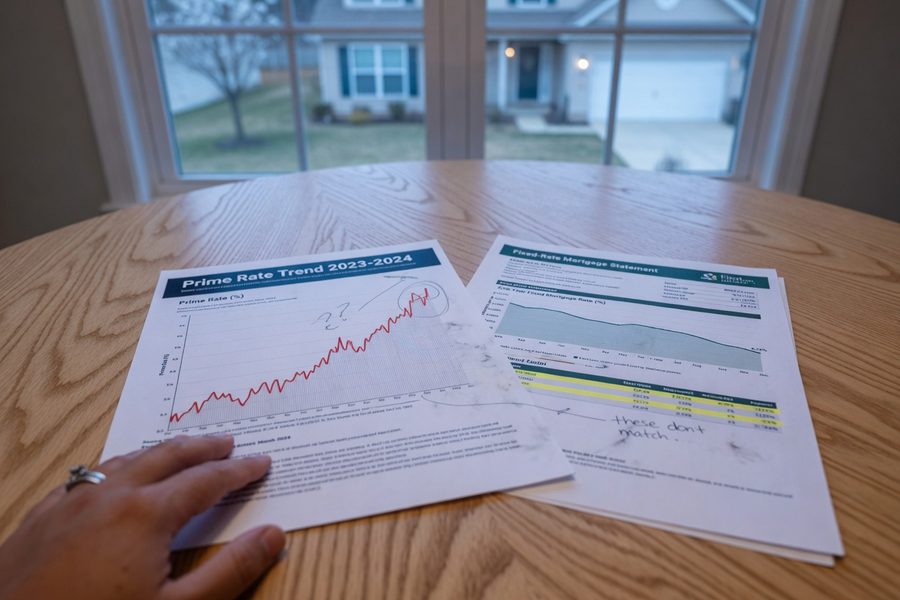
Fixed-rate mortgages do not move with prime rate. Full stop. The 30-year fixed and the prime rate have diverged repeatedly over the past two years, and 2026 is no exception.
Consider the math: the prime rate stands at 6.75%, while the 30-year fixed averaged 6.52% in early June 2026. They are close in absolute value right now, but that proximity is coincidence, not correlation. In prior cycles, the spread between them has swung by several percentage points in either direction. Buyers who waited through 2025 hoping Fed cuts would drag fixed rates down with the prime rate learned this the hard way, the bond market had already priced in those cuts months earlier, and rates barely moved on announcement days.
When Prime Rate Actually Matters to a First-Time Buyer
Prime rate matters the moment you step outside a 30-year fixed mortgage. Adjustable-rate mortgages (ARMs) and home equity lines of credit (HELOCs) are directly tied to prime, usually expressed as prime plus a margin, so a 6.75% prime rate and a lender margin of 1% gives you a 7.75% HELOC rate, for instance.
ARMs and Payment Shock
A 5/1 ARM, popular among buyers who plan to sell or refinance within five years, is fixed for the initial period and then resets annually against an index. Many ARM products today index to the Secured Overnight Financing Rate (SOFR) rather than prime directly, but the exposure to rate movement is real either way. For a first-time buyer who stretches to qualify on an ARM’s initial low payment, a reset in a higher-rate environment can create genuine hardship.
HELOCs and Future Equity Access
Here is the scenario most first-timers do not think about at purchase time: five years from now, you want to tap home equity for a renovation or an emergency. At that point, the prime rate becomes very relevant. Understanding what happens when the prime rate rises matters not just for your savings accounts, it shapes how expensive that future HELOC draw will be. Buying with a fixed rate does not insulate you from prime rate risk indefinitely.
Where this gets tricky: First-time buyers often dismiss ARMs as too risky without doing the arithmetic. For a buyer certain they will sell in four years, a lower ARM rate can save real money. The risk is not the product, it is buyers who use ARMs to qualify for more house than they can afford on a reset payment.
How Lenders Actually Price Your First-Time Homebuyer Mortgage
Your mortgage rate is not prime rate plus a fixed number. Lenders build quotes from several overlapping variables, and the first-time homebuyer prime rate mortgage market is particularly spread-sensitive because these borrowers often present higher risk on multiple factors simultaneously.
The Variables That Move Your Rate
Credit score tiers are the biggest lever most borrowers control. A borrower at 760 FICO and a borrower at 680 FICO can receive quotes from the same lender that differ by 0.5% to 0.75% on the same loan. Loan-to-value ratio matters nearly as much: a 3.5% FHA down payment triggers mortgage insurance premiums that add effective cost beyond the stated rate. Debt-to-income ratio, property type, and whether you are buying a primary residence versus a second home all shift the spread.
Points (discount points) are where buyers often get confused. A lender quoting 6.25% with one point is not offering a better rate than 6.52% with no points, it is offering a buydown that takes years to recoup through monthly savings. On a $350,000 loan at 6.52%, one point costs $3,500 upfront and reduces the rate by roughly 0.25%. The monthly payment difference is about $58. Break-even is approximately five years. For a first-time buyer uncertain about how long they will stay, paying points rarely wins. To understand how a sound monthly budget can absorb mortgage costs, building that break-even analysis into your pre-purchase planning is worth the time.
| Borrower Profile | Approximate Rate (June 2026) | Monthly Payment (on $350,000 loan) |
|---|---|---|
| 760+ FICO, 20% down, conventional | 6.25% | $2,156 |
| 720 FICO, 10% down, conventional | 6.75% | $2,270 |
| 680 FICO, 3.5% down, FHA | 7.00% + MIP | ~$2,430 (with MIP) |
| 640 FICO, 3.5% down, FHA | 7.50% + MIP | ~$2,520 (with MIP) |
The spread between the best and worst scenario above is roughly $364 per month, or about $4,370 per year. That is real money, and prime rate news explains none of it. What does explain it is understanding what a good credit score actually gets you and working to achieve it before you apply.

Timing Your Purchase Around Rate Benchmarks: What Actually Works in 2026
Waiting for prime rate cuts to lower your mortgage quote is almost always the wrong strategy. Bond markets are forward-looking, by the time the Fed announces a rate cut, the 10-year Treasury has typically already moved. Mortgage rates often price in expected cuts months before they happen, and they can rise on the day of the announcement if traders think the Fed is behind on inflation.
What First-Time Buyers Should Do Instead
Rate locks matter more than rate timing. A 45- to 60-day rate lock from a reputable lender protects you from upward movement during the closing process. Shopping at least three lenders on the same day, so you are comparing quotes under identical market conditions, is more valuable than any macro timing strategy. The CFPB’s mortgage rate exploration tool is a practical starting point for understanding how your credit and down payment affect the range of offers you should expect.
One concrete step: if you are worried about rates rising before you close, ask lenders about float-down provisions. Some rate locks allow you to capture a lower rate if market rates drop before closing, for a modest fee. That is a more rational hedge than sitting on the sideline waiting for a prime rate headline.
What clients often miss: The buyers who regret their timing decisions most are not the ones who bought at a “high” rate, it is the ones who waited 18 months, rents kept rising, and they ultimately bought at the same rate anyway. Total cost matters more than rate alone.
If you are still building the financial foundation before buying, getting clear on how to build credit from scratch or understanding how your existing debt load affects your DTI ratio will move your rate more than any Fed announcement.
Where This Recommendation Falls Short
The honest concession here: telling first-time buyers to ignore prime rate entirely is a slight overcorrection, and there are real situations where following benchmark rate movements matters.
The clearest drawback to this article’s position is timing sensitivity. For buyers who are genuinely flexible, not under a lease expiration deadline, not in a competitive bidding situation, there are windows where bond market movement does produce meaningfully lower fixed rates. If the 10-year Treasury yield drops 50 basis points over a quarter, 30-year fixed rates will follow, and a buyer who waits three months could save real money. The catch is that most first-time buyers are not that flexible, and the cost of waiting (continued rent, rising home prices, depleted savings) often exceeds the rate savings.
There is also a tradeoff for buyers considering FHA loans specifically. FHA mortgage insurance premiums are set by the U.S. Department of Housing and Urban Development, not by market rates, and they can change with policy. A buyer laser-focused on benchmark rate timing might overlook a more impactful variable: whether MIP rates or FHA program terms shift in a way that affects total loan cost more than a quarter-point rate move would.
The risk is also different for buyers who genuinely cannot hold a 30-year fixed for the long term. If there is a reasonable chance of selling within five to seven years, job relocation, family changes, income instability, the ARM versus fixed calculation deserves a real look. In that scenario, prime rate matters more, not less, because ARM resets are directly exposed to it. Ignoring prime rate in that context is genuinely bad advice.
The recommendation to focus on credit score, down payment size, and lender comparison holds for the majority of first-time buyers purchasing a primary residence with a fixed loan. It does not hold as cleanly for buyers using ARMs to qualify for higher purchase prices, buyers in high-cost markets where jumbo loan rules apply, or buyers who expect to access home equity aggressively within a few years of purchase.
How We Sourced This
Rate data for this article draws from Freddie Mac’s Primary Mortgage Market Survey (PMMS) for the week of June 11, 2026, and the Federal Reserve’s FRED database for the Bank Prime Loan Rate effective December 11, 2025. Mortgage distribution statistics come from the CFPB’s 2024 Data Spotlight on changing mortgage interest rates. Median payment figures are sourced from the Federal Reserve’s 2025 Report on the Economic Well-Being of U.S. Households, which covers 2024 survey data. Monthly payment calculations in the comparison table use a standard amortization formula applied to the approximate rate ranges shown; FHA figures include an estimated annual MIP of 0.55% for illustrative purposes. This article was written and verified.
Frequently Asked Questions
Does the prime rate directly affect my 30-year fixed mortgage rate?
No, 30-year fixed mortgages are benchmarked against 10-year Treasury yields and mortgage-backed securities markets, not the prime rate. The prime rate (currently 6.75%) primarily drives ARM resets, HELOCs, and consumer credit products like credit cards. Fixed mortgage rates can move independently of and even opposite to prime rate changes.
What rate benchmark should first-time homebuyers actually watch?
Watch the 10-year U.S. Treasury yield. When the 10-year rises, 30-year fixed mortgage rates typically follow within days. The spread between the 10-year yield and the 30-year fixed rate has historically averaged around 1.5 to 2 percentage points, though it has been wider in recent years. That spread, called the mortgage-credit spread, reflects lender risk pricing and secondary market conditions.
How much can my credit score change my mortgage rate?
Substantially. The difference between a 640 FICO score and a 760 FICO score on a conventional loan can produce rate quotes that differ by 0.75% to 1.25% from the same lender. On a $350,000 loan, that spread translates to roughly $175 to $290 per month, far more than most prime rate movements would ever deliver.
Will a Fed rate cut lower my mortgage rate before I close?
Not reliably. Bond markets price in expected Fed cuts weeks or months before the announcement, so mortgage rates often move earlier and smaller than buyers expect. If rates are acceptable today and you have found the right home, a rate lock is more reliable protection than waiting for a Fed announcement that the market has likely already absorbed.
When does prime rate actually matter for a first-time buyer?
Prime rate matters directly if you choose an adjustable-rate mortgage, open a HELOC after purchase, or carry other variable-rate debt. It also shapes the cost of home equity loans down the road. Buyers who purchase with a 30-year fixed rate are insulated from prime rate movement for the life of that loan, but should understand prime rate exposure before taking on any variable-rate product later.
Is an FHA loan priced differently relative to prime rate benchmarks?
FHA fixed-rate loans are priced off the same MBS and Treasury benchmarks as conventional fixed loans, not off the prime rate. The key difference is that FHA loans carry mandatory mortgage insurance premiums set by HUD, which add to the effective cost regardless of benchmark movement. A first-time buyer with lower credit and a small down payment should compare the total cost of FHA (rate plus MIP) against conventional PMI rather than focusing on benchmark rate headlines.
How do I know if the rate a lender quotes me is competitive?
Get quotes from at least three lenders on the same day, using the same loan amount and down payment scenario, so you are comparing apples to apples. The CFPB’s owning-a-home resource walks through loan types and what to expect. Pay attention to APR, not just the stated rate, APR folds in lender fees and gives a truer cost comparison across competing offers.
Sources
- Freddie Mac, Primary Mortgage Market Survey (PMMS), June 11, 2026
- Federal Reserve FRED, Bank Prime Loan Rate, December 2025
- Consumer Financial Protection Bureau, Data Spotlight: The Impact of Changing Mortgage Interest Rates, 2024
- Federal Reserve, 2025 Report on the Economic Well-Being of U.S. Households: Housing, 2024 data
- Consumer Financial Protection Bureau, Explore Interest Rates Tool
- U.S. Department of Housing and Urban Development, FHA History and Program Overview
- Federal Reserve, Selected Interest Rates (H.15), Treasury and Mortgage Benchmarks
- Consumer Financial Protection Bureau, Loan Options for Homebuyers
- Urban Institute, Housing Finance at a Glance: Monthly Chartbook
- Federal Reserve, Federal Open Market Committee (FOMC) Meeting Statements and Rate Decisions