Fact-checked by the Prime Rate editorial team
Key Takeaways
- The prime rate peaked at 8.50% in July 2023 and fell to 7.50% by December 2024, a 100-basis-point drop that automatically saved SBA variable-rate borrowers roughly $3,500 per year per $200,000 outstanding, with no refinancing paperwork required.
- Most equipment financing (captive lenders, fintechs, many online lenders) uses fixed rates set at origination and unaffected by prime rate changes, “variable” only truly matters for SBA 7(a) loans and bank lines of credit used for equipment purchases.
- SBA 7(a) variable rates adjust quarterly, not in real time, giving borrowers a 60–90 day buffer before a Fed rate hike hits their payment, making these loans less volatile than most business owners assume.
- Fixed-rate equipment loans often include prepayment penalties that make refinancing expensive when rates fall, effectively locking in the downside of a high-rate environment with no easy exit.
- The SBA 504 program offers below-market fixed rates pegged to Treasury yields (not prime), only 10% down, and is purpose-built for heavy equipment over $500,000, yet most business owners never hear about it because banks default to pitching the 7(a).
- Variable-rate equipment financing beats fixed most decisively on loan terms under 48 months; on 7–10 year terms, the FDIC notes that variable-rate risk compounds sharply with duration, and fixed becomes the more defensible choice.
In This Guide
- What the Prime Rate Actually Has to Do With Your Equipment Loan
- The Rate Environment in April 2025: Why This Moment Changes the Calculus
- Fixed-Rate Equipment Financing: What You’re Really Paying For
- When Variable-Rate Equipment Financing Genuinely Wins
- SBA 504 vs. SBA 7(a): The Equipment Financing Choice Most Business Owners Get Wrong
- How to Calculate Whether Variable Actually Saves You Money
- Practical Steps: Choosing and Negotiating Your Rate Structure
- The Honest Bottom Line: Variable Wins Under Specific Conditions, Not Always
What the Prime Rate Actually Has to Do With Your Equipment Loan
Here is the question most business owners never think to ask: does the prime rate actually affect your equipment loan, or does it just feel like it should? Prime rate equipment financing is a real product category, but it is narrower than the term implies, and conflating it with all equipment lending leads to decisions based on the wrong framework entirely. The Federal Reserve’s H.15 Selected Interest Rates release defines the Bank Prime Loan Rate as one of several base rates used by banks to price short-term business loans, emphasis on “several,” not “all.”
The majority of equipment loans originated through captive finance companies (think manufacturer-affiliated lenders), most fintech platforms, and many direct-market lenders are priced on fixed collateral-based models. The prime rate does not move those payments. A $150,000 CNC machine financed through a manufacturer’s captive arm at 9.5% will still cost 9.5% if the Fed cuts rates three times. The loan was priced on the equipment’s collateral value and the borrower’s credit profile, full stop. Calling that a “prime rate product” is a category error.
The loans that genuinely float with prime are a specific set: SBA 7(a) variable-rate loans used for equipment purchases, and bank lines of credit drawn down to buy equipment. The SBA’s official 7(a) loan program terms confirm that variable rates are negotiated between borrower and lender subject to SBA maximums pegged to the prime rate. Those maximums cap lender spreads at prime + 2.25% for loans over $250,000 with terms over 7 years, making SBA 7(a) variable loans the most tightly regulated floating-rate product in commercial lending. That regulation matters; it is a meaningful structural difference from unregulated variable products sold by alternative lenders.
How the Prime Rate Is Actually Set
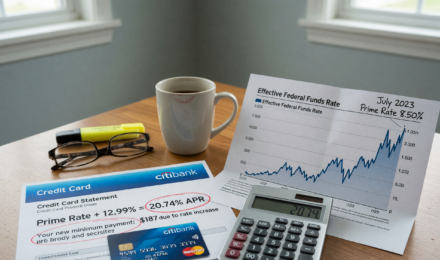
The prime rate is not set by committee vote or market auction. It sits exactly 300 basis points above the federal funds rate target, always has, reliably will. When the Fed moves the funds rate, every major bank adjusts prime within hours. With the funds rate target range at 4.25%–4.50%, prime sits at 7.50%. It peaked at 8.50% in July 2023, the highest level since early 2001, and has since come down 100 basis points through three consecutive cuts in the final months of 2024.
For variable-rate equipment borrowers, that 100-basis-point decline meant their monthly payment dropped automatically. No phone calls. No refinancing costs. No new appraisals. The CFPB’s definition of a variable APR captures this cleanly: a variable-rate product changes with an index rate, and for most commercial equipment loans tied to prime, that index adjustment passes through automatically on a quarterly schedule. Understanding that schedule, and how it differs from real-time adjustment, is one of the most underappreciated features of these loans.
The Bank Prime Loan Rate has tracked exactly 300 basis points above the federal funds rate target for decades. When the Fed acts, prime moves the same day, but your SBA 7(a) variable-rate payment typically does not adjust until the next quarterly reset, giving borrowers up to 90 days of buffer before a rate change hits their statement.
The Rate Environment in April 2025: Why This Moment Changes the Calculus
Prime at 7.50% in April 2025 is a very different number than prime at 7.50% in 2019, because of where it came from. A rate that just fell 100 basis points in 18 months carries a different forward probability distribution than one that has been flat for three years. Borrowers making equipment financing decisions now are not choosing between fixed and variable in a vacuum; they are choosing in the context of the first sustained cutting cycle since 2020, with the question of whether it continues still genuinely open.
The honest answer is that nobody knows. Fed projections for 2025 have been revised repeatedly, and tariff-driven inflation pressures introduced in early 2025 have complicated the path. The Equipment Leasing and Finance Foundation’s U.S. Economic Outlook noted that three Fed rate cuts in the back half of 2024 “should provide a boost to the industry as borrowing costs fall,” but that observation was written before the new inflationary uncertainty took hold. Cuts may continue; they may pause. A variable-rate bet in April 2025 is not a guaranteed win.
What the Cutting Cycle Has Already Done for Variable Borrowers
Even with the uncertainty ahead, the math on what already happened is concrete. Prime fell from 8.50% to 7.50% between July 2023 and December 2024. A business owner carrying $200,000 in SBA 7(a) variable-rate equipment debt saw their interest cost drop by roughly $3,500 per year, automatically, with no action required on their part. A business owner who had locked into a fixed-rate equipment loan at the 2023 peak did not share in that savings at all.
That asymmetry is the core of the variable argument in a cutting cycle. Fixed locks in certainty; it also locks in cost. When prime was rising from 2022 to mid-2023, fixed-rate borrowers looked smart. Since mid-2023, they have been paying a premium compared to the floating-rate alternative, and they cannot easily escape it, prepayment penalties on fixed-rate equipment loans are common and are rarely discussed in lender sales conversations.
Prime rate fell 100 basis points between July 2023 and December 2024, from 8.50% to 7.50%. On a $200,000 SBA variable-rate equipment loan, that single decline saved borrowers approximately $3,500 per year in interest costs, with zero refinancing fees or paperwork.
The Honest Uncertainty: What Could Go Wrong for Variable Borrowers
Tariff-related inflation, if it persists through mid-2025, could force the Fed to hold rates longer than projected, or even reverse course. A business owner who took a variable-rate equipment loan at prime + 2% in early 2025 expecting further cuts could find themselves holding the same rate (or higher) through the full term of a 36-month loan. That is not a catastrophic outcome, but it is a meaningful risk that deserves acknowledgment before signing.
The break-even question is simple: if prime stays at 7.50% or rises during your loan term, a fixed rate locked in below the current variable equivalent wins on total interest cost. If prime falls another 50 basis points or more, variable likely wins. Where do you think rates are going? That is the real question, and the answer depends on your read of inflation, growth, and Fed policy over your specific loan term.

Fixed-Rate Equipment Financing: What You’re Really Paying For
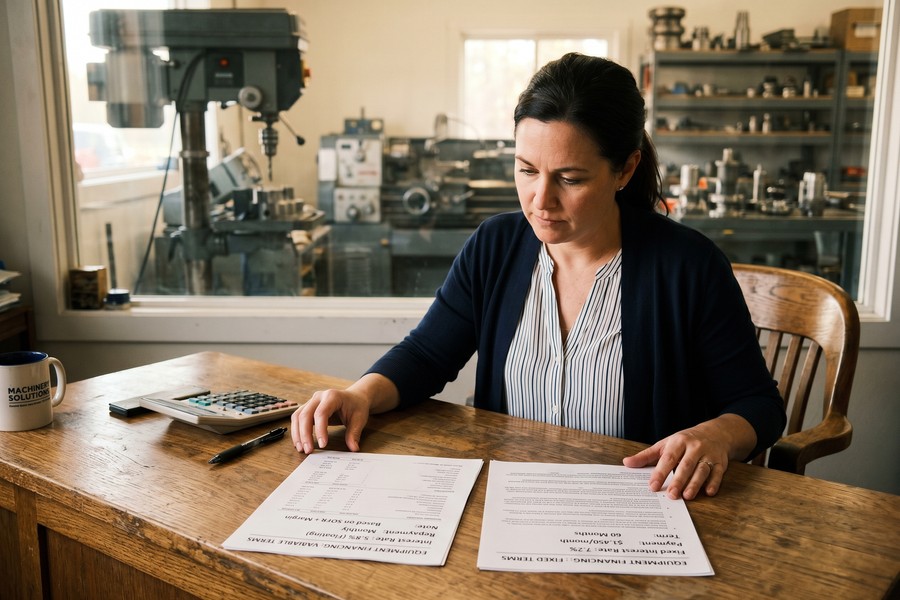
Fixed-rate equipment loans deserve a fair hearing, because the case for them is real, it is just not always the case lenders present. What you are actually buying with a fixed rate is certainty, not cheapness. For a small business with thin margins and a monthly budget that cannot absorb variability, knowing the exact payment on a $150,000 lathe for the next 60 months has genuine operational value. That value is harder to quantify than an interest rate comparison, but it is not imaginary.
To make the stakes concrete: a 2% rate spike on a $150,000 equipment loan with a 5-year term would increase the monthly payment by roughly $130–$150 and add approximately $8,000–$9,000 in total interest over the life of the loan. For a business with predictable revenue and comfortable margins, that is manageable. For a service business running on 10% net margins with lumpy cash flow, it is a different conversation entirely.
The Prepayment Penalty Problem Nobody Talks About
The most underappreciated downside of fixed-rate equipment financing is the exit cost. Many fixed-rate equipment loans, particularly those from bank lenders and captive finance companies, include prepayment penalties that can run 2%–5% of the outstanding balance, or a flat fee equivalent to several months of interest. The practical effect: a business owner who locked in a 12% fixed rate when prime was 8.50% in 2023 cannot simply refinance into a lower rate today without paying a penalty that may offset much of the savings.
This is the part of the fixed-vs-variable debate that rarely appears in lender marketing. Fixed-rate loans are sold as “security,” and they do provide that security against rate increases. But they also lock in the risk that rates fall, and provide no escape hatch without cost. That is not a reason to avoid fixed rates; it is a reason to read the prepayment clause carefully before signing and to factor that exit cost into any scenario analysis. Understanding how the prime rate affects business and personal loan rates broadly helps put the prepayment risk in its proper context.
Fixed-rate equipment loans commonly include prepayment penalties of 2%–5% of the outstanding balance. A business owner who financed $200,000 in equipment at a 2023 peak rate and wants to refinance today could face a penalty of $4,000–$10,000, easily wiping out a year or more of interest savings from a lower rate.
What Fixed-Rate Pricing Actually Reflects
Unlike prime-linked loans, fixed-rate equipment loans from direct lenders are priced primarily on the equipment’s collateral value, the borrower’s credit profile, and the lender’s own cost of funds. A business owner with strong credit financing a newer, highly liquid asset (a commercial vehicle, for example) will typically receive a lower fixed rate than one financing specialized machinery with limited resale market. Prime is not the primary input; the equipment itself is.
This means fixed rates do not automatically drop when the Fed cuts. A borrower who got a 10.5% fixed rate on a forklift in January 2025 will still pay 10.5% even if prime falls to 6.50% by January 2027. The lender priced the rate based on conditions at origination and their own funding costs, not a floating benchmark. That is structurally different from an SBA 7(a) variable loan, and understanding the difference is the foundation of any rational choice between the two.
When Variable-Rate Equipment Financing Genuinely Wins
Short loan terms are the clearest case. On a 24- or 36-month equipment loan, there are only a handful of Fed decision cycles that could move your rate, and the probability of a dramatic, sustained spike in that window is meaningfully lower than on a 7- or 10-year term. Variable rate risk compounds with time; a 3-year variable loan is a different risk proposition entirely from a 7-year one.
The sector hedge is worth noting too. Businesses whose revenues are sensitive to interest rate cycles, construction, real estate services, hospitality, have a natural alignment with variable-rate equipment loans. When the economy softens and the Fed cuts, loan payments fall at roughly the same time revenue comes under pressure. The hedge is imperfect, but it is not accidental. For these businesses, variable-rate equipment financing can function as a partial offset to cyclical revenue risk, not just a bet on rate direction.
SBA 7(a) variable rates adjust quarterly, not monthly or in real time. That means a sudden Fed rate hike does not hit your payment immediately, you have up to 90 days before the adjustment appears on your statement. Most business owners assume variable-rate loans reprice instantly, which overstates the day-to-day volatility of SBA equipment financing.
SBA 504 vs. SBA 7(a): The Equipment Financing Choice Most Business Owners Get Wrong
Most business owners who finance equipment through the SBA do not know the 504 program exists. That is not entirely their fault; banks often default to presenting the 7(a) because it is more profitable for the lender and simpler to administer. The result is that business owners end up choosing between “fixed-rate bank loan” and “SBA 7(a) variable,” when a third option with meaningfully better economics may be available to them.
The SBA 504 program is fixed-rate by design, with rates pegged to U.S. Treasury yields rather than prime. As of early 2025, blended 504 rates for 10-year loans were running in the 6%–7% range for qualifying borrowers, well below what most 7(a) variable loans start at (prime + 1.5% to prime + 4.75% = 9% to 12.25% at current prime). It requires only 10% down on qualifying projects and is specifically designed for heavy equipment with useful lives over 10 years and project costs over $500,000. The Equipment Leasing and Finance Association’s Survey of Equipment Finance Activity tracks this segment as a distinct and growing portion of the $1.3 trillion equipment finance market.
The 7(a) Variable Advantage for Lighter Equipment Needs
Where the 7(a) genuinely fits: equipment under $250,000, shorter useful life assets, situations where working capital needs are bundled with the equipment purchase, and borrowers who want the flexibility to pay down principal faster without penalty. Its variable rate passes through every Fed cut automatically and quarterly, and unlike the 504, it does not require a certified development company as an intermediary, which simplifies the process considerably.
The practical rule for most borrowers: equipment under $250,000 or with a useful life under 10 years, consider the 7(a) variable. For heavy machinery over $500,000 with a 10-plus year productive life, in a falling-rate environment where Treasury yields are also low, the 504’s fixed rate pegged to Treasuries may still produce lower total interest cost than a floating prime-based loan, despite being “fixed.” The comparison is more nuanced than fixed-vs-variable framing suggests.
As you consider further anticipated rate cut(s), capacity reshoring and the potential for 100% bonus being reinstated, we expect companies to increase investments in new technology, resources and production equipment.
| Feature | SBA 504 | SBA 7(a) Variable |
|---|---|---|
| Rate Type | Fixed (Treasury-pegged) | Variable (Prime + spread) |
| Typical Rate (April 2025) | 6%–7% blended | 9%–12.25% |
| Minimum Down Payment | 10% | 10%–20%+ |
| Best For | Heavy equipment $500K+, 10+ year life | Equipment under $250K, shorter useful life |
| Fed Cut Benefit | None (fixed) | Automatic quarterly adjustment |
| Early Payoff Flexibility | Limited; prepayment fees apply | More flexible; SBA-regulated caps |

How to Calculate Whether Variable Actually Saves You Money
The calculation is not complicated, but most borrowers never run it. Consider a $200,000 equipment loan over 5 years: a fixed rate at 10% versus a variable rate starting at 9% (prime 7.50% + 1.50%). The fixed loan carries a monthly payment of approximately $4,249 and total interest over 60 months of about $54,940. The variable loan starts at a monthly payment of roughly $4,151, saving about $98 per month, but only as long as prime stays at 7.50% or falls further.
The break-even question is: how much can prime rise before the variable loan costs more in total than the fixed? On a 5-year term with the rate adjusting quarterly, prime would need to climb approximately 0.75%–1.00% above the starting level and stay there for a sustained period to erase the initial savings advantage. That is entirely possible, particularly if tariff-driven inflation forces the Fed to pause or reverse. Readers who want to track where prime stands in real time should check the Fed’s H.15 release, updated daily.
The Rate Floor Question: Where You Think Rates Are Going
Be direct with yourself about this: if you believe prime will hold at 7.50% or rise during your loan term, fixed wins or breaks even. If you believe prime will fall at least another 50 basis points, to 7.00% or below during the term, variable likely wins on total cost. The honest answer in April 2025 is that reasonable people disagree, and the Fed’s own projections have been revised multiple times in the past 18 months.
One detail that makes variable less risky than it sounds: the quarterly adjustment period on SBA 7(a) loans. A sudden Fed hike in October does not hit your payment until January. That buffer does not eliminate rate risk, but it gives borrowers time to respond, build reserves, accelerate principal paydown, or explore refinancing. Treating an SBA 7(a) variable loan as equivalent to a daily-repricing product overstates its volatility considerably.
Before comparing fixed vs. variable, ask your lender for the exact adjustment schedule and spread margin on the variable option. The headline rate matters less than knowing precisely when adjustments occur, what index they use, and whether the lender offers a rate cap or a one-time conversion to fixed. These details change the risk profile significantly and are fully negotiable in many cases.
| Scenario | Fixed at 10% | Variable Starting at 9% |
|---|---|---|
| Loan Amount | $200,000 | $200,000 |
| Term | 60 months | 60 months |
| Starting Monthly Payment | ~$4,249 | ~$4,151 |
| Monthly Savings (initial) | ~$98/month | |
| Total Interest (prime flat) | ~$54,940 | ~$49,100 |
| Break-Even Prime Increase | ~+0.75% sustained |
Practical Steps: Choosing and Negotiating Your Rate Structure
The first step, and it is genuinely important, is to confirm what kind of lender you are talking to. Bank lenders and SBA-approved lenders pass Fed cuts through to variable-rate borrowers on the quarterly schedule. Online lenders like OnDeck, many fintech platforms, and most equipment-specific alternative lenders use fixed rates set at origination that do not move with prime. A loan described as “variable” by a non-bank lender may not actually benefit from Fed cuts at all; the “variable” label sometimes refers only to the factor rate structure, not a prime-indexed floating rate.
This distinction is almost never surfaced in equipment financing articles or lender presentations, which is why so many business owners are surprised when their “variable rate” loan from a fintech platform does not drop when the Fed cuts. Ask the lender directly: “Is this loan indexed to the WSJ Prime Rate, and does my payment adjust automatically when prime changes?” If the answer is anything other than a clear yes, you are looking at a fixed product under a different name. Understanding how the prime rate moves through the broader financial system gives helpful context for asking these questions confidently.
Negotiating the Margin, Not Just the Headline Rate
For prime-indexed loans, the lender’s spread is where negotiating leverage lives. The headline rate (prime + 2% vs. prime + 3%) is the number that gets attention, but the spread is often negotiable, particularly for borrowers with strong credit, quality collateral, or an existing banking relationship. A 1% difference in the spread on a $300,000 loan saves $3,000 per year in interest. Over a 5-year term, that is $15,000, more than enough to justify asking the question.
Credit score matters here. A business owner who has built and maintained a strong credit profile is in a genuinely better negotiating position on spread than one who has not. Lenders price the spread partly on default risk, and a higher credit score signals lower risk, which translates directly to margin. The same is true for collateral quality: newer equipment with a deep secondary market commands better terms than specialized machinery with limited resale value.
Rate Caps and Conversion Options: Features Worth Asking For
Some bank lenders and SBA-approved lenders offer variable-rate equipment loans with interest rate caps, a ceiling the rate cannot exceed regardless of where prime goes. A cap at prime + 3% on a loan currently priced at prime + 1.5% provides meaningful insurance against a severe rate spike without eliminating the benefit of downward rate movement. Similarly, a one-time conversion option (the right to convert from variable to fixed at a future point) can make a variable loan significantly safer, particularly for borrowers uncertain about the rate direction.
These features are not universally available, and lenders rarely volunteer them. But they exist, and asking for them before signing costs nothing. A lender unwilling to discuss rate caps or conversion options on a variable product is worth questioning, particularly if the loan term is 5 years or longer.
The SBA caps lender spreads on 7(a) variable-rate loans at prime + 2.25% for loans over $250,000 with terms over 7 years. On a $300,000 loan, the difference between a lender charging prime + 2.25% versus one charging prime + 3.25% is $3,000 per year, making spread negotiation one of the highest-return conversations a borrower can have before signing.
| Lender Type | Rate Type | Prime Cut Passthrough | Best For |
|---|---|---|---|
| SBA-Approved Bank | Variable (prime-indexed) | Yes, quarterly | Borrowers who want Fed cut benefits |
| Traditional Bank (non-SBA) | Fixed or variable (line of credit) | Usually yes on lines of credit | Relationship-based borrowers |
| Captive Finance (manufacturer) | Fixed (collateral-based) | No | Simple financing of specific equipment |
| Online/Fintech Lender | Fixed (origination-priced) | No | Speed and convenience; not rate flexibility |
| SBA 504 CDC | Fixed (Treasury-pegged) | No | Heavy equipment, long useful life, low down payment |
The current interest rate environment is night and day compared to the past two spring buying seasons. Interest rates are approximately 4% higher today than they were in the spring of 2021.
The Honest Bottom Line: Variable Wins Under Specific Conditions, Not Always
Variable-rate equipment financing beats fixed in April 2025 under a specific set of conditions: the loan term is under 4 years, the business can absorb a 1–2% payment increase without disrupting cash flow, the lender actually passes Fed cuts through to the borrower (meaning it is a bank or SBA lender, not a fintech), and the borrower has reasonable basis to believe prime will hold flat or fall during the loan term. All four conditions matter. Missing one changes the answer.
Fixed deserves honest credit too. For equipment with 7–10 year useful lives, the kind of capital investment where certainty over a long horizon has real operational value, fixed is the rational choice even if it costs slightly more in total interest. For businesses with thin margins where a $200/month payment increase could disrupt payroll, the certainty of fixed is a financial planning tool, not just a comfort. And for owners who simply will not sleep well with a floating rate, that psychological cost is real and should factor into the decision. Knowing how to build a monthly budget that absorbs variable costs can help determine whether your cash flow can genuinely handle rate fluctuation before you commit.
The action before choosing: run both scenarios to their full term using current actual rates from the specific lender you are considering. Ask for the adjustment schedule, the cap structure, and the prepayment terms in writing. Then decide. The math is not mysterious, it just requires doing it.
Business owners who financed equipment at fixed rates when prime was 8.50% in mid-2023 are now paying a 100-plus basis-point premium over what a new fixed-rate loan would cost today, and many cannot refinance affordably due to prepayment penalties. Fixed-rate financing locks in certainty, but it also locks in today’s rate risk on the upside. That cuts both ways.
According to the Equipment Leasing and Finance Association, industry analysts expect companies to increase investments in new technology, resources, and production equipment as rate cuts continue and capacity reshoring accelerates, suggesting equipment financing demand will grow as the rate environment improves for variable-rate borrowers.
| Business Situation | Better Choice | Primary Reason |
|---|---|---|
| Loan term under 36 months | Variable (SBA 7a) | Limited rate-change cycles; initial savings meaningful |
| Loan term 7–10 years | Fixed or SBA 504 | Duration amplifies variable risk; certainty has real value |
| Heavy equipment $500K+ | SBA 504 (fixed) | Treasury-pegged rate often below prime-based variable |
| Cash flow tight or seasonal | Fixed | Payment certainty protects thin-margin operations |
| Rate-sensitive revenue sector | Variable | Natural hedge, loan costs fall when revenues soften |
| Strong credit, negotiating leverage | Variable (negotiate spread) | Margin reduction amplifies interest savings over term |
Real-World Example: Variable vs. Fixed on a Manufacturing Equipment Purchase
Consider an illustrative example: a regional manufacturer needs to finance $250,000 in CNC machining equipment in early 2024, when prime is at 8.50%. Two options are on the table. Option A: a fixed-rate equipment loan at 11.5% from a captive lender, 60-month term, monthly payment approximately $5,481, total interest over the term approximately $78,860. Option B: an SBA 7(a) variable-rate loan at prime + 2.25% (10.75% starting rate), 60-month term, monthly payment approximately $5,384 at origination.
By December 2024, prime has fallen to 7.50%. The SBA variable loan reprices to 9.75% on the quarterly adjustment date. The new monthly payment drops to approximately $5,198, a reduction of $186 per month from origination. The fixed-rate borrower still pays $5,481. Over the next 12 months, the variable borrower saves roughly $2,230. The fixed-rate borrower explores refinancing into the lower-rate environment but discovers a prepayment penalty of 3% on the outstanding balance, approximately $6,900, that erases more than three years of savings from refinancing. They stay in the original loan.
By April 2025, with prime still at 7.50%, the variable borrower has accumulated approximately $3,700 in savings relative to the fixed-rate option. Even if prime rises 50 basis points at the next Fed decision, the variable borrower maintains an advantage through the end of year two. The variable loan does not “win” definitively until it runs at least 48 months, but it has been winning consistently since the first quarterly repricing, and the fixed-rate borrower has no cost-effective way out.
The lesson is not that variable always wins. If prime had risen 100 basis points instead of falling, the picture would reverse: the fixed borrower would be saving $180–$200 per month relative to the variable option. The outcome depends almost entirely on rate direction during the loan term, and on whether the fixed-rate loan contains exit costs that make it more permanent than it first appears. Running this scenario forward before signing, using your best honest estimate of rate direction, is the single most valuable thing a borrower can do.
Your Action Plan
-
Identify what type of lender you are actually dealing with
Before comparing fixed and variable rates, confirm whether the lender is an SBA-approved bank, a traditional bank offering lines of credit, a captive finance company, or an online/fintech lender. Only the first two categories offer prime-indexed variable rates that automatically pass Fed cuts through to your payment. A “variable rate” from a fintech or captive lender is typically a fixed rate by another name. This single step narrows the decision considerably.
-
Get the exact spread and adjustment schedule in writing
For any variable-rate product, ask for the margin over prime (e.g., prime + 1.75%), the specific index used (WSJ Prime Rate is standard), and the precise adjustment schedule, quarterly is typical for SBA 7(a) loans, but confirm it. This information should be in the loan term sheet; if a lender cannot provide it clearly, that is a red flag about the product’s structure.
-
Run the full-term comparison using both scenarios
Use the current prime rate (7.50%) to calculate the starting variable rate, then model two forward scenarios: prime holds flat for the full term, and prime falls 50 basis points within 12 months. Compare total interest cost against the fixed option under both scenarios. The break-even rate level, the point at which prime would need to rise for fixed to be cheaper, is the most useful single number this exercise produces.
-
Check your loan term against the risk curve
Loan terms under 36 months carry meaningfully lower rate-change risk than terms of 7–10 years. If your equipment has a useful life over 10 years and the project cost exceeds $500,000, research the SBA 504 program specifically. Its Treasury-pegged fixed rate is frequently lower than what a prime-indexed variable loan starts at, making it a third option that often outperforms both alternatives in that segment.
-
Negotiate the spread on any prime-indexed loan
On SBA 7(a) variable loans, the lender’s spread is negotiable based on credit score, collateral quality, and business relationship. Pull your business credit report and personal credit report before approaching lenders. Know your score, know the quality of your collateral, and ask competing lenders for their best spread. A 1% reduction in margin on a $250,000 loan saves $2,500 per year, over a 5-year term, that is $12,500, which more than justifies the conversation.
-
Ask about rate caps and conversion options before signing
Some bank lenders offer variable-rate equipment loans with interest rate caps, a ceiling the rate cannot exceed, or a one-time option to convert to fixed mid-term. These features make variable significantly safer and are worth requesting before the loan documents are finalized. If the lender does not offer them, ask whether a slightly higher starting spread would buy a cap. The answer may be yes.
-
Read the prepayment clause on any fixed-rate option
Before accepting a fixed-rate equipment loan, locate the prepayment penalty language, not just the rate and term. Penalties of 2%–5% of outstanding balance can make refinancing into a lower-rate product economically irrational even after a significant rate drop. If the fixed-rate loan you are considering has a substantial prepayment penalty and a term over 5 years, the actual cost of “certainty” is higher than the headline rate suggests. Factor that into your comparison.
Frequently Asked Questions
What is the current prime rate and how does it affect equipment financing in April 2025?
The prime rate stands at 7.50%, down from a peak of 8.50% in July 2023. For equipment financing, this matters primarily for SBA 7(a) variable-rate loans and bank lines of credit used to purchase equipment, both of which are indexed to prime. If your equipment loan is from a captive finance company or online lender with a fixed rate set at origination, the prime rate does not directly affect your payment.
Does every variable-rate equipment loan automatically benefit when the Fed cuts rates?
No, and this is one of the most consequential misunderstandings in equipment financing. Only loans genuinely indexed to the prime rate (primarily SBA 7(a) variable loans and bank lines of credit) pass Fed cuts through to the borrower. Many online lenders and fintech platforms use fixed rates set at origination, even when they use the word “variable” loosely. Always ask your lender directly: “Is this loan indexed to the WSJ Prime Rate, and does my payment adjust automatically each quarter?”
How often does a variable-rate SBA 7(a) equipment loan reprice?
SBA 7(a) variable-rate loans typically reprice quarterly, not in real time or monthly. That means a Fed rate change does not hit your payment immediately, there is a buffer of up to 90 days before the adjustment appears. This makes SBA variable loans less volatile in practice than borrowers often expect. A sudden rate hike in October, for example, would not change your payment until January.
Are there SBA loan caps that protect variable-rate borrowers from unlimited rate increases?
Yes. The SBA regulates the maximum spread lenders can charge on 7(a) variable-rate loans. For loans over $250,000 with terms over 7 years, lenders cannot charge more than prime + 2.25%. For loans under $50,000, the cap is higher. These regulated caps make SBA 7(a) variable loans significantly safer than unregulated variable-rate products from alternative lenders, where spreads and adjustment terms may be far less borrower-friendly.
What is the difference between an SBA 504 and an SBA 7(a) loan for equipment financing?
The SBA 504 offers below-market fixed rates pegged to U.S. Treasury yields, requires only 10% down, and is specifically designed for heavy equipment projects over $500,000 with useful lives of 10 years or more. The SBA 7(a) is more flexible, useful for lighter equipment, shorter useful lives, or when working capital needs are bundled with the equipment purchase, and its variable-rate structure passes Fed cuts through automatically. Most business owners only hear about the 7(a) because banks default to presenting it; the 504 may be the better option for substantial capital equipment investments.
Can a business owner with a fixed-rate equipment loan refinance to take advantage of lower rates?
Technically yes, but often not economically. Many fixed-rate equipment loans include prepayment penalties of 2%–5% of the outstanding balance. A borrower carrying $180,000 on a fixed-rate loan could face a penalty of $3,600–$9,000 to exit early. Depending on how much the new rate saves per month, it may take 2–4 years of payments to break even on the refinancing cost. Run that calculation explicitly before deciding to refinance, and factor the prepayment cost into the total picture.
Is variable-rate equipment financing too risky for a small business with tight margins?
It depends on the loan term and the size of the potential payment increase. On a short 24- or 36-month loan, even a 1% rate spike increases monthly payments by a manageable amount, on a $150,000 loan, roughly $60–$75 per month. On a 7-year loan, the cumulative risk is much larger, and businesses with thin margins may find that payment certainty is worth the extra interest cost. The right answer depends on your cash flow cushion, your loan term, and whether your lender offers a rate cap. Understanding how to structure debt payoff strategically can also help businesses manage variable-rate exposure by reducing principal faster during low-rate periods.
Sources
- Federal Reserve Board of Governors, H.15 Selected Interest Rates: Bank Prime Loan Rate
- U.S. Small Business Administration, SBA 7(a) Loan Program: Terms, Conditions, and Eligibility
- Consumer Financial Protection Bureau, Fixed APR vs. Variable APR: What Is the Difference?
- Equipment Leasing and Finance Association, 2025 Survey of Equipment Finance Activity (SEFA)
- Equipment Leasing and Finance Foundation, U.S. Economic Outlook Report
- Equipment Leasing and Finance Association, Industry Outlook: Rate Cuts and Equipment Investment, November 2024
- AgDirect (Farm Credit), Fixed Versus Variable Rate Financing
- U.S. Small Business Administration, SBA 504 Loan Program Overview
- Federal Reserve, Open Market Operations and Federal Funds Rate Target History
- The Wall Street Journal, Money Rates: WSJ Prime Rate
- National Federation of Independent Business, Small Business Economic Trends Survey