Reviewed by the Prime Rate Editorial Team
Our Take
A variable rate line of credit is structurally more complex than a variable-rate loan, and most borrowers underestimate that complexity until it costs them. For open-ended, staged expenses in a stable or falling rate environment, a line of credit wins because interest accrues only on what you draw. The case against: if rates rise while you are still drawing, you face a double exposure, a higher rate on a growing balance, that a fixed-disbursement variable-rate loan cannot produce. Know which situation you are actually in before you sign.
The Federal Reserve’s rate-hiking cycle pushed the average HELOC rate to 10.16% in early 2024, according to Bankrate’s 2024 HELOC rate forecast, a level that surprised borrowers who opened lines when rates sat near historic lows. The surprise was not just the rate itself; it was how fast it arrived, and how different the math felt compared to a standard installment loan.
This article is for borrowers weighing a revolving line of credit against a variable-rate installment loan and trying to understand why the two products behave so differently in practice. The recommendation turns on one structural question: do you know exactly how much you need to borrow, and when?
Key Takeaways
- Interest on a variable rate line of credit accrues only on the drawn balance, so a borrower approved for $121,613 (the average HELOC credit limit in 2024 per Experian) pays interest only on what is actually used, not on the full limit.
- HELOC rates dropped from 9.36% in September 2024 to 8.48% by year-end 2024 following Fed rate cuts, according to CBS News and Bankrate data, a repricing speed that fixed-disbursement installment loans do not match.
- The average two-year personal loan rate was 12.32% in Q4 2024, per Federal Reserve data via Experian, meaning rate alone does not make lines of credit cheaper, utilization behavior and timing matter more.
- Total HELOC debt outstanding reached $359.9 billion in 2024, the third consecutive year of growth after a decade of decline, per Experian’s 2024 HELOC study, suggesting consumers are returning to revolving home equity credit even as rates remain elevated.
- In my experience reviewing how borrowers respond to rate changes, the payment shock at the end of a draw period catches more people off guard than the rate itself, a structural problem that no rate cap can fix.
Revolving Credit vs. Installment Debt: The Core Structural Difference
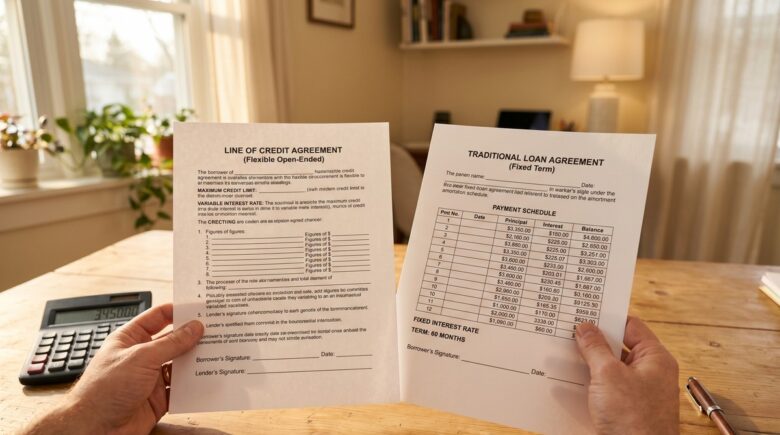
The most important difference between a variable rate line of credit and a variable-rate loan has nothing to do with the interest rate. It is the disbursement structure. A variable-rate loan hands you a fixed lump sum on day one, starts amortizing immediately, and gives you a payoff date. A revolving line of credit does none of those things.
With a line, you draw what you need, repay it, and draw again, repeatedly, up to your credit limit and within the draw period. The Federal Reserve’s G.19 statistical release formally distinguishes revolving consumer credit (which includes lines of credit) from nonrevolving installment loans, precisely because the mechanics of how principal accumulates and how interest is calculated differ in kind, not just degree.
Here is what that means in practice. Two borrowers approved for the same $50,000 line can have monthly obligations that look nothing alike. One draws the full amount on day one and holds it; the other draws $10,000, repays $8,000, and draws $5,000 more. Their rates may be identical; their interest charges will not be.
Why the “Loan Amount” Is Never Fixed on a Line
On a standard installment loan, the principal is static at origination. The rate changes; the principal does not until you pay it down. On a line of credit, the outstanding balance, effectively the principal on which interest accrues, shifts every time you draw or repay. The CFPB’s consumer guidance on HELOCs describes this as an open-end revolving structure with a draw period and a repayment period, and notes that the lender may even freeze or reduce the line if the home’s value drops or the borrower’s financial situation changes, a constraint with no equivalent on an already-disbursed installment loan.
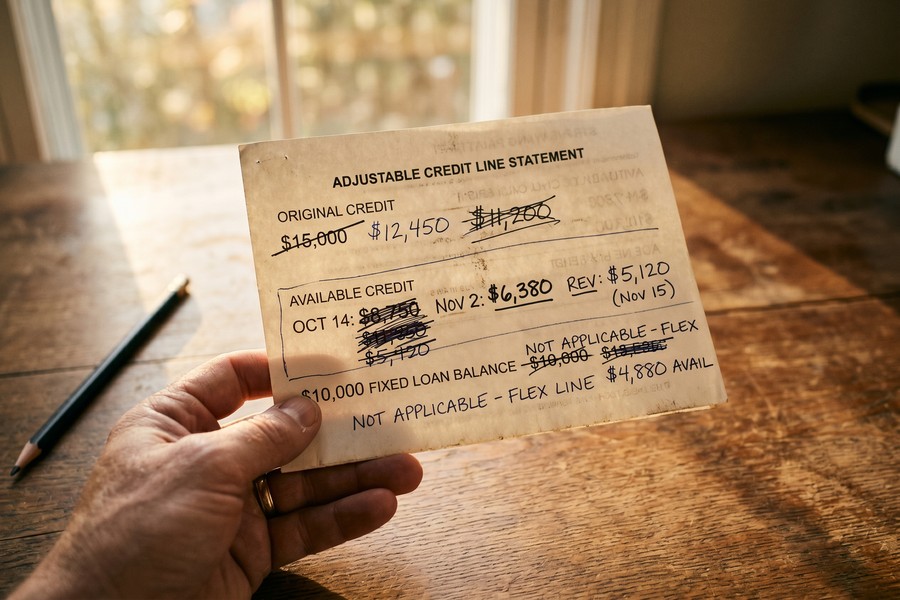
What I see in practice: Borrowers frequently compare the rate on a line of credit to the rate on a loan and stop there. That comparison misses the question that matters more: how much of the approved amount will you actually use, and for how long? The answer to that question does more work than the rate itself when projecting total interest paid.
Repricing Speed and What It Actually Costs You
Both products use the index-plus-margin formula, usually the Wall Street Journal Prime Rate as the index, but the adjustment frequency is where they diverge sharply, and that frequency has real dollar consequences.
Most personal lines of credit and HELOCs reprice monthly or quarterly, within roughly 30 days of a Prime Rate change. A 5/1 ARM mortgage, by contrast, holds its initial rate for five years before adjusting annually. The Prime Rate sits exactly 3 percentage points above the federal funds rate and moves within days of each Fed decision, making open lines of credit the fastest-responding consumer debt product outside of credit cards.
Consider what that meant during the Fed’s 2022–2023 tightening cycle. A borrower who opened a HELOC in early 2022 at roughly 4% watched that rate climb toward 9% and then past it within 18 months. A borrower who took a 5/1 ARM mortgage in the same month did not feel a single adjustment until 2027. The CFPB’s official HELOC booklet explains that the borrower’s cost depends on the publicly available index plus the lender’s margin, and that the rate paid will change to mirror changes in that index, with no multi-year grace period built in.
This repricing speed is also what makes a line of credit respond faster to rate cuts. The drop from 9.36% to 8.48% between September and December 2024 happened quickly precisely because the structure requires no waiting period. That cuts both ways, though.
Where this gets tricky: Borrowers sometimes open a line of credit expecting rate cuts to lower their cost within months, then find that the Fed pauses longer than expected. The monthly repricing mechanism that feels like an advantage in a falling-rate environment becomes a liability the moment the Fed reverses course.
Payment Mechanics: The Draw Period, the Repayment Period, and the Shock Between Them
Most lines of credit require only an interest-only minimum payment during the draw period. That sounds manageable, until you consider what it means structurally. A borrower who makes only the minimum payment for ten years has repaid exactly zero principal. When the draw period closes and the repayment period opens, the entire drawn balance must now amortize over a compressed 15- to 20-year window.
Even with no rate change at all, that shift can roughly double the required monthly payment. Here is a worked example using actual figures. A borrower carries the average HELOC balance of $45,157 at 8.48% (the year-end 2024 average rate). During the draw period, the interest-only minimum is approximately $319 per month. In the repayment period, assuming a 20-year amortization at the same rate, the payment rises to roughly $391 per month. That is a 23% increase with no rate change. If the rate climbs back toward 10% during the repayment period, the same balance costs approximately $436 per month. The payment shock is structural; the rate is an amplifier on top of it.
Fixed-disbursement variable-rate loans produce no equivalent shock. The payment adjusts when the rate adjusts, but the amortization schedule is continuous from day one. There is no transition from interest-only to fully amortizing. If the prime rate affects your personal loan rate, the monthly payment shifts, but only because of the rate, not because the entire repayment structure just changed underneath you.
| Feature | Variable Rate Line of Credit | Variable-Rate Installment Loan |
|---|---|---|
| Disbursement | Draw as needed, up to credit limit | Full lump sum on day one |
| Interest Accrues On | Drawn balance only | Full principal from origination |
| Rate Repricing Frequency | Monthly or quarterly (within ~30 days of Prime Rate change) | Per loan terms; variable personal loans rare in the U.S. |
| Payment During Draw Period | Interest-only minimum (most products) | Principal + interest from day one |
| Payment Shock Risk | High, payment can roughly double at draw period end | None, no draw/repayment period transition |
| Rate Cap Protections | Lifetime cap required for HELOCs; unsecured lines often have fewer caps | Fixed rate most common; terms fixed at origination |
| Ongoing Fees | Annual/monthly maintenance, inactivity, and draw fees possible | Origination fee at closing only; no ongoing account fees |
Rate Caps and the Fine Print Most Borrowers Skip
HELOCs are required to disclose a lifetime rate cap. A common structure limits the rate to the starting rate plus 6 percentage points. The CFPB’s Regulation Z, Section 1026.40 requires creditors to disclose the index, the margin, and how those combine into the APR, and prohibits lenders from increasing the margin based on a borrower’s changed financial circumstances, limiting them instead to freezing or reducing the credit line.
Unsecured personal lines of credit operate under fewer constraints. They sometimes carry no periodic caps at all, meaning the rate can theoretically move more aggressively in a single adjustment period than an ARM mortgage would permit. This consumer-protection gap rarely gets discussed in personal finance coverage, but it matters. A borrower who assumes a personal line of credit behaves like an adjustable-rate mortgage, because both are “variable rate,” may be carrying more rate risk than they realize.

The Fee Layer That Changes the Total-Cost Comparison
Rate comparisons between a line of credit and a loan are useful but incomplete. Lines of credit often carry annual or monthly maintenance fees, per-draw transaction fees, and inactivity fees, costs that accumulate whether the borrower uses the line or not. A variable-rate loan has no ongoing account fee once originated.
The APR on a line of credit is calculated on a hypothetical fully-drawn balance. If you draw only $15,000 on a $50,000 line, the actual cost of that borrowing includes fees spread across a smaller balance, which drives the true effective rate higher than the quoted APR suggests. Comparing APRs across the two products without adjusting for utilization is a common mistake. For borrowers already thinking carefully about how to pay off debt strategically, this fee asymmetry is worth modeling before opening a line.
What clients often miss: An inactivity fee on a low-use line of credit can easily exceed the interest savings from drawing only a fraction of the limit. I have seen borrowers open a $30,000 line for a project that ultimately cost $8,000, then pay maintenance fees for three years on a nearly idle account, erasing most of the interest advantage they expected.
Where This Recommendation Falls Short
The case for a variable rate line of credit is real and defensible, but it only holds in specific conditions, and the tradeoffs are substantial enough that the wrong borrower in the wrong rate environment will pay more, not less.
The catch is utilization behavior. A line of credit is cheaper than a loan only when you draw less than the full approved amount, repay promptly, and the rate environment is stable or falling. If rates are rising and you are still drawing, a scenario that describes many home-renovation borrowers who hit unexpected costs mid-project, you face a compounding effect that a fixed-disbursement loan cannot produce. The outstanding balance grows while the rate climbs. Both move against you at the same time. On a variable-rate loan, the principal is fixed from day one; the rate can change, but the exposure is capped at the original loan amount.
The drawback for borrowers with tight monthly budgets is the payment-shock risk at the draw period’s end. Someone who budgets around an interest-only minimum payment for ten years and then faces a fully amortizing payment that is 20–40% higher may have no room to absorb that increase. No rate cap protects against this; it is structural, not rate-driven.
A line of credit is also not for everyone from a discipline standpoint. The revolving structure means a borrower can redraw after repaying, which is a feature for some and a liability for others. Borrowers who have struggled with revolving credit before (credit cards are the clearest parallel) should weigh whether the behavioral risk of a credit line outweighs the interest-cost advantage. Understanding what constitutes a good credit score and how utilization affects it is directly relevant here, high HELOC utilization can affect credit scoring in ways a fully disbursed installment loan does not.
The alternative wins when the borrowing need is known and finite. Debt consolidation, a one-time purchase with a quoted price, a medical bill with a fixed total, these suit an installment loan because the amount is certain, the amortization schedule is predictable, and there is no ongoing fee structure to manage. The risk is lower, not because the rate is better, but because the structure matches the need.
How We Sourced This
Rate figures in this article draw from Bankrate’s 2024 HELOC rate forecast, CBS News and Bankrate’s year-end 2024 HELOC rate data, and the Federal Reserve’s G.19 Consumer Credit Statistical Release as reported via Experian, all covering data through Q4 2024. Balance and credit limit statistics come from Experian’s 2024 HELOC study, which aggregates data across U.S. borrowers through mid-2024. Regulatory and structural information is sourced from the CFPB’s official HELOC booklet, the CFPB’s Regulation Z (Section 1026.40), and the OCC’s Comptroller’s Handbook on accounts receivable and inventory financing. All sources were last verified in February 2025. No statistics were extrapolated beyond their stated measurement periods.
Frequently Asked Questions
What is the main difference between a variable rate line of credit and a variable-rate loan?
A variable-rate loan disburses a fixed lump sum and amortizes from day one; the principal is set at origination and only decreases as you repay. A variable rate line of credit is revolving, you draw, repay, and draw again, and interest accrues only on the outstanding drawn balance, not the full approved limit.
How quickly does a line of credit reprice when interest rates change?
Most personal lines of credit and HELOCs reprice monthly or quarterly, typically within 30 days of a change in the Prime Rate. Because the Prime Rate moves in lockstep with the federal funds rate, a Fed decision translates almost immediately into a new rate on an open line, faster than an ARM mortgage, which may hold its initial rate for five years before its first adjustment.
Can the payment on a line of credit really double at the end of the draw period?
Yes, and a rate change is not required to produce that outcome. A borrower who makes only interest-only minimum payments during the draw period has repaid zero principal. When the repayment period begins, the full drawn balance must amortize over a compressed window, typically 15 to 20 years, which structurally increases the required payment even if the rate holds steady.
Do personal lines of credit have rate caps like ARM mortgages?
HELOCs are required under CFPB regulations to disclose a lifetime rate cap, but unsecured personal lines of credit are subject to fewer regulatory constraints on periodic adjustment caps. This means some personal lines of credit can reprice more aggressively in a single period than an ARM mortgage would be permitted to, a protection gap that rarely gets addressed in standard product comparisons.
Is a line of credit always cheaper than a loan if the rate is lower?
Not necessarily. The quoted rate on a line of credit assumes a fully drawn balance, but fees, annual maintenance, inactivity charges, per-draw transaction fees, accumulate regardless of utilization. If you borrow only a fraction of the approved limit, those fees raise your effective cost well above the stated rate, and a straightforward installment loan may be cheaper in total.
What type of expense is best suited to a variable rate line of credit?
Open-ended or staged expenses fit a line of credit well: home renovations where the scope may expand, bridging an income gap, or ongoing medical costs. The key advantage is that you pay interest only on what you actually draw, a contractor who finds unexpected damage mid-project benefits from not having borrowed a fixed lump sum they may not fully need.
How does drawing repeatedly on a line of credit affect my credit score?
Credit utilization on a revolving line of credit is reported to the credit bureaus and affects your score similarly to credit card utilization, high balances relative to your credit limit can lower your score even if you make every payment on time. A fully disbursed installment loan does not create this ongoing utilization signal, which is one reason some borrowers prefer the installment structure for credit score management. You can learn more about how to build and manage credit effectively if utilization is a concern.
Sources
- Consumer Financial Protection Bureau, What You Should Know About Home Equity Lines of Credit (HELOC Booklet)
- Consumer Financial Protection Bureau, Regulation Z, Section 1026.40: Requirements for Home Equity Plans
- Federal Reserve Board, Consumer Credit Statistical Release (G.19)
- Experian, 2024 HELOC Study: Balances, Limits, and Borrower Trends
- Bankrate, HELOC and Home Equity Rate Forecast 2024
- CBS News, How Much Further Can HELOC Rates Fall in 2025? Lending Experts Weigh In
- Experian, What’s a Good Interest Rate for a Personal Loan? (Federal Reserve Q4 2024 Data)