Fact-checked by the Prime Rate editorial team
Quick Answer
Your credit card APR changes without warning because most cards use a variable rate tied directly to the prime rate, which moves every time the Federal Reserve adjusts its federal funds rate. As of July 2025, the prime rate is 7.50%, and the average credit card APR sits above 20%, meaning Fed decisions hit your wallet within one to two billing cycles.
The prime rate credit card APR connection is the core reason millions of cardholders watch their interest charges rise or fall without ever changing their spending habits. Most variable-rate credit cards are structured so that your APR equals the prime rate plus a fixed margin set by the issuer. According to the Federal Reserve’s H.15 release, the prime rate is currently 7.50%, directly reflecting the Fed’s target for the federal funds rate.
That formula sounds simple. In practice, most cardholders have never read the relevant paragraph in their card agreement, which is exactly why a Fed meeting in Washington can translate to a larger minimum payment before the next statement arrives. Understanding how the mechanism works gives you better options for managing it.
The Federal Open Market Committee (FOMC) is operating in an uncertain rate environment heading into 2026, which makes this worth understanding clearly rather than abstractly.
Key Takeaways
- Most variable-rate credit cards price your APR as prime rate + issuer margin. With the prime rate at 7.50%, a card with a “Prime + 15%” spread carries a 22.50% APR (Federal Reserve H.15).
- The prime rate climbed 525 basis points between March 2022 and August 2023, adding more than five percentage points to every variable-rate card in America (Federal Reserve G.19).
- The average credit card interest rate on accounts assessed interest reached 21.76% as of Q1 2025, per Federal Reserve G.19 consumer credit data.
- The Credit CARD Act of 2009 requires 45 days’ advance notice for discretionary rate hikes but explicitly exempts index-linked changes, meaning no individual notice is legally required when the prime rate moves (CFPB).
- Carrying a $5,000 balance at 22% instead of 17% costs roughly $250 more per year in interest charges alone.
- The FOMC meets eight times per year, and each meeting is a potential trigger for an APR change on every variable-rate card you hold (Federal Reserve FOMC).
How Does the Prime Rate Actually Set Your Credit Card APR?
Your credit card APR is almost never a fixed number chosen at random. It is a formula. Issuers like Chase, Citibank, American Express, and Capital One set your rate as the prime rate plus a fixed margin (also called a spread), which reflects your creditworthiness at the time you opened the account.
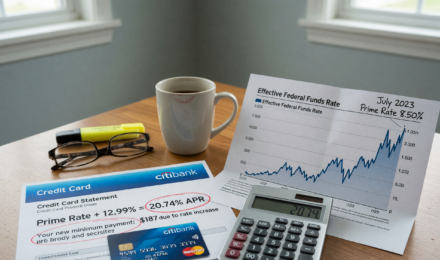
If your card agreement states “Prime + 14.99%,” and the prime rate is 7.50%, your APR is 22.49%. When the Fed raises rates by 25 basis points, the prime rate moves to 7.75% and your APR becomes 22.74%, automatically, with no action required from your issuer. The Consumer Financial Protection Bureau (CFPB) confirms that issuers must disclose this variable-rate structure in your card agreement but are not required to send individual notices each time the prime rate changes.
The margin is where issuers price credit risk. A borrower with a 780 FICO score might receive “Prime + 11.99%,” while someone with a 660 score might see “Prime + 19.99%.” Both borrowers feel the same rate movement in absolute terms, but the higher-margin cardholder starts from a more expensive base.
What Does “Index Rate” Mean on Your Statement?
Card agreements often refer to a “Daily Periodic Rate” tied to an “index.” That index is almost always the Wall Street Journal Prime Rate, which major U.S. banks use as a benchmark and which mirrors the federal funds rate plus 3 percentage points. When you see “index rate” on your statement, that is the prime rate, and it changes the same day the Fed acts.
Some cardholders spend years assuming their APR reflects some internal bank decision that might be negotiated or appealed. In reality, roughly half of it is determined by a public benchmark set eight times per year in Washington.
Key Takeaway: Credit card APR is calculated as prime rate + issuer margin. With the prime rate at 7.50%, a card with a “Prime + 15%” spread carries a 22.50% APR. The CFPB notes no individual notice is required each time the rate changes.
Why Are Card Issuers Allowed to Change Your Rate Without Warning?
Federal law permits variable-rate changes tied to an index without advance notice. This is a legally distinct carve-out from the protections cardholders have against discretionary rate hikes. The Credit CARD Act of 2009 requires 45 days’ notice before an issuer can raise a fixed rate or increase the margin on an existing balance, but it explicitly exempts rate changes that result from index movement.
Because the prime rate functions as a publicly published index, your issuer can update your APR the moment the Fed acts. Three or four Fed rate hikes in a single year, as happened in 2022 and 2023, can stack multiple increases onto your card without a single piece of mail arriving at your door. For a broader look at how prime rate shifts ripple across other borrowing products, see our guide on how the prime rate affects your credit card interest rates.
What the Credit CARD Act Does and Does Not Protect
The Credit CARD Act protects you from retroactive rate increases on existing balances caused by issuer discretion. It does not protect you from prime-rate-linked increases, which apply to both new purchases and, in most cases, existing balances on variable-rate cards.
The distinction matters practically. If your issuer decides unilaterally to raise your margin, you get 45 days’ warning and the right to reject the change (usually by closing the account). If the Fed raises rates, no warning arrives and no opt-out exists. Your agreement disclosed this in the fine print, and the law considers that sufficient.
Key Takeaway: The Credit CARD Act of 2009 requires 45 days notice for discretionary rate hikes but explicitly exempts index-linked changes. Every Fed rate decision flows directly to your variable APR with no legal notice requirement.
What Does the Current Rate Environment Mean for Your Balance?
The prime rate climbed from 3.25% in March 2022 to a peak of 8.50% in August 2023, a 525-basis-point swing that added more than 5 percentage points to every variable-rate card in America. According to Federal Reserve G.19 consumer credit data, the average interest rate on credit card accounts assessed interest was 21.76% as of Q1 2025.
The prime rate credit card APR impact is not theoretical. Carrying a $5,000 balance at 22% instead of 17% costs roughly $250 more per year in interest charges alone. The Fed cut rates three times in late 2024, bringing the prime rate down from 8.50% to the current 7.50%, but average card APRs have not fallen proportionally because issuer margins have widened. To understand how these same rate forces affect savings products on the other side of the ledger, see what happens to your savings when the prime rate rises.
| Prime Rate | Example Card (Prime + 15%) | Annual Interest on $5,000 Balance |
|---|---|---|
| 3.25% (Mar 2022) | 18.25% APR | ~$913 |
| 6.25% (Dec 2022) | 21.25% APR | ~$1,063 |
| 8.50% (Aug 2023) | 23.50% APR | ~$1,175 |
| 7.50% (Jul 2025) | 22.50% APR | ~$1,125 |
Key Takeaway: The prime rate rose 525 basis points between March 2022 and August 2023, pushing the average credit card rate to 21.76% per Federal Reserve G.19 data. A $5,000 balance now costs roughly $250 more annually than it did before the rate cycle began.
Why Didn’t Credit Card APRs Fall Further After the Fed’s 2024 Rate Cuts?
The Fed cut rates three times in late 2024, reducing the federal funds rate by a cumulative 100 basis points. Mathematically, that should have lowered average variable APRs by the same amount. It did not, and the reason is worth understanding.
When the prime rate falls, the index portion of your APR declines exactly as advertised. The problem is that issuers control the margin, and margins have quietly widened over the same period. A cardholder who received “Prime + 13%” in 2019 may find that new applicants today are being offered “Prime + 17%” for equivalent credit profiles. The index declined; the spread increased. Net result: rates stayed elevated even after the Fed eased.
This asymmetry has a name in lending research: “sticky rates.” Banks tend to pass rate increases through to borrowers quickly and rate decreases through more slowly. Federal Reserve G.19 data reflects this pattern in the aggregate numbers. The average assessed rate of 21.76% in Q1 2025 remained far above the pre-hike baseline despite a full year of Fed easing.
For cardholders carrying balances, waiting for the Fed to rescue you is not a reliable strategy. The prime rate mechanism passes costs upward efficiently and savings downward selectively.
How Issuer Margins Have Changed Over Time
In 2015, when the prime rate sat at 3.25% following years of near-zero Fed policy, the average credit card rate on accounts assessed interest was approximately 13%. By early 2022, before the hiking cycle began, that average had already climbed to roughly 16% on a prime rate still at 3.25%. The prime rate had not moved, but margins had expanded by several percentage points over that period.
That margin expansion means the rate cycle’s full damage was larger than the 525-basis-point Fed hike alone would suggest. Cardholders absorbed both the index increase and a quiet repricing of the spread beneath it. This dynamic helps explain why paying off variable-rate card debt remains one of the highest-return financial moves available to most households, regardless of what the Fed does next.
Key Takeaway: Rate cuts reduce the index portion of your APR, but issuers control the margin. Because margins have widened since 2019, average card APRs have not returned to pre-hiking-cycle levels despite Fed easing. Check Federal Reserve G.19 data to track where average rates stand.
How Quickly Does a Fed Rate Change Reach Your Statement?
The timeline from Fed decision to higher APR is shorter than most cardholders realize. The prime rate changes the same day the Fed announces its decision, typically at 2:00 p.m. Eastern time on the second day of an FOMC meeting. Your issuer’s systems update your account’s APR that day or within a few business days.
Where there is a slight delay is in when you see the effect on interest charges. Credit card interest accrues daily based on your average daily balance and the daily periodic rate. If a rate hike happens mid-cycle, only the days after the change accrue at the higher rate. You will see the full impact on your next complete billing cycle. For most cardholders, that means a rate hike in January shows its full cost in the February or March statement.
Calculating Your Daily Periodic Rate After a Change
Your daily periodic rate is your annual APR divided by 365. At a 22.50% APR, that is approximately 0.0616% per day. On a $5,000 balance, each day accrues roughly $3.08 in interest. A 25-basis-point rate hike adds about $0.034 per day, which is $12.50 per year on that balance. Small in isolation, but four hikes in a year adds $50 annually just from rate movement, before any balance growth.
The compounding effect matters too. Credit card interest compounds daily, meaning accrued interest that is not paid off in full becomes part of the balance on which the next day’s interest is calculated. Over a full year on a revolving balance, the effective cost of a rate hike is modestly higher than the simple arithmetic suggests.
Key Takeaway: The prime rate changes the day the Fed announces its decision. Your APR updates that day, and the full billing-cycle impact appears within 1 to 2 billing cycles. Track FOMC meeting dates at the Federal Reserve’s FOMC page to anticipate changes before your statement arrives.
How Can You Protect Yourself From Prime Rate Credit Card APR Increases?
The most direct defense is eliminating the balance that the variable rate applies to. A rate hike has zero impact on a card you pay in full every month. For cardholders carrying balances, there are four practical strategies worth considering.
- Balance transfer cards: Many issuers offer 0% introductory APR periods of 12 to 21 months. Moving high-rate balances here locks in a temporary fixed rate. Our detailed guide on how to pay off $10,000 in credit card debt walks through this approach step by step.
- Personal loans: Fixed-rate personal loans can consolidate variable-rate card debt into a predictable monthly payment. See how the prime rate affects personal loan rates before deciding.
- Negotiate your margin: Your issuer sets the spread, not the prime rate. Cardholders with strong payment history can sometimes negotiate a lower margin directly with their bank.
- Monitor FOMC decisions: The Federal Open Market Committee meets eight times per year. Tracking these dates lets you anticipate rate changes before they hit your statement.
Building a budget that accounts for APR variability is equally important. If you carry a revolving balance, factor in a worst-case scenario where your rate rises another 100 to 200 basis points. Our resource on how to create a monthly budget that actually works includes tools for modeling variable-expense scenarios like this.
Is a Balance Transfer Actually Worth It?
The math usually favors a balance transfer when the promotional period is long enough to pay off the balance and the transfer fee is reasonable. Most issuers charge 3% to 5% of the transferred amount as an upfront fee. On a $5,000 balance, that is $150 to $250, which is still less than one year of interest at current APRs. The critical variable is discipline: if you do not pay the balance down during the 0% period, you revert to a new variable APR at the end of the promotional window, often higher than your original card’s rate.
Personal loans work differently. They convert revolving credit card debt into installment debt with a fixed rate and a defined payoff timeline. The fixed rate means Fed decisions no longer affect your cost on that balance. The trade-off is losing the flexibility of a revolving credit line, though for someone focused on payoff rather than continued borrowing, that is rarely a meaningful loss.
Key Takeaway: Carrying a $0 balance is the only complete hedge against prime rate credit card APR increases. For those with balances, a 0% balance transfer offer lasting up to 21 months can freeze interest costs during a rising-rate environment. Check the CFPB’s credit card comparison tool to evaluate options.
How Do You Find Your Card’s Prime Rate Formula?
Your prime rate credit card APR formula is disclosed in two places: your original card agreement and your monthly statement. Look for language such as “variable APR” or “Daily Periodic Rate” followed by a reference to the Wall Street Journal Prime Rate as the index.
The Schumer Box, the standardized disclosure table required by the Truth in Lending Act (TILA), will show your current APR and indicate whether it is variable. Federal law, enforced by the CFPB, requires this table to appear on all credit card solicitations and agreements. If your card reads “22.49% variable,” divide by 365 to find your daily periodic rate (approximately 0.0616% per day), which compounds daily on your statement balance.
Where to Track the Prime Rate in Real Time
The Wall Street Journal Money Rates page publishes the current prime rate immediately after each Fed decision. The Federal Reserve also publishes it in the H.15 statistical release. Bookmarking either source lets you know when to expect an APR change before your next statement arrives.
Pulling your actual card agreement is also worthwhile if you have not read it recently. The CFPB maintains a credit card agreement database where you can search by issuer and card name to find the full terms. The relevant section is typically labeled “Interest Rates and Interest Charges” and will state your current index, your margin, and whether your margin can change independently of the index.
Key Takeaway: The Schumer Box on every card agreement, mandated by the Truth in Lending Act, discloses your APR formula. Check the Wall Street Journal Money Rates page after each FOMC meeting. Your new APR takes effect within 1 to 2 billing cycles.
What Should Cardholders Watch for in 2026?
The FOMC enters 2026 with the federal funds rate at a level substantially higher than the pre-pandemic baseline. Whether further cuts materialize depends on inflation data, labor market conditions, and a range of factors the Fed has described in publicly available meeting minutes and projections. No credible forecast guarantees a particular direction.
Any rate cut the Fed delivers reduces the prime rate by the same amount and reduces the index portion of every variable-rate card APR accordingly. Any rate hike reverses that. The margin your issuer charges is the variable you can partially influence through creditworthiness and negotiation. The index is the variable you can only monitor.
For borrowers carrying balances, the practical implication of an uncertain rate path is straightforward: the longer a variable-rate balance remains unpaid, the more exposure it has to future index movement in either direction. That asymmetry (the Fed can always hike again) is a reasonable argument for prioritizing payoff over minimum payments, independent of any rate forecast.
Key Takeaway: The FOMC meets eight times per year. Track meeting dates and statements at the Federal Reserve’s FOMC page. Each meeting is a potential trigger for an APR change on every variable-rate card you hold.
Frequently Asked Questions
Why did my credit card APR go up when I never missed a payment?
Your APR increased because your card has a variable rate tied to the prime rate, which rises whenever the Federal Reserve raises its federal funds rate. This change is automatic and does not reflect your payment behavior. The Credit CARD Act of 2009 exempts index-linked rate changes from the 45-day advance notice requirement.
What is the prime rate right now and what does it mean for my credit card?
As of July 2025, the prime rate is 7.50%. Most variable-rate credit cards add a fixed margin of 10 to 20 percentage points on top of that figure, producing the APR shown on your statement. A card with “Prime + 15%” currently carries a 22.50% APR.
Does the prime rate credit card APR change affect my existing balance or only new purchases?
For most variable-rate cards, the new APR applies to both new purchases and existing balances simultaneously. This is different from a discretionary rate increase, where the Credit CARD Act requires issuers to keep the old rate on pre-existing balances for 45 days after notice.
How many times can the Federal Reserve change the prime rate in a year?
The FOMC meets eight times per year, and each meeting is an opportunity to adjust the federal funds rate, which directly sets the prime rate. In 2022, the Fed raised rates at seven consecutive meetings. In 2024, it cut rates at three consecutive meetings.
Can I get a credit card with a fixed APR that won’t change with the prime rate?
True fixed-rate credit cards are rare in the current market, as most major issuers now offer variable-rate products exclusively. Some credit unions offer fixed-rate cards, and 0% introductory APR balance transfer cards effectively fix your rate at zero for the promotional period, typically 12 to 21 months.
What credit score do I need to get a lower margin on my credit card APR?
Issuers typically reserve their lowest margins for applicants with credit scores above 740 (FICO scale). A higher score reduces the spread the issuer adds to the prime rate, lowering your total APR. You can review what constitutes a good credit score and how to build toward that threshold.
Sources
- Federal Reserve, H.15 Selected Interest Rates (Prime Rate)
- Federal Reserve, G.19 Consumer Credit Statistical Release
- Federal Reserve, Federal Open Market Committee (FOMC)
- The Wall Street Journal, Money Rates (Prime Rate)
- Consumer Financial Protection Bureau, Credit Card Agreement Database
- Bankrate, Current Credit Card Interest Rates