Fact-checked by the Prime Rate editorial team
If you’ve been watching your variable-rate credit card balance climb while waiting for relief that never comes, you’re not alone. The prime rate hold borrowing strategy — the approach of restructuring debt and savings around a prolonged Federal Reserve pause — has become one of the most important financial concepts American households need to understand right now. When the Fed holds its benchmark federal funds rate steady for 12 consecutive months, the ripple effects touch every line of credit you carry, from your HELOC to your car loan to your small business line of credit.
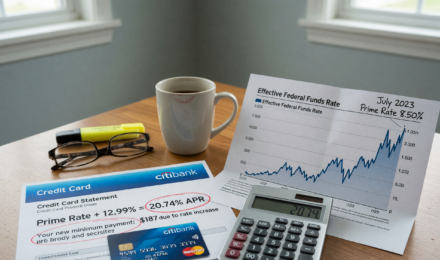
Consider the scale: Federal Reserve consumer credit data shows Americans carry over $1.3 trillion in revolving credit card debt. With the average credit card APR hovering near 21.5% — a level directly pegged to prime — every month the rate stays frozen is a month that debt compounds at near-record cost. Meanwhile, the Fed held rates flat from July 2023 through September 2024, an extended pause that caught millions of variable-rate borrowers in a high-cost holding pattern. A second prolonged freeze could be just around the corner.
This guide gives you a concrete, data-backed roadmap for what to do when the prime rate stays put for a year or longer. You’ll learn exactly which loans to attack first, how to lock in savings yields before they slip, which refinancing windows open during a hold, and how to position your entire borrowing portfolio for the next rate move — whether that’s a cut or a hike. Let’s get specific.
Key Takeaways
- A 12-month prime rate hold keeps variable APRs — currently averaging 21.47% on credit cards — frozen at elevated levels, costing the average indebted household an extra $1,380 per year in interest versus pre-2022 rates.
- The Federal Reserve’s most recent extended pause ran 14 months (July 2023 to September 2024), giving borrowers a real-world template for how long a hold can last and how much it costs to stay passive.
- HELOCs are directly tied to prime (currently 8.50%) and carry balances exceeding $350 billion nationally — a prime hold means no automatic payment relief for these borrowers without refinancing action.
- High-yield savings accounts and short-term CDs paying 4.5%–5.25% represent the best risk-free return window during a hold; locking in now protects yield before the next rate cut.
- Borrowers who converted variable-rate debt to fixed-rate instruments during the 2023–2024 hold period saved an average of 3.2 percentage points on personal loan rates compared to those who did nothing.
- Your credit score is worth up to 5.5 percentage points on a mortgage rate — improving from 650 to 760 during a hold period could save $187,000 in interest over a 30-year loan on a $400,000 home.
In This Guide
- What a Prime Rate Hold Actually Means for Borrowers
- How Long Rate Holds Last — and What History Tells Us
- Credit Card Debt Strategy During a Prime Rate Hold
- HELOC and Home Equity Strategy When Rates Are Frozen
- Savings and CD Strategy: Locking In Yield Before It Disappears
- Refinancing Windows That Open During a Hold Period
- Auto and Personal Loan Strategy in a Flat-Rate Environment
- Prime Rate Hold Borrowing Strategy for Small Business Owners
- Credit Score Positioning: Your Most Powerful Tool During a Hold
- Preparing Your Portfolio for the Next Rate Move
What a Prime Rate Hold Actually Means for Borrowers
The prime rate is the benchmark interest rate that U.S. banks use to set rates on a wide range of consumer and business loans. It has historically tracked 3 percentage points above the Federal Reserve’s federal funds rate target. When the Fed holds its benchmark steady, prime holds steady — and so do the rates on every loan product tied to it.
That stability sounds neutral. It isn’t. A frozen prime rate at 8.50% means that variable-rate borrowers continue paying near-peak rates with no automatic relief. Every billing cycle that passes without a rate cut is another month where minimum payments on credit cards barely dent principal and HELOC balances accrue at their full elevated cost.
Which Loan Products Are Directly Tied to Prime
Not all debt responds to a prime rate hold the same way. Fixed-rate mortgages and auto loans locked before the hold are unaffected. But a large share of American consumer debt is variable — and those products feel every month of a freeze.
| Loan Type | Tied to Prime? | Current Rate Range | Impact of 12-Month Hold |
|---|---|---|---|
| Credit Cards | Yes — directly | 19.5%–29.99% | No relief; debt compounds at peak rate |
| HELOC | Yes — directly | 8.25%–10.5% | Payments stay elevated; no automatic reduction |
| Personal Loans (variable) | Yes — indexed | 10%–28% | Rate stays fixed at origination level |
| Small Business Lines of Credit | Yes — prime-based | 9%–15% | Carry costs remain high for operating lines |
| Fixed Mortgages | No | 6.5%–7.25% | Unaffected — but refinancing window may open |
| Federal Student Loans | No | 5.5%–8.05% | Unaffected by prime movements |
The Psychological Trap of “Waiting It Out”
Many borrowers adopt a passive stance during a hold — waiting for cuts to arrive and deliver automatic relief. This is one of the most expensive mistakes you can make. In a 12-month hold at today’s prime rate, a household carrying $15,000 in credit card debt at 21.47% will pay approximately $3,220 in interest charges alone — just while waiting.
The prime rate hold period is not dead time. It is an active strategic window. The borrowers who use it well emerge with lower debt balances, better credit scores, and locked-in savings yields that protect them regardless of which direction rates move next.
The prime rate has been at or above 8.00% for the longest sustained stretch since 2001. The last time borrowers faced a comparable extended pause at elevated rates was during the 2006–2007 plateau, which preceded the financial crisis.
How Long Rate Holds Last — and What History Tells Us
Understanding the typical duration of a Fed pause is critical to planning your prime rate hold borrowing strategy. History shows that extended holds are not rare — they’re a recurring feature of monetary policy. And they often last longer than markets initially expect.
The Federal Reserve’s open market committee meeting history reveals clear patterns in how long pauses extend before the next policy move. Knowing those patterns helps you set a realistic timeline for your financial planning.
Historical Rate Hold Periods at a Glance
| Hold Period | Duration | Peak Prime Rate | What Followed |
|---|---|---|---|
| June 2006–Sept 2007 | 15 months | 8.25% | Series of aggressive rate cuts |
| Dec 2018–July 2019 | 7 months | 5.50% | Three cuts in 2019 |
| March 2020 (COVID hold) | 24+ months near zero | 3.25% | Rapid rate hike cycle 2022 |
| July 2023–Sept 2024 | 14 months | 8.50% | Three 25-bp cuts through Dec 2024 |
The 2023–2024 hold lasted 14 months before the first cut arrived. That’s a full year and two months during which every variable-rate borrower who did nothing paid peak rates without relief. The median duration of modern Fed pause cycles is approximately 11 months — meaning a full year of planning time is a realistic baseline assumption.
The average Fed rate hold since 1990 has lasted 11.3 months. The longest modern hold — 24+ months near zero post-COVID — ran until March 2022 before hikes began. Planning for at least 12 months of rate stability is a historically sound assumption.
Reading the Fed’s Forward Guidance
The Federal Open Market Committee (FOMC) provides forward guidance — signals about future rate intentions — in its meeting statements and through the “dot plot” projections. When the dot plot shows only one or two cuts projected over the next 12 months, borrowers should treat that as a hold scenario and plan accordingly.
Fed Chair statements about inflation being “sticky” or employment remaining “robust” are code for a longer hold. Each of those phrases adds weeks or months to your planning window. Check the FOMC statement after every meeting to recalibrate your timeline.
“When the Fed signals patience, borrowers need to act — not wait. A 12-month pause at current rates is not a neutral event for household balance sheets. It’s a slow drain on wealth that compounds quietly every single month.”
Credit Card Debt Strategy During a Prime Rate Hold
Credit cards are the most urgent battlefield in any prime rate hold borrowing strategy. With the average card APR at 21.47% and balances totaling more than $1.3 trillion nationally, the math on inaction is brutal. A $10,000 balance at 21.47% costs $2,147 per year in interest — and that number doesn’t move down until either you pay down the balance or the prime rate drops.
During a hold, you control the variable. You can’t control the Fed. That means every dollar of extra payment is your personal rate cut — one that works immediately rather than waiting for Jerome Powell to act.
The Avalanche Method Is Your Best Tool Right Now
The debt avalanche method directs extra payments to the highest-APR balance first, minimizing total interest paid. During a rate hold, this approach is mathematically superior because high-rate balances continue compounding without any automatic relief. If you have a card at 26% and another at 19%, the 26% card is costing you an extra $700 per year on a $10,000 balance compared to the lower-rate card.
Our detailed guide on how to pay off debt using the snowball vs. avalanche method breaks down exactly how to apply this strategy to your specific debt mix. The avalanche consistently wins on total interest savings — often by $1,000 or more over the life of a payoff plan.
Balance Transfer Cards: The 0% Window
A balance transfer card offering 0% APR for 15–21 months is effectively a personal rate cut that doesn’t require Fed action. Moving $10,000 from a 21.47% card to a 0% promotional card saves $1,790–$2,505 in interest during the promotional window — money you can redirect to principal payoff.
The critical discipline: calculate the transfer fee (typically 3%–5% of the balance), compare it to projected interest savings, and commit to paying the balance before the promotional period ends. A $300 transfer fee against $1,800 in saved interest is a clear win. But missing the payoff deadline triggers retroactive interest — wiping out the benefit entirely.
Balance transfer promotional rates revert to standard APR — often 24%–29% — when the introductory period ends. Always know your exact payoff deadline and set a calendar reminder 60 days before it expires. If you can’t pay the full balance in time, plan a second transfer or personal loan to cover the remainder.
For deeper context on how the prime rate directly affects your card rate, read our analysis of how the prime rate affects your credit card interest rates.
HELOC and Home Equity Strategy When Rates Are Frozen
Home equity lines of credit carry over $350 billion in outstanding balances in the U.S. They are directly pegged to prime — meaning your HELOC rate today is likely prime plus a margin of 0.5%–2.0%, putting most borrowers between 9.0% and 10.5%. During a 12-month hold, every dollar in your HELOC draw phase continues accruing at that rate.
The strategic question during a hold is whether to convert, consolidate, or aggressively pay down. Each option has a different math profile depending on your balance, remaining draw period, and plans for the property.
Converting a HELOC to a Fixed Home Equity Loan
Many lenders allow HELOC borrowers to lock all or part of their balance into a fixed-rate sub-account. This is called a rate-lock option or fixed-rate conversion. If your lender offers this at 9.25% fixed versus your current variable rate of 10.0%, the conversion saves $75 per year per $10,000 of balance — and provides certainty against rate hikes.
Our detailed breakdown of how the prime rate affects your mortgage and home equity loan covers the math on conversion timing in detail. The key variable is your lender’s conversion fee — typically $250–$500 — weighed against projected interest savings over the remaining loan term.
The average HELOC draw period is 10 years, followed by a 20-year repayment period. Borrowers in year 6–10 of their draw phase face a “payment shock” when repayment begins — monthly payments can nearly double even at a frozen rate, simply because principal repayment begins.
Using Home Equity Strategically, Not Reactively
Some homeowners consider drawing on their HELOC during a hold period to consolidate higher-rate debt. This can make mathematical sense — replacing 21% credit card debt with 9.5% HELOC debt saves 11.5 percentage points. On $20,000 of debt, that’s $2,300 per year in saved interest.
The critical risk: you’ve converted unsecured debt into secured debt backed by your home. If you can’t repay, you risk foreclosure rather than a credit score hit. This strategy only makes sense with a firm, written payoff plan and the cash flow discipline to execute it.

Savings and CD Strategy: Locking In Yield Before It Disappears
A prime rate hold is a double-edged event. While it keeps borrowing costs high, it also keeps savings yields elevated — but only for as long as the hold lasts. When the Fed eventually cuts, high-yield savings account rates drop within days. CD rates available today will be gone the moment rate expectations shift. The window to lock in yield is finite, and it may be shorter than you think.
High-yield savings accounts currently pay 4.5%–5.25% APY — the highest levels since 2007. That gap versus the national average savings rate of 0.47% represents a $472 per year difference on every $10,000 in savings. If you’re not already earning a competitive yield, every month of inaction is money left behind.
The CD Ladder Strategy During a Rate Hold
A CD ladder is the most powerful tool for capturing today’s elevated yields while maintaining liquidity for future rate changes. By splitting savings across CDs with staggered maturities — 3 months, 6 months, 1 year, 18 months — you lock in current rates on portions of your savings while preserving the ability to reinvest at potentially different rates as each rung matures.
Our step-by-step guide to what a CD ladder is and how to build one walks through the exact mechanics. The key during a hold period: weight your ladder toward 12–18 month CDs to capture the full yield window before cuts arrive, while keeping a 3-month rung liquid in case rates do rise unexpectedly.
A $50,000 CD ladder built at today’s average 12-month CD rate of 4.85% APY generates $2,425 in guaranteed interest over 12 months. The same $50,000 in a national average savings account at 0.47% earns only $235 — a difference of $2,190 per year.
High-Yield Savings vs. Money Market Accounts
Both high-yield savings accounts and money market accounts offer competitive rates during a hold — but with different trade-offs. High-yield savings accounts typically offer slightly higher APYs, while money market accounts often include check-writing privileges and debit card access that savings accounts don’t provide.
If you need liquidity alongside yield, a money market account may serve better. Our comparison of the best money market accounts available in 2026 shows current rates from 4.50%–5.10% APY on leading products — competitive with savings accounts and with more flexibility.
| Account Type | Current APY Range | Liquidity | Best For |
|---|---|---|---|
| High-Yield Savings | 4.50%–5.25% | High (ACH transfers) | Emergency fund, short-term savings |
| Money Market Account | 4.50%–5.10% | High (checks + debit) | Operating cash, near-term expenses |
| 6-Month CD | 4.60%–5.00% | Low (penalty for early withdrawal) | Known expenses in 6 months |
| 12-Month CD | 4.75%–5.15% | Very low | Locking in hold-period yield |
| 18-Month CD | 4.50%–4.90% | Very low | Bridging into post-cut environment |
Refinancing Windows That Open During a Hold Period
Counterintuitively, a prime rate hold can create refinancing opportunities — particularly for mortgage borrowers who took out loans at the rate peak. While the prime rate itself isn’t moving, fixed mortgage rates are influenced by 10-year Treasury yields, which can decline even when the Fed is on hold. A drop of 0.50%–0.75% in the 10-year yield can bring 30-year mortgage rates down meaningfully without any Fed action.
The general rule of thumb: refinancing makes financial sense when you can reduce your rate by at least 0.75%–1.0% AND you plan to stay in the home long enough to recoup closing costs (typically 2–4 years). During a hold period, monitor 10-year Treasury yields weekly — they signal mortgage rate direction before it shows up at the lender level.
Personal Loan Refinancing: The Overlooked Move
Variable-rate personal loans originated during the rate hike cycle may carry rates of 18%–28%. During a hold, competition among online lenders for creditworthy borrowers has kept personal loan rates more competitive than credit cards. Borrowers with credit scores above 720 can often access fixed personal loans at 10%–14% — offering a 7–14 percentage point reduction versus high-rate credit card debt.
For a full analysis of how prime rate movements flow into personal loan pricing, see our guide on how the prime rate affects personal loan rates. The key is locking in a fixed rate during the hold — before potential rate cuts make lenders less competitive on new originations.
Before refinancing any loan, calculate your break-even point: divide total closing costs by monthly savings. If closing costs are $3,000 and you save $150/month, you break even in 20 months. Only refinance if you’ll hold the loan longer than that period.
Student Loan Refinancing Considerations
Federal student loans are fixed-rate and not tied to prime, but private student loan refinancing during a hold can make sense for borrowers with variable-rate private loans. Private variable student loans are often indexed to SOFR or prime and currently carry rates of 8%–14%. Refinancing to a fixed rate in the 6.5%–9% range locks in a ceiling before any rate volatility arrives.
Important caveat: refinancing federal student loans into private loans permanently eliminates access to income-driven repayment plans, Public Service Loan Forgiveness, and federal deferment options. This trade-off is only worth considering for borrowers with stable income and no plans to seek federal loan benefits.
Auto and Personal Loan Strategy in a Flat-Rate Environment
Auto loan rates are not directly tied to prime but are influenced by the broader interest rate environment. New car loan rates currently average 7.1% for a 60-month term, while used car loans average 11.5%. These rates reflect the high-rate environment created by the Fed’s 2022–2023 hike cycle — and they won’t fall until either the prime rate drops or you negotiate aggressively.
During a hold, the best strategy for prospective auto buyers is to prioritize credit score improvement (see Section 9), shop at least 4–5 lenders before accepting dealer financing, and consider a shorter loan term. A 48-month loan versus a 72-month loan on a $35,000 vehicle saves approximately $2,800 in total interest at current rates, even though the monthly payment is higher.
When to Pay Extra vs. When to Invest the Difference
One of the most debated questions during a rate hold: should you accelerate debt payoff or direct surplus cash toward investments? The answer depends entirely on comparing after-tax interest rates on your debt against expected investment returns.
| Debt or Investment | Effective Rate | Recommended Action |
|---|---|---|
| Credit Card Debt | 21.47% | Pay off aggressively — guaranteed 21% return |
| Personal Loan (high rate) | 18%–28% | Refinance or pay off first |
| Auto Loan | 7.1%–11.5% | Match against savings/investment rates |
| Mortgage (fixed) | 6.5%–7.25% | Invest difference if expected return exceeds rate |
| S&P 500 Index Fund | ~10% historical avg | Favor over paying extra on sub-7% debt |
| High-Yield Savings/CD | 4.75%–5.25% | Park emergency fund here; beats paying off 5% debt |
Prime Rate Hold Borrowing Strategy for Small Business Owners
Small business owners face a distinct set of challenges during a rate hold. Business lines of credit, SBA loans, and commercial real estate loans are all prime-indexed — meaning elevated rates directly compress operating margins. The prime rate hold borrowing strategy for businesses involves both defensive cost management and offensive positioning for growth financing.
The SBA loan program rates are based on prime plus a spread — typically prime + 2.75% to prime + 3.75% for 7(a) loans. At a prime rate of 8.50%, that puts most SBA 7(a) loans between 11.25% and 12.25%. Understanding the full cost of capital is essential before drawing on any business credit line during a hold.
Locking In Fixed Financing for Planned Expansion
If business expansion is planned within the next 18–24 months, a hold period is an ideal time to lock in fixed-rate term financing before rates change. Fixed-rate SBA loans and USDA business loans offer rate certainty for 10–25 year terms — and during a hold, lenders are actively competing for quality borrowers.
Business owners should also review their operating lines of credit and consider converting floating-rate lines to fixed-rate term loans for any amount they expect to carry for 12+ months. The conversion typically costs 0.25%–0.50% in rate premium but eliminates exposure to any potential future rate hikes.
“For small business owners, the cost of doing nothing during a rate hold is often invisible — it shows up in cash flow statements six months later when interest expense has quietly compounded. Proactive refinancing and debt structure review during a hold is exactly when businesses should be acting.”

Credit Score Positioning: Your Most Powerful Tool During a Hold
Your credit score is not a passive number. It is an active determinant of the rates you’ll receive on every financial product — from mortgages to auto loans to credit cards — and improving it during a hold period can deliver savings that dwarf any single refinancing move.
The difference between a 650 and a 760 credit score on a 30-year fixed mortgage at today’s rates is approximately 0.75%–1.5%. On a $400,000 mortgage, that 1.5% gap costs $187,000 in additional interest over 30 years. A 12-month hold gives you the exact time window needed to meaningfully improve your score before the next major borrowing decision.
The Credit Actions That Move the Needle Fastest
Credit utilization — the percentage of available credit you’re using — is the fastest-moving scoring factor. It updates every month. Reducing utilization from 70% to under 30% can add 40–80 points to your score within 60–90 days. On a $20,000 credit limit, that means keeping balances below $6,000.
Payment history makes up 35% of your FICO score — the largest single factor. Setting up autopay for at least the minimum on every account ensures zero late payments during the hold period. Even one 30-day late payment can drop a score 60–110 points and remains on your report for seven years.
Requesting a credit limit increase — without spending more — instantly improves your utilization ratio. A $5,000 limit increase on a card with a $2,000 balance drops utilization from 40% to 29%, potentially adding 20–30 points to your credit score within 30 days.
Building Credit as a Foundation for Future Borrowing
For borrowers earlier in their credit journey, a 12-month hold period is an invaluable runway for building history and score. Our guide on how to build credit from scratch covers the fastest legitimate path from no credit to a qualifying score for competitive loan products. The strategies there — secured cards, credit-builder loans, authorized user status — work best when applied over 12+ months of consistent behavior.
Preparing Your Portfolio for the Next Rate Move
The purpose of a prime rate hold borrowing strategy isn’t just to survive the pause — it’s to position yourself to win regardless of what comes next. Rate cuts benefit borrowers with variable-rate debt and hurt savers locking in yield. Rate hikes do the opposite. The goal is a portfolio structured to benefit from either outcome.
This principle is called interest rate diversification. It means holding a mix of fixed-rate debt (immune to hike risk), paid-down variable debt (less exposure to rate moves), locked-in CD yields (protected against cut risk), and flexible savings (to capitalize on rate hikes if they come).
The Rate-Cut Preparation Checklist
If the Fed signals cuts are coming, your priorities shift quickly. Lock in remaining CD rates before they’re repriced downward. Variable-rate debt that survived the hold will soon get cheaper — so aggressive prepayment becomes less urgent. Mortgage refinancing windows can open sharply when rates drop, so having your credit score and financial documents ready reduces response time from weeks to days.
When the Fed cut rates 75 basis points between September and December 2024, the best high-yield savings account rates dropped from 5.25% to 4.50% within 60 days. Borrowers who locked 18-month CDs in August 2024 continued earning 5.10%–5.25% through early 2026.
The Rate-Hike Preparation Checklist
If inflation surprises to the upside and the Fed resumes hiking, variable-rate debt becomes more expensive immediately. Accelerate payoff of any remaining variable-rate balances. Consider converting adjustable-rate mortgages to fixed before hikes arrive — the refinancing window closes fast once hike expectations firm up. And deploy any remaining cash into the highest-rate savings products available, since yields will climb in lockstep with the Fed.
“The borrowers who consistently do best across rate cycles are the ones who don’t try to time the Fed perfectly. They reduce variable-rate exposure when rates are high, lock in savings yields when they’re available, and keep their credit profile strong so they can act quickly when opportunities emerge.”

Real-World Example: How Marcus and Denise Turned a Rate Hold Into a $31,000 Financial Advantage
In August 2023 — one month after the Fed’s last rate hike — Marcus and Denise, a couple in their late 30s from Nashville, Tennessee, had $18,400 in credit card debt spread across three cards at rates of 22.99%, 19.99%, and 18.74%. They also had a $42,000 HELOC balance at prime + 1% (9.50% at the time) and $22,000 sitting in a traditional savings account earning 0.35% APY. Their total annual interest cost on debt was approximately $7,120. Their savings were earning $77 per year. The household was losing ground every month — just too slowly to feel urgent.
When Marcus read about the Fed’s likely extended hold, he made three moves in October 2023. First, he transferred $12,000 of credit card debt to a 21-month 0% balance transfer card, paying a $360 transfer fee (3%). He then moved his $22,000 savings into a combination of a high-yield savings account at 5.10% APY ($7,000) and a 14-month CD at 5.35% APY ($15,000). Finally, he began making $600 extra payments per month on the highest-rate credit card. Denise handled the HELOC by calling their lender and converting $30,000 of the variable balance to a fixed sub-account at 9.10% — locking in below the then-current variable rate of 9.50%.
Over the next 14 months — the full duration of the Fed’s hold — the results were dramatic. The balance transfer card was fully paid off by month 18, saving $1,997 in interest versus keeping it on the original card. The high-yield savings earned $1,112 in interest. The CD matured at $15,808 — a $808 gain on a risk-free instrument. The fixed HELOC conversion saved $120 per year in interest compared to the variable rate that eventually rose no further. And the aggressive credit card paydown reduced their total card debt from $18,400 to $4,200 — cutting annual interest cost by $2,890.
Total financial improvement over 14 months: approximately $6,927 in interest saved on debt, $1,920 in savings income captured, and a credit score improvement from 692 to 741 (from lower utilization). When the Fed finally began cutting in September 2024, Marcus and Denise were positioned to refinance their 7.25% mortgage to 6.50% — a move that will save them an additional $22,400 over the remaining 28 years of their loan. Total estimated advantage from their prime rate hold borrowing strategy: over $31,000.
Your Action Plan
-
Audit every variable-rate balance you carry this week
List every debt with its current rate, balance, and whether the rate is fixed or variable. Include credit cards, HELOCs, personal loans, auto loans, and business lines. Identify which are prime-indexed and calculate your total annual interest cost. This audit is the foundation of your entire prime rate hold borrowing strategy — you can’t optimize what you haven’t measured.
-
Prioritize and attack your highest-APR debt using the avalanche method
Rank debts from highest to lowest APR. Direct every extra dollar to the top of that list while making minimums on everything else. If your highest-rate balance is a credit card at 24%, explore a balance transfer card with a 0% introductory period to buy time for payoff. Use our breakdown of the step-by-step credit card debt payoff plan to structure your attack.
-
Move idle savings to a high-yield account or CD ladder immediately
Any savings earning less than 4.0% APY is leaving money on the table in the current environment. Open a high-yield savings account or money market account for your emergency fund and operational cash. For savings you won’t need for 6–18 months, build a CD ladder starting with a 6-month and 12-month rung to capture current elevated yields before they reprice lower.
-
Evaluate your HELOC for a fixed-rate conversion
Call your HELOC lender and ask about fixed-rate conversion options on your outstanding balance. Compare the offered fixed rate to your current variable rate and calculate the break-even on any conversion fee. If you’re in the draw period with 2+ years remaining, a fixed-rate conversion provides cost certainty for the full hold period and protects against any unexpected future hikes.
-
Check your credit score and build a 90-day improvement plan
Pull your free credit reports from AnnualCreditReport.com and your FICO score from your bank or card issuer. Identify your top two score-limiting factors — typically utilization and payment history. Set autopay for every account. If utilization is above 30%, pay it down or request a limit increase. Improve your understanding of what makes a strong score with our guide on what a good credit score is and what you can do with it.
-
Model a refinancing scenario for your mortgage or highest fixed-rate loan
Even during a hold, mortgage rates can drift lower if Treasury yields fall. Set a rate alert with at least three lenders for the rate threshold that makes refinancing worthwhile (typically your current rate minus 0.75%–1.0%). Gather all required documents — W-2s, pay stubs, tax returns, bank statements — so you can submit a refinancing application within 48 hours of a rate drop.
-
Maximize tax-advantaged savings contributions during the hold period
A hold period with high savings yields is an ideal time to maximize IRA contributions and 401(k) deferrals. The tax deduction or tax-free growth from these accounts compounds the benefit of elevated yields. Review the current contribution limits in our guide to IRA contribution limits for 2026 and confirm you’re on track to hit the annual maximum before year-end.
-
Set a quarterly review calendar for the duration of the hold
Schedule a 30-minute financial review every 90 days to check your debt payoff progress, confirm savings yields are still competitive, review the Fed’s most recent FOMC statement for rate signals, and rebalance your strategy if needed. The prime rate hold borrowing strategy is not a set-it-and-forget-it plan — it’s a living framework that should adapt as conditions evolve.
Frequently Asked Questions
What exactly is the prime rate and why does it affect my loans?
The prime rate is a benchmark interest rate that U.S. commercial banks use to set rates on loans to their most creditworthy customers. It typically sits 3 percentage points above the Federal Reserve’s federal funds rate. When the Fed holds its benchmark rate steady, prime holds steady too — and since most credit cards, HELOCs, and many personal loans are tied to prime, your rates on those products don’t change either.
The current prime rate is 8.50%, reflecting a federal funds rate target of 5.25%–5.50% before recent Fed cuts. Even after modest 2024 cuts, prime remains historically elevated — significantly above the 3.25% prime rate that prevailed from 2020 to 2022.
How is a “prime rate hold” different from a rate cut or rate hike?
A rate hold means the Federal Reserve keeps its benchmark interest rate unchanged at consecutive FOMC meetings. Unlike a rate cut (which would lower variable loan rates) or a rate hike (which would raise them), a hold freezes the rate environment. For borrowers, this means no automatic relief is coming — but also no additional pain from new hikes.
The strategic implication is that a hold period rewards proactive action. You can’t wait for the rate environment to improve your finances — you have to create your own improvement through debt paydown, refinancing, and yield optimization.
How long could the current rate hold last?
Based on historical FOMC patterns, modern rate hold periods have ranged from 7 months to over 24 months. The median duration since 1990 is approximately 11.3 months. The 2023–2024 hold lasted 14 months before the first cut arrived in September 2024. Any new hold period triggered by renewed inflation concerns could last a similar duration.
Watch the FOMC’s dot plot projections and the language in Chair Powell’s press conferences for the most reliable forward guidance. Phrases like “higher for longer,” “data dependent,” and “still above target” typically signal an extended hold ahead.
Should I pay off debt or invest during a prime rate hold?
The answer depends on your debt’s interest rate. Any debt costing more than 10%–12% APR — essentially all credit card debt and most personal loans — should be paid down before investing in market assets, because the guaranteed return of eliminating 21% debt exceeds any realistic expected market return. Debt below 6%–7% may be worth carrying while investing, since long-term index fund returns have historically averaged around 10% annually.
The exception is tax-advantaged accounts. Always capture any employer 401(k) match first — that’s a 50%–100% immediate return. Then attack high-rate debt. Then maximize IRA contributions. Then invest in taxable accounts. This sequence maximizes total financial efficiency regardless of rate environment.
Will my HELOC rate automatically drop when the Fed cuts rates?
Yes — HELOC rates are variable and directly indexed to prime. When the Fed cuts the federal funds rate by 25 basis points (0.25%), prime drops by the same amount, and your HELOC rate adjusts within one to two billing cycles. A full 1% reduction in prime saves approximately $420 per year on a $42,000 HELOC balance.
The timing, however, is unpredictable. If you’re holding a large HELOC balance at 9.5%+ and waiting for cuts, you may be paying elevated rates for 12+ months before relief arrives. Consider a fixed-rate conversion for any balance you’ll carry for more than 12 months.
Are CD rates better than high-yield savings accounts right now?
For money you won’t need for 6–18 months, CDs often offer slightly higher rates than savings accounts — and they lock in that rate for the full term. This is valuable during a hold period because savings account rates can drop at any time, even without an official Fed rate cut, if banks decide to lower their rates to manage deposit costs.
Our detailed comparison of CD rates versus high-yield savings accounts breaks down exactly when each product wins. The short answer: CDs for fixed-horizon savings, high-yield savings for your emergency fund and money you may need within 90 days.
How much can improving my credit score actually save me?
The savings are larger than most people realize. On a $400,000 30-year fixed mortgage, the difference between a 650 score (roughly 7.25% rate) and a 760 score (roughly 6.25% rate) is $245 per month — or $88,200 over the life of the loan. Even on shorter-term products, the savings are meaningful: a 760 versus 650 credit score on a $35,000 auto loan can save $4,200 in total interest over 60 months.
A 12-month hold gives you a realistic runway to move your score significantly — especially if you’re currently carrying high utilization. Paying down card balances to below 30% utilization and maintaining zero late payments for 12 months can move most scores 50–80 points.
Can I negotiate a lower rate on my existing credit card during a hold?
Yes — and more borrowers should try this. Card issuers have retention teams whose explicit job is to keep customers from leaving. Calling and requesting a rate reduction works approximately 70% of the time for customers with good payment histories, according to industry surveys. The key phrase: “I’ve been a customer for X years, I always pay on time, and I’d like to discuss lowering my interest rate.”
The typical reduction from a successful negotiation is 2%–6 percentage points. On a $5,000 balance, a 4-point reduction saves $200 per year with no balance transfer fee, no application, and no credit inquiry. It takes about 10 minutes and costs nothing to ask.
What’s the risk of converting variable-rate debt to fixed-rate during a hold?
The main risk is opportunity cost: if the Fed cuts rates aggressively after you lock in a fixed rate, your variable-rate debt would have gotten cheaper while you’re now stuck at the fixed rate. However, this risk is asymmetric. Credit card and personal loan fixed rates typically don’t drop as quickly or as much as the theoretical variable rate reduction would suggest — lenders protect margins during cut cycles.
The more meaningful risk on the opposite side is failing to lock in and then seeing rates stay elevated — or rise — for longer than expected. For most borrowers with significant variable-rate debt, locking in a known fixed rate provides peace of mind and guaranteed savings that outweigh the risk of leaving future cut savings on the table.
How does the prime rate hold affect small business borrowing specifically?
Small businesses are particularly exposed to prime rate holds because their working capital lines, equipment loans, and SBA 7(a) loans are typically prime-indexed. A 12-month hold at prime 8.50% keeps borrowing costs for small businesses at their highest level since 2007. This compresses margins for businesses that rely on credit for operations, inventory, or payroll.
The strategic response is to convert floating-rate operating lines to fixed-rate term debt for any amount expected to be outstanding for 12+ months, explore SBA 504 loans (which offer fixed rates on real estate and equipment), and aggressively manage accounts receivable to reduce reliance on credit lines for cash flow.
Sources
- Federal Reserve — Consumer Credit Outstanding (G.19 Statistical Release)
- Federal Reserve — Open Market Operations and FOMC Meeting History
- Federal Reserve — FOMC Meeting Calendars, Statements, and Minutes
- Bankrate — Average Credit Card Interest Rate in America
- Bankrate — Best High-Yield Savings Account Rates
- Consumer Financial Protection Bureau — Consumer Credit Trends
- U.S. Small Business Administration — SBA Loan Programs and Rates
- AnnualCreditReport.com — Free Credit Reports from All Three Bureaus
- myFICO — How Credit Scores Affect Mortgage Rates
- Federal Reserve Bank of St. Louis (FRED) — Bank Prime Loan Rate Historical Data
- FDIC — National Deposit Rates and Rate Cap Information
- The Wall Street Journal — Money Rates Including Prime Rate
- Federal Reserve Bank of New York — SOFR Reference Rates
- Experian — Credit Score Ranges and What They Mean
- Federal Reserve — Selected Interest Rates (H.15 Statistical Release)