
Fact-checked by the Prime Rate editorial team
When a client deposit lands in your checking account, the natural instinct is to treat the whole amount as income. That instinct is expensive. For anyone running their own business or working as a freelancer, a significant slice of every dollar earned belongs to the IRS before you spend a cent, and without an employer withholding it for you, the responsibility falls entirely on you to set it aside. Building a dedicated self employed tax savings account is the structural fix that makes this manageable rather than stressful.
About 16.63 million Americans are self-employed, representing roughly 10.2% of the U.S. civilian labor force. Most of them face the same quarterly tax obligation, yet the IRS collected billions in penalties from small business owners who missed or underpaid their estimated taxes in a single year. This is a widespread problem with a straightforward solution, and the solution is mostly about structure, not discipline.
By the end of this guide, you will know exactly how much to set aside, which account type earns you the most while your money waits, how to automate the habit so it requires almost no ongoing effort, and how to time your payments to avoid IRS penalties entirely.
Key Takeaways
- The self-employment tax rate is 15.3% (12.4% Social Security plus 2.9% Medicare), and you pay every penny of it yourself since no employer shares the burden.
- Quarterly estimated payments are required once you expect to owe $1,000 or more; missing them triggers an underpayment penalty currently running at 7% per year, compounded daily.
- A top high-yield savings account earning roughly 4% APY generates about $600 per year in interest on a $15,000 tax reserve, money earned on funds that were simply waiting to be paid out.
- Most tax professionals recommend setting aside 25–30% of net income (after business expenses, not gross revenue), but the right number for your situation could be as low as 20% or as high as 35%+ depending on your state and deductions.
- Paying 100% of the prior year’s tax liability in four equal installments (or 110% if your prior AGI exceeded $150,000) eliminates underpayment penalties entirely, regardless of how much your income changes.
- SEP-IRA and Solo 401(k) contributions reduce your taxable income dollar-for-dollar, which directly lowers both your quarterly payment amounts and the total balance you need to hold in the tax reserve account.
In This Guide
- Why Self-Employed People Get Blindsided by Tax Bills
- What You’re Actually Saving For: The Self-Employed Tax Stack
- How Much to Actually Set Aside
- Choosing the Right Account: HYSA, Money Market, or Business Savings
- The Mechanics: Transfers, Automation, and Account Separation
- Calculating and Timing Your Quarterly Payments
- Deductions That Shrink the Balance You Need to Hold
Why Self-Employed People Get Blindsided by Tax Bills
Most people who go self-employed have worked as employees first, and the employee experience of taxes is almost entirely invisible. Your employer calculates what you owe, withholds it from each paycheck, and sends it to the IRS on your behalf. You file in April, maybe get a small refund, and move on. The system is invisible because someone else runs it for you.
The moment you go independent, that entire infrastructure disappears. No withholding, no employer sharing your Social Security and Medicare burden, no automated quarterly filings. Every dollar of federal income tax, state income tax, and self-employment (SE) tax becomes your responsibility to calculate, save, and remit four times a year. First-year freelancers often discover this at tax time in April when they owe a number they haven’t saved for, and simultaneously get hit with underpayment penalties on top of the principal balance.
The Real Cost of Getting It Wrong
The underpayment penalty isn’t a flat fee. It accrues at 7% per year (as of Q3 and Q4 2025), compounded daily, from the due date of each quarterly installment. A $2,000 underpayment on a Q1 deadline held until the annual filing date translates to roughly $140–$150 in additional interest charges, not catastrophic for a single quarter, but multiply that across multiple quarters and a few years of inconsistent saving, and the total becomes meaningful.
A dedicated savings account structured specifically for taxes solves this problem at the root. Once the habit is automated, the money moves before you have a chance to spend it, and the account balance grows steadily toward each quarterly deadline.
Quarterly estimated payments are required if you expect to owe $1,000 or more in taxes for the year. This threshold catches nearly every full-time freelancer and self-employed business owner within the first year of going independent.
What You’re Actually Saving For: The Self-Employed Tax Stack
Before you can size your tax reserve correctly, you need to understand exactly what you’re reserving for. There are two distinct tax layers stacked on top of each other, and confusing them is one of the most common reasons people either over-save or, more dangerously, under-save.
The Self-Employment Tax Layer
The self-employment tax rate is 15.3%, 12.4% for Social Security (applied to the first $176,100 of net self-employment earnings in 2025) and 2.9% for Medicare with no earnings cap. Critically, this rate applies to 92.35% of your net self-employment income, not your gross revenue. The IRS allows a 7.65% reduction to approximate the employer’s share deduction that W-2 workers effectively receive. That distinction matters: on $80,000 of net income, the SE tax base is $73,880, not $80,000.
There is also an Additional Medicare Tax of 0.9% on net SE income above $200,000 for single filers ($250,000 for married filing jointly), which high earners need to factor in separately.
Federal Income Tax, State Tax, and the Deductions That Reduce Both
Federal income tax rates from 10% to 37% stack on top of the SE tax calculation, and state income taxes add anywhere from zero (in states like Texas and Florida) to over 10% (in California and New York). Your total obligation is highly variable depending on where you live and how much you earn.
Two deductions meaningfully reduce what you actually owe. First, you can deduct 50% of your SE tax above the line, which lowers your adjusted gross income without requiring itemization. Second, eligible filers can claim the Qualified Business Income (QBI) deduction of up to 20% of qualified business income under IRS Section 199A. Both of these reduce the dollar amount that needs to sit in your tax reserve, which is exactly why the savings percentage should be recalculated annually from actual numbers rather than assumed constant.
A single filer with $60,000 in net self-employment income in a state with a 5% income tax rate faces roughly $8,479 in SE tax, $6,500 in federal income tax, and $3,000 in state tax, a combined burden of approximately $18,000, or about 30% of net income. The same gross revenue with strong Schedule C deductions could reduce that effective rate closer to 20%.
How Much to Actually Set Aside
The “save 25–30%” rule of thumb is a reasonable starting point, but it’s frequently misapplied in a way that either over-reserves your cash or sets you up for a shortfall. The most important detail is that the percentage applies to net income after business expenses, not to gross revenue.
Applying 30% to gross revenue when your business has a 40% expense ratio means you’re reserving thousands of dollars more than you actually owe, unnecessarily constraining the operating cash available to run your business. Run the percentage on net profit. Then add a deliberate buffer of 5–10% on top of your estimate to absorb income spikes, deductions that don’t materialize as expected, or mid-year surprises. This buffer isn’t anxious over-saving; it’s a planned float that prevents a scramble at year-end.
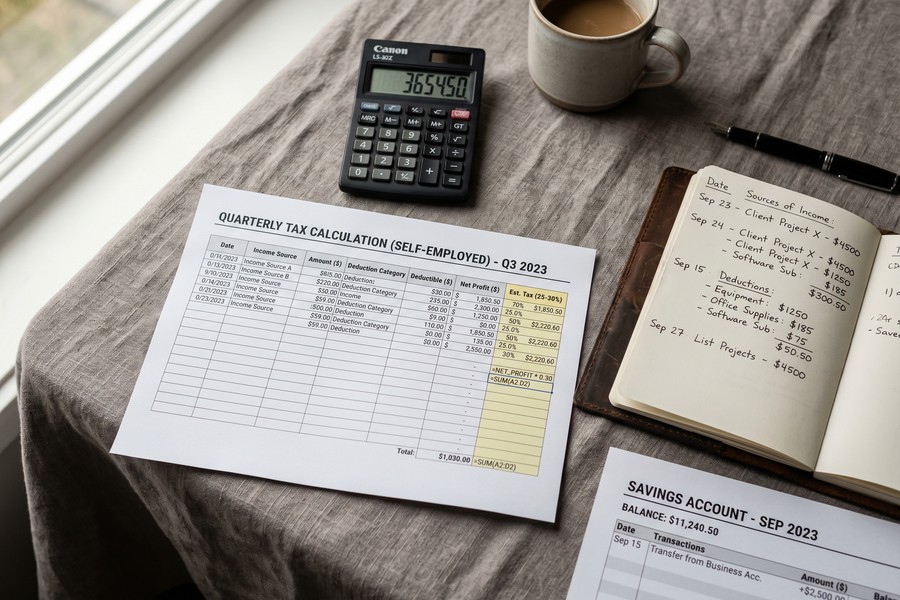
| Income Scenario | Gross Revenue | Business Expenses | Net Income | Recommended Save Rate | Amount to Reserve |
|---|---|---|---|---|---|
| Freelance writer, low-tax state (TX) | $70,000 | $8,000 | $62,000 | 25% | $15,500 |
| Consultant, mid-tax state (CO, 4.4%) | $100,000 | $15,000 | $85,000 | 28% | $23,800 |
| Designer, high-tax state (CA, 9.3%+) | $90,000 | $10,000 | $80,000 | 32% | $25,600 |
| Contractor, high income, no state tax (FL) | $180,000 | $30,000 | $150,000 | 30% | $45,000 |
| Part-time freelancer, low net income | $30,000 | $5,000 | $25,000 | 20% | $5,000 |
Choosing the Right Account for Your Self Employed Tax Savings Account
Most advice on this topic stops at “open a separate account.” That’s necessary but incomplete. The type of account you choose determines how much you earn on your reserve while it waits, and on $15,000 sitting in an account for several months at a time, the difference between a traditional savings account and a high-yield savings account (HYSA) is roughly $600 per year.
The national average traditional savings rate sits at around 0.40% APY. Top HYSAs are offering rates in the 4% range. On a $15,000 tax reserve, that gap generates approximately $585 in additional annual interest, money earned on funds that simply need to exist before being paid out. That argument alone makes the account-type decision worth thinking through carefully. You can compare current options at our guide to the best high-yield savings accounts.
HYSA vs. Money Market Account for Tax Savers
HYSAs typically offer higher APYs with low or no minimum balance requirements. The main tradeoff is access: transfers from an HYSA to your operating account usually take 1–3 business days. Money market accounts often provide debit card access or check-writing privileges for faster payment, but they frequently require higher minimum balances and carry maintenance fees if those thresholds aren’t met. For a more detailed comparison, see what a money market account is and whether it’s worth it.
For quarterly tax payments with predictable deadlines, the 1–3 day transfer window from an HYSA is rarely a practical problem. You know exactly when the payment is due. Schedule the transfer a few days early and the timing concern disappears entirely. For most self-employed savers, the HYSA’s higher yield makes it the better fit.
One Caveat on HYSA Interest
Interest earned in a high-yield savings account is reported as ordinary income on a Form 1099-INT if it exceeds $10 in a calendar year. That means you’ll owe a small amount of additional tax on the interest your reserve earns, roughly $20–$30 in additional federal tax on $600 of HYSA interest at a moderate marginal rate. After taxes, earning 4% still vastly outperforms earning 0.40%, so this is a caveat to note, not a reason to choose a lower-yield option.
Keep your tax reserve account at a different bank than your primary checking account. The small friction of logging into a separate institution makes it psychologically harder to dip into the balance for non-tax purposes, a simple behavioral guardrail that costs nothing.
The Mechanics: Transfers, Automation, and Account Separation
The single most effective behavioral rule for a self-employed tax reserve isn’t about spreadsheets or apps. Move the designated percentage the same day a client payment arrives, before the money settles into your operating account and starts blending with rent and groceries. Waiting until the end of the week, or the end of the month, dramatically increases the chance of spending it first.
Three Accounts, Three Jobs
Your financial infrastructure as a self-employed person needs at least three separate accounts with clearly defined roles. Your operating account handles all business income and expenses. Your emergency fund covers three to six months of personal living expenses. Your tax reserve account exists solely for quarterly estimated tax payments. Mixing any two of these creates confusion about what is actually available and increases the risk of raiding the tax fund for other purposes.
Behavioral finance research on mental accounting consistently shows that earmarked single-purpose accounts increase follow-through. When the tax reserve is its own account with its own balance, the number on the screen reflects exactly what it is: money that isn’t yours to spend. If you haven’t built out a broader emergency cushion yet, the step-by-step guide to building a six-month emergency fund covers the mechanics of doing both in parallel.
Handling Variable Income Months
Freelance income is lumpy by nature. During a high-revenue month, save the full percentage immediately, the buffer you’re building during good months is exactly what covers the slow ones. During a low-revenue month, you may not move much into the tax account, but the existing balance provides the cushion. The goal is that the tax account balance always exceeds your cumulative estimated liability at any point in the quarter, not that every transfer is identical.
Never treat a high HYSA balance as a sign you’ve over-saved and withdraw from it for non-tax purposes mid-quarter. That balance represents real obligations with real deadlines. Raiding it, even temporarily, is the behavioral pattern that leads to the April scramble most self-employed people are trying to escape.
Calculating and Timing Your Quarterly Payments
Four specific deadlines govern quarterly estimated tax payments each year: April 15 (Q1), June 16 (Q2), September 15 (Q3), and January 15 of the following year (Q4). Notice that Q2 covers only two months, May and June, while Q4 covers four months (October through January). Many first-year self-employed filers treat the four payments as identical installments covering equal time periods, then get caught underpaying in Q2 because the period is shorter. See the IRS estimated taxes page for the full schedule.
Safe Harbor: The Penalty-Free Floor
Two safe harbor options exist, and understanding which one fits your situation is the most important calculation you’ll make. Option 1: Pay 100% of your prior year’s total federal tax liability in four equal installments. This approach completely eliminates underpayment penalties, regardless of how much your income grows during the current year. If your prior-year AGI exceeded $150,000, the threshold rises to 110%. Option 2: Pay at least 90% of the current year’s actual liability. This is more precise and saves money when income is lower than last year, but it requires accurate ongoing estimates.
For most self-employed people whose income is growing or unpredictable, the prior-year safe harbor is the cleaner default. It requires no current-year projection, and it provides a penalty-free floor no matter what your income does. The caveat: in a year where income drops significantly, you may overpay versus what Option 2 would require, but overpayment means a refund in April, not a penalty.
The Annualized Income Installment Method for Seasonal Earners
Freelancers and contractors with lumpy or seasonal income have a third option that almost no competing resource mentions: the Annualized Income Installment Method, filed via IRS Form 2210, Schedule AI. This IRS-approved approach lets you pay proportionally less in slow quarters and more in high-earning ones, avoiding underpayment penalties that would otherwise result from equal-installment calculations. IRS data suggests only about 10% of eligible taxpayers actually use it, meaning most seasonal self-employed earners are either over-saving in slow quarters, creating unnecessary cash flow pressure, or risking penalties because their income pattern doesn’t fit the equal-installment model.

The 7% annual IRS underpayment rate for Q3 and Q4 2025 compounds daily from each missed quarterly deadline, not just from the annual April filing date. That means a Q1 underpayment accrues interest for nearly a full year by the time you file in April of the following year.
Deductions That Shrink the Balance You Need to Hold
Retirement contributions are simultaneously a retirement savings tool and a quarterly tax management tool, and most self-employed people treat them as completely separate topics. They aren’t. A SEP-IRA lets you contribute up to 25% of net self-employment income. A Solo 401(k) allows even higher combined contribution limits. Both reduce your taxable income dollar-for-dollar, which directly lowers both your income tax layer and the total estimated payment amount you need to hold in the tax reserve. A self-employed person who maximizes retirement contributions in Q1 can legitimately reduce their subsequent quarterly payment amounts and pull money from the reserve sooner than expected.
If you’re comparing retirement account options, the Roth IRA vs. Traditional IRA breakdown is worth reading alongside the SEP-IRA and Solo 401(k) analysis, since all four interact with your self-employment tax picture in different ways.
The Health Insurance Deduction Misunderstanding
Self-employed health insurance premiums are deductible above the line for income tax purposes, but they do not reduce your net self-employment earnings for the 15.3% SE tax calculation. This is a consistent misunderstanding that leads some people to save less than they should, reasoning that their large health insurance deduction offsets more of their tax burden than it actually does. It reduces only the income tax layer, not the SE tax layer. Keep that distinction clear when sizing your reserve.
Accurate tracking of all legitimate business expenses, home office, equipment, software, professional development, mileage, reduces your Schedule C net income, which is the actual base both tax calculations use. The more precisely you track expenses, the more precisely you can size your tax account balance, and the less you over-reserve.
You can deduct 50% of your self-employment tax from your gross income as an above-the-line adjustment, no itemizing required. On $80,000 of net SE income, that deduction is approximately $5,652, which meaningfully reduces your adjusted gross income and the federal income tax owed on top of SE tax.

Set a recurring calendar reminder for each IRS quarterly deadline, two weeks out and one week out. Use the two-week reminder to run a quick year-to-date income check, recalculate your estimate, and confirm your HYSA balance covers what’s due. The one-week reminder is your cue to initiate the transfer so it clears before the deadline.
Your Action Plan
-
Open a dedicated high-yield savings account for taxes only
Choose an HYSA offering at least 4% APY and keep it at a separate institution from your checking account. Label it clearly as “Tax Reserve” so its purpose is never ambiguous. Do not link it to an emergency fund or operating account. This separation is the foundation everything else rests on.
-
Calculate your net income and choose a savings rate
Start with net income, gross revenue minus legitimate business expenses, not gross revenue. Apply 25–30% as your initial savings rate. If you’re in a high-tax state or expect strong earnings, start at 30%; if you have significant deductions and low state taxes, 25% may be sufficient. Revisit the percentage quarterly as your income becomes clearer.
-
Automate same-day transfers on every client payment
Set up a standing transfer rule: every time a payment clears your operating account, move the designated percentage to the tax reserve account the same day. Most banks allow percentage-based recurring transfers. If yours doesn’t, schedule a manual transfer immediately on receipt as a non-negotiable habit.
-
Decide which safe harbor method you’ll use
If your income is growing or unpredictable, default to the prior-year safe harbor: pay 100% of last year’s total federal tax liability in four equal installments (110% if your prior AGI exceeded $150,000). If income is declining from last year, the 90% current-year method may let you pay less without penalty, but it requires careful ongoing tracking.
-
If you have seasonal income, explore the Annualized Income Installment Method
Pull up IRS Form 2210 and Schedule AI. If your income is meaningfully higher in certain quarters than others, this method allows proportionally lower payments in slow quarters without triggering underpayment penalties. Only about 10% of eligible taxpayers use it; most who qualify simply don’t know it exists.
-
Fund retirement accounts early to reduce your quarterly obligations
SEP-IRA and Solo 401(k) contributions reduce taxable income dollar-for-dollar. The earlier in the year you fund them, the sooner you can revise your estimated quarterly payment amounts downward, reducing how much needs to sit in the tax reserve. Treat retirement contributions as a lever that directly adjusts your tax bill, not a separate financial goal.
-
Run a five-minute quarterly check-in at each payment deadline
At each quarterly deadline, compare year-to-date net income against the prior-year baseline, recalculate your estimated full-year liability, and adjust the ongoing transfer percentage for the next quarter. If a major new client, large one-time payment, or significant deduction has changed your picture, now is the time to catch it, not in April.
-
Track your deductions precisely to calibrate your reserve balance
Every legitimate Schedule C deduction reduces the net income that both your SE tax and income tax calculations use as their base. Home office, equipment, software, professional development, and business travel all count. The more accurately you track them throughout the year, the more precisely you can size the tax account balance, and the less operating cash you tie up unnecessarily.
Frequently Asked Questions
Do I really need a separate account for quarterly taxes, or can I just keep track mentally?
Keeping track mentally almost always fails. The core problem isn’t awareness, most self-employed people know they owe quarterly taxes. The problem is that money sitting in a general checking account gets spent, because every other expense also lives there. A dedicated account makes the balance visible and psychologically earmarked, which is the behavioral mechanism that actually prevents raiding it. Mental accounting only works when the account structure reinforces it.
What happens if I miss a quarterly payment deadline?
Missing a deadline doesn’t trigger an immediate bill or notice from the IRS. Instead, an underpayment penalty accrues from the missed deadline at the current rate, 7% per year as of Q3 and Q4 2025, compounded daily. You won’t typically know the penalty amount until you file your annual return, at which point it’s added to any balance owed. Missing one quarter is manageable. Missing several builds into a meaningful additional charge on top of your principal tax bill.
Should I use a business savings account instead of a personal HYSA?
If you operate as an LLC, S-corp, or have a formal business banking relationship, a business savings account keeps your financial separation cleaner for accounting and legal purposes. The tradeoff is that business savings accounts typically offer lower APYs than the best personal HYSAs. For a sole proprietor with no formal entity, a personal HYSA dedicated exclusively to taxes is a perfectly valid and often higher-yielding option. Either way, the account should be used for nothing except tax payments.
How do I handle a month where my income is zero?
Transfer nothing that month, and rely on the buffer you’ve built in higher-revenue months to cover the cumulative liability. This is precisely why the 5–10% additional buffer over your estimated obligation exists. The goal isn’t a consistent monthly transfer; the goal is a balance that always equals or exceeds what you’ll owe at the next quarterly deadline. Zero-income months are expected in freelance work, and the account structure should absorb them without requiring emergency adjustments.
Does my self employed tax savings account interest count as income?
Yes. Interest earned on any savings account, including an HYSA used as a tax reserve, is taxable as ordinary income in the year it’s received. You’ll receive a Form 1099-INT if you earn more than $10 in interest. On $600 of HYSA interest at a 22% marginal rate, the additional tax is roughly $132. After that tax drag, a 4% HYSA still vastly outperforms a 0.40% traditional savings account, so the taxability of interest doesn’t change the account-type recommendation.
Can I use a CD for my tax reserve instead of a savings account?
CDs can work, but only with careful timing. A CD vs. high-yield savings comparison typically shows that short-term CDs offer competitive rates, but the fixed lock-up period creates a mismatch with quarterly payment deadlines. If a CD matures a few days after a quarterly deadline, you’re either paying from another account or missing the deadline. For most self-employed savers, the flexibility of an HYSA outweighs any marginal rate advantage a CD might offer on the same term.
What if my income is significantly higher this year than last year, am I protected by the prior-year safe harbor?
Yes, completely. Paying 100% of your prior year’s total federal tax liability (or 110% if prior AGI exceeded $150,000) in four equal installments eliminates the underpayment penalty regardless of current-year income. The prior-year safe harbor is an IRS-codified rule, not an approximation. The consequence of using it when income doubles is simply that you’ll owe a larger balance in April, but no penalty on top of it. Once you’ve filed and know the full current-year liability, you adjust your forward-looking quarterly payments accordingly.
How does the self-employment tax deduction actually reduce my bill?
The IRS lets you deduct 50% of the SE tax you owe as an above-the-line adjustment to your gross income. This deduction doesn’t reduce the SE tax itself, it reduces your adjusted gross income, which then reduces the federal income tax calculated on top. On $80,000 of net self-employment income, the SE tax is approximately $11,304, and the 50% deduction ($5,652) reduces your AGI by that amount. At a 22% federal marginal rate, that saves roughly $1,243 in income tax. That’s a meaningful reduction, and it’s one of the figures that should flow into your quarterly estimate rather than being discovered at filing time.
Sources
- Internal Revenue Service, Self-Employment Tax (Social Security and Medicare Taxes)
- Internal Revenue Service, Estimated Taxes
- Internal Revenue Service, Underpayment of Estimated Tax by Individuals Penalty
- Internal Revenue Service, Interest Rates Remain the Same for the Fourth Quarter of 2025
- Carry, Self-Employed Americans Statistics (Current Population Survey Data)
- Internal Revenue Service, About Form 2210, Underpayment of Estimated Tax by Individuals
- Federal Deposit Insurance Corporation, National Rates and Rate Caps