Fact-checked by the Prime Rate editorial team
Quick Answer
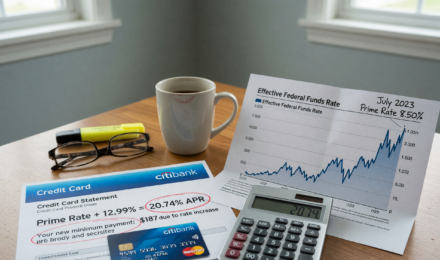
When the prime rate rises, every variable-rate debt you carry gets more expensive — simultaneously. As of July 2025, the U.S. prime rate stands at 7.50%, meaning credit card APRs now average over 20%. To protect yourself, you need to identify which debts are variable-rate, prioritize high-rate balances first, and explore consolidation or fixed-rate alternatives before your next billing cycle.
Managing a rising prime rate multiple debt situation means understanding that rate increases do not hit your finances in isolation — they move through every variable-rate product you carry at the same time. As of July 2025, the Federal Reserve’s benchmark has kept the prime rate elevated at 7.50%, and according to Federal Reserve H.15 data, that single benchmark directly sets the floor for credit card rates, home equity lines of credit, auto loans, and personal lines of credit across the country.
This matters now because the rate environment has shifted dramatically. Between March 2022 and July 2023, the Fed raised its benchmark rate by 525 basis points — the fastest tightening cycle in four decades. Even with modest cuts in late 2024, rates remain historically high, and consumers carrying balances across multiple products are feeling compounded pressure on every front.
This guide is written for anyone juggling two or more variable-rate debt products — credit cards, a HELOC, a personal line of credit, or a variable-rate auto loan — who wants a clear, step-by-step framework for understanding what is happening to their balances, quantifying the real dollar cost, and taking targeted action to reduce exposure before rates rise again.
Key Takeaways
- The U.S. prime rate is currently 7.50%, directly tied to the Federal Reserve’s federal funds rate, which affects every variable-rate debt product you carry simultaneously. (Federal Reserve, 2025)
- Credit card APRs now average 20.78%, an all-time high driven by prime rate increases, meaning a $10,000 balance costs roughly $2,078 per year in interest alone. (Federal Reserve G.19 Report)
- A typical HELOC is priced at prime plus 0–2%, so borrowers with a $50,000 HELOC balance saw their annual interest cost increase by approximately $2,625 over the 2022–2023 tightening cycle. (Consumer Financial Protection Bureau)
- Consumers carrying balances on three or more credit accounts face a compounded rate-sensitivity problem, because each 25-basis-point Fed hike raises interest costs across all variable products at once. (Federal Reserve SHED Report)
- Balance transfer cards with 0% introductory APRs lasting 15–21 months remain available for borrowers with credit scores above 670, offering a fixed window to pay down principal with zero interest. (CFPB Credit Card Tool)
- Debt consolidation via a fixed-rate personal loan can lock in a rate, and borrowers with scores above 720 currently qualify for personal loan rates as low as 10–12% — well below the average credit card APR. (Federal Reserve G.19 Report)
In This Guide
- Step 1: Which of My Debts Actually Change When the Prime Rate Goes Up?
- Step 2: How Do I Calculate the Real Dollar Cost of a Rising Prime Rate Across All My Debts?
- Step 3: How Should I Prioritize Paying Off Multiple Debts When the Prime Rate Is Rising?
- Step 4: Should I Consolidate My Debts Into One Fixed-Rate Product to Escape a Rising Prime Rate?
- Step 5: How Do I Protect My Credit Score While Managing Multiple Debt Accounts in a High-Rate Environment?
- Step 6: How Do I Adjust My Monthly Budget When Rising Interest Rates Increase My Minimum Payments?
- Frequently Asked Questions
Step 1: Which of My Debts Actually Change When the Prime Rate Goes Up?
Any debt with a variable interest rate will reprice when the prime rate moves — and the repricing often happens within one to two billing cycles. Fixed-rate products, such as most mortgages and standard auto loans, are locked at origination and do not change.
How to Identify Your Variable-Rate Debt
Pull out every loan statement and credit card agreement you have. Look for the phrase “variable APR” or “prime rate plus a margin.” The most common variable-rate products include:
- Credit cards — Nearly all consumer credit cards carry variable APRs tied directly to the prime rate. When the prime moves, your card’s APR moves in the same direction, usually within the next statement cycle.
- Home Equity Lines of Credit (HELOCs) — Priced at prime plus a margin, typically ranging from 0% to 2%, as explained by the Consumer Financial Protection Bureau’s HELOC guide.
- Personal lines of credit — Variable-rate products offered by banks and credit unions that reprice alongside prime.
- Adjustable-rate mortgages (ARMs) — Tied to indices like SOFR or the 1-year Treasury, not always directly to prime, but correlated with Fed rate changes.
- Variable-rate student loans — Private student loans frequently carry variable rates; federal student loans are fixed by law.
For a deeper breakdown of how prime rate changes flow through to your credit card specifically, see our guide on how the prime rate affects your credit card interest rates.
What to Watch Out For
Do not assume that a loan labeled “fixed” is immune to rising rates in every way. Some fixed-rate installment loans carry prepayment penalties, meaning that even if you want to refinance into a lower rate later, you could face costs. Read your loan agreement’s prepayment clause before making any payoff decisions.
The prime rate is set by commercial banks and is almost universally calculated as the federal funds target rate plus 3 percentage points. When the Federal Open Market Committee raises rates by 25 basis points, your variable-rate credit products rise by the same amount — automatically, with no action from the lender required.
Step 2: How Do I Calculate the Real Dollar Cost of a Rising Prime Rate Across All My Debts?
The real cost of a rising prime rate on multiple debts is the sum of incremental interest increases across every variable-rate account you carry. You can calculate this in about ten minutes with a spreadsheet or a free online loan calculator.
How to Do This
For each variable-rate account, use this simple formula to find the annual dollar impact of a rate increase:
- Write down the current balance on each account.
- Note the current APR and the new APR after the rate increase (add the same basis-point increase to each).
- Multiply each balance by the rate increase expressed as a decimal. For example, a 0.25% increase on a $15,000 HELOC balance adds $37.50 per year — or about $3.13 per month — to your cost.
- Add the incremental costs across all accounts to find your total annual rate-increase exposure.
For a household carrying a $8,000 credit card balance, a $25,000 HELOC, and a $5,000 personal line of credit, a single 25-basis-point Fed hike adds roughly $95 per year in combined interest. A full 100-basis-point increase would add approximately $380 per year — before compounding.
The CFPB’s suite of financial calculators can help you model payoff scenarios across multiple accounts simultaneously.
What to Watch Out For
Minimum payments on credit cards are calculated as a percentage of the balance or a flat dollar amount, whichever is higher. When your APR rises, a larger share of each minimum payment goes toward interest, which means principal paydown slows — a compounding trap that accelerates the longer you carry balances during a rising prime rate multiple debt environment.
According to the Federal Reserve’s G.19 Consumer Credit Report, revolving credit card debt in the U.S. totaled over $1.3 trillion as of early 2025, with the average interest rate on accounts assessed finance charges running above 20%.

Step 3: How Should I Prioritize Paying Off Multiple Debts When the Prime Rate Is Rising?
When facing a rising prime rate multiple debt situation, direct every available dollar toward the debt with the highest APR first — a strategy known as the debt avalanche method. This approach minimizes total interest paid across all accounts and is mathematically optimal when rates are high and rising.
How to Do This
Rank all your variable-rate debts by current APR from highest to lowest. Maintain minimum payments on all accounts. Then apply every extra dollar of available cash to the top-ranked debt until it is eliminated. Move to the next-highest-rate debt and repeat.
For a detailed step-by-step walkthrough of both the avalanche and snowball methods, see our guide on how to pay off debt fast using the snowball vs. avalanche method.
In a high-rate environment, the priority order for most borrowers will look like this:
- Credit cards (average APR: 20.78%)
- Personal lines of credit (typical APR: 12–18%)
- HELOCs (typical APR at prime + margin: 8.5–10%)
- Variable-rate private student loans (varies by lender)
“In a rising rate environment, every dollar sitting in a high-rate revolving balance is losing ground twice — once to the interest charge and once to the lost opportunity of not putting that dollar to work somewhere more productive. The urgency to attack your highest-rate debt first has never been greater.”
What to Watch Out For
Do not neglect minimum payments while focusing on your top-priority debt. Missing a minimum payment can trigger a penalty APR — often 29.99% or higher — on the account where you missed, and potentially on other cards through a “universal default” clause in some card agreements. Read every card agreement for universal default language.
Some HELOC agreements include a “draw period” during which you only pay interest. If your HELOC transitions to its repayment period while rates are elevated, your monthly payment can spike dramatically. Check your HELOC agreement for the draw period end date and plan accordingly.
| Debt Type | Typical APR (July 2025) | Rate Structure | Rate-Change Lag | Priority in Rising-Rate Env. |
|---|---|---|---|---|
| Credit Card | 20.78% avg. | Variable (prime + margin) | 1–2 billing cycles | Highest — pay first |
| Personal Line of Credit | 12–18% | Variable (prime + margin) | 1–2 billing cycles | High |
| HELOC | 8.5–10% | Variable (prime + 0–2%) | Next statement period | Medium |
| Variable Private Student Loan | 8–13% | Variable (SOFR or prime-linked) | Quarterly or annually | Medium |
| Adjustable-Rate Mortgage | 6.5–8% | Variable (SOFR-indexed) | At reset interval (1–5 yrs) | Lower — but monitor |
| Fixed-Rate Mortgage | Locked at origination | Fixed | No change | Not affected |
Step 4: Should I Consolidate My Debts Into One Fixed-Rate Product to Escape a Rising Prime Rate?
Consolidating variable-rate debt into a single fixed-rate product is one of the most effective moves available when managing rising prime rate multiple debt exposure — but the right consolidation vehicle depends on your credit score, the total amount owed, and whether you own a home.
How to Do This
There are three main consolidation paths, each with a different risk-and-reward profile:
- Fixed-rate personal loan: Borrow a lump sum at a fixed APR to pay off all variable-rate balances. Borrowers with credit scores above 720 currently qualify for rates as low as 10–12% — dramatically lower than the average credit card APR. Use the CFPB’s personal loan comparison resource to evaluate lenders.
- Balance transfer card with 0% intro APR: Cards from issuers like Citi, Chase, and Wells Fargo currently offer 0% intro periods of 15–21 months. Balance transfer fees typically run 3–5% of the transferred amount. This works best for balances you can realistically pay off within the promotional window.
- Cash-out refinance or home equity loan (fixed): Homeowners with equity can access a fixed-rate home equity loan to retire variable-rate debt. This converts unsecured debt into secured debt, which carries lower rates but puts your home at risk if you cannot make payments.
For a broader look at how the prime rate affects home equity products specifically, see our detailed guide on how the prime rate affects your mortgage and home equity loan.
For credit cards specifically, a step-by-step payoff plan is available in our guide on how to pay off $10,000 in credit card debt in 2026.
What to Watch Out For
Consolidation only works if you stop adding new balances to the accounts you just paid off. Closing those accounts immediately after paying them off can hurt your credit utilization ratio and lower your score. Instead, keep the accounts open but avoid using them until the consolidation loan is repaid.
Before applying for a personal loan or balance transfer card, check your credit score for free through your bank or a service like Credit Karma. Knowing your score lets you target the right lenders and avoid hard inquiries from applications you are unlikely to be approved for. A single targeted application is far better than five that all result in denials.

Step 5: How Do I Protect My Credit Score While Managing Multiple Debt Accounts in a High-Rate Environment?
Protecting your credit score during a period of rising prime rate multiple debt stress requires keeping utilization low, payments on time, and avoiding unnecessary new inquiries. Your score directly determines which consolidation tools are available to you — so guarding it is a financial priority, not just a vanity metric.
How to Do This
The two factors that carry the most weight in your FICO score are payment history (35%) and credit utilization (30%), according to myFICO’s credit score breakdown. Focus your energy there first.
- Set up autopay for at least the minimum payment on every account so you never miss a due date, even during a cash-flow crunch.
- Keep your overall credit utilization below 30% — and below 10% if you want to maximize your score.
- Do not open new credit accounts unless the savings from the new product are material and you have a clear repayment plan.
- Request a credit limit increase on existing cards (without a hard pull if possible) — this lowers your utilization ratio without requiring you to pay down more principal immediately.
For more context on what credit score thresholds unlock the best consolidation offers, see our guide on what is a good credit score and what you can do with it.
What to Watch Out For
When rates rise, some borrowers make the mistake of letting smaller balances go past due while focusing all cash on the largest account. A single 30-day late payment can drop your FICO score by 50–100 points, closing off the balance transfer and personal loan options that could have solved the problem in the first place.
“Your credit score is your rate card in a high-interest-rate environment. Borrowers who enter a rate-rising cycle with scores above 740 have access to consolidation tools that can cut their effective interest rate in half. Those who let their scores slip during the same period end up trapped paying the highest rates with no exit.”
Step 6: How Do I Adjust My Monthly Budget When Rising Interest Rates Increase My Minimum Payments?
When a rising prime rate multiple debt situation pushes up your minimum payments, you need to rebuild your monthly budget around the new numbers immediately — not at year-end, not after the next pay raise. Waiting even one month costs you real money.
How to Do This
Start by pulling your most recent statements from every variable-rate account and recording the new minimum payment amounts. Then compare those totals to what you were paying six months ago. That gap is your immediate budget shortfall.
To find the extra cash, work through this priority order:
- Identify discretionary spending cuts first. Subscriptions, dining, and entertainment are the fastest levers. A household spending $300 per month on subscriptions and streaming has a significant opportunity.
- Apply a structured budget framework. The 50/30/20 budget rule can help you reallocate spending categories systematically when debt payments swell.
- Redirect any windfalls immediately. Tax refunds, bonuses, and side income should go directly to the highest-APR balance before lifestyle expenses absorb them.
- Contact lenders proactively if you are at risk of missing payments. Many card issuers have hardship programs that temporarily reduce your rate or waive minimum payments. The CFPB recommends calling the number on the back of your card before you miss a payment, not after.
Building or maintaining an emergency fund alongside debt payoff is not contradictory — it is protective. Without one, any unexpected expense forces you to add new debt on top of existing balances. Our guide on how to build a 6-month emergency fund in 2026 walks through a realistic savings plan you can run in parallel with debt paydown.
What to Watch Out For
Avoid the temptation to pause retirement contributions entirely in order to free up cash for debt payments. If your employer offers a 401(k) match, stopping contributions means forfeiting free money. Contribute at least enough to capture the full match — it is an immediate 50–100% return on that dollar — then redirect the rest of available cash toward high-rate debt.
Use a free budgeting tool like YNAB (You Need A Budget) or Mint to create a zero-based budget that assigns every dollar a job before the month begins. When minimum payments increase, update the budget in the same week — not next month. Real-time awareness prevents the slow drift into deeper debt that catches most households by surprise.

Frequently Asked Questions
How much more will I pay in interest if the prime rate goes up by 0.50% and I have $20,000 in credit card debt?
A 0.50% rate increase on a $20,000 credit card balance adds exactly $100 per year — or about $8.33 per month — in additional interest charges. This calculation is straightforward: multiply your balance ($20,000) by the rate increase as a decimal (0.005). If you carry that balance across multiple cards, add each account’s calculation together for your true total exposure.
Does the prime rate affect my HELOC and my credit card at the same time?
Yes — both products reprice simultaneously when the prime rate changes, which is the core challenge of a rising prime rate multiple debt situation. Your credit card APR typically adjusts within the next statement cycle, while your HELOC adjusts at the start of the next billing period following the rate change. Both move in the same direction and by the same number of basis points as the prime rate increase.
Should I pay off my HELOC or my credit cards first when rates are rising?
Pay off your credit cards first in nearly every scenario, because they carry a significantly higher APR — currently averaging over 20% — compared to a typical HELOC rate of 8.5–10%. The avalanche method (highest APR first) minimizes total interest paid. Only prioritize the HELOC first if your HELOC rate is somehow higher than your card rates, which would be unusual.
Can I negotiate a lower interest rate on my credit card when the prime rate is high?
Yes, and more often than most people realize. A study by CreditCards.com found that 76% of cardholders who asked for a lower rate received one. Call the number on the back of your card, reference your payment history, and ask specifically for a rate reduction. This works best if you have made on-time payments for at least 12 months and have not recently missed a payment.
Will my fixed-rate personal loan rate go up if the prime rate rises?
No. A fixed-rate personal loan is locked at the rate you received at origination — the prime rate has no effect on it after the loan is funded. This is one reason why converting variable-rate credit card debt into a fixed-rate personal loan is a popular strategy during a rate-rising environment. Only variable-rate products reprice with the prime rate.
How do I know if a balance transfer card is worth it when I have multiple credit card balances?
A balance transfer is worth it if the interest you save during the promotional period exceeds the balance transfer fee (typically 3–5% of the transferred amount). For example, transferring a $10,000 balance at a $300–$500 fee is worth it if you would otherwise pay more than $500 in interest during the same period — which at a 20% APR you would within the first three months. The key requirement is a concrete plan to pay off the full transferred amount before the promotional period ends.
What happens to my minimum payments if the prime rate keeps rising?
Minimum payments on credit cards will increase as the prime rate rises, because they are calculated as a percentage of the balance — but a higher APR means more of your minimum payment goes toward interest and less toward principal. This effectively extends how long it takes to pay off the debt and increases total interest paid. Paying above the minimum is the only way to counteract this dynamic in a high-rate environment.
Is a home equity loan or HELOC better for consolidating credit card debt when rates are high?
A fixed-rate home equity loan is generally the better choice for consolidation when rates are already high, because it locks your rate at origination rather than staying variable like a HELOC. The tradeoff is that home equity loans typically involve closing costs of 2–5% of the loan amount. A HELOC carries a lower upfront cost but continues to expose you to future rate increases — defeating part of the purpose of consolidating in a rising prime rate multiple debt environment. For more detail, see our analysis of how the prime rate affects personal loan rates.
How does a rising prime rate affect my credit score indirectly?
A rising prime rate does not directly change your credit score, but it creates conditions that can lower it. Higher minimum payments strain cash flow, making it harder to pay on time. Higher interest charges increase your balances faster, raising your credit utilization ratio. Both effects — late payments and high utilization — are among the top credit score killers. Managing your utilization actively during a rate-rising period is essential for preserving access to consolidation options.
Sources
- Federal Reserve — H.15 Selected Interest Rates (Prime Rate Data)
- Federal Reserve — G.19 Consumer Credit Report (Revolving Debt and Interest Rates)
- Consumer Financial Protection Bureau — What Is a HELOC?
- Consumer Financial Protection Bureau — Credit Card Compare Tool
- Federal Reserve — Report on the Economic Well-Being of U.S. Households (SHED)
- myFICO — What’s in Your Credit Score?
- Consumer Financial Protection Bureau — Personal Loan Comparison Resource
- Federal Reserve — Federal Open Market Committee (FOMC) Policy Decisions