Fact-checked by the Prime Rate editorial team
Quick Answer
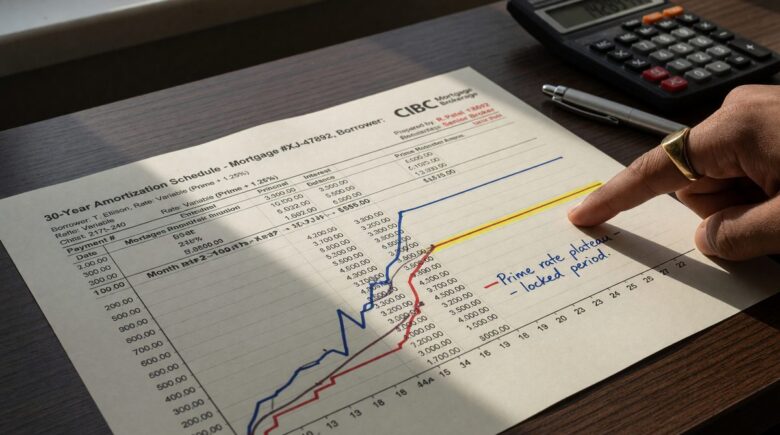
A prime rate plateau locks variable mortgage holders into a stable rate for its duration. With the U.S. prime rate holding at 6.75% since December 2025 and Canada’s prime at 4.45% since October 2025, borrowers on prime-linked variable mortgages see no payment increases, and accelerated principal paydown, for as long as the hold lasts.
Most variable mortgage borrowers spend their energy watching for rate hikes. The more interesting question is what happens when rates stop moving at all. A prime rate plateau on a variable mortgage freezes your interest cost, shifts a larger share of every payment toward principal, and quietly changes the total interest you will pay over a 30-year term. The U.S. Federal Reserve’s prime rate has held at 6.75% since December 11, 2025, and the Bank of Canada has left its overnight rate at 2.25% through five consecutive announcements, putting Canadian prime at 4.45% since October 2025.
That stability sounds reassuring. It is, though how much it benefits you depends entirely on where the plateau sits in your amortization schedule and what comes after it ends. Understanding that distinction is what separates borrowers who save meaningfully from those who simply delay a larger problem.
Key Takeaways
- The U.S. prime rate has held at 6.75% since December 11, 2025, per Federal Reserve H.15 rate history.
- The Bank of Canada held its overnight rate at 2.25% through at least five consecutive announcements, keeping Canadian prime at 4.45% since October 2025, according to Bank of Canada monetary policy guidance.
- The 2022–2023 tightening cycle moved the U.S. prime rate from 3.25% to 8.5% in roughly 18 months, showing what variable borrowers face when a plateau breaks into hikes, as documented by Federal Reserve historical data.
- A prime rate plateau most benefits borrowers in years 5 through 15 of a 30-year schedule, where stable rates allow steady principal compounding, per CFPB amortization guidance.
- With U.S. prime at 6.75%, a typical prime-minus-1% variable rate sits at 5.75% and holds there for the plateau’s duration, per Federal Reserve open market operations history.
- Variable borrowers who ride the plateau passively and then absorb rate hikes could pay more total interest than borrowers who locked a fixed rate in mid-2026, as analyzed by the Consumer Financial Protection Bureau’s ARM vs. fixed-rate guidance.
How a Variable Mortgage Actually Works
Variable-rate mortgages are priced directly off the prime rate, not off Treasury yields or bond benchmarks the way fixed-rate products are. A typical structure sets your rate at prime minus a margin, often between 0.5% and 1.5%, so when the prime rate plateau holds, your mortgage rate holds with it, dollar for dollar.
Fixed mortgages are benchmarked to longer-duration instruments. A 30-year fixed rate in the U.S. tracks the 10-year Treasury yield plus a spread, which means it can move even when the Fed holds its policy rate steady. Variable mortgages have no such buffer; they are directly tethered. That direct link is precisely why a prime rate plateau variable mortgage interest calculation is simpler and more predictable than it looks on paper.
Payment Recalculation on Adjustment Dates
Most U.S. adjustable-rate mortgages (ARMs) recalculate on a defined schedule, annually, semi-annually, or at specific intervals, regardless of when the rate changed. Canadian variable-rate mortgages often adjust the payment immediately when prime moves. During a plateau, neither product sees a change, which means the payment you budgeted for last year is the same one you make today. For borrowers tracking a monthly budget that accounts for housing costs, that consistency has real practical value.
The 30-year term amplifies small rate differences in ways that feel abstract until you run the amortization math. A half-percentage-point difference in rate, sustained for even five years in the early life of a loan, shifts thousands of dollars between interest and principal columns. That sensitivity is why the plateau’s timing within your loan life matters more than most borrowers realize.
Key Takeaway: Variable mortgages price off prime directly, so a plateau freezes the mortgage rate for its full duration. With U.S. prime at 6.75%, a typical prime-minus-1% variable rate sits at 5.75%, and holds there as long as the Federal Reserve holds its policy rate steady.
What the Current Plateau Looks Like in Mid-2026
Five consecutive Bank of Canada holds through June 2026 make this one of the longest recent plateau stretches for Canadian variable mortgage holders. The U.S. picture is similar: the Federal Reserve last moved in December 2025, and market expectations as of mid-2026 lean toward a hold through at least the third quarter.
The economic logic behind both holds is the same tension that has defined monetary policy since 2022. Inflation has cooled enough to pause tightening, but not enough to justify cuts. Growth signals remain mixed. Central banks are waiting for clarity neither the labor market nor CPI data has yet delivered. That ambiguity tends to extend plateaus beyond initial forecasts, which is worth keeping in mind if you are making decisions about your mortgage structure right now.
Historical Fed cycles offer a useful reference point. The 2004–2006 tightening cycle lasted roughly two years before leveling off. The post-2008 plateau lasted several years. The current period shares more characteristics with the latter, where “higher for longer” was the operating posture, than with the shorter tightening-and-pivot cycles of prior decades. Borrowers who assumed the plateau would be brief in 2022 were wrong; the same assumption in 2026 carries similar risk.
Key Takeaway: The Bank of Canada held its policy rate at 2.25% for at least five consecutive announcements through June 2026, placing Canadian prime at 4.45%. Historical plateau cycles suggest the hold could extend well into 2027, a meaningful window for variable borrowers to benefit from stable payments, according to Bank of Canada monetary policy guidance.
Monthly Payment Stability During the Plateau
No rate movement means no payment increase. That is the most immediate benefit for variable borrowers. But “stable payment” is not quite the same as “stable housing cost.” Escrow components, property taxes, homeowner’s insurance, and where applicable, PMI, can still shift upward independent of interest rates. A borrower who sees no change in their base mortgage rate may still find their total monthly housing cost rising by $50 to $150 annually from escrow adjustments.
That distinction matters for cash flow planning. The interest portion of your payment is locked during the plateau; the ancillary costs are not. If you are using the plateau to build a financial buffer, calculating against only the principal-and-interest figure overstates your safety margin.
The flip side is genuine. During rising-rate periods, variable borrowers on 30-year schedules can see their monthly payment climb hundreds of dollars within a single year. The 2022–2023 rate cycle moved the U.S. prime rate from 3.25% to 8.5% in roughly 18 months. Borrowers who held variable products through that stretch absorbed payment increases that were, in many cases, larger than their initial monthly mortgage amount. A plateau, even one held at elevated levels, eliminates that risk for its duration.
Key Takeaway: Variable mortgage payments are fully stable during a prime rate plateau, but total housing costs can still rise due to escrow changes. The 2022–2023 tightening cycle pushed U.S. prime from 3.25% to 8.5%, a reminder of what a plateau protects against, as documented by Federal Reserve H.15 rate history.
How the Plateau Reshapes Total Interest Over 30 Years
This is where the math gets counterintuitive. A plateau does not minimize total interest on its own, it just keeps the rate fixed. Whether that fixed rate is favorable depends on where it sits relative to what could come next.
On a standard amortization schedule, every payment is split between interest and principal based on the outstanding balance and the current rate. When the rate holds steady, that split improves gradually and predictably: each month, a slightly larger share goes to principal because the prior month’s principal paydown reduced the base on which interest is calculated. In a rising-rate environment, that natural improvement is erased. A higher rate applied to the balance partially or fully reverses the principal gains from prior periods.
| Scenario | Rate Path (Years 1–10) | Effect on Principal Paydown | Total Interest Outcome |
|---|---|---|---|
| Plateau (current) | Constant at 5.75% | Steady improvement each year | Predictable; lower than volatile path |
| Rising-rate path | Rises from 5.75% to 7.5%+ | Slows or reverses in mid-years | Substantially higher cumulative interest |
| Falling-rate path | Falls from 5.75% to 4.5% | Accelerates beyond plateau pace | Lower cumulative interest than plateau |
| Plateau then hike | Flat 5.75%, then spike in year 4+ | Good early, then stalls sharply | Potentially higher than pure plateau |
Years 5 through 15 of a 30-year mortgage are where rate stability matters most. In early years, the loan balance is high and interest dominates every payment regardless of the rate. In later years, the balance has fallen enough that rate volatility has diminished absolute impact. The middle stretch, when the balance is still substantial but principal reduction is gaining momentum, is where a prime rate plateau variable mortgage interest calculation shows its clearest benefit. Holding rates flat through that window preserves the compounding effect of incremental principal gains.
One genuine limitation: if the plateau is followed by a rate increase rather than a cut, the total interest advantage of the stable period can be partially or fully offset. A borrower who benefits from three years of rate stability and then absorbs two years of rising prime may end up paying more over the full 30 years than one who locked into a fixed rate before the plateau began. For more detail on how the prime rate interacts with broader mortgage products, see our explainer on how the prime rate affects your mortgage and home equity loan.
Key Takeaway: A prime rate plateau most benefits borrowers in years 5–15 of a 30-year schedule, where stable rates allow steady principal compounding. A plateau followed by rate hikes can eliminate that advantage, making the post-plateau path more consequential than the plateau itself, as shown in standard CFPB amortization guidance.
Plateau vs. Rising or Falling Rate Paths: The Real Trade-Off
Staying variable during the current plateau is not obviously the right or wrong call. The answer depends on a factor no one can know with certainty: what happens when the plateau breaks.
If the Fed and Bank of Canada begin cutting rates in late 2026 or 2027, variable borrowers will benefit automatically. Their rates will fall without the need to refinance, and total interest paid will drop below what a fixed-rate borrower locked in today would pay. That is the scenario variable-rate advocates typically cite, and it is a real possibility given the current inflation trajectory.
The opposing scenario is harder to dismiss. If inflation re-accelerates, driven by energy prices, tariff pass-through, or fiscal expansion, central banks may hike again before cutting. A borrower who rode the plateau at 5.75% and then absorbed a move back toward 7% or higher would face both higher payments and a higher total interest burden than a borrower who locked fixed during the stable window. This is the opportunity cost that most discussions of prime rate plateau variable mortgage interest do not address directly.
Locking fixed before a potential hike offers protection but not cost certainty. Fixed rates reflect market expectations of future prime moves; they are already priced higher than the current variable floor in most products. Switching from variable to fixed during a plateau means paying a premium for protection against a risk that may not materialize. That is a reasonable trade in some situations, particularly for borrowers with limited payment flexibility. For anyone already managing debt across multiple products, the decision connects naturally to broader payoff strategy, see our comparison of debt payoff methods including the avalanche approach for context on prioritizing high-rate obligations.
The most defensible position for most variable borrowers right now is neither complacency nor a hasty switch to fixed. It is deliberate monitoring combined with the practical step that delivers guaranteed return: extra principal payments. Every additional dollar applied to principal during the plateau reduces the balance on which future rate increases would apply, a benefit that exists regardless of which rate path materializes next. Similarly, borrowers assessing the full impact of rate changes on their financial picture may want to review what happens to savings accounts when the prime rate rises, since the plateau affects both sides of the balance sheet.
Key Takeaway: The plateau’s real risk is that it precedes rate hikes rather than cuts. With U.S. prime currently at 6.75%, variable borrowers who wait passively through the plateau and then absorb hikes could pay more total interest than borrowers who locked a fixed rate in mid-2026, a trade-off analyzed in detail by the Consumer Financial Protection Bureau’s ARM vs. fixed-rate guidance.
Frequently Asked Questions
Does a prime rate plateau mean my variable mortgage payment stays the same?
For most variable mortgage products, yes, the interest portion of your payment holds steady as long as prime does not move. Your total housing payment may still shift slightly if escrow components like property taxes or homeowner’s insurance are adjusted at your annual review.
How does a prime rate plateau affect total interest paid over 30 years?
A plateau allows the natural amortization process to run cleanly, each payment gradually shifts more toward principal as the balance declines. This reduces total interest compared to a rising-rate scenario. But it produces more total interest than a falling-rate path, so the plateau’s benefit is real but relative, not absolute.
Should I switch from a variable to a fixed mortgage during the current plateau?
It depends on your risk tolerance and payment flexibility. Fixed rates are priced to include a premium for certainty; you are paying for protection against hikes that may not come. If you have limited ability to absorb a payment increase and the current plateau represents a favorable fixed-rate window, locking in has defensible logic. If rates fall as expected, staying variable wins on total interest.
Is the Canadian prime rate plateau different from the U.S. one for variable mortgage holders?
Structurally, yes. Canadian variable mortgages are often priced at prime minus a set discount, and payment recalculations can happen immediately when prime moves. U.S. adjustable-rate mortgages typically adjust on scheduled intervals with rate caps. Both product types benefit from a plateau, but the Canadian structure is more directly and immediately responsive to every prime rate movement, in both directions.
What should I do with the payment stability a prime rate plateau provides?
The most financially efficient use of a stable-payment period is accelerated principal repayment. Extra principal payments during the plateau reduce your outstanding balance permanently, which lowers the total interest you would pay if rates rise after the plateau ends. Even modest additional payments in years 5 through 15 of a 30-year schedule can produce material long-term savings, and complement a broader strategy of paying down high-interest debt systematically.
Sources
- Federal Reserve, H.15 Selected Interest Rates (Historical Prime Rate Data)
- Bank of Canada, Monetary Policy and Policy Rate Announcements
- Consumer Financial Protection Bureau, Fixed-Rate vs. Adjustable-Rate Mortgage Explainer
- Consumer Financial Protection Bureau, Understanding Your Mortgage Estimate and Amortization
- Federal Reserve, Open Market Operations and Federal Funds Rate Target History