Fact-checked by the Prime Rate editorial team
Quick Answer
The prime rate is not set by the Federal Reserve, does not directly equal your loan rate, and does not change daily. As of July 2025, the U.S. prime rate sits at 7.50%, exactly 3 percentage points above the federal funds rate. Understanding these prime rate misconceptions can save you thousands in borrowing costs and help you time financial decisions more effectively.
Misconceptions about the prime rate are widespread, and they cost everyday borrowers real money. Millions of Americans are carrying variable-rate debt, from credit cards to home equity lines, without fully understanding how the prime rate works or who actually controls it. According to the Federal Reserve’s H.15 statistical release, the prime rate has historically tracked at exactly 3% above the federal funds target rate, yet many people believe the Fed sets it directly. That single misunderstanding leads to poor borrowing decisions every time the Fed meets.
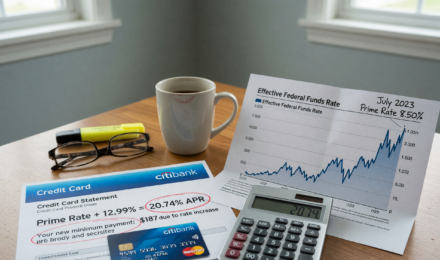
The topic carries particular weight now. After an aggressive rate-hiking cycle that pushed the prime rate to a 22-year high of 8.50% in 2023, the Fed began cutting in late 2024. Rates have since eased, but confusion about how the prime rate flows through to consumer products remains as thick as ever. Every Federal Open Market Committee (FOMC) meeting triggers a wave of misinformation online about what will happen to mortgages, savings accounts, and auto loans, most of it wrong.
This guide is for anyone carrying variable-rate debt, shopping for a new loan, or trying to make smarter savings decisions in a shifting rate environment. By the end, you will know exactly how the prime rate is set, what it actually affects, and what it does not control so you can stop leaving money on the table.
Key Takeaways
- The U.S. prime rate is currently 7.50% as of July 2025, according to the Federal Reserve’s H.15 release, it is not set by the Fed but by commercial banks following the federal funds rate.
- Your credit card APR is typically the prime rate plus a margin of 10–20 percentage points, meaning the prime rate is only one component of what you pay, per CFPB consumer credit data.
- The prime rate does not directly influence 30-year fixed mortgage rates, which are tied to 10-year Treasury yields, a fact confirmed by Federal Reserve research on interest rate transmission.
- The FOMC meets 8 times per year, meaning the prime rate changes at most 8 times annually, not daily or weekly as many borrowers assume, per the Fed’s official FOMC calendar.
- Variable-rate student loans issued after July 1, 2006 are fixed by federal law, they are not tied to the prime rate at all, per the Federal Student Aid office.
- Home equity lines of credit (HELOCs) are among the products most directly tied to the prime rate, with rate adjustments typically occurring within 30–60 days of a prime rate change, according to Bankrate’s HELOC rate tracker.
In This Guide
- Who actually sets the prime rate, and is it the Federal Reserve?
- How is the prime rate calculated and how often does it change?
- Which loans and accounts is the prime rate actually tied to?
- Does the prime rate affect mortgage rates when the Fed raises rates?
- Why is my credit card APR so much higher than the prime rate?
- How should I use the prime rate to make smarter borrowing decisions?
- Frequently Asked Questions
Step 1: Who Actually Sets the Prime Rate, and Is It the Federal Reserve?
Commercial banks set the prime rate, not the Federal Reserve. The Fed sets the federal funds rate, which is the rate banks charge each other for overnight loans. Major U.S. banks then independently set their own prime rates, which in practice always land at exactly 3 percentage points above the federal funds target rate.
How This Works in Practice
When the FOMC adjusts the federal funds rate, institutions like JPMorgan Chase, Bank of America, and Wells Fargo announce their own prime rate changes, typically within hours. The Wall Street Journal Prime Rate is the most widely cited benchmark and is calculated as the rate that at least 70% of the 10 largest U.S. banks charge their most creditworthy corporate customers.
This distinction matters enormously. The Fed does not order banks to charge a specific prime rate. Banks follow the federal funds rate because their own cost of funds is tied to it. If the FOMC holds rates steady, the prime rate stays put, regardless of inflation news, economic data, or anything else in the headlines.
What to Watch Out For
Many financial news headlines read “Fed raises prime rate,” which is technically inaccurate. The Fed raises the federal funds rate, and banks respond by raising the prime rate. Confusing the two leads borrowers to believe the Fed has more direct control over consumer lending rates than it actually does, which can lead to misplaced optimism or panic about loan costs.
The 3-percentage-point spread between the federal funds rate and the prime rate has been consistent since the early 1990s. Before that era, the relationship was less rigid, and the spread fluctuated based on competitive pressures among banks.
Step 2: How Is the Prime Rate Calculated and How Often Does It Change?
Changes to the prime rate happen only when the Federal Open Market Committee adjusts the federal funds rate, which occurs at most 8 scheduled times per year. Between FOMC meetings, the rate is fixed. It does not float daily or respond to stock market swings, inflation reports, or jobs data in real time.
The Math Behind the Rate
The formula is straightforward: Prime Rate = Federal Funds Rate Target + 3.00%. When the FOMC set the federal funds rate target range at 4.25%–4.50% in late 2024, the prime rate moved to 7.50%, and that is where it remains as of July 2025. Each 0.25% FOMC rate move produces an identical 0.25% prime rate move, applied to every variable-rate product linked to the prime.
The FOMC can also hold rates unchanged at a meeting, lower them, or in rare circumstances conduct emergency inter-meeting rate changes. In March 2020, for example, the Fed cut the federal funds rate to near zero in two emergency moves outside the normal schedule, and the prime rate followed to 3.25% within days.
What to Watch Out For
One of the most common prime rate misconceptions is that borrowers should monitor the rate daily the way they watch stock prices. In reality, your HELOC or credit card rate will not change until after the next FOMC decision, and even then, your lender typically applies the new rate at the start of your next billing cycle, not immediately.
Between March 2022 and July 2023, the FOMC raised the federal funds rate 11 times, pushing the prime rate from 3.25% to 8.50%, the fastest and largest prime rate increase in four decades, according to Federal Reserve historical data.

Step 3: Which Loans and Accounts Is the Prime Rate Actually Tied To?
Home equity lines of credit (HELOCs), variable-rate credit cards, variable-rate personal loans, and certain small business loans are all directly influenced by movements in the prime rate. Fixed-rate mortgages, car loans, federal student loans, and most savings account rates are not, a set of distinctions that represents some of the biggest misconceptions in personal finance.
Products Directly Tied to the Prime Rate
- HELOCs: Most HELOCs are indexed directly to the prime rate, with your rate expressed as “Prime + X%.” A rate change typically appears on your next statement cycle.
- Variable-rate credit cards: The vast majority of U.S. credit cards carry a variable APR calculated as prime rate plus a margin. Understanding how the prime rate affects your credit card interest rates is essential for managing revolving debt.
- Variable-rate personal loans: Some personal loans from banks and credit unions use the prime rate as their index. Learn more about how the prime rate affects personal loan rates before signing a variable-rate agreement.
- SBA loans: Many Small Business Administration (SBA) loan programs use the prime rate as their base rate, often set at prime plus 2.25% to 2.75%.
Products Not Directly Tied to the Prime Rate
- 30-year fixed mortgages: These track 10-year U.S. Treasury yields, not the prime rate.
- Federal student loans: Rates are set by Congress annually based on 10-year Treasury note yields.
- New auto loans: Primarily driven by competition among lenders and Treasury yields, not the prime rate directly.
- High-yield savings accounts and CDs: Savings rates are influenced by the federal funds rate but are not mechanically tied to the prime rate. See how savings accounts respond when the prime rate rises for the nuanced relationship.
What to Watch Out For
Always read your loan agreement to identify the index your rate uses. Some lenders use SOFR (Secured Overnight Financing Rate), LIBOR’s replacement, rather than the prime rate. Assuming your loan follows the prime rate when it actually follows a different index can lead to inaccurate rate-change expectations.
| Financial Product | Rate Index Used | Typical Rate Structure (July 2025) |
|---|---|---|
| Variable Credit Card | Prime Rate | Prime (7.50%) + 12–20% margin = 19.50%–27.50% APR |
| HELOC | Prime Rate | Prime (7.50%) + 0%–2% margin = 7.50%–9.50% APR |
| Variable Personal Loan | Prime Rate or SOFR | Prime (7.50%) + 3%–8% margin = 10.50%–15.50% APR |
| 30-Year Fixed Mortgage | 10-Year Treasury Yield | ~6.80%–7.10% (independent of prime rate) |
| Federal Student Loan (undergrad) | 10-Year Treasury + 2.05% | Fixed at 6.53% for 2024–2025 academic year |
| High-Yield Savings Account | Federal Funds Rate (indirect) | 4.50%–5.00% APY (bank discretion) |
| New Auto Loan (60-month) | Lender discretion / Treasury | ~6.50%–8.00% (varies by credit score) |
Think of it this way: the Fed pulls the lever on the federal funds rate, commercial banks respond with their prime rate adjustments, and from there the effect fans out unevenly across different loan types. Consumers who understand that chain of causation make far better borrowing and refinancing decisions than those who assume every rate on every product moves in lockstep with FOMC decisions.
Step 4: Does the Prime Rate Affect Mortgage Rates When the Fed Raises Rates?
No, not directly. Fixed mortgage rates are tied primarily to the yield on the 10-year U.S. Treasury note, which responds to inflation expectations, global bond demand, and long-term economic outlook, not to FOMC decisions in any direct mechanical way. This is one of the most persistent misconceptions among homebuyers, and acting on it can cost you.
Why Fixed Mortgages Move Differently
Mortgage-backed securities (MBS) are priced in relation to Treasury yields. When investors expect inflation to remain elevated over 10 to 30 years, they demand higher yields on long-term bonds, which pushes mortgage rates up. The FOMC’s short-term rate decisions influence this indirectly through inflation expectations, but a Fed rate cut does not guarantee an immediate drop in your 30-year mortgage rate.
During the 2022–2023 hiking cycle, the Fed raised short-term rates aggressively while long-term mortgage rates sometimes moved in ways that seemed disconnected. Mortgage rates peaked near 8.0% in October 2023, according to Freddie Mac’s Primary Mortgage Market Survey, even as the prime rate had already been elevated for months. The timing and magnitude of the movements were not identical.
What About Adjustable-Rate Mortgages?
Adjustable-rate mortgages (ARMs) use various indices, many now use SOFR rather than the prime rate. After an initial fixed period (often 5 or 7 years), the rate adjusts based on the index plus a margin. Understanding how the prime rate affects your mortgage and home equity loan depends entirely on whether your product is fixed or adjustable.
What to Watch Out For
Do not wait for an FOMC rate cut before locking a mortgage rate, assuming the cut will automatically lower your rate. Mortgage lenders often price in expected Fed moves weeks before they happen. By the time a cut is announced, mortgage rates may have already adjusted, or even risen if the economic outlook shifted.
Assuming a Fed rate cut will immediately lower your mortgage rate is a costly mistake. Fixed mortgage rates are driven by bond markets, which can move in the opposite direction of the federal funds rate. Always get a rate quote the day you need it, not based on what you expect the Fed to do next month.

Step 5: Why Is My Credit Card APR So Much Higher Than the Prime Rate?
Your credit card APR is the prime rate plus a lender-set margin, and that margin typically ranges from 10 to 20 percentage points, sometimes higher for subprime borrowers. Confusing the prime rate with the total APR is one of the most financially damaging misconceptions consumers carry, because it creates the false impression that a Fed rate cut will deliver meaningful relief on revolving balances.
How Your Card’s APR Is Calculated
When you open a credit card, the issuer sets a margin based on your credit score and card type. That margin is contractually fixed in your cardholder agreement. When the prime rate moves, your total APR moves by the same amount, but the margin never changes. So if your card is “Prime + 16.99%” and the prime rate drops by 0.50%, your APR drops by 0.50%, from 24.49% to 23.99%.
According to CFPB consumer credit trend data, the average credit card interest rate for accounts assessed interest exceeded 22% in 2024, more than triple the prime rate at the time. Even a series of Fed rate cuts would leave most cardholders paying punishing rates unless they address their margin through negotiation, balance transfers, or payoff strategies. If you carry balances, reviewing a step-by-step credit card payoff plan is far more impactful than waiting for the prime rate to fall.
What to Watch Out For
Some card issuers advertise a range of APRs, such as “19.99%–29.99% variable.” The rate you receive depends on your creditworthiness at the time of application. If your credit score improves significantly after you open the card, you can call the issuer and request a margin reduction, something many borrowers never think to do. Understanding what constitutes a good credit score and how to use it is your best tool for lowering that margin.
Call your credit card issuer and ask for a rate reduction. Studies show that roughly 70% of cardholders who ask receive some reduction. The prime rate component of your APR moves automatically, but the margin is negotiable. Reducing your margin by even 3–5 percentage points saves hundreds of dollars per year on a $5,000 balance.
Step 6: How Should I Use the Prime Rate to Make Smarter Borrowing Decisions?
Use prime rate trends as a timing signal for variable-rate products, specifically to decide when to lock in fixed rates, when to pay down variable debt aggressively, and when flexible borrowing tools like HELOCs offer better value than fixed alternatives. Knowing the direction of the prime rate is more actionable than knowing its current level.
When the Prime Rate Is Rising
A rising rate environment is the time to eliminate variable-rate debt as quickly as possible, convert HELOCs to fixed-rate home equity loans if your lender allows it, and avoid new variable-rate borrowing. During the 2022–2023 rate cycle, borrowers with variable-rate home equity debt saw their minimum payments rise significantly as the prime rate climbed 5.25 percentage points in under 18 months.
Carrying high-interest variable debt in that environment rewards one strategy above all others: attack the highest-rate balances first. The debt avalanche method becomes especially powerful during rate-rising cycles because the cost of inaction compounds rapidly.
When the Prime Rate Is Falling or Stable
A falling prime rate benefits borrowers with existing variable-rate debt automatically, as their rates decline with each FOMC cut. This is the environment in which HELOCs become more attractive relative to fixed home equity loans, and in which variable-rate personal loans may offer better initial pricing. That said, locking in a fixed rate when rates are near a perceived low still provides certainty that variable products cannot match, and rate cycles rarely bottom out exactly where forecasters expect them to.
What to Watch Out For
Do not try to perfectly time the bottom of a rate cycle. No one, including professional economists, consistently predicts FOMC decisions accurately. Make borrowing and repayment decisions based on your current financial situation and stress-test your budget against a scenario where the prime rate rises an additional 1–2% before you finish repaying.
There is also a real downside to over-optimizing around rate direction: it can lead borrowers to defer payoff decisions while waiting for cuts that may not arrive on schedule. A variable rate that looks manageable at 7.50% can strain a household budget quickly if it climbs back toward 8.50%. Build your repayment plan around what you can handle today, not what you hope the Fed will do next quarter.

Set a Google Alert for “FOMC decision” so you receive news the day the Fed announces a rate change. Then log into your lender’s portal and confirm when the new prime rate will be reflected on your account, typically at the next billing cycle close. This gives you two to four weeks to make strategic payments before the higher or lower rate takes effect.
Frequently Asked Questions
Is the prime rate the same as the federal funds rate?
No. These are two separate rates. The federal funds rate is what banks charge each other for overnight loans, set by the FOMC. The prime rate is what banks charge their most creditworthy commercial customers, and it consistently runs 3 percentage points above the federal funds rate. As of July 2025, the federal funds target range is 4.25%–4.50% and the prime rate is 7.50%, per the Federal Reserve’s H.15 statistical release.
Does the prime rate affect my savings account or CD rate?
Not directly. Savings account and CD rates are influenced by the federal funds rate indirectly, but they are not mechanically tied to the prime rate. Banks set deposit rates based on competition, their funding needs, and the federal funds rate environment, not a fixed formula. When the prime rate falls, savings rates typically follow within weeks, though the timing varies by institution. Comparing CD rates versus high-yield savings accounts helps you find the best option in any rate environment.
How quickly does my HELOC rate change after the prime rate changes?
Most HELOC agreements specify that a rate change takes effect at the start of the next billing cycle following an FOMC decision, typically 30 to 60 days after the announcement. Some agreements adjust the rate on the first day of the calendar month after the change. Your loan agreement’s “index and margin” section will specify the exact timing. Review that document rather than assuming immediate application.
Will the prime rate go down in 2025?
As of July 2025, the prime rate stands at 7.50%, and futures markets are pricing in a modest possibility of one additional FOMC rate cut later in 2025, though nothing is guaranteed. The FOMC has repeatedly emphasized its data-dependent approach, meaning inflation and employment reports will drive the decision. For the most current projections, track the CME Group’s FedWatch Tool, which shows market-implied probabilities of rate changes at each upcoming FOMC meeting.
Why didn’t my credit card rate go down after the Fed cut rates?
Your credit card rate likely did drop, but only by the same increment as the FOMC cut, typically 0.25% per move. Because credit card APRs include a fixed margin (often 12–20%) on top of the prime rate, a 0.25% prime rate cut reduces your APR by 0.25%, not dramatically. The larger component of your APR is the margin, which does not change unless you negotiate it or open a new card. This is one of the most frustrating realities for cardholders who expected big relief after Fed cuts.
Does my federal student loan rate change when the prime rate changes?
No. Federal student loan rates issued after July 1, 2006 are fixed for the life of the loan. The rate is set by Congress each year based on the 10-year Treasury note yield from the prior May, not the prime rate. Once you receive a federal loan at a specific rate, that rate never changes regardless of what the Fed does. This is confirmed by the Federal Student Aid office’s interest rate policy page.
Should I choose a fixed or variable rate loan when the prime rate is high?
When the prime rate is elevated and rate cuts are expected, a variable-rate loan can be advantageous because your rate will fall automatically as the prime rate drops, without requiring a refinance. The real risk is that cuts may not materialize on schedule, leaving you exposed to sustained high costs. A fixed rate provides certainty and protection against that outcome. Short-term borrowers typically benefit more from variable rates; long-term borrowers generally benefit from the certainty of fixed rates. Base the decision on your loan term and how much rate volatility your budget can absorb.
How does the prime rate affect small business loans?
Many SBA (Small Business Administration) loan programs set their maximum interest rates as the prime rate plus a fixed spread, commonly 2.25% to 2.75% for loans over seven years. With the prime rate at 7.50%, maximum SBA loan rates fall in the range of 9.75%–10.25% for longer-term loans. When the prime rate is high, small business borrowing costs rise significantly, which can affect expansion plans and cash flow projections. Always model your debt service based on a prime rate that is 1–2% higher than current levels as a stress test.
What is the difference between the prime rate and SOFR?
Both are interest rate benchmarks, but they serve different markets. The prime rate is set by commercial banks and is used primarily for consumer and small business loans. SOFR (Secured Overnight Financing Rate) is a wholesale benchmark published by the Federal Reserve Bank of New York, based on actual overnight Treasury repurchase agreement transactions. SOFR replaced LIBOR as the dominant benchmark for adjustable-rate mortgages and institutional lending. Many ARMs, syndicated business loans, and floating-rate securities now use SOFR rather than the prime rate, so borrowers must check their loan documents carefully to identify which index applies.
Can the prime rate change more than 8 times in a year?
Yes, in rare circumstances. The FOMC holds 8 scheduled meetings per year, but it can also convene emergency inter-meeting sessions. In March 2020, the Fed cut rates twice outside the regular schedule, moving the prime rate rapidly from 4.75% to 3.25% within weeks. These emergency actions are uncommon and typically reserved for acute economic disruptions. In ordinary conditions, 8 changes per year is the practical ceiling.
Sources
- Federal Reserve, H.15 Selected Interest Rates (Prime Rate Historical Data)
- Federal Reserve, FOMC Meeting Calendar
- Consumer Financial Protection Bureau, Consumer Credit Trends
- Freddie Mac, Primary Mortgage Market Survey
- Wall Street Journal, Money Rates (WSJ Prime Rate)
- Bankrate, Current HELOC Rates
- Federal Reserve Bank of New York, SOFR Reference Rates
- U.S. Small Business Administration, SBA Loan Programs