Fact-checked by the Prime Rate editorial team
Quick Answer
As of July 2025, the U.S. prime rate stands at 7.50%, directly tied to the Federal Reserve’s federal funds rate target range of 4.25%–4.50%. Most forecasters expect one to two Fed rate cuts before year-end, which would bring the prime rate to approximately 7.00%–7.25% by late 2025, depending on inflation and labor market data.
The prime rate forecast for 2025 points toward gradual easing, but the path is far from certain. The prime rate currently sits at 7.50%, confirmed by the Federal Reserve’s H.15 Selected Interest Rates release, and has held steady since the Fed paused its rate-cutting cycle in January 2025. Whether cuts resume depends heavily on inflation progress and employment data in the months ahead.
For borrowers, savers, and investors, even a quarter-point move in the prime rate ripples across credit card APRs, home equity lines, and business loans. This guide breaks down where rates stand today, what the Fed is signaling, and what a credible prime rate forecast looks like for the rest of 2025 and into 2026.
Key Takeaways
- The prime rate is currently 7.50%, set at exactly 300 basis points above the federal funds rate target midpoint, as maintained by the Federal Open Market Committee (FOMC).
- The Fed held rates steady at its May 2025 meeting, with the federal funds rate target remaining at 4.25%–4.50%, according to the FOMC’s May 2025 statement.
- The CME FedWatch Tool shows markets pricing in approximately a 60% probability of at least one quarter-point cut by September 2025, according to CME Group’s FedWatch Tool.
- The Consumer Price Index rose 3.4% year-over-year as of recent data, remaining above the Fed’s 2% target, per the U.S. Bureau of Labor Statistics.
- Average credit card APRs exceed 20%, roughly prime plus a margin, meaning borrowers feel prime rate changes almost immediately, as tracked by the Fed’s G.19 Consumer Credit report.
In This Guide
- What Is the Prime Rate Today and How Is It Set?
- What Is the Federal Reserve Signaling About Rate Cuts?
- What Does the Prime Rate Forecast Look Like for 2025?
- Where Could the Prime Rate Go in 2026?
- How Does the Prime Rate Affect Borrowers and Savers?
- What Economic Factors Drive the Prime Rate Forecast?
- What Should You Do With Your Money Right Now?
What Is the Prime Rate Today and How Is It Set?
The prime rate is currently 7.50%, set at exactly 3 percentage points above the federal funds rate’s upper target. This relationship is not a legal rule but a long-standing banking convention followed by virtually every major U.S. lender, including JPMorgan Chase, Bank of America, and Wells Fargo.
The Fed Funds Rate Connection
The Federal Open Market Committee (FOMC) sets the federal funds rate target range at each of its eight scheduled meetings per year. When the Fed moves that target, the prime rate moves in lockstep. The current federal funds rate target of 4.25%–4.50% places the prime rate exactly at 7.50%.
The prime rate is published daily by the Wall Street Journal and serves as the baseline for most variable-rate consumer and business lending products. It is distinct from the federal funds rate itself, which is the overnight rate at which banks lend reserves to each other.
The prime rate has moved in exact 25-basis-point increments alongside every Fed rate change since the early 1990s. It has never deviated from the federal funds rate upper bound plus 3% in modern monetary history.
What Is the Federal Reserve Signaling About Rate Cuts?
The Fed is signaling patience, not urgency. At its May 2025 meeting, the FOMC voted unanimously to hold rates steady and emphasized that it needs greater confidence that inflation is moving sustainably toward its 2% target before cutting again.
Fed Dot Plot and Projections
The Fed’s March 2025 Summary of Economic Projections, commonly called the “dot plot,” showed the median FOMC member expecting two quarter-point cuts in 2025. The range of individual projections was wide, with some members projecting no cuts at all. That internal disagreement reflects genuine uncertainty about the inflation trajectory.
Fed Chair Jerome Powell reinforced a data-dependent stance at the May 2025 press conference, explicitly linking any future cuts to sustained progress on core inflation. At that press conference, Powell stated: “We do not need to be in a hurry, and we think that our current stance is well-positioned to deal with the risks and uncertainties that we face. The labor market is solid, and inflation has been coming down, but we want to see further progress.” The full statement is available via the FOMC’s May 2025 press release.
What the Fed Funds Futures Market Says
Markets are slightly more optimistic than the Fed’s own projections. The CME FedWatch Tool currently prices in a roughly 60% probability of at least one cut by September 2025. That would bring the federal funds rate to 4.00%–4.25% and the prime rate to 7.25%.

What Does the Prime Rate Forecast Look Like for 2025?
The most credible prime rate forecast for 2025 projects one to two quarter-point cuts, landing the prime rate between 7.00% and 7.25% by December. This base case assumes inflation continues its gradual decline and the labor market avoids a sharp deterioration.
Scenario Analysis: Three Possible Outcomes
The table below summarizes three plausible scenarios for the prime rate by the end of 2025, based on Fed guidance and market pricing as of July 2025.
| Scenario | Fed Cuts in 2025 | Prime Rate by Dec 2025 | Trigger |
|---|---|---|---|
| Base Case | 2 cuts (50 bps total) | 7.00% | Inflation falls to ~2.5%, labor stable |
| Hawkish Case | 0 cuts | 7.50% | Inflation stays above 3%, tariffs re-escalate |
| Dovish Case | 3–4 cuts (75–100 bps) | 6.50%–6.75% | Recession risk rises, unemployment exceeds 5% |
The hawkish scenario has gained credibility in 2025 due to trade policy uncertainty. New tariff announcements have introduced upside inflation risk, which could delay cuts beyond September.
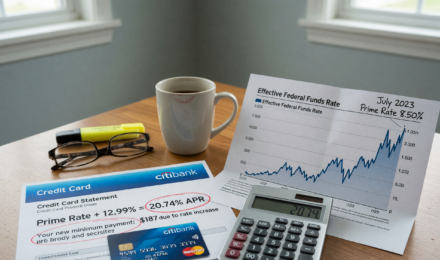
The prime rate peaked at 8.50% in July 2023, its highest level since 2001. It has since declined by 100 basis points through three Fed cuts in late 2024, before the current pause began in January 2025.
Where Could the Prime Rate Go in 2026?
The prime rate forecast for 2026 points toward a range of 6.00%–6.75%, assuming the Fed follows through on its longer-run neutral rate projections. The Fed’s March 2025 dot plot placed the longer-run federal funds rate at 3.0%, which would imply a long-run prime rate of 6.0%.
The Neutral Rate Question
The neutral rate is the rate that neither stimulates nor restricts growth, and it is a key variable in any multi-year prime rate forecast. Many economists at institutions like the Brookings Institution and the Peterson Institute for International Economics argue the neutral rate has risen post-pandemic, possibly to 3.0%–3.5%. If correct, that would anchor the prime rate closer to 6.0%–6.5% even in a fully normalized environment.
Understanding the 2026 outlook also matters for savers deciding whether to lock in rates now. Our CD rates forecast for 2026 explores how falling prime rates will affect certificate of deposit yields and what locking in today could mean for your returns.
How Does the Prime Rate Affect Borrowers and Savers?
The prime rate directly determines borrowing costs for millions of Americans. Variable-rate products, including credit cards, home equity lines of credit (HELOCs), and many personal loans, are priced as “prime plus a margin.” A drop in the prime rate translates immediately into lower monthly interest charges on these products.
Credit Cards and HELOCs
Credit card APRs average above 20% because issuers add a margin of roughly 12–14 percentage points on top of prime. Even a 50-basis-point prime rate cut would lower a typical variable card’s APR by the same amount. For a borrower carrying a $10,000 balance, that equals roughly $50 in annual interest savings: modest, but real.
HELOCs are more sensitive. Most HELOC rates reset monthly with the prime rate, so two cuts totaling 50 bps would reduce a $100,000 HELOC balance payment by approximately $42 per month. Our guide on how the prime rate affects your mortgage and home equity loan covers these dynamics in more detail.
A HELOC tied to the prime rate adjusts its interest rate within one to two billing cycles of a Fed rate change. Fixed-rate home equity loans, by contrast, are unaffected by prime rate moves after closing.
Savers and Deposit Accounts
For savers, a falling prime rate is a warning signal. High-yield savings account rates and money market account yields tend to decline in step with the prime rate, so savers who want to preserve today’s elevated yields should consider locking in rates through CDs before cuts arrive. Our comparison of CD rates vs. high-yield savings can help you decide which vehicle fits your timeline.
For a fuller picture of what rising or falling prime rates mean for your savings account specifically, our article on what happens to your savings when the prime rate rises covers the mechanics in detail.

What Economic Factors Drive the Prime Rate Forecast?
Three variables carry the most weight in any near-term prime rate forecast: inflation data, employment conditions, and geopolitical or trade policy shocks. The Fed has been explicit that all three are live inputs to its decisions.
Inflation: The Primary Gating Factor
The Consumer Price Index (CPI), published monthly by the Bureau of Labor Statistics, is the Fed’s most-watched public inflation gauge. Core CPI, which strips out food and energy, ran at approximately 3.4% year-over-year as of recent months, well above the Fed’s 2% target. The Personal Consumption Expenditures (PCE) price index, the Fed’s preferred measure, has been running slightly below CPI but also remains elevated.
Until core PCE shows consistent monthly readings near 0.2% or below, the Fed is unlikely to cut aggressively. Tariff-driven goods price increases in mid-2025 have added complexity to the inflation picture.
Labor Market and GDP Growth
The U.S. labor market has remained resilient, with the Bureau of Labor Statistics reporting unemployment near 4.2% through mid-2025. A labor market this strong gives the Fed little urgency to cut rates to support growth. If hiring slows materially, particularly in rate-sensitive sectors like construction and manufacturing, the calculus would shift quickly toward cuts.
GDP growth also factors in. The Bureau of Economic Analysis reported first-quarter 2025 GDP contracted slightly, raising brief recession concerns. If negative growth persists, rate cuts would likely accelerate.
What Should You Do With Your Money Right Now?
The prime rate forecast suggests rates are more likely to fall than rise over the next 12–18 months. That directional signal has clear implications for how you manage debt and savings today.
Borrowers: Act on Variable-Rate Debt
If you carry variable-rate debt, particularly credit card balances or a HELOC, the prime rate forecast offers a short-term reprieve, but high rates today are still costly. Paying down high-interest debt aggressively now, before any cuts materialize, is the dominant strategy. Our guide on how to pay off debt fast using the snowball vs. avalanche method outlines which approach eliminates interest faster.
Even a 50-basis-point cut will not meaningfully reduce a 20%+ APR. Reducing the balance itself remains the primary lever. Our step-by-step plan on how to pay off $10,000 in credit card debt in 2026 provides a concrete payoff roadmap.
Savers: Lock In Rates Before Cuts Arrive
High-yield savings and money market account rates will fall as the prime rate drops. Savers with a 12–24 month time horizon should consider locking in today’s CD rates before the Fed acts. A CD ladder strategy, which spreads deposits across multiple maturity dates, balances the need for liquidity with the desire to capture current yields. Learn how to build one in our guide to CD ladders.
If you expect two Fed rate cuts in the next 12 months, locking a portion of your savings into a 12-month CD today captures current yields before they decline. Pair it with a high-yield savings account for liquidity, rates on both will fall when the prime rate drops.
Frequently Asked Questions
What is the prime rate today in 2025?
The U.S. prime rate is 7.50% as of July 2025. It has held at this level since January 2025, when the Federal Reserve paused its rate-cutting cycle. It equals the federal funds rate upper bound of 4.50% plus a fixed spread of 3 percentage points.
Will the prime rate go down in 2025?
Most forecasters expect the prime rate to decline by 25–50 basis points before the end of 2025, bringing it to 7.00%–7.25%. This base case depends on inflation continuing to ease toward the Fed’s 2% target. If inflation stays stubbornly high, the prime rate could remain at 7.50% through year-end.
How does the prime rate forecast affect credit card rates?
Credit card APRs are typically priced at prime plus a fixed margin, so they move directly with the prime rate. A 50-basis-point drop in the prime rate would reduce a variable card’s APR by 0.50 percentage points. On a $10,000 balance, that saves roughly $50 per year in interest charges.
What is the prime rate forecast for 2026?
The prime rate forecast for 2026 points to a range of 6.00%–6.75%, assuming the Federal Reserve continues cutting at a gradual pace. The Fed’s own longer-run neutral rate projection of 3.0% implies a long-run prime rate of 6.0%, though elevated inflation and trade policy uncertainty could keep rates higher for longer.
How often does the prime rate change?
The prime rate changes only when the Federal Reserve adjusts the federal funds rate target. The FOMC meets eight times per year, but does not change rates at every meeting. Between 2022 and 2023, the Fed raised rates at 11 consecutive meetings; since mid-2024, it has moved more cautiously.
Is the prime rate the same as the federal funds rate?
No. The federal funds rate is the overnight rate banks charge each other for reserve lending. The prime rate is a commercial lending benchmark set by banks at exactly 3 percentage points above the federal funds rate’s upper target. The two are directly linked, but they are not the same rate.
Who sets the prime rate?
No single entity officially sets the prime rate. Major banks set their own prime rates, and virtually all follow the Wall Street Journal prime rate, which is updated whenever at least 23 of the 30 largest U.S. banks change their base rates. In practice, this always follows a Fed rate decision.
Sources
- Federal Reserve, H.15 Selected Interest Rates (Prime Rate Historical Data)
- Federal Reserve, FOMC Press Release, May 7, 2025
- U.S. Bureau of Labor Statistics, Consumer Price Index Summary
- U.S. Bureau of Labor Statistics, Employment Situation Summary
- U.S. Bureau of Economic Analysis, Gross Domestic Product (GDP)
- Federal Reserve, Open Market Operations and FOMC Decisions
- Federal Reserve, G.19 Consumer Credit Report