
Fact-checked by the Prime Rate editorial team
The Verdict
Invoice financing makes sense when you need cash within 24 to 48 hours and your effective cost stays below your gross margin on the invoice. It is not worth it if your financing fee converts to an APR above 36% and a bank line of credit or SBA loan is available. Most small businesses should treat it as a last resort, not a routine tool.
Here is a question worth sitting with: if a lender charged you 36% APR to borrow money, you would walk away fast, yet many small business owners pay exactly that, or more, every time they advance an unpaid invoice without running the math first. The invoice financing prime rate cost is the missing piece of that math, and it moves every time the Federal Reserve adjusts its benchmark., the U.S. prime rate sits at 6.75%, unchanged since late 2025, which means the margin providers stack on top has become the dominant cost variable for businesses using prime-linked facilities.
For owners watching payroll deadlines and supplier terms collide with net-60 receivables, the choice to finance an invoice feels urgent and obvious. But the personal financial consequences of paying 2% to 4% per month in fees add up fast, owner draws shrink, retirement contributions get skipped, and household cash flow tightens in ways that are easy to miss until the damage is done.
| Factor | Reasons to Use Invoice Financing | Reasons Not to Use Invoice Financing |
|---|---|---|
| Speed | Funds available in 24–48 hours; no lengthy underwriting | Speed premium baked into the fee; you pay for urgency every time |
| Qualification | Approval based on customer creditworthiness, not yours | Poor customer credit can disqualify the invoice or raise your rate |
| Debt structure | Off-balance-sheet in some accounting treatments; no term loan added | Recourse agreements expose you personally if the customer doesn’t pay |
| Cost vs. alternatives | Cheaper than merchant cash advances, which can exceed 100% APR | SBA 7(a) loans currently price at 9.75%–14.75% APR, far lower for eligible borrowers |
| Cash flow fit | Turns receivables into working capital without new equity dilution | Routine use compounds costs; 1–3% monthly fees annualize to 12%–42%+ |
| Flexibility | Finance select invoices only; no requirement to advance all receivables | Minimum volume commitments at some providers lock you in even when you don’t need it |
Key Takeaways
- Invoice financing is likely the right move if your effective cost, including all fees, stays below 36% APR and no bank line of credit is available within your timeline.
- Run the annualized math before signing: a 2% flat fee on a 30-day invoice equals roughly 27% APR once compounding is accounted for.
- Your customer’s payment history matters as much as your own credit; a slow payer extends the term and multiplies your cost per dollar advanced.
- If the prime rate rises from its current 6.75%, any prime-linked invoice facility will immediately become more expensive with no renegotiation needed.
- Check whether your agreement is recourse or non-recourse; a recourse arrangement means a customer default lands back on your personal guarantee.
- Compare the total financing cost against the gross margin on the specific invoice; if fees exceed 50% of your margin, the transaction may not be worth advancing.
- If invoice financing is becoming a monthly habit, that signals a structural cash flow problem better solved by tighter net terms or a revolving credit line.
What Does Invoice Financing Actually Do to Your Cash Flow?
Invoice financing converts a confirmed but unpaid receivable into immediate working capital, typically advancing 70% to 90% of the invoice face value upfront, with the remainder paid once your customer settles. It is not a loan in the traditional sense. There is no fixed repayment schedule tied to your revenue, no collateral beyond the invoice itself, and no requirement to pledge business or personal assets, unless the agreement includes a personal guarantee, which many do.
The practical distinction from invoice factoring is worth understanding. In factoring, you sell the receivable outright to a third party, who then collects directly from your customer. With financing, you retain the customer relationship and collection responsibility; the lender holds the invoice as security. Both structures share the same core cost driver: the longer your customer takes to pay, the more you owe. That dynamic is what makes slow-paying clients expensive in ways that are hard to predict at the start of a deal.
Small businesses turn to this tool primarily because traditional bank credit moves slowly. Payroll does not wait for a loan committee. Supplier discounts expire. According to the 2024 Small Business Credit Survey conducted by the Federal Reserve Banks, only 2% of employer-based small businesses used invoice factoring on a regular basis, a number that suggests most owners either do not know the product exists or have found the cost prohibitive after trying it.

The Prime Rate and Invoice Financing Cost: How the Link Actually Works
Not every provider prices off the prime rate directly, but the benchmark still shapes what you pay. Some invoice financing platforms use a flat discount rate, say, 1.5% to 3% of the invoice value per 30 days, while others structure their pricing as prime plus a margin, typically prime plus 1% to 3% on top of their discount fee. With prime at 6.75%, a prime-plus-2% facility already carries a base cost of 8.75% before the discount rate is added.
Even flat-fee providers feel the ripple. When benchmark rates are high, their own cost of capital rises, and those costs eventually filter into the fees they charge. The difference between a low-rate environment (prime at 3.25%, as it was in early 2022) and today is meaningful: a provider that raised its discount rate by just 0.5 percentage points in response to tightening conditions added roughly $500 in annual cost for every $100,000 in receivables financed on 30-day terms. That is not dramatic on a single transaction, but it accumulates.
Understanding how the prime rate affects business and personal borrowing costs is essential context here. The Federal Reserve sets the federal funds rate; banks then price their prime rate at roughly 3 percentage points above it. Invoice financing providers, whether bank-affiliated or fintech, calibrate their own margins relative to that baseline. A sustained high prime rate, like the current 6.75%, effectively puts a floor under what you can expect to pay for short-term receivables funding.
Real Cost Math: What a $50,000 Invoice Actually Costs You
Flat percentages obscure the real burden. Here is the arithmetic on a common scenario.
Assume you have a $50,000 invoice due in 60 days and a provider charges a 2% fee per 30 days. The lender advances 85%, or $42,500. At day 60, your customer pays. The provider collects their fees: 2% for the first 30 days ($1,000) plus 2% for the second 30 days (another $1,000), totaling $2,000 in fees. You receive the remaining reserve of $7,500 minus $2,000, netting $5,500. Your effective cost on the $42,500 advance over 60 days: $2,000 divided by $42,500 equals about 4.7% for two months, which annualizes to roughly 28% APR.
Now add a $250 origination fee. That same deal costs $2,250 in total, pushing the annualized rate closer to 30%. If your customer pays late, say, day 75, you owe fees for a third partial period too, and the APR climbs further. This is the mechanism most pitch decks leave out. A 2% monthly fee sounds manageable; a 30% annualized cost sounds like what it is.
For comparison, SBA 7(a) loans currently carry APRs in the range of 9.75% to 14.75%, well below what most invoice financing arrangements produce once the math is done properly. The gap is not trivial. On $100,000 in recurring monthly financing over a year, the difference between 14% and 30% APR is roughly $16,000 in extra interest costs, money that could otherwise flow to owner draws, equipment, or retained earnings.
Hidden Costs That Hit Hardest, and the Recourse Risk Few Discuss
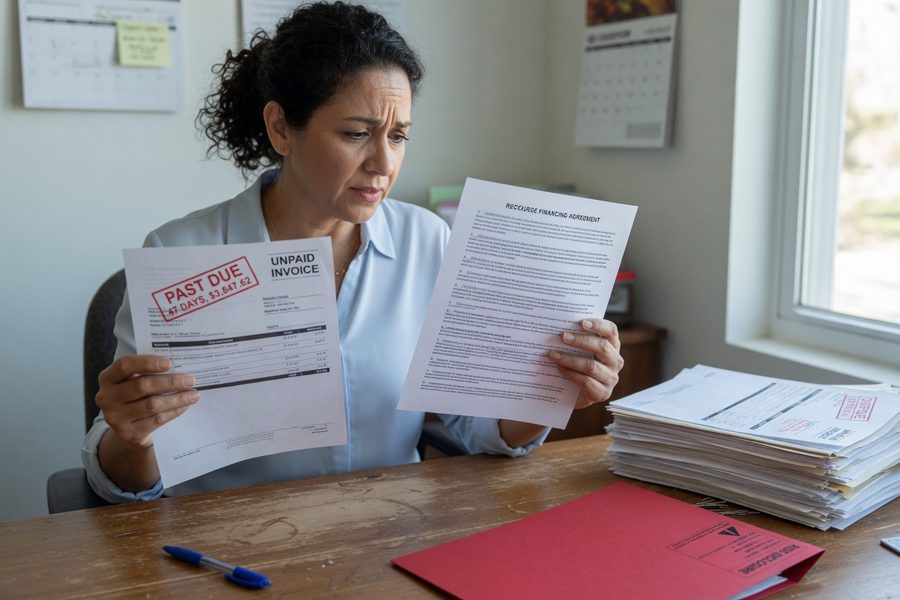
Recourse agreements are the cost that does not appear in the fee schedule. Under a recourse structure, if your customer fails to pay the invoice within the agreed window, you must buy the receivable back from the financier. This means a client’s bankruptcy or simple nonpayment becomes your personal problem, not the lender’s. Depending on whether you signed a personal guarantee, that obligation can attach to your household assets directly.
Non-recourse agreements exist but come at a premium. A provider assuming the credit risk of your customer will charge a higher discount rate to compensate, typically 0.5% to 1% more per period. That premium is often worth it for businesses with concentrated customer bases, where a single large client’s default could be catastrophic. But it further raises the effective APR you are already paying.
Beyond recourse risk, watch for these cost layers:
- Minimum volume commitments: Some providers require you to advance a minimum dollar amount monthly or quarterly. Miss the threshold and you pay a fee anyway.
- Concentration limits: If more than 20%–25% of your receivables come from a single customer, the provider may cap what they will advance or charge a higher rate for that concentration risk.
- Early termination penalties: Contracts with 12-month minimums often carry termination fees equal to several months of expected fees.
- Wire or ACH fees: Small per-transaction charges that add up when you are financing frequently.
The personal finance ripple effect is real and often underestimated. When financing fees reduce net business income by several thousand dollars per month, owner draws shrink by a similar amount. That contraction affects household cash flow directly, a monthly budget built around a certain draw level can fall apart quickly when invoice financing costs are running hot. And because those fees are a business expense, they reduce taxable income, but the net-of-tax cost is still substantial for most owners in the 25%–32% bracket.
Who Should and Who Should Not
Good candidates
Invoice financing earns its premium in a narrow set of situations where speed and accessibility outweigh the cost.
- A business with strong gross margins above 40% where a 2%–3% financing fee still leaves a profitable transaction
- A seasonal business that needs a one-time bridge to cover payroll during a slow month, not a recurring facility
- A company that has been turned down for a bank line of credit due to short operating history but has creditworthy B2B customers
- An owner who has run the annualized cost math and confirmed the effective APR stays below 30% after all fees
Who should skip it
For many small businesses, cheaper alternatives exist and the discipline required to avoid overusing invoice financing is simply too hard to maintain in practice.
- Any owner who qualifies for an SBA 7(a) line of credit or a bank revolving credit facility, the rate gap is too wide to justify the premium
- Businesses with thin margins below 15%, where financing fees could eliminate profitability on the underlying transaction
- Owners who are already managing personal debt stress; recourse obligations can compound an already fragile household balance sheet, understanding the role of an emergency fund matters more in those situations
- Companies whose customers routinely pay late, stretching 30-day terms to 60 or 90 days and doubling or tripling the effective cost
Frequently Asked Questions
Is invoice financing more expensive when the prime rate is high?
For prime-linked facilities, yes, directly. A provider charging prime plus 2% on a discount rate already starts at 8.75% with the current 6.75% prime, before any flat service fees are added. Flat-fee providers are less immediately sensitive, but their cost of capital rises with benchmark rates too, which tends to push flat fees higher over time.
What is a typical effective APR for invoice financing in 2026?
Most invoice financing arrangements convert to effective APRs between 15% and 60%, depending on the fee structure, invoice term, and any add-on charges. A 1.5% monthly fee on a 30-day invoice annualizes to roughly 18%–20% APR; a 3% fee on a 60-day invoice can exceed 40%. Knowing your annualized cost before signing is the single most important calculation you can do.
Can invoice financing hurt my personal credit?
It can, under two conditions. First, if you signed a personal guarantee and your customer defaults on a recourse agreement, the unpaid balance can become a personal debt obligation. Second, if the financing company reports to personal credit bureaus, missed obligations will appear on your personal report. Always confirm whether a personal guarantee is required and whether reporting goes to Experian, Equifax, or TransUnion before agreeing to terms.
What is the cheapest alternative to invoice financing for a small business?
A bank revolving line of credit or an SBA 7(a) loan is almost always cheaper on an annualized basis, with current rates ranging from roughly 9.75% to 14.75% APR. The trade-off is approval time and eligibility requirements, both take weeks and require documentation that a newer business may not have. If you can qualify, the rate savings over a full year of financing are substantial enough to make the application effort worth it. Understanding how the prime rate affects different loan types can help you compare options with realistic numbers.