
Quick Answer
To start investing in dividend stocks as a beginner, open a brokerage account, research companies with a dividend yield between 2% and 5%, and reinvest your payouts automatically. The S&P 500’s average dividend yield sits near 1.35%, making stock selection and diversification critical for meaningful income growth.
Dividend stocks represent one of the most reliable pathways to building long-term wealth, and the strategy is simpler than most new investors assume. More than 84% of S&P 500 companies pay a regular dividend, giving beginners a deep pool of battle-tested options to choose from (S&P Dow Jones Indices, 2025). The core idea is straightforward: buy shares in profitable companies, collect quarterly cash payments, and let compounding do the heavy lifting over time.
Hartford Funds calculates that dividends have accounted for approximately 40% of the S&P 500’s total return since 1930 (Hartford Funds, 2024). That single data point explains why dividend investing is not merely a passive-income trick but a foundational pillar of serious long-term portfolio construction. Research from Ned Davis Research further confirms that dividend-growing companies have outperformed non-dividend-paying stocks by a wide margin over multi-decade periods.
This guide walks you through every step of the process. From understanding what dividends are and how they work, to choosing your first stocks, avoiding common beginner mistakes, and building a portfolio that generates reliable income for years. You will find comparison tables, real-world benchmarks, and a clear action plan you can start implementing today.
Key Takeaways
- Dividends have contributed approximately 40% of the S&P 500’s total return since 1930 (Hartford Funds, 2024), making them a critical component of long-term wealth building.
- The average dividend yield for S&P 500 stocks is currently near 1.35% (S&P Dow Jones Indices, 2025), so targeting individual stocks or dividend ETFs with yields of 2%–5% is generally the optimal range for beginners.
- Dividend Aristocrats, companies that have raised their dividend for at least 25 consecutive years, have historically outperformed the broader market with lower volatility (S&P Global, 2024).
- Reinvesting dividends through a Dividend Reinvestment Plan (DRIP) can grow a $10,000 initial investment to over $57,000 in 20 years at a 9% annualized total return (SEC compound interest data, 2024).
- A diversified dividend portfolio should hold stocks across at least 5 to 7 sectors to reduce concentration risk, according to guidelines from the Financial Industry Regulatory Authority (FINRA, 2024).
- Qualified dividends are taxed at capital gains rates of 0%, 15%, or 20% depending on income bracket, compared to ordinary income tax rates up to 37% for non-qualified dividends (IRS Publication 550, 2024).
In This Guide
- What Are Dividend Stocks and How Do They Work?
- Why Are Dividend Stocks a Good Starting Point for Beginners?
- What Key Metrics Should Beginners Evaluate Before Buying a Dividend Stock?
- What Are the Best Types of Dividend Stocks for Beginners?
- How Do You Open a Brokerage Account to Start Buying Dividend Stocks?
- How Do You Build a Dividend Stock Portfolio from Scratch?
- How Does Dividend Reinvestment (DRIP) Accelerate Your Wealth?
- How Are Dividend Stock Payments Taxed?
- What Are the Most Common Dividend Investing Mistakes Beginners Make?
What Are Dividend Stocks and How Do They Work?
Dividend stocks are shares of companies that distribute a portion of their profits to shareholders on a regular schedule, typically quarterly. When you own a dividend-paying stock, you receive cash payments simply for holding shares, regardless of whether the stock price rises or falls on any given day.
The mechanics are straightforward. A company’s board of directors declares a dividend, announces the record date (who qualifies to receive the payment), and then distributes cash on the payment date. To receive the dividend, you must own shares before the ex-dividend date, which is typically one business day before the record date.
How Dividend Yield Is Calculated
The dividend yield is the annual dividend payment divided by the stock’s current price, expressed as a percentage. If a stock pays $2.00 per share annually and trades at $50, its dividend yield is 4.0%.
Yield fluctuates as stock prices move. A rising yield can signal either a generous payout or a falling stock price, which is why yield should never be evaluated in isolation. Beginners should always pair yield analysis with payout ratio and earnings growth data.
Types of Dividends You May Receive
Most dividends are paid in cash, but companies occasionally issue stock dividends, which give shareholders additional shares instead of cash. Some companies also pay special dividends: one-time distributions funded by extraordinary profits or asset sales.
Real Estate Investment Trusts (REITs) are legally required to distribute at least 90% of their taxable income as dividends (IRS, 2024), making them among the highest-yielding dividend vehicles available to retail investors.
The first recorded dividend in the United States was paid by the Bank of New York in 1784. Today, the company, now BNY Mellon, has paid uninterrupted dividends for over 230 years, making it one of the longest dividend-paying streaks in American corporate history.
Why Are Dividend Stocks a Good Starting Point for Beginners?
Regular cash payments give new investors something concrete to track and measure, which makes it far easier to stay disciplined during market downturns. Unlike growth stocks that offer no income until you sell, dividend stocks reward you simply for holding.
Research from Morningstar shows that dividend-paying stocks exhibit lower price volatility than non-dividend payers, largely because consistent dividend payments signal financial strength and management discipline (Morningstar, 2024). For a new investor learning to manage emotions during market swings, that stability is invaluable.
That said, dividend investing is not a perfect fit for everyone. Investors with a very long horizon (20-plus years) who can stomach significant volatility sometimes build more wealth through growth-oriented strategies. And someone carrying high-interest debt above 7% APR will almost always generate better returns by paying that off first. The income focus that makes dividend stocks psychologically easier to hold can also create a bias toward lower-growth companies.
The Power of Compounding Dividend Income
When dividends are reinvested rather than spent, they purchase additional shares, which then generate their own dividends, a cycle that accelerates wealth accumulation over time. This concept, closely related to how compound growth rewards boring decisions, is the foundational engine behind dividend investing’s long-term effectiveness.
Per the SEC’s compound interest calculator, a $10,000 investment growing at 9% annually (a realistic estimate for a total-return dividend portfolio) grows to approximately $56,044 over 20 years (SEC, 2024). The same investment without reinvested dividends would grow significantly slower.
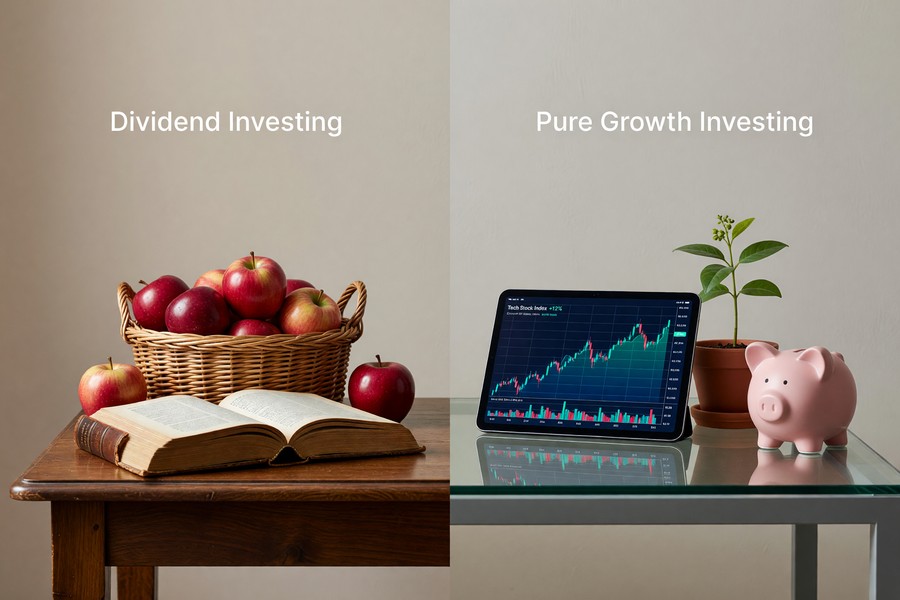
Dividend Investing vs. Pure Growth Investing for Beginners
Growth stocks (like many technology companies) can deliver spectacular returns but often pay zero dividends, meaning your only profit comes from price appreciation. That approach requires predicting price movements, which is notoriously difficult even for professionals.
Shifting part of your return to a more predictable income stream is what dividend investing does well. This does not mean growth is irrelevant. The best dividend portfolios combine solid yield with steady earnings growth.
From 1973 to 2023, dividend-growing stocks returned an average of 10.19% annually, compared to just 3.95% for non-dividend-paying stocks and 6.99% for the equal-weighted S&P 500 Index (Ned Davis Research, cited in Hartford Funds, 2024).
What Key Metrics Should Beginners Evaluate Before Buying a Dividend Stock?
Before buying any dividend stock, beginners must evaluate five core metrics: dividend yield, payout ratio, dividend growth rate, earnings stability, and free cash flow. Ignoring any one of these can lead to “dividend traps,” stocks with unsustainably high yields that eventually cut their payments.
Dividend Yield
A yield between 2% and 5% is generally considered the safe zone for most beginners. Yields above 6%–7% often signal financial distress or a recent stock price collapse and deserve extra scrutiny. Data from Simply Safe Dividends shows that companies with yields above 8% cut their dividend at a rate more than 3 times higher than those yielding 2%–4% (Simply Safe Dividends, 2024).
Payout Ratio
The payout ratio measures what percentage of earnings a company pays as dividends. A ratio below 60% is generally healthy for most industries, leaving room for dividend growth and business reinvestment. REITs are an exception, where payout ratios above 90% are normal due to their legal distribution requirements.
Dividend Growth Rate and Streak
A consistent history of dividend increases is one of the strongest signals of financial health. Companies that have raised dividends for 25 or more consecutive years earn the title of “Dividend Aristocrat,” a designation tracked by S&P Global. There are 69 Dividend Aristocrats in the S&P 500 (S&P Global, 2025).
| Metric | Healthy Range | Red Flag Range | Why It Matters |
|---|---|---|---|
| Dividend Yield | 2.0% – 5.0% | Above 7.0% | High yield may signal distress |
| Payout Ratio | Below 60% | Above 80% (non-REIT) | Ensures dividend sustainability |
| Dividend Growth Rate | 3% – 10% annually | 0% or negative | Signals earnings momentum |
| Consecutive Dividend Growth | 10+ years | No track record | Demonstrates management discipline |
| Free Cash Flow Coverage | FCF > Dividends paid | FCF < Dividends paid | Cash, not earnings, pays dividends |
Free cash flow is arguably more important than earnings per share, because dividends are paid in cash, not accounting profits. A company with strong earnings but weak free cash flow may struggle to maintain its dividend during economic downturns.
Beginners who fixate on yield and overlook payout ratio frequently end up in the dividend trap: a 7% yield with a 95% payout ratio is a warning sign, not an opportunity. Sustainable dividend investing starts with finding companies where the dividend is well-covered by free cash flow and has a history of consistent growth, a standard documented across dividend research from Morningstar (Morningstar, 2024).
What Are the Best Types of Dividend Stocks for Beginners?
For beginners, the most appropriate starting points are Dividend Aristocrats, dividend-focused ETFs, and blue-chip stocks in defensive sectors like consumer staples, utilities, and healthcare. These categories offer predictability, transparency, and lower risk of sudden dividend cuts.
Dividend Aristocrats and Dividend Kings
Dividend Aristocrats have raised dividends for at least 25 consecutive years. Dividend Kings have done so for 50 or more years. Examples include Johnson & Johnson, Procter & Gamble, Coca-Cola, and Colgate-Palmolive, companies with globally dominant brands and cash flows that have weathered multiple recessions.
Procter & Gamble has increased its dividend for 68 consecutive years (Procter & Gamble Investor Relations, 2025), making it one of the most reliable dividend growth stories in market history.
Dividend ETFs for Instant Diversification
For beginners who want broad exposure without picking individual stocks, dividend ETFs (Exchange-Traded Funds) are an excellent alternative. Popular options include the Vanguard Dividend Appreciation ETF (VIG), the Schwab U.S. Dividend Equity ETF (SCHD), and the iShares Select Dividend ETF (DVY).
SCHD holds roughly 100 stocks and has delivered a 10-year annualized return of approximately 11.5% through mid-2025 (Morningstar, 2025). Understanding the differences between ETF structures is important here; our guide on index funds vs. ETFs explains the key distinctions beginners should know.
Sector Diversification for Dividend Investors
Income is most stable when spread across multiple sectors. Utilities provide steady yield but low growth. Consumer staples offer recession resistance. Healthcare combines moderate yield with strong long-term demand. Technology has increasingly become a dividend payer, with companies like Apple and Microsoft now paying consistent, if modest, dividends.
Start with a core holding in a dividend ETF like SCHD or VIG to build instant diversification, then gradually add individual Dividend Aristocrat stocks as you gain confidence analyzing payout ratios and earnings reports. This layered approach reduces early mistakes while you develop your research skills.
How Do You Open a Brokerage Account to Start Buying Dividend Stocks?
Opening a brokerage account is the essential first step for any beginner entering dividend investing. The process takes under 15 minutes at most major platforms and requires only a government-issued ID, Social Security number, and bank account for funding.
Choosing the Right Brokerage Platform
For beginners focused on dividend investing, the best brokerage platforms offer commission-free trades, automatic DRIP enrollment, fractional shares, and tax-advantaged account options. The table below compares leading options.
| Brokerage | Stock Trade Commission | DRIP Available | Fractional Shares | Account Minimum |
|---|---|---|---|---|
| Fidelity | $0 | Yes | Yes | $0 |
| Charles Schwab | $0 | Yes | Yes | $0 |
| Vanguard | $0 | Yes | Yes (ETFs) | $0 |
| TD Ameritrade (Schwab) | $0 | Yes | Yes | $0 |
| Robinhood | $0 | Yes | Yes | $0 |
Tax-Advantaged Accounts for Dividend Investors
Where you hold your dividend stocks matters significantly for your after-tax returns. Holding dividend stocks inside a Roth IRA allows all dividends and capital gains to grow completely tax-free, provided you follow withdrawal rules. A Traditional IRA defers taxes until withdrawal.
Taxable brokerage accounts are fully accessible but require you to report dividends as income each year. For high-yield assets like REITs, which pay non-qualified dividends taxed as ordinary income, a tax-advantaged account is especially valuable. Understanding the Roth vs. Traditional 401(k) distinction can inform which account structure fits your tax situation best.

How Do You Build a Dividend Stock Portfolio from Scratch?
Building a portfolio from scratch requires defining your income goal, selecting stocks across multiple sectors, sizing your positions appropriately, and setting a reinvestment plan. Most beginners can construct a functional starter portfolio with as little as $500 to $1,000 using fractional shares.
Setting a Target Income Goal
Begin with a specific number. If your goal is to generate $200 per month in dividend income, you need a portfolio generating $2,400 annually. At an average yield of 3.5%, that requires approximately $68,570 in invested capital. This backward calculation helps you understand how much you need to save and invest to hit any income target.
Building good financial habits and developing a personal financial system before investing helps ensure you are not putting money to work that you may need for short-term expenses.
Position Sizing and Diversification Guidelines
FINRA recommends that no single stock represent more than 10% of your portfolio (FINRA, 2024). For a beginner building a 15-stock portfolio, equal weighting at approximately 6.7% per position is a sound starting framework. Spread positions across at least five sectors: utilities, consumer staples, healthcare, financials, and industrials.
Dollar-Cost Averaging Into Positions
Dollar-cost averaging (DCA) means investing a fixed dollar amount at regular intervals regardless of price. It is the most effective method for beginners entering the market, reducing the risk of investing a large lump sum at a market peak. Investing $250 per month consistently over 10 years, assuming a 9% total return, produces approximately $48,600 in final account value from $30,000 in total contributions (SEC compound interest data, 2024).
Dividend stocks pay on a quarterly cycle, but not all pay at the same time of year. By selecting stocks with different payment months, you can engineer a portfolio that generates monthly dividend income, a strategy known as “dividend laddering.” Many seasoned investors structure payouts across January/April/July/October, February/May/August/November, and March/June/September/December cycles.
How Does Dividend Reinvestment (DRIP) Accelerate Your Wealth?
A Dividend Reinvestment Plan (DRIP) automatically uses your dividend payments to purchase additional shares of the same stock, without charging a brokerage commission. This is the single most powerful tool available to beginners because it activates compounding at the earliest stage of portfolio growth.
The Compounding Math Behind DRIP
Consider an investor who puts $10,000 into a stock with a 3.5% dividend yield and 6% annual price appreciation, roughly consistent with historical Dividend Aristocrat performance. Without DRIP, after 20 years of collecting and spending dividends, that investor accumulates approximately $32,000 in share value plus $7,000 in collected dividends.
With DRIP enabled, those dividends continuously purchase new shares that also grow and pay dividends. The same investment compounds to approximately $57,000 or more over the same period, a difference of nearly 78% (SEC compound interest data, 2024).
Investors who DRIP for 20 or 30 years often end up holding 30–50% more shares than they originally purchased, all from reinvested income alone. That outcome is not speculative; it is the direct mathematical result of sustained compounding, documented in SEC compound interest modeling (SEC, 2024).
How to Enable DRIP on Your Brokerage Account
Most major brokerages, including Fidelity, Charles Schwab, and Vanguard, allow you to enable DRIP with a single account setting. Navigate to your account’s dividend preferences and select “Reinvest” for each position. Some platforms let you enable DRIP across your entire account with one click.
For ETFs like SCHD or VIG, DRIP purchases fractional ETF shares, meaning every dollar of dividend income goes back to work immediately without accumulating idle cash.
How Are Dividend Stock Payments Taxed?
Dividends are taxed differently depending on whether they are classified as “qualified” or “ordinary.” Understanding this distinction can meaningfully affect your after-tax returns, especially as your portfolio grows larger.
Qualified vs. Ordinary Dividends
Qualified dividends are paid by U.S. corporations or qualifying foreign corporations and are taxed at the lower long-term capital gains rates: 0% for income below $47,025 (single), 15% for most middle-income earners, and 20% for those in the top bracket (IRS Publication 550, 2024).
Ordinary (non-qualified) dividends are taxed at your standard income tax rate, which can reach 37% for high earners. REITs, master limited partnerships (MLPs), and money market funds typically pay ordinary dividends. This is a key reason why REITs are often best held inside tax-advantaged accounts.
The Net Investment Income Tax (NIIT)
High-income earners, those with modified adjusted gross income above $200,000 (single) or $250,000 (married filing jointly), may also owe an additional 3.8% Net Investment Income Tax on dividend income under the Affordable Care Act provisions (IRS, 2024).
Your brokerage will issue a Form 1099-DIV each tax year summarizing all dividend income received and its tax classification. Fidelity, Schwab, and Vanguard all provide this form automatically in January for the preceding tax year.
A dividend investor in the 22% ordinary income tax bracket who receives $5,000 in qualified dividends pays $750 in federal tax (15% rate). The same investor receiving ordinary dividends pays $1,100, a difference of $350 per year that compounds significantly over decades (IRS Publication 550, 2024).

What Are the Most Common Dividend Investing Mistakes Beginners Make?
The most damaging errors include chasing high yields without analyzing sustainability, failing to diversify across sectors, ignoring dividend tax placement, and selling during market downturns when dividend income is still flowing. Each of these can significantly reduce long-term returns.
Chasing Yield: The Dividend Trap
A stock yielding 9% may look attractive compared to the market’s 1.35% average, but elevated yields often exist because the stock price has fallen sharply, signaling that the market expects a dividend cut. This phenomenon is called a “dividend trap.” Per Simply Safe Dividends, stocks with yields above 8% cut their dividends at a rate more than 3 times higher than lower-yielding peers (Simply Safe Dividends, 2024).
Ignoring Total Return in Favor of Yield Alone
Income is only one component of total return. A stock yielding 4% but declining 6% annually delivers a negative real return. Beginners should target companies where dividend growth is supported by earnings growth, ensuring that share price appreciation and income both contribute positively to portfolio value.
This connects directly to broader financial resilience: if a setback interrupts your investing contributions, knowing how to handle a financial setback without resetting your plan will help you stay on course without panic-selling dividend positions.
Not Using Tax-Advantaged Accounts Strategically
Many beginners place high-yield dividend stocks in taxable accounts, creating an unnecessary annual tax burden. A better strategy places high-yield assets (REITs, MLPs, high-dividend ETFs) inside a Roth IRA or Traditional IRA and holds lower-yield, higher-growth dividend stocks in taxable accounts where qualified dividend rates apply.
A dividend cut is not always announced in advance. In 2020, more than 60 S&P 500 companies cut or suspended dividends during the COVID-19 pandemic (S&P Dow Jones Indices, 2020). This is why a diversified portfolio of 15 or more stocks across multiple sectors is essential, it ensures no single cut eliminates a significant portion of your income stream.
Real-World Example: How Marcus Built a $400/Month Dividend Income Stream in 6 Years
Marcus, 31, began investing in dividend stocks in January 2019 with an initial $5,000 deposit into a Roth IRA at Fidelity. He invested in a mix of 8 Dividend Aristocrats, including Procter & Gamble, Johnson & Johnson, and Realty Income Corporation, and two dividend ETFs (SCHD and VIG), targeting an average portfolio yield of 3.2%.
He automated $400 per month in new contributions and enabled DRIP on all holdings. By July 2025, six years later, his portfolio had grown to approximately $47,200 in total value, generating roughly $1,510 in annual dividend income ($125 per month). His total out-of-pocket contributions were $33,800 ($5,000 initial plus $28,800 in monthly deposits).
His portfolio gained approximately $13,400 in combined price appreciation and reinvested dividend compounding above his contributions. Projecting forward at a similar trajectory, Marcus’s portfolio should cross $400 per month in dividend income by year 10, without adding any additional capital, purely through DRIP compounding and dividend growth from his existing holdings.
Your Action Plan
-
Define your dividend income goal using backward math
Decide how much monthly dividend income you want to generate, start with a realistic target like $100 or $200 per month. Divide your annual target by your target yield (e.g., 3.5%) to calculate the portfolio size you need to build toward. Write this number down and revisit it quarterly to track progress.
-
Audit your finances and establish an investment budget
Before investing a single dollar, confirm that you have no high-interest debt above 7% APR and that you maintain a 3-to-6-month emergency fund in a high-yield savings account. Use a free budgeting tool like Mint or YNAB to identify how much you can invest monthly without straining your cash flow.
-
Open a tax-advantaged brokerage account at Fidelity, Schwab, or Vanguard
If you qualify, open a Roth IRA first, the 2025 contribution limit is $7,000 per year ($8,000 if age 50 or older) per IRS guidelines (IRS, 2025). Complete the account application at Fidelity.com or Schwab.com, the process takes approximately 10 minutes. Fund the account via ACH transfer from your checking account.
-
Research your first holdings using the five core metrics
Use free research tools at Morningstar.com, Simply Safe Dividends, or the Dividend Aristocrats list published by S&P Global to screen for stocks with yields of 2%–5%, payout ratios below 60%, and at least 10 consecutive years of dividend growth. Start your watchlist with 10–15 candidates before selecting your first 3–5 positions.
-
Make your first purchases and enable DRIP immediately
Begin with a core dividend ETF, SCHD or VIG, for broad instant diversification. Then add 2–3 individual Dividend Aristocrat stocks across different sectors. After each purchase, navigate to your brokerage’s dividend settings and enable automatic reinvestment (DRIP) for every position. Do not skip this step, it activates compounding from day one.
-
Set up automatic monthly contributions via dollar-cost averaging
Schedule a recurring monthly transfer from your bank account to your brokerage, even $100 or $200 per month creates meaningful compounding over a decade. Set the transfer to occur two to three days after your paycheck deposits. Automation eliminates the temptation to time the market or delay contributions.
-
Review your portfolio quarterly, not daily
Checking stock prices daily creates anxiety and encourages poor decision-making. Set a quarterly calendar reminder to review each holding’s payout ratio, dividend growth, and earnings stability using Morningstar or the company’s investor relations page. Rebalance only if a single position has grown beyond 15% of your total portfolio.
-
Track taxes and prepare your 1099-DIV each January
Your brokerage will issue a Form 1099-DIV by late January each year. Use free tax software like TurboTax Free Edition or IRS Free File to report dividend income accurately, distinguishing between qualified and ordinary dividends. As your portfolio grows, consider consulting a CPA or Certified Financial Planner (CFP) for tax-optimization strategies specific to your situation.
Frequently Asked Questions
How much money do I need to start investing in dividend stocks?
You can start with as little as $1 at brokerages that offer fractional shares, such as Fidelity or Charles Schwab. A more realistic starting point is $500 to $1,000, which allows you to build an initial position in a dividend ETF and begin DRIP compounding immediately.
What is a good dividend yield for beginners?
A yield between 2% and 5% is generally the healthy range for beginner investors. Yields above 7% often indicate financial stress or a recent price collapse and carry significantly higher risk of a dividend cut, according to Simply Safe Dividends (2024).
How often do dividend stocks pay out?
Most dividend stocks pay on a quarterly basis, four times per year. Some companies, including Realty Income Corporation (known as “The Monthly Dividend Company”), pay monthly dividends. A small number of companies pay semi-annually or annually, which is more common among international stocks.
Are dividend stocks safe during a recession?
Dividend Aristocrats, companies with 25 or more consecutive years of dividend growth, have historically maintained or increased their payouts through multiple recessions. However, no dividend is guaranteed. During the 2020 recession, more than 60 S&P 500 companies cut or suspended dividends (S&P Dow Jones Indices, 2020), highlighting the importance of diversification and conservative payout ratios. Our article on preparing your finances for a possible recession provides broader context for managing investment risk.
Should I reinvest dividends or take the cash?
For investors in the accumulation phase, anyone not yet relying on dividend income for living expenses, reinvesting through a DRIP is almost always the stronger move. SEC compound interest data (2024) shows DRIP reinvestment can increase a 20-year portfolio value by as much as 78% compared to spending dividends as received.
What is a Dividend Aristocrat?
A Dividend Aristocrat is an S&P 500 company that has raised its dividend for at least 25 consecutive years. There are 69 Dividend Aristocrats, tracked and published by S&P Global (S&P Global, 2025). Examples include Procter & Gamble, Johnson & Johnson, Coca-Cola, and Colgate-Palmolive.
Can I live off dividend income?
Yes, but it requires a substantial portfolio. To replace a $60,000 annual salary at a 3.5% average yield, you would need approximately $1.71 million in invested assets. Most investors use dividend income as a supplement to Social Security, retirement accounts, and other income sources rather than a sole income stream. Our guide on retirement planning for those who feel late covers how dividend income fits into broader retirement strategies.
What is the difference between dividend stocks and dividend ETFs?
Individual dividend stocks let you hand-pick companies based on your own research and target specific yields and growth profiles. Dividend ETFs like SCHD or VIG hold a basket of dividend-paying stocks automatically, providing instant diversification with a single purchase. For most beginners, starting with a dividend ETF reduces research burden and concentration risk significantly.
Are dividends guaranteed?
No. A company’s board of directors can reduce or eliminate a dividend at any time without shareholder approval. This is why payout ratio, free cash flow, and dividend growth history are critical screening metrics. Companies with a long history of consistent dividend growth are far less likely to cut, but no payment is ever contractually certain.
How do I find dividend stocks to research?
Reliable free resources include the S&P Dividend Aristocrats list at S&P Global’s Dividend Aristocrats index page, Morningstar’s stock screener at Morningstar.com, and the SEC’s EDGAR database for company financial filings. Many brokerages, including Fidelity and Schwab, also offer built-in dividend stock screeners at no cost.
Is dividend investing right for everyone?
Not necessarily. Investors carrying high-interest debt above 7% APR will almost always generate better returns by paying it off before buying any stocks. Young investors with very long time horizons who can tolerate volatility may build more total wealth through growth-oriented strategies. Dividend investing rewards patience and consistency; it is a poor fit for anyone expecting rapid capital appreciation or needing liquidity within a few years.
Our Methodology
This guide was developed using publicly available data from S&P Dow Jones Indices, Hartford Funds, Morningstar, the SEC, the IRS, FINRA, and Simply Safe Dividends. All yield and return figures cited reflect data available through July 2025 or the most recently published annual reports from each source. Brokerage platform features (commissions, DRIP availability, fractional shares) were verified against each platform’s publicly available product pages. No brokerage or financial product paid for inclusion in this article. This content is educational and does not constitute personalized investment advice. Investors should consult a licensed financial advisor or CFP before making investment decisions.