
Fact-checked by the Prime Rate editorial team
Quick Answer
The right grocery budget household size determines how much you should spend on food each month., the USDA’s Thrifty Plan estimates $475–$1,100 per month for households of two to four people, while the Liberal Plan reaches $1,500 or more. To set your target, identify your household size, choose a spending tier, and track actual purchases against that benchmark weekly.
Setting an accurate grocery budget household target starts with knowing what comparable families actually spend, and in 2025, that number is higher than most people expect. According to the USDA’s monthly Food Plans Cost of Food report, a family of four on the Moderate-Cost Plan spends roughly $1,100–$1,200 per month on groceries. If your spending drifts far above that figure without a clear reason, this guide will show you where to recalibrate.
Food inflation has made benchmarking your grocery spend more urgent than ever. The Bureau of Labor Statistics reported that grocery prices rose 1.2% year-over-year through early 2025, on top of the cumulative increases from prior years. Even modest overages compound quickly, an extra $150 per month equals $1,800 per year that could go toward savings or debt payoff instead.
This guide is for anyone who wants a concrete, household-specific grocery spending target, whether you are a single adult, a couple, or a family of six. By the end, you will know exactly what a realistic grocery budget looks like for your household size, how to build it, and how to stay inside it without sacrificing nutrition.
Key Takeaways
- The USDA Thrifty Plan sets a food-budget floor of roughly $226 per month for a single adult aged 19–50, according to the USDA Food Plans (2025).
- A household of four on the USDA Moderate-Cost Plan spends an average of $1,128 per month, making it the most commonly referenced grocery budget household benchmark in the U.S.
- Americans waste an estimated 30–40% of the food supply, according to the USDA’s food waste data, meaning the average household throws away hundreds of dollars annually.
- Meal planning alone can reduce weekly grocery spending by up to 25%, according to research cited by the USDA’s MyPlate program.
- Grocery spending accounts for roughly 8–10% of pre-tax household income for middle-income American families, per the Bureau of Labor Statistics Consumer Expenditure Survey.
- Households that use a written monthly budget are significantly more likely to stay within their grocery spending target and build emergency savings simultaneously.
In This Guide
- What should my grocery budget be based on household size?
- How much should one person spend on groceries per month?
- What is a realistic grocery budget for a family of four?
- How do I set a grocery budget that actually works for my household?
- How do I lower my grocery bill without cutting nutrition?
- How do I track grocery spending and adjust my budget over time?
- Frequently Asked Questions
Step 1: What Should My Grocery Budget Be Based on Household Size?
The best starting point for any grocery budget household calculation is the USDA’s four official Food Plans, which provide nationally recognized spending benchmarks broken down by age, sex, and family size. These plans exist alongside federal nutrition programs administered by the USDA Food and Nutrition Service, the same agency that oversees SNAP benefits and the National School Lunch Program. Use these as your baseline before adjusting for your region and lifestyle.
How to Use the USDA Food Plans
The USDA publishes four monthly food plan tiers: Thrifty, Low-Cost, Moderate-Cost, and Liberal. Each tier reflects a different level of dietary variety and convenience. The USDA Food Plans Cost of Food report is updated monthly and is the most authoritative public benchmark available.
Here are the approximate 2025 monthly ranges by household size:
- Single adult (19–50): $226 (Thrifty) to $450 (Liberal)
- Couple, both 19–50: $430 (Thrifty) to $900 (Liberal)
- Family of three: $620 (Thrifty) to $1,200 (Liberal)
- Family of four: $790 (Thrifty) to $1,580 (Liberal)
- Family of five: $935 (Thrifty) to $1,850 (Liberal)
- Family of six: $1,060 (Thrifty) to $2,100 (Liberal)
What to Watch Out For
USDA figures are national averages and do not account for regional price differences. Groceries in San Francisco or New York City can run 20–30% higher than the national benchmark, while rural Midwest markets may come in below it. Always treat these numbers as a floor, not an exact prescription.
One honest limitation worth naming: the USDA Thrifty Plan, which also sets the basis for SNAP benefit calculations, assumes substantial time for scratch cooking and near-zero convenience foods. For households where both adults work full time, staying at Thrifty-Plan spending levels is genuinely difficult. The Low-Cost or Moderate-Cost tier is a more honest target for most working families.
The USDA’s Thrifty Food Plan also serves as the basis for calculating SNAP (Supplemental Nutrition Assistance Program) benefit levels., the maximum monthly SNAP allotment for a family of four is $973, according to the USDA SNAP eligibility page.
Step 2: How Much Should One Person Spend on Groceries Per Month?
A single adult cooking at home should budget $226 to $450 per month on groceries, depending on their dietary preferences and how much they rely on convenience foods. That works out to roughly $52 to $104 per week, a wide range that narrows once you factor in your cooking habits.
How to Do This
Single-person households face a structural disadvantage that rarely gets acknowledged: bulk discounts require buying more than one person can realistically consume before spoilage. The workaround is to buy staples in bulk, dried beans, rice, oats, frozen vegetables, and shop fresh produce in smaller quantities two to three times per week. The USDA MyPlate guidelines recommend filling half your plate with fruits and vegetables, which is achievable inexpensively with seasonal and frozen options.
A realistic weekly grocery list for one adult on a moderate budget includes proteins ($25–$35), produce ($15–$20), dairy and eggs ($10–$15), grains and pantry staples ($10–$15), and miscellaneous items ($5–$10). That totals $65–$95 per week, or $280–$410 per month.
Budgeting apps from financial platforms like SoFi and tools like YNAB (You Need a Budget) can automatically tag grocery transactions and flag when spending trends upward over consecutive weeks. Building that visibility into your routine costs nothing and catches problems early.
What to Watch Out For
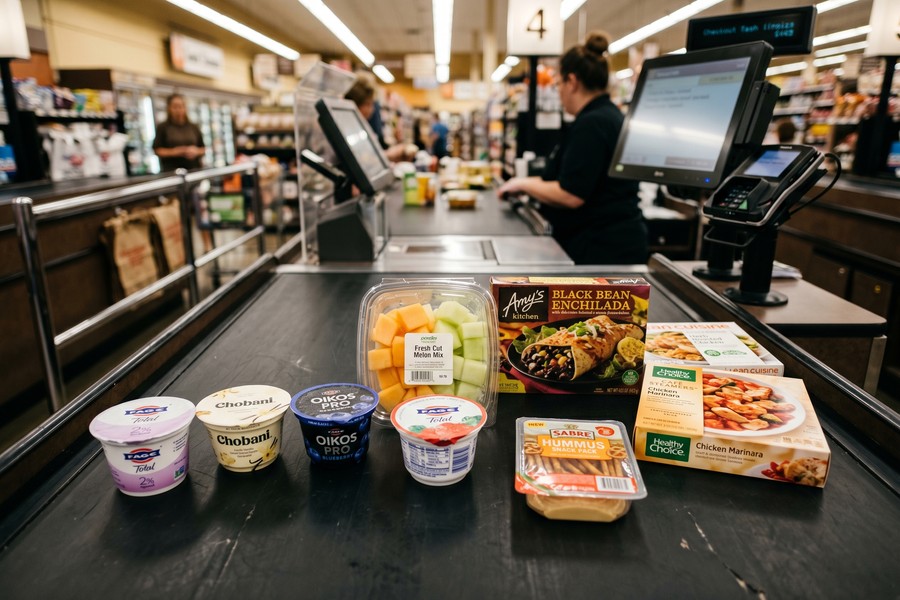
Single adults tend to over-spend on pre-portioned convenience items, single-serve yogurts, pre-cut produce, individual frozen meals, that cost significantly more per ounce than their bulk equivalents. A single-serve Greek yogurt can cost three times as much per ounce as a 32-ounce container of the same brand. That premium adds up faster than most people realize.
Cook one large batch of a protein, a whole roasted chicken, a pot of lentils, or a sheet pan of salmon, on Sunday and use it across four to five different meals during the week. This “batch protein” approach cuts per-meal cost by up to 40% compared to cooking single servings each night.
Step 3: What Is a Realistic Grocery Budget for a Family of Four?
A realistic grocery budget for a family of four falls between $790 and $1,580 per month, depending on which USDA spending tier fits your household’s income and lifestyle. Most middle-income families of four land near the Moderate-Cost Plan, which averages around $1,100–$1,200 per month in 2025.
How to Do This
Families with two adults and two children (ages 6–11) face a different cost structure than families with teenagers, who eat significantly more. The USDA applies age-based adjustment factors: teenage boys, for example, add roughly $50–$80 per month more to a household food budget than younger children. Use the USDA’s detailed age-sex adjustment tables to calculate your household’s specific number.
A practical breakdown for a family of four on a $1,100 monthly grocery budget might look like this: $350 on proteins (meat, fish, eggs, legumes), $250 on produce, $150 on dairy, $200 on grains and pantry staples, and $150 on snacks, beverages, and miscellaneous items.
What to Watch Out For
Many families accidentally inflate their grocery budget by including non-food household items, paper towels, cleaning supplies, personal care products, in their grocery total. Track these separately so your food budget reflects actual food spending and comparisons to benchmarks stay accurate. This single habit change frequently reveals that a household is spending $100–$150 less on food than their checkout total suggested.
Research and reporting on consumer spending habits consistently show that families overestimate how carefully they shop. According to the Bureau of Labor Statistics Consumer Expenditure Survey, households often underreport food-at-home spending by 10–20% when asked to self-estimate, compared with their actual transaction records. Pulling three months of real data from your bank or a credit card issuer like Chase or Citi almost always produces a different number than what families guess.
| Household Size | Thrifty Plan (Monthly) | Moderate-Cost Plan (Monthly) | Liberal Plan (Monthly) |
|---|---|---|---|
| 1 Adult (19–50) | $226 | $330 | $450 |
| Couple (both 19–50) | $430 | $665 | $900 |
| Family of 3 | $620 | $900 | $1,200 |
| Family of 4 | $790 | $1,128 | $1,580 |
| Family of 5 | $935 | $1,340 | $1,850 |
| Family of 6 | $1,060 | $1,530 | $2,100 |
These figures are derived from the USDA’s 2025 monthly Food Plans report and represent national averages for nutritionally adequate diets at each spending level.
The average American household spends $475 per month on groceries, according to the Bureau of Labor Statistics 2023 Consumer Expenditure Survey. For a family of four, that figure rises to roughly $1,050–$1,200 per month when accounting for household size adjustments.
Step 4: How Do I Set a Grocery Budget That Actually Works for My Household?
Setting a working grocery budget household target requires three inputs: your USDA benchmark for your size, your actual 90-day spending average, and a realistic reduction goal. Start with data, not willpower.
How to Do This
Pull your last three months of grocery transactions from your bank or credit card statements. Add them up, divide by three, and compare that number to your USDA benchmark. If you are spending more than 20% above the Moderate-Cost Plan for your household size, set an initial goal to close half that gap within 60 days, not all of it immediately.
Next, allocate your grocery budget as a fixed line item in your monthly spending plan. If you follow the 50/30/20 budget rule, groceries fall under your “needs” category alongside housing and utilities. For most households, food should not exceed 10–15% of take-home pay. A household bringing home $5,000 per month should aim to keep groceries under $500–$750.
Use a dedicated tracking tool to monitor weekly progress. Apps like YNAB (You Need a Budget), Copilot, or Monarch Money can categorize grocery transactions automatically. Financial platforms including SoFi and some Chase banking products also offer built-in spending category tracking that requires no additional setup. The key is reviewing spending weekly, not monthly, so you can course-correct before you blow the entire budget.
There is a version of this approach that does not work well, and it is worth naming directly: households with highly variable income, freelancers, gig workers, commission-based earners, struggle to apply a fixed monthly grocery number when their take-home pay fluctuates 40–60% from month to month. For these households, a percentage-of-income target (10–12% of whatever came in that month) is more practical than a flat dollar figure.
What to Watch Out For
Setting a grocery budget too low in the first month almost always leads to abandonment. Undercutting your actual spending by more than 25% at once is rarely sustainable. Gradual reductions of 5–10% per month are far more likely to stick. Build a 10% buffer into any monthly grocery budget to account for price fluctuations, guests, or special occasions.
Use the envelope method, withdraw your monthly grocery budget in cash or load it onto a prepaid debit card. When the card balance hits zero, the shopping is done for the month. This physical constraint reduces impulse purchases more effectively than checking a phone app after the fact.
Step 5: How Do I Lower My Grocery Bill Without Cutting Nutrition?
Lowering your grocery spending by 15–25% is achievable for most households without reducing nutritional quality. The key is shifting where you buy and how you plan, not simply eating less or eating worse.
How to Do This
Start with a weekly meal plan before you write a shopping list. Research consistently shows that planned shopping reduces impulse purchases and food waste. A structured meal plan aligned with USDA MyPlate guidelines also tends to produce a more nutritionally balanced diet than unplanned shopping. Plan seven dinners, build lunches around leftovers, and keep breakfasts simple and consistent.
Switch to store-brand (private-label) products for pantry staples. Store brands cost an average of 25–30% less than national brands for identical products, according to the Consumer Reports National Research Center. Items where store brands are particularly competitive include canned goods, dried pasta, flour, sugar, cooking oils, and frozen vegetables.
Shop at discount grocery chains where possible. Retailers like ALDI, Lidl, WinCo Foods, and Grocery Outlet consistently price staples below conventional supermarkets. A 2024 Dunnhumby Retailer Preference Index found that ALDI customers report among the highest price satisfaction scores of any U.S. grocery chain.
What to Watch Out For
Buying in bulk saves money only when the items get used before they expire. Bulk purchases of fresh produce, specialty items, or foods your family rarely eats often end up in the trash, which defeats the purpose entirely. Apply the bulk-buying strategy selectively to nonperishable staples and items your household consumes at high frequency.
Warehouse clubs like Costco and Sam’s Club offer real savings on select items, but annual membership fees ($65–$130) must be factored into the calculation. If your household does not spend heavily on the specific items where these clubs have competitive pricing, the membership cost can erode most of the savings.
Use loyalty programs and digital coupons strategically. Most major grocery chains, Kroger, Safeway, Publix, and Target, offer digital coupons through their apps that automatically apply at checkout. Stacking these with weekly sale cycles can reduce a typical grocery basket by $20–$40 per trip with minimal effort.
Reducing food waste is arguably the fastest way to lower your effective grocery spend. The USDA estimates that the average U.S. household wastes $1,500–$1,800 in food annually. Simple habits, using a first-in, first-out system in your fridge, freezing items before they expire, and repurposing leftovers, can recover a significant portion of that waste.
Step 6: How Do I Track Grocery Spending and Adjust My Budget Over Time?
Tracking your grocery budget household spending consistently is what separates people who hit their targets from those who set budgets and abandon them. The most effective system is one you will actually use, whether that is an app, a spreadsheet, or a notes app on your phone.
How to Do This
Choose a tracking method and stick with it for at least 90 days before evaluating whether it is working. The three most practical options for grocery tracking are: a budgeting app with automatic transaction categorization (YNAB, Monarch Money, or Copilot), a shared family spreadsheet updated weekly, or a simple tally in a notes app every time you shop. Some people also find that linking a dedicated debit card, separate from the primary checking account used for bills, to grocery purchases makes tracking frictionless because all grocery transactions appear in one place.
Review your grocery spending against your target every Sunday. A weekly review takes less than five minutes and lets you adjust the coming week’s shopping plan if you have already spent a large portion of your monthly budget. Monthly reviews alone are too infrequent, by the time you notice you are over budget, the month is already gone. For a complete system, see our guide on how to create a monthly budget that actually works.
Adjust your grocery budget annually, at minimum. Food inflation, household size changes (a new baby, a child leaving for college), and income changes all affect what your grocery budget should be. Revisiting your benchmark against the USDA’s updated Food Plans each January keeps your target aligned with current conditions. The Consumer Price Index, published monthly by the Bureau of Labor Statistics, is a useful secondary check on whether your grocery budget needs an inflation adjustment mid-year.
What to Watch Out For
Do not conflate grocery spending with total food spending. If you are eating out frequently, reducing your restaurant budget may free up more money than trying to cut an already-lean grocery budget. The Bureau of Labor Statistics reports that the average household spends nearly as much on food away from home as on groceries, tracking both categories separately gives you the full picture.
The Consumer Financial Protection Bureau (CFPB) has published research showing that households actively tracking their spending are 20% more likely to stay within their monthly budget than those who do not. That finding holds across income levels, which means the habit matters more than the dollar amount you are trying to manage.
If you consistently exceed your grocery budget despite genuine effort, consider whether your target is realistic for your household size and region. Setting a budget below your USDA benchmark without a clear cost-reduction strategy often leads to frustration rather than savings. Meeting your benchmark first, then gradually reducing, is a more sustainable path. Pairing your grocery savings with a broader financial plan, including an emergency fund and monthly savings targets, amplifies the long-term impact.

Households that actively track their spending are 20% more likely to stay within their monthly budget, according to research published by the Consumer Financial Protection Bureau. Consistent tracking is one of the highest-return habits in personal finance.
Frequently Asked Questions
What is the average grocery budget for a single person per month in 2025?
A single adult should budget between $226 and $450 per month for groceries in 2025, based on the USDA’s Thrifty to Liberal food plan range. The midpoint, around $300–$330 per month, aligns with the USDA Moderate-Cost Plan and is a realistic target for most single adults who cook at home regularly. Regional cost differences can push this number up to 20–30% higher in expensive metro areas.
How much should a couple spend on groceries each month?
A couple with two adults aged 19–50 should expect to spend $430 to $900 per month on groceries, depending on their spending tier. The USDA Moderate-Cost Plan for two adults comes in at approximately $665 per month, which is the most commonly cited benchmark. Couples often benefit from economy of scale compared to single adults, per-person costs are typically 10–15% lower when buying for two.
Is $200 a month a realistic grocery budget for one person?
$200 per month is below the USDA Thrifty Plan floor of approximately $226 for a single adult and is difficult to sustain while maintaining a nutritionally complete diet. It is possible with extreme discipline, relying heavily on dried legumes, rice, oats, eggs, and frozen vegetables, but most people find it unsustainable beyond a few months. A more achievable tight budget is $250–$280 per month.
How do I figure out what my family’s grocery budget should be?
Start by looking up the USDA Food Plans for your specific household composition, then compare it to your actual three-month average grocery spend. Choose a spending tier (Thrifty, Low-Cost, Moderate, or Liberal) based on your household income and goals, and set your monthly target within 20% of that benchmark. Adjusting down by more than 25% at once tends to be unsustainable, gradual reductions of 5–10% per month work far better.
Why is my grocery bill so high even when I think I am being careful?
The most common reasons grocery bills exceed expectations are: including non-food household items in the grocery total, frequent small top-up trips that add up unnoticed, significant food waste, and over-reliance on convenience and pre-packaged foods. Separate your food purchases from non-food purchases at checkout, limit shopping trips to once or twice per week, and start a meal plan to reduce waste. Many households find they are spending $150–$300 more per month than they realized once they audit their receipts carefully.
Should I use the USDA Thrifty Plan as my grocery budget target?
The USDA Thrifty Plan is a useful floor for understanding the minimum cost of a nutritionally adequate diet, but it assumes significant time for scratch cooking and minimal convenience foods. For most working households, the Low-Cost or Moderate-Cost Plan is a more realistic target. Use the Thrifty Plan as an aspirational benchmark if you are trying to aggressively cut spending, but build in a small buffer to account for real-life variation.
How can I cut my grocery budget by $100 a month without eating worse?
Cutting $100 per month from your grocery budget is achievable by switching to store-brand staples (saves $25–$40), reducing pre-packaged and convenience foods (saves $20–$30), planning meals before shopping to eliminate impulse buys and food waste (saves $20–$40), and using digital coupons available through your grocery store’s app (saves $15–$30). Focus on just two or three of these changes simultaneously rather than all at once. For a broader financial strategy, pair grocery savings with a 6-month emergency fund plan to make those savings work harder.
How much of my income should go toward groceries?
Most personal finance guidelines suggest allocating 10–15% of take-home pay to groceries for a typical household. The Bureau of Labor Statistics Consumer Expenditure Survey shows that middle-income households spend roughly 8–10% of pre-tax income on food at home. If your grocery spending exceeds 15% of take-home pay, it is worth auditing whether your budget in other categories, like housing, is out of balance, or whether your grocery spending simply needs tightening.
Does buying organic food significantly increase my grocery budget?
Yes, organic produce typically costs 20–100% more than conventional equivalents, depending on the item. If maintaining an organic diet is a priority, you can minimize the cost premium by applying the Environmental Working Group’s “Dirty Dozen” list to identify which items are most worth buying organic, and choosing conventional for items on the “Clean Fifteen.” Buying organic selectively rather than exclusively can limit the budget impact to an additional $30–$60 per month for most households.
How does grocery spending change when kids become teenagers?
Grocery costs increase noticeably when children enter their teenage years, particularly for boys. The USDA estimates that a teenage male (age 14–18) adds roughly $50–$80 more per month to a household grocery budget compared to a younger child. Families with multiple teenagers should expect their total grocery spend to approach or exceed the USDA Liberal Plan for their household size, and should revisit their monthly food budget annually during these years.
Is this approach to grocery budgeting right for everyone?
Not exactly. Households managing a medical condition that requires a specialized diet, celiac disease, severe food allergies, diabetes-related dietary restrictions, often face food costs that exceed even the USDA Liberal Plan, regardless of how carefully they shop. The USDA benchmarks are built around standard nutritional needs and do not account for medically necessary substitutions, which can be two to four times the cost of conventional equivalents. If your household falls into this category, the USDA figures are still a useful reference point, but your realistic target will be higher, and that is not a budgeting failure.
How does grocery budgeting interact with other parts of my financial plan?
Grocery spending is categorized as a “need” in most personal finance frameworks, including the 50/30/20 rule, where it sits alongside housing, utilities, and minimum debt payments. Keeping food costs controlled directly affects how much room you have in your budget for debt payoff, retirement contributions, and building an emergency fund. The CFPB recommends that households maintain three to six months of essential expenses, including food, in liquid savings. Running a tight grocery budget while carrying high-interest credit card debt (where APR often runs 20–29%) is one of the faster ways to free up cash for that kind of debt reduction.
Sources
- Bureau of Labor Statistics, Consumer Expenditure Surveys
- Bureau of Labor Statistics, Consumer Price Index News Release
- Consumer Financial Protection Bureau, Financial Well-Being Research
- USDA Economic Research Service, Food Prices, Expenditures, and Establishments
- Environmental Working Group, Dirty Dozen and Clean Fifteen Lists