Fact-checked by the Prime Rate editorial team
Quick Answer
Grocery prices are 2.9% higher year-over-year and roughly 29% higher cumulatively since 2020. To reset your grocery budget 2026, track your actual spending by category, compare it to USDA food plan benchmarks, shift toward store brands, consolidate shopping trips, and audit any delivery app markups that inflate your real cost.
Grocery budgets haven’t simply gotten tighter over the past few years. They’ve been fundamentally repriced. The cumulative rise in food-at-home prices since February 2020 sits at roughly 29%, which means a family that hasn’t rethought their shopping habits has absorbed the equivalent of nearly a one-third price increase. The USDA Economic Research Service now projects food-at-home prices will rise 3.2% in 2026, faster than the 20-year historical average of 2.6%.
That 3.2% figure sounds modest. The checkout receipt doesn’t feel modest. That gap between the official number and lived experience is real, and it matters for how you plan. Understanding why the mismatch exists, which categories are actually moving, and what your household should realistically spend is the foundation of any honest grocery budget 2026 reset.
This guide is for households that want to move beyond generic “meal prep more” advice and work with actual numbers. By the end, you’ll be able to benchmark your current spending against verified USDA data, identify the specific behaviors driving overspending, and apply three concrete levers to reduce your bill without overhauling your lifestyle.
Key Takeaways
- Food-at-home prices are 2.9% higher year-over-year in April 2026, but the cumulative increase since 2020 is approximately 29%, according to USDA ERS.
- The USDA projects grocery inflation will reach 3.2% in 2026, above the 20-year historical average of 2.6%, per USDA ERS Food Price Outlook.
- Middle-income households spent an average of $9,097 on food in 2024, representing 12.2% of before-tax income, per USDA ERS spending data.
- Retail egg prices were 21.9% higher in 2025 than in 2024 due to avian flu outbreaks, according to USDA ERS.
- U.S. households allocated 12.9% of total budgets to food in 2024, slightly down from 13.3% in 2004, per USDA ERS chart data.
- Store brand (private label) sales hit a record $282.8 billion in 2025, commanding 21.3% dollar share of U.S. grocery sales, signaling a structural shift in how Americans shop.
In This Guide
- Step 1: How Much Has Your Grocery Bill Actually Changed Since 2020?
- Step 2: What’s Getting More Expensive, What’s Getting Cheaper?
- Step 3: What Should You Actually Be Spending on Groceries in 2026?
- Step 4: The Hidden Ways Your Grocery Spending Has Quietly Grown
- Step 5: How Shopper Behavior Has Shifted in Response
- Step 6: Why Your Grocery Budget Feels Worse Than the Numbers Suggest
- Step 7: A Practical Framework for Rebuilding Your Grocery Budget in 2026
- Frequently Asked Questions
Step 1: How Much Has Your Grocery Bill Actually Changed Since 2020?
Start by grounding your budget in the real cumulative number, not just this year’s headline. Grocery prices have risen roughly 29% since February 2020. That’s not a single year’s figure. It’s the compounded result of supply chain disruptions, pandemic demand surges, and energy cost spikes across several years, and it means every benchmark you used to carry in your head is now wrong by a significant margin.
Why “Slowing Inflation” Doesn’t Feel Like Relief
The year-over-year rate in April 2026 is 2.9% according to USDA ERS Food Price Outlook data. That’s technically a slowdown from the 10%+ spikes seen in 2022. But slower inflation means prices are still rising on top of the already-elevated 2022 and 2023 base. A $100 grocery haul from early 2020 now costs closer to $129 for the same items.
There’s also a documented perception gap worth naming directly. Consumers consistently self-report food inflation higher than official CPI figures show. That disconnect isn’t purely a psychological illusion. Households buy specific products in specific stores, and their personal market basket can diverge sharply from the national average. If you shop at a premium retailer or concentrate spending on proteins, your actual inflation rate is higher than what you read in headlines.
What to Watch Out For
Don’t anchor your 2026 budget to pre-2022 spending norms. Those numbers reflect a pricing environment that no longer exists. Pull your actual monthly average from the last six months, not a number you remember from 2021.
A middle-income household spent an average of $9,097 on food in 2024, representing 12.2% of before-tax income, according to USDA ERS spending data. Divided across 12 months, that works out to roughly $758 per month for all food, including restaurant spending.
Step 2: What’s Getting More Expensive, What’s Getting Cheaper?
The single biggest budgeting mistake you can make right now is treating “grocery inflation” as a uniform number. In 2026, the average masks dramatic category volatility that directly determines whether your specific cart goes up or down.
Beef and veal prices are running approximately 14.8% higher year-over-year. Fresh tomatoes have surged around 39.7%. Meanwhile, eggs tell a different story: after spiking 21.9% higher in 2025 compared to 2024 due to a prolonged highly pathogenic avian influenza (HPAI) outbreak per USDA ERS, egg prices have come down sharply from their peak as flocks recover. Cereal and grain products are tracking below overall food inflation.
Build your weekly meal plan around which protein category is currently cheaper, not which one your household has always preferred. Swapping two beef dinners per week for pork, chicken, or eggs (now declining in price) can reduce monthly protein spending by $30 to $60 for a family of four without changing how you cook.
Step 3: What Should You Actually Be Spending on Groceries in 2026?
Get a real benchmark before you set a target. The USDA publishes four food plan tiers monthly, and the updated figures provide the most credible starting point available for a grocery budget 2026 reset.
USDA Food Plan Benchmarks by Household Size
The USDA’s Thrifty Food Plan for a family of four now sits at approximately $1,003 per month. That’s the rock-bottom figure, and it assumes cooking nearly everything from scratch with minimal convenience items or prepared foods. The Moderate-Cost Plan for the same family runs roughly $1,330 per month. Both figures exclude non-food household goods, toiletries, and pet food, which typically represent 15 to 20% of a typical grocery receipt. When you factor those in, the “real” grocery trip cost is meaningfully higher than any USDA benchmark implies.
The income-percentage framework is a useful cross-check. Financial planners commonly recommend allocating 10 to 15% of take-home pay to all food, with 6 to 10% for groceries specifically. Geography distorts this significantly: Louisiana households spend around 13% of income on groceries, while Massachusetts households spend closer to 6.7%. Neither number is wrong; they reflect different costs of living and different baseline incomes.
A Worked Example
Say your household’s take-home pay is $6,000 per month. A 10% food allocation is $600. But the USDA Thrifty Plan for a family of four is $1,003. That’s a gap of $403 per month, or $4,836 per year, between the common financial-planning rule of thumb and the USDA’s most frugal realistic benchmark. That gap isn’t a budgeting failure. It’s evidence that the 10% guideline is calibrated for smaller households or higher incomes, and applying it mechanically to a family of four produces a target that’s genuinely unachievable without extreme sacrifice.
What to Watch Out For
Outdated benchmarks are circulating widely. The $800-per-month figures still referenced in many online budget templates predate the 29% cumulative increase since 2020. Do not use them. For a solid foundation on building a monthly budget that accounts for current food costs, USDA tier data is the right anchor.
The USDA Thrifty Plan is not aspirational for most working families. It requires cooking nearly every meal from scratch and eliminating convenience items entirely. Using it as your target without accounting for your household’s actual cooking capacity sets you up for repeated budget failure. Use the Moderate-Cost Plan as your realistic baseline and treat Thrifty as a floor for financial emergencies only.
| USDA Food Plan | Family of 4 (Monthly) | Assumptions |
|---|---|---|
| Thrifty Plan | ~$1,003 | All meals cooked from scratch; zero convenience items |
| Low-Cost Plan | ~$1,170 | Most meals home-cooked; minimal prepared foods |
| Moderate-Cost Plan | ~$1,330 | Typical home cooking with some convenience items |
| Liberal Plan | ~$1,660 | Full variety; frequent use of prepared and premium items |
All four figures exclude household supplies, cleaning products, and pet food. Add 15 to 20% to any of these to estimate your real grocery receipt total.
Step 4: The Hidden Ways Your Grocery Spending Has Quietly Grown
Three spending behaviors quietly inflate grocery bills well above the rate official inflation data captures. Identifying them is the fastest way to find real savings without changing what you eat.
Shrinkflation Has Changed Shape
Shrinkflation used to be easy to spot: a bag of chips with fewer chips. In 2026, brands have moved to more sophisticated methods. Package redesigns, formula tweaks, and reformulated products now accomplish the same cost transfer without the obvious size reduction. The Government Accountability Office found per-unit price increases of 12% for paper towels and 32% for coffee among products that had been downsized, according to a GAO analysis of consumer packaged goods. These increases don’t fully register in headline CPI because the methodology doesn’t perfectly capture quality-adjusted unit pricing in all categories. The practical implication: start reading the price-per-unit tag on the shelf label, not just the package price.
The Unplanned Trip Tax
The average unplanned grocery trip costs approximately $54. Secondary trips (the “quick stop” for one item that turns into a basket) often account for 30 to 40% of total grocery spending for households that haven’t tracked them. Most budgeting advice ignores this entirely because it focuses on the planned weekly shop and treats impulse trips as minor. They’re not minor. A household making two unplanned trips per week is spending an additional $432 per month, more than the gap between the USDA Thrifty and Liberal food plans.
Delivery App Markup Creep
Items on third-party grocery delivery apps often run 10 to 15% higher than in-store shelf prices before service fees or tips. For a household spending $1,200 per month on groceries, that markup alone adds $120 to $180 per month, or $1,440 to $2,160 per year. This is an area where regulatory pressure is building: the FTC has pursued settlements related to pricing transparency in grocery delivery, and scrutiny of hidden fee structures is increasing. For households where delivery prevents two unplanned trips per week, the math may still favor delivery. The key is to compare your last delivery receipt directly against current in-store prices for the same items so you know your actual markup delta rather than assuming it.
The average American spends roughly $1,200 per year on snacks alone. Younger households skewing toward higher-margin snacks, energy drinks, and premium fresh produce face structurally higher grocery bills than older cohorts buying the same total volume of food. Snack spending rarely appears as a line item in household budget reviews, but it compounds significantly over 12 months.
Step 5: How Shopper Behavior Has Shifted in Response
Consumers have responded to sustained price pressure with a structural, not temporary, shift in how they shop. U.S. private label (store brand) sales hit a record $282.8 billion in 2025 and now command 21.3% dollar share of grocery sales. Roughly 72% of consumers now buy store brands over national brands, and survey data from early 2026 shows that 32% of consumers switched to lower-priced grocery brands in the first quarter alone. This is not recession behavior that reverses when conditions ease. Category managers at major retailers now treat private label as the default competitive offering, not a budget tier.
Multi-store shopping has also become a deliberate habit, especially among younger consumers. Price comparison has moved from a time-intensive chore to a passive behavior, aided by store apps, grocery savings content on social platforms, and tools built into major retailer loyalty programs. If you’re still doing all your shopping at one store out of convenience, you’re paying a loyalty premium that has grown meaningfully as stores differentiate on price.
Step 6: Why Your Grocery Budget Feels Worse Than the Numbers Suggest
The official numbers and the emotional reality of grocery shopping have diverged, and it’s not simply a matter of perception error.
The Cumulative Damage Problem
Even as year-over-year grocery inflation slows toward 2.9 to 3.2%, the damage from 2021 through 2023 is already baked in. Prices don’t reset when inflation slows; they just rise more slowly from an already-elevated base. A family that spent $900 per month on groceries in 2020 and didn’t adjust their budget is now structurally underfunded by roughly $260 per month, even if they haven’t changed a single shopping habit. That’s the 29% cumulative increase applied to a fixed budget: real and compounding.
Food Insecurity Is Rising Even as Inflation Eases
The U.S. food insecurity rate reached 13.3% of households in 2025, up from 12.5% in 2024. Among SNAP participants, that rate surged to 46%. This context matters for any budget conversation because it establishes a ceiling: for a meaningful share of households, the problem is not spending discipline. It’s income. Budget-optimization tactics work best for households with discretionary room to reallocate. For households already stretched past the USDA Thrifty threshold on a tight income, the more urgent need is benefits access and income support, not a tighter shopping list. Acknowledging this honestly is not a detour from practical advice; it’s the difference between advice that helps and advice that blames.
Understanding where your food budget pressure is coming from also affects how you think about the broader picture. If rising grocery costs are forcing you to carry a balance, understanding how the prime rate affects your credit card interest costs is worth factoring into the full household cash-flow picture.
U.S. households allocated 12.9% of total budgets to food in 2024, down slightly from 13.3% in 2004, according to USDA ERS chart data. But that long-run decline masks short-run pain: the 2024 figure reflects higher incomes among upper quintiles pulling the average down, not uniform relief across income levels.
Step 7: A Practical Framework for Rebuilding Your Grocery Budget in 2026
Reset your grocery budget with three specific levers. These aren’t lifestyle overhauls. They’re targeted changes that produce measurable dollar outcomes.
Lever 1: Switch to Store Brands Systematically
Store brands typically run 15 to 30% below national brand prices for equivalent products. Apply that to your current monthly spend: a household at $1,200 per month that converts 50% of its national brand purchases to store brands saves roughly $90 to $180 per month, or $1,080 to $2,160 per year. Start with pantry staples (canned goods, pasta, flour, oils) where quality differences are minimal, then test dairy and frozen items. Reserve national brand loyalty for the two or three specific products where you’ve genuinely compared and found the difference worth the premium.
Lever 2: Consolidate to One or Two Planned Weekly Shops
Eliminate unplanned trips with a firm default rule: nothing gets purchased outside the scheduled shop unless it’s a genuine emergency. At an average of $54 per unplanned trip, cutting two secondary trips per week saves $108 per week, or $5,616 per year. That figure is not an approximation designed to sound dramatic. It’s straightforward arithmetic applied to the $54 per-trip average. Even cutting one unplanned trip per week produces $2,808 in annual savings. For context, that exceeds the difference between the USDA Thrifty and Low-Cost food plans for a family of four.
Lever 3: Audit Your Delivery Markup Delta
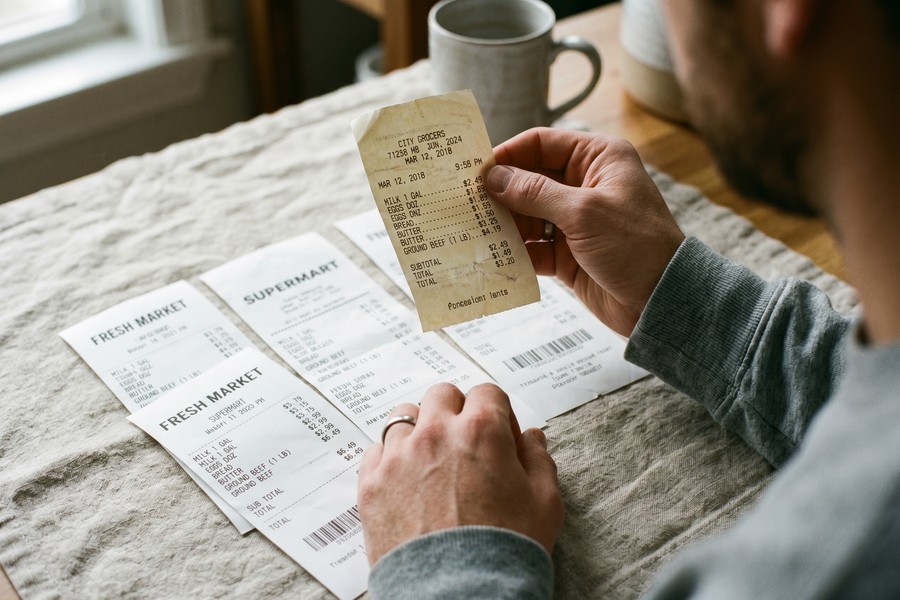
Pull your last delivery app receipt and compare five to ten items to current in-store prices at the same retailer. Calculate your actual markup percentage. If it’s above 12%, you’re paying a premium that likely outweighs the convenience value unless delivery genuinely prevents multiple unplanned in-store visits. If your markup is under 8%, the time savings may justify it. This is a one-time 20-minute exercise that gives you a defensible, specific number rather than a vague sense that delivery “might be costing more.”
Once you’ve worked these three levers, the savings freed up can serve your broader financial health. Households who’ve reduced grocery overspend often redirect that margin toward building a six-month emergency fund or paying down high-interest debt. If debt elimination is the priority, the snowball vs. avalanche payoff methods provide a clear framework for where those extra dollars should go first.
One honest caveat: even all three levers combined won’t bring a family of four’s grocery bill below the USDA Thrifty Plan floor of approximately $1,003 per month without significantly altering what you eat and how much time you spend cooking. Realistic grocery budget 2026 planning means setting a target within the tier that fits your actual household capacity, not the one that looks best on a spreadsheet. If your budget needs a fuller structural review, a reassessment of your 50/30/20 budget allocation is worth doing alongside this grocery reset, since food costs are large enough to throw off every other category ratio.
Don’t wait for year-end to calibrate your grocery budget. Check your actual monthly average every 90 days. Category inflation is shifting fast enough in 2026 that a budget set in January may be significantly off by April. A quarterly review takes 15 minutes and prevents the compounding drift that turns a manageable overrun into a significant annual gap. If you want your food budget to feed into a broader financial plan, build it as a tracked line item in a structured monthly budget system.
Frequently Asked Questions
How much should a family of four spend on groceries per month in 2026?
The USDA’s Thrifty Food Plan sets the minimum at approximately $1,003 per month for a family of four, assuming nearly all meals are cooked from scratch. The Moderate-Cost Plan, which better reflects typical household cooking habits, runs closer to $1,330 per month. Add 15 to 20% to either figure if your grocery receipt regularly includes household supplies, toiletries, or pet food, which the USDA benchmarks exclude.
Why does my grocery bill feel so much worse than the official inflation rate suggests?
Two things are happening simultaneously. First, official CPI measures year-over-year change, but your bill is still carrying the full 29% cumulative increase since 2020. Second, your personal market basket may include categories running well above the average, such as beef (up roughly 14.8% year-over-year) or produce items with sharp seasonal spikes. The headline number averages across all food categories; your specific purchases may be inflating faster.
Is it actually cheaper to cook at home versus eating out in 2026?
Yes, and the gap is wider than it’s been in recent years. Food-at-home prices are rising at 2.9 to 3.2% in 2026, while restaurant prices are increasing at roughly 3.6%, according to USDA ERS projections. That differential compounds over time: a household spending $1,200 per month on home groceries typically replaces meals that would cost $2,000 to $2,800 at restaurants for the same nutritional content.
What’s the best way to reduce my grocery bill without changing what I eat?
Switch systematically to store brands on pantry staples, which typically cost 15 to 30% less than national brands. Then eliminate unplanned grocery trips: at an average of $54 per unplanned visit, cutting just one per week saves over $2,800 annually. These two changes alone can reduce a typical household’s grocery bill by $200 to $400 per month without altering a single meal.
How much more am I paying if I use grocery delivery apps instead of shopping in store?
Items on third-party grocery delivery apps typically run 10 to 15% above in-store shelf prices before service fees or tips. For a household spending $1,200 per month on groceries, that markup adds $120 to $180 per month, or up to $2,160 per year. The net cost depends on whether delivery prevents unplanned in-store trips; if it does, the math may still favor delivery for some households.
Should I be worried about food prices rising even more before the end of 2026?
The USDA projects food-at-home prices will rise 3.2% for full-year 2026, per USDA ERS forecasts. Upside risks include supply-side shocks from ongoing trade disruptions and crop yield variability. Building a grocery buffer into your monthly budget (10 to 15% above your current average) is prudent planning given forecast uncertainty.
Are store brands actually as good as name brands for most products?
For most pantry staples, canned goods, frozen vegetables, dairy basics, and cooking oils, store brands meet or closely match national brand quality. The most meaningful quality differences tend to appear in heavily processed snacks, beverages, and personal care products. The practical approach is to switch to store brands on 60 to 70% of purchases and reserve the national brand premium for the handful of specific products where you’ve genuinely tested and found the difference matters to your household.
Sources
- USDA Economic Research Service, Food Price Outlook: Summary Findings (2026)
- USDA Economic Research Service, Ag and Food Statistics: Food Prices and Spending
- USDA Economic Research Service, Share of Consumer Expenditures Spent on Food (Chart Gallery)
- USDA Economic Research Service, Food Security in the U.S.