Fact-checked by the Prime Rate editorial team
Quick Answer
A falling prime rate reduces variable-rate debt costs incrementally, but the savings are smaller than most borrowers expect. A 0.25% cut saves roughly $25 per year on a $10,000 credit card balance, while that same balance at 20%+ APR costs about $2,000 annually in interest. For credit card holders, aggressive payoff now beats waiting for rate relief by a wide margin.
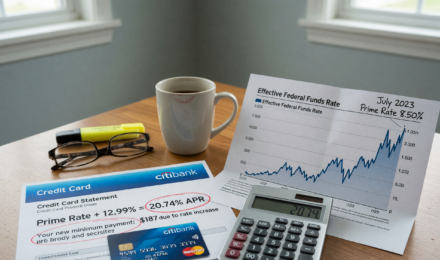
When the falling prime rate dominates financial headlines, many borrowers assume the smart move is to wait before attacking their debt. That assumption is mostly wrong. The U.S. prime rate currently sits at 6.75%, down 1.75 percentage points from its peak of 8.50% in mid-2024, according to Commerce Bank’s Prime Rate tracking page. Despite five consecutive Federal Reserve cuts since September 2024, the average credit card APR remains near historic highs at 21.52%, per LendingTree’s analysis of Federal Reserve G.19 data.
The gap between those two numbers tells the real story. This article breaks down which debts actually respond to prime rate cuts, what the dollar savings look like at realistic balance sizes, when a rate environment genuinely shifts the math on paying off debt early, and why the “wait for relief” strategy has cost borrowers money throughout this easing cycle.
Key Takeaways
- The U.S. prime rate stands at 6.75%, down 1.75 percentage points from its 8.50% peak in mid-2024 after five Fed cuts (Commerce Bank Prime Rate Update, 2025).
- The average credit card APR on accounts accruing interest is 21.52% in Q1 2026, down from a record 23.37% in Q3 2024 but still near all-time highs (LendingTree / Federal Reserve G.19, 2026).
- Total U.S. credit card debt reached $1.252 trillion in Q1 2026, with borrowers carrying an average balance that makes rate-cut savings trivial compared to ongoing interest costs (The Motley Fool / Federal Reserve Quarterly Report, 2026).
- A 0.25% prime rate cut saves approximately $12.50 per year on a $5,000 credit card balance, a figure so small it does not change the payoff calculus for most households carrying revolving debt.
- An estimated $4.8 trillion in U.S. consumer debt is directly tied to the prime rate, including credit cards, HELOCs, and SBA loans, meaning rate movements have broad but uneven reach across borrower types (PrimeRates.com / Federal Reserve G.19, 2026).
In This Guide
- Where the Prime Rate Stands Right Now
- Which of Your Debts Actually Changes When Prime Falls?
- What Does a Quarter-Point Cut Actually Save You?
- The Crossover Question: When Does Falling Rate Make Investing Smarter Than Payoff?
- Why Waiting for Rates to Drop Before Paying Off Debt Usually Backfires
- Refinancing as a Smarter Lever Than Early Payoff
- A Rate-Environment Playbook for May 2026
- Frequently Asked Questions
Where the Prime Rate Stands Right Now
The prime rate is at 6.75%, and the path forward is likely slower than most borrowers hope. The Federal Open Market Committee (FOMC) delivered five cuts between September 2024 and December 2025, trimming the federal funds rate by a cumulative 1.75 percentage points. Since then, the Fed has held rates steady through its first three 2026 meetings, with the April vote the most divided since October 1992.
The Federal Reserve’s official FAQ on the prime rate confirms that banks set their prime rates based on the federal funds rate target, and that the prime is used as a reference rate for credit cards, HELOCs, and small business loans. Most major commercial banks post their prime rate daily through the Fed’s H.15 Selected Interest Rates release.
What Forecasters Expect Through Year-End
Most Wall Street forecasters project one or two additional cuts in 2026, potentially bringing prime to 6.25%–6.50% by December. That is a plausible base case, not a certainty. Inflation remains above the Fed’s 2% target, and geopolitical uncertainty adds further friction. Borrowers who are building their debt strategy around an assumed rate path should treat those projections as a range of scenarios, not a schedule.
The honest framing: this is a slow staircase, not a straight-down slide. Planning for 1.75 more points of cuts in 2026 would be overoptimistic based on the current pace.
Which of Your Debts Actually Changes When Prime Falls?
Not all debt responds to prime rate cuts. The dividing line is whether your rate is variable and directly indexed to prime. Credit cards, HELOCs, most SBA loans, and some adjustable-rate mortgages move with prime. Fixed-rate personal loans, fixed mortgages, and federal student loans do not.
Credit cards are the most widely held prime-linked debt, and their APR formula is almost always stated as prime plus a margin, typically prime + 12% to 23% depending on the issuer and borrower creditworthiness. At the current prime of 6.75%, that translates to an effective APR range of roughly 18.75% to nearly 30% before any issuer-specific adjustments. The Consumer Financial Protection Bureau (CFPB) has documented that banks are often quick to raise rates on borrowers but slower to pass savings back, a pattern fully consistent with what happened during this easing cycle.
The Margin Manipulation Risk Most Borrowers Miss
Here is a gap most financial content ignores: even when prime falls, card issuers can legally raise their margin, the fixed spread added on top of prime, leaving your APR unchanged or even higher. This is not hypothetical. During the 2024–2025 easing cycle, some issuers quietly widened their spreads, which is why the average APR dropped by far less than the 1.75-point prime reduction would suggest. Pull your cardholder agreement and verify the exact formula before assuming you are getting full benefit from any rate cut.
HELOCs behave differently. The national average HELOC rate is 7.41% as of May 20, 2026, according to Bankrate’s survey of major home equity lenders. With a typical margin of prime + 0.5% to 2%, HELOC borrowers receive a more direct and proportional benefit from each prime cut, and because HELOC balances are often much larger than credit card balances, the dollar savings per cut are meaningfully higher.
Federal student loans use 10-year Treasury yields as their benchmark, not the prime rate. A falling prime rate has zero automatic effect on existing federal student loan balances, which carry fixed rates set at the start of each academic year.
What Does a Quarter-Point Cut Actually Save You?
The real dollar impact of a 0.25% prime rate cut is far smaller than most borrowers assume, and naming the actual number changes the conversation entirely. On a $5,000 credit card balance, a 0.25% APR reduction saves roughly $12.50 per year, about $1.04 per month. On a $10,000 balance, that same cut saves about $25 per year, or just over $2 per month.
To put that in context: carrying a $10,000 balance at 20% costs approximately $2,000 per year in interest charges. The entire 1.75-percentage-point reduction delivered since September 2024 saves that borrower about $175 per year, less than 9% of their annual interest burden. Waiting for more cuts while carrying that balance is, numerically, a losing trade.
Where Rate Cuts Actually Move the Needle
The math shifts materially for larger, lower-rate variable balances. A HELOC with a $100,000 outstanding balance at 7.41% costs roughly $7,410 per year in interest. A full percentage point of cuts on that balance saves $1,000 per year, which genuinely accelerates payoff and is worth monitoring. Two more quarter-point cuts, the most likely scenario through year-end 2026, would save that borrower around $500 annually.
That difference matters for strategy. For HELOC holders with six-figure balances, rate movements are worth tracking and acting on. For credit card holders carrying $5,000–$15,000, the math points strongly toward aggressive payoff now rather than waiting for incremental relief.
Total U.S. consumer debt reached $18.8 trillion in Q1 2026, a record high according to the Federal Reserve Bank of New York’s Household Debt and Credit Survey. Of that, an estimated $4.8 trillion is directly indexed to the prime rate.
| Debt Type | Typical APR (May 2026) | Savings from 0.25% Cut on $10,000 Balance |
|---|---|---|
| Credit Card (revolving) | 21.52% average | $25/year |
| HELOC | 7.41% average | $25/year |
| Variable Personal Loan | 12.00%–18.00% | $25/year |
| Fixed Personal Loan | Rate locked at origination | $0 (no automatic benefit) |
| Fixed Mortgage (30-yr) | Rate locked at origination | $0 (no automatic benefit) |
| Federal Student Loan | Fixed to 10-yr Treasury | $0 (no automatic benefit) |
One important note on the table above: while the per-$10,000 savings from a 0.25% cut are identical across variable debt types, real-world HELOC balances typically range from $50,000 to $150,000, making the total dollar impact three to fifteen times larger than a typical credit card balance would produce.
The Crossover Question: When Does a Falling Rate Make Investing Smarter Than Payoff?
The standard framework for this decision is the 6% threshold: if your debt’s interest rate exceeds 6%, prioritize payoff; if it falls below 6%, the long-term expected return from a broad equity portfolio (historically around 7%–10% annualized) likely produces better outcomes. This is the approach Fidelity and several major financial planning organizations have articulated for years.
Applied to the current environment, nearly every prime-linked consumer debt sits well above that threshold. Most credit cards are charging 18%–28%. The average HELOC is at 7.41%. Fixed-rate personal loans originated in the past two years frequently carry rates of 11%–18%. None of these are close to the 6% crossover point yet.
Where the Crossover Becomes Relevant in 2026
The one debt category worth watching is the HELOC. If the Fed delivers two more quarter-point cuts in the back half of 2026, bringing prime to 6.25%, a HELOC priced at prime + 0.5% would reach 6.75%. At prime + 0% (some home equity lines use this floor), the rate would be 6.25%, approaching crossover territory. That gives HELOC borrowers a concrete prime rate level to watch: if prime drops to around 5.50%–6.00%, their effective rate could dip below the 6% threshold for the first time since early 2022.
For the vast majority of credit card carriers, this analysis is largely academic. A 20%+ APR is more than three times the crossover threshold. No amount of market return projections makes carrying that balance financially sensible. See our guide on paying off debt using the snowball and avalanche methods for a direct framework on accelerating repayment.
The 6% invest-vs-payoff threshold assumes tax-advantaged investing with a long time horizon of at least 20–35 years. For borrowers without maxed-out 401(k) or IRA contributions, the employer match alone can make contributing to retirement accounts the higher-priority move before making extra debt payments. See how a 401(k) match changes your debt payoff calculus.
Why Waiting for Rates to Drop Before Paying Off Debt Usually Backfires
The case against rate-watching paralysis is not philosophical, it is arithmetic. The Fed has held rates steady through all three of its 2026 meetings despite widespread market expectations for cuts. Borrowers who delayed aggressive repayment in January, waiting for spring relief that never came, paid roughly five additional months of high-rate interest for nothing.
Five cuts over 15 months produced only about $175 of annual savings on a $10,000 credit card balance, while that balance continued generating roughly $2,000 in annual interest. Cumulative cuts do add up, but the relief remains marginal relative to the ongoing cost of carrying the debt. Individual quarter-point reductions simply do not change the arithmetic enough to justify deferring payoff.
Credit card debt represents the highest-cost debt for millions of American households, and no plausible rate-cut scenario closes that gap. At 21.52% average APR, a borrower carrying $10,000 is paying more in interest each year than the entire savings generated by every Fed cut since September 2024. That is the clearest argument for acting now.
The One Scenario Where Waiting Makes Sense
There is a legitimate exception. Borrowers whose only outstanding debt is a fixed-rate obligation below 4.35%, for example, a pre-2022 mortgage at 3.0% or a pre-pandemic car loan at 2.9%, are in a genuinely different position. Top-tier high-yield savings accounts are still paying around 4.35% APY. Parking extra cash there earns more than the after-tax cost of a 3% fixed loan in most tax brackets. For these borrowers, building liquid savings rather than making extra principal payments is mathematically sound.
That group is a minority. Anyone carrying revolving credit card debt, a HELOC above 6%, or a variable personal loan above 6% should not apply this logic to their situation.
The CFPB’s debt reduction guidance recommends the highest-interest-rate method (avalanche) as the approach that saves the most money over time, a position unchanged by where the prime rate happens to be on any given month. Our article on paying off $10,000 in credit card debt applies this framework to specific payoff timelines.

Refinancing as a Smarter Lever Than Early Payoff
When a falling prime rate opens a rate window, refinancing can be more powerful than making extra principal payments, because it locks in a lower rate immediately rather than waiting for variable relief to trickle through. This applies most cleanly to credit card debt and HELOC balances.
A balance transfer to a 0% introductory APR card eliminates interest for the promotional period, typically 15 to 21 months. That is effectively refinancing at near-zero cost. The CFPB warns that balance transfer fees (usually 3%–5% of the transferred amount) and the reversion rate after the promotional period can cost more than the original debt if the borrower does not complete payoff before the introductory rate expires. The strategy works when it is treated as a disciplined payoff plan, not a deferral tool. That distinction matters: borrowers who transfer a balance and then continue spending on the old card routinely end up deeper in debt than when they started.
Consolidating Into a Fixed-Rate Personal Loan
Consolidating high-rate revolving debt into a fixed-rate personal loan locks in a known rate immediately. For borrowers with good credit, personal loan APRs in the 10%–15% range are achievable, a substantial improvement over the 21.52% average credit card rate, and one that does not depend on future Fed action. The trade-off is that fixed-rate personal loans eliminate the upside if rates continue falling; once locked, the rate does not drop further. For borrowers with strong credit considering this path, understanding how the prime rate affects personal loan rates is worth reviewing before committing to a fixed product.
For HELOC holders, the timing question is more nuanced. If two additional prime cuts materialize in H2 2026 as some forecasters project, converting a variable HELOC balance to a fixed home equity loan near that potential rate floor would lock in permanent savings rather than riding the rate back up when the next tightening cycle begins. The risk is that cuts do not arrive, and locking in now means missing a lower rate later. Given the Fed’s 2026 track record on holds, locking now is defensible for borrowers who value certainty over optionality.
A Rate-Environment Playbook for May 2026
The right action depends on your specific debt type. Here is what the math supports for each major category as of this month.
Credit card holders: Pay aggressively now. Rate relief is too small and too slow to justify waiting. Each month of delay at 20%+ costs real money that no future cut will recover. The CFPB’s avalanche method, directing extra payments to the highest-rate balance first, remains the most cost-effective approach regardless of prime rate direction. If your balance is large enough that full payoff is not near-term realistic, a 0% balance transfer is worth exploring before rates on those promotional offers rise further.
HELOC holders: Monitor the June and September FOMC meetings. If prime drops to 6.50% or below, recalculate whether converting to a fixed home equity loan makes sense given your balance and remaining term. With the average HELOC at 7.41% today, you are still above the 6% invest-vs-payoff threshold; prioritize payoff over new investing for now.
Fixed-rate mortgage holders: Prime movements are largely irrelevant to you. Your rate is locked. The relevant variable is the 10-year Treasury yield, not the federal funds rate. Refinancing a fixed mortgage requires a separate analysis. Our detailed breakdown of how the prime rate affects mortgages and home equity loans covers when refinancing makes sense in this environment.
Savers with liquid cash: High-yield savings account rates, currently around 4.35% APY at top institutions, are projected to fall toward 3.7% by year-end 2026 as further cuts arrive. Locking in a longer-duration CD now before yields drop further is a reasonable hedge, but not at the cost of letting high-rate revolving debt continue compounding. For a comparison of current savings options, see CD rates vs. high-yield savings.
Before assuming your credit card rate dropped after a Fed cut, pull your latest statement and compare the APR to what your cardholder agreement promises. If your issuer raised its margin while prime fell, your effective APR may not have moved at all, and a call to request a rate reduction or a balance transfer to a competitor may recover more savings than any future Fed action.
Frequently Asked Questions
Does my credit card rate automatically drop when the prime rate falls?
Usually yes, but not always by the full amount of the cut. Most credit cards are priced at prime plus a fixed margin, so a prime rate cut typically reduces your APR within one to two billing cycles. However, issuers can legally raise their margin while prime falls, leaving your APR unchanged. Always verify your current APR against your cardholder agreement’s rate formula.
How much money will I save on credit card debt if the Fed cuts rates again?
A single 0.25% cut saves approximately $25 per year on a $10,000 credit card balance. Two cuts over the remainder of 2026 would save about $50 annually on that balance, while carrying it at 20% costs roughly $2,000 per year. The savings from rate cuts are real but small relative to the ongoing cost of the debt.
Should I pay off debt or invest when rates are falling?
For any debt above 6% APR, prioritize payoff. At current rates, credit cards (averaging 21.52%) and HELOCs (averaging 7.41%) both sit well above that threshold. The exception is borrowers whose only debt carries a fixed rate below 4.35%; they may reasonably hold that debt while earning more in a high-yield savings account. Most borrowers with revolving debt are not in that category.
How does the prime rate affect HELOC payments?
HELOCs are almost always variable-rate products priced as prime plus a margin. When the prime rate falls, your HELOC’s minimum payment typically decreases within one billing cycle. On a $100,000 HELOC balance, a full percentage point of cuts saves approximately $1,000 per year, a meaningfully larger impact than most credit card holders experience from the same rate reduction.
Is now a good time to do a balance transfer to pay off credit card debt?
For borrowers who can realistically pay off the transferred balance within the promotional period (typically 15–21 months), a 0% balance transfer remains one of the most effective debt reduction tools available. Watch for transfer fees of 3%–5% and confirm the rate that applies after the promotional period ends. The CFPB cautions that teaser rates that expire can leave borrowers worse off if the full balance is not cleared in time.
Will rates continue to fall through the rest of 2026?
Most forecasters project one to two additional quarter-point cuts in 2026, potentially bringing the prime rate to 6.25%–6.50% by year-end. However, the Fed held rates steady through its first three 2026 meetings, and the April vote was the most divided since 1992. Borrowers should treat further cuts as a possibility, not a certainty, and structure their debt strategy around what rates are today rather than what they might become.
Does a falling prime rate help with fixed-rate personal loans or student loans?
No. Fixed-rate personal loans carry rates locked at origination and receive zero automatic benefit from prime rate cuts. Federal student loans are priced off the 10-year Treasury yield, not the prime rate, and existing balances are fixed. Borrowers with these products must actively refinance to capture any savings from a lower-rate environment, which only makes sense if current market rates are lower than their existing rate.
Sources
- Federal Reserve Board, What Is the Prime Rate and Does the Federal Reserve Set the Prime Rate?
- Federal Reserve Board, H.15 Selected Interest Rates
- Consumer Financial Protection Bureau, How to Reduce Your Debt
- Consumer Financial Protection Bureau, Fed Is Raising Interest Rates: What Does That Mean for Borrowers and Savers?
- Consumer Financial Protection Bureau, What Do I Need to Know About Consolidating Credit Card Debt?
- LendingTree, Average Credit Card Interest Rate in America (Federal Reserve G.19 Data)
- Bankrate, Current HELOC Rates
- The Motley Fool, Credit Card Debt Statistics 2026 (Federal Reserve Quarterly Report)
- Commerce Bank, Prime Rate Update
- The Motley Fool, Average Household Debt Statistics (Federal Reserve Bank of New York)