
Reviewed by the Prime Rate Editorial Team
Our Take
For residential borrowers with strong credit (720+), meaningful equity (20% or more down), and a bonded general contractor, negotiating the construction loan spread prime down to prime +0.50%–1.00% at a community bank is realistic. That beats private lender pricing by 175–300 basis points and saves thousands over a 12–18 month build. The case for accepting a wider spread is narrow: when you need faster approval, higher proceeds, or have a profile a bank will not touch. Outside those conditions, accepting the first spread you’re quoted is leaving real money on the table.
Construction lending has quietly shifted since late 2024. According to Trepp’s Anonymized Loan-Level Repository data, the median spread on newly originated construction loans at 55%–65% LTV tightened from 310 basis points in Q4 2024 to 237.5 basis points in Q3 2025. That 72.5-basis-point compression happened while the prime rate itself was also moving, which means the construction loan spread above prime is genuinely negotiable right now in ways it wasn’t two years ago. Understanding what drives that number is the first step to shrinking it.
This article is for individuals financing a custom or spec home build, not commercial developers. The mechanics below apply whether you’re working with a community bank, a regional lender, or a credit union. What makes the recommendation work is equity depth and builder credentials; what makes it fail is a rushed timeline with a thin contingency budget.
Key Takeaways
- The median construction loan spread compressed from 310 bps in Q4 2024 to 237.5 bps in Q3 2025 for loans at 55%–65% LTV, according to Trepp’s 2025 ALLR data, signaling that spreads are not fixed and respond to market conditions.
- Community banks routinely quote prime +1.00%–1.50% for standard residential construction; strong borrowers with 20%+ equity can reach prime +0.50% or better.
- Private and hard-money lenders target spreads of prime +2.75%–4.00% or higher, according to industry lender disclosures, because they accept risk profiles that banks decline.
- On a $400,000 construction loan, a 0.75% spread reduction saves roughly $3,000–$4,500 in interest over an 18-month build, a figure most borrowers never negotiate for.
- In my experience reviewing construction loan disclosures, lenders rarely volunteer a lower spread; borrowers who bring competing quotes and document contractor quality consistently achieve better terms than those who don’t.
Why the Prime Rate Is the Benchmark Construction Lenders Default To
Construction loans float above prime because the collateral itself doesn’t fully exist yet. A finished house has a clear market value; a half-framed structure does not. That uncertainty is built into the pricing structure from the first draw.
The federal funds rate set by the Federal Reserve is the foundation. Banks borrow from each other at or near that rate, then add a margin to reach the prime rate, which has historically run about 300 basis points above the federal funds rate. Construction lenders then layer their own spread on top of prime to arrive at your note rate. As the prime rate moves, your construction loan rate moves with it unless a cap or conversion feature locks it in.
Why Variable Pricing Makes Sense for Lenders, and Creates Risk for Borrowers
During the construction period, you typically pay interest only on each draw as it’s disbursed, not on the full loan amount from day one. That structure is borrower-friendly in isolation. The problem is that a rate reset mid-build can materially change your monthly interest obligation when new draws are funded at a higher rate. On a $400,000 loan that funds 60% of its balance by month nine, a 50-basis-point prime increase adds roughly $100 per month to your interest-only payment, small in isolation, significant when stacked against cost overruns.
SOFR (the Secured Overnight Financing Rate) has replaced LIBOR as an alternative floating benchmark, and some larger lenders now offer SOFR-based construction lines. But for residential construction loans at community banks and regional lenders, prime-plus pricing remains dominant as of mid-2026.
What I see in practice: Borrowers often focus entirely on the total note rate and overlook whether it’s prime-based or SOFR-based. That distinction matters if you’re comparing quotes across lenders; you’re not comparing apples to apples until you normalize both to the same underlying index.

How Lenders Actually Calculate the Construction Loan Spread Above Prime
Three distinct layers stack to produce the spread you’re quoted. Understanding each one tells you which levers you can actually pull.
Layer 1: Cost of Funds
Every bank funds its loans with depositor money, wholesale borrowings, or a mix. The spread must first cover that funding cost. Average U.S. bank net interest margin runs approximately 3%, according to FDIC Quarterly Banking Profile data. After funding costs, what remains is the bank’s operating margin and risk compensation. This layer is largely outside borrower control; it reflects macro market conditions.
Layer 2: Incomplete-Collateral Risk Premium
This is the most negotiable layer. A construction loan is secured by land plus a partially complete building. Until the certificate of occupancy is issued, the lender cannot liquidate collateral at full market value if you default. That gap between current liquidation value and projected completed value is priced into the spread. A lower LTV shrinks that gap. A bonded, licensed general contractor with a proven project history shrinks it further. Third-party inspections tied to draw disbursements also reduce the lender’s perceived exposure, and that reduced perception translates directly to a lower spread if you make the case explicitly.
Layer 3: Net Interest Margin Target
Banks targeting 10–12% return on equity on construction portfolios (consistent with FDIC lender disclosures) set spreads partly to hit that internal hurdle. That number is not arbitrary; it reflects that construction loans default at higher rates than permanent mortgages. Still, when a borrower’s profile is well below the bank’s average risk level, the spread should reflect that, and often doesn’t unless the borrower pushes back.
Where this gets tricky: Loan officers at community banks often don’t have wide discretion on spreads below a certain threshold. Escalating to a senior credit officer or commercial relationship manager is sometimes the only way to get a spread exception approved, especially for borrowers crossing into a new deposit relationship.
| Lender Type | Typical Spread Above Prime | LTV Range | Key Risk Factor |
|---|---|---|---|
| Community Bank | Prime +0.50%–1.50% | Up to 80% | Borrower credit and contractor approval |
| Regional Bank | Prime +1.00%–2.00% | Up to 75% | Project budget documentation |
| Credit Union | Prime +0.75%–1.50% | Up to 80% | Membership and relationship depth |
| Private/Hard Money | Prime +2.75%–4.00%+ | Up to 65% | Speed and weak borrower profiles |
| One-Time-Close (OTC) | Prime +1.25%–2.25% | Up to 95% (FHA) | Combined construction-perm risk |
One-Time-Close vs. Two-Time-Close: The Spread Difference Most Borrowers Miss
One-time-close (OTC) construction-to-permanent loans carry a wider spread than standalone construction lines for a specific reason: the lender is committing to a permanent mortgage at today’s terms, on a house that doesn’t exist yet. That forward commitment is an additional risk, and the pricing reflects it.
Two-time-close loans separate the construction phase from the permanent mortgage. You take a standalone construction loan now, then refinance into a conventional mortgage at completion. The construction loan spread is often lower because the lender’s exposure ends at certificate of occupancy. The tradeoff is two sets of closing costs and refinance risk: if rates rise significantly during your build, the permanent loan you convert into may be worse than what an OTC product would have locked.
For borrowers who are highly confident that rates will stay flat or fall, the two-time-close structure often yields a lower blended cost. For those who want rate certainty above all else, OTC wins despite the wider spread. The relationship between floating rates and your total borrowing cost is something to model explicitly before choosing a structure.
Negotiation Tactics That Actually Move the Spread
Competing quotes are the single most effective tool. Lenders know you can walk, and a written quote showing prime +0.75% from a competing institution creates immediate leverage at your preferred bank. What I’ve seen consistently is that borrowers who present this documentation, not just mention it verbally, get a faster response and a more substantive counter-offer.
Equity and Contingency Depth
A 10–20% larger down payment than the lender’s minimum typically reduces the spread by 25–50 basis points on residential projects. This is a gap most competing articles on construction loan pricing ignore entirely. The math is straightforward from the lender’s perspective: lower LTV means a smaller gap between draw advances and collateral recovery value, which directly reduces incomplete-collateral risk premium. Document your contingency reserve explicitly in your loan application. A 10–15% contingency budget shows the lender that cost overruns won’t derail the project and force a distressed payoff.
Contractor Credentials and Third-Party Oversight
Using a bonded, licensed general contractor with a clean completion history addresses the lender’s second-largest concern after borrower creditworthiness. Some banks will reduce a quoted spread by 25 basis points for borrowers who hire a third-party project manager or commit to independent draw inspections. Put that proposal in writing when you apply. Few borrowers do, which is why it works when you do.
Mid-Build Renegotiation
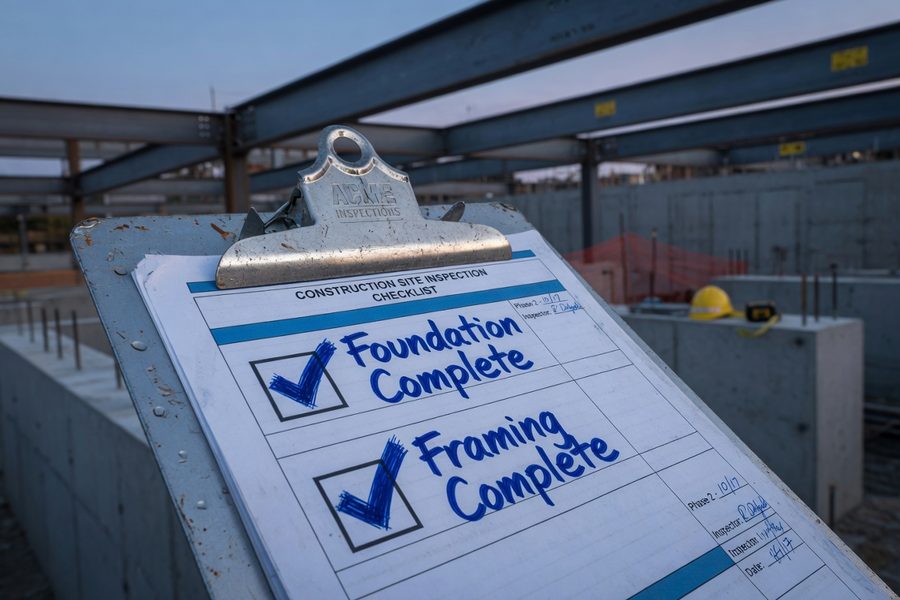
Most borrowers assume the spread is fixed once the loan closes. It isn’t always. Hitting major inspection milestones on time, foundation complete, framing complete, rough-ins passed, demonstrates project execution quality. Some lenders will entertain a spread reduction of 10–25 basis points at the midpoint of a well-performing construction loan, particularly if you’ve also improved your credit score during the build or deposited additional funds. Ask explicitly; the worst answer is no.
Your credit score affects this directly. A score that improves from 710 to 740 during a 12-month build is a legitimate renegotiation trigger. For context on what credit tiers actually matter for borrowing costs, understanding good credit score ranges helps you know which threshold changes carry real pricing weight.
What clients often miss: The lender’s construction administration fee (typically 0.25%–0.50% of the loan amount) is often more negotiable than the spread itself. Reducing or waiving that fee on a $500,000 loan is equivalent to a 25–50 bps spread reduction over a 12-month draw period, and loan officers have more discretion on fees than on spread floors.
Where This Recommendation Falls Short
The negotiation playbook above works best for borrowers who fit within a bank’s standard credit box. If your credit score is below 680, your debt-to-income ratio exceeds 43%, or your contractor doesn’t have a documentable track record, the strategies described here will either fail outright or produce marginal results. That’s the honest catch: the borrowers most likely to benefit from a lower spread are those who need it least.
There’s also a speed tradeoff. Community banks with the tightest spreads often have slower underwriting timelines, three to six weeks is common for full approval. If your lot purchase or construction start date is time-sensitive, accepting a wider spread from a lender who can approve in ten days is a rational choice. The risk is real: construction windows close, contractor schedules fill, and a 45-day delay can cost more in site carrying costs than a 50-basis-point spread reduction saves in interest.
Private lenders charging prime +3.00%–4.00% are genuinely the right tool for certain situations: broken ground with title complications, borrowers with recent credit events, projects in rural or non-conforming markets, or investors who need a bridge to a permanent takeout loan. The drawback of reflexively avoiding private money is that it can trap a project at a critical juncture.
One-time-close loans carry a specific tradeoff that deserves naming: the wider spread during construction is the cost of locking your permanent rate today. If rates fall 100 basis points during your 18-month build, you’ll wish you had a two-time-close structure. If rates rise 100 basis points, you’ll be glad you locked. Neither outcome is predictable, and acting as though it is leads to regret. Model both scenarios before committing to a structure, and weigh that against how rising prime rates affect your broader financial position.
Finally, the interest deductibility assumption matters here. Construction loan interest is only deductible as qualified residence interest during the construction period under specific IRS conditions, the build must be completed within 24 months and the home must become your primary or secondary residence. If those conditions aren’t met, the after-tax cost of a wider spread is higher than most borrowers model. That changes the calculus on accepting a slightly wider spread for faster approval.
How We Sourced This
Spread data cited in this article comes from Trepp’s Anonymized Loan-Level Repository (T-ALLR), specifically their 2025 construction lending analysis covering Q3 2025 and Q4 2024 originations. Prime rate mechanics and bank profitability benchmarks draw from the Federal Reserve’s H.15 statistical release and FDIC Quarterly Banking Profile data through Q1 2026. Lender type spread ranges (community bank, private lender, OTC) reflect disclosed rate sheets and origination data from publicly available lender disclosures. IRS interest deductibility references are drawn from IRS Publication 936. Any figure not directly sourced from the above was expressed qualitatively rather than numerically.
Frequently Asked Questions
What is a typical construction loan spread above prime in 2026?
For residential borrowers at community banks with solid credit and 20% or more equity, prime +0.75%–1.50% is the realistic range as of mid-2026. Trepp data shows the median spread on loans at 55%–65% LTV was 237.5 basis points in Q3 2025, down sharply from 310 bps in Q4 2024. Private lenders run significantly higher, typically prime +2.75%–4.00% or more.
Can you negotiate a construction loan spread after closing?
Yes, though few borrowers attempt it. Hitting major construction milestones on schedule, improving your credit score, or increasing your equity position mid-build are legitimate triggers for a spread renegotiation request. The lender is not required to agree, but banks with ongoing draw relationships have an incentive to keep well-performing loans from being refinanced away.
Does a one-time-close construction loan have a higher spread than a two-time-close?
Generally yes. One-time-close loans commit the lender to permanent financing terms at application, before the home exists. That forward exposure carries a spread premium of roughly 50–100 basis points compared to standalone construction lines at similar LTVs. The tradeoff is rate certainty; two-time-close structures expose you to refinance risk at completion.
How does LTV affect the construction loan spread?
Lower LTV directly compresses the spread. A borrower at 60% LTV typically receives a spread 25–75 basis points tighter than the same borrower at 80% LTV because the gap between draw advances and collateral recovery value is smaller. Increasing your down payment or using land equity to reduce LTV is one of the most reliable ways to negotiate a lower spread before closing.
Are construction loan interest payments tax-deductible?
Construction loan interest qualifies as deductible qualified residence interest under IRS Publication 936, but only if the home is completed and occupied as your primary or secondary residence within 24 months of the first draw. If the build runs long or the property doesn’t qualify as a residence, the deduction is lost. Model the after-tax cost before accepting a wider spread based on assumed deductibility.
How does using a bonded contractor affect the construction loan spread?
A bonded, licensed contractor with a documented completion history directly reduces the lender’s incomplete-collateral risk premium, which is one of the three layers that make up the spread. Some banks will reduce the quoted spread by 25 basis points for borrowers who also commit to independent draw inspections. Put the contractor’s credentials and bonding documentation in your initial loan application package, not as an afterthought.
Sources
- Trepp, Construction Lending SLOOS and T-ALLR Spread Data (2025)
- Federal Reserve, H.15 Selected Interest Rates
- FDIC, Quarterly Banking Profile, Net Interest Margin and ROE Data
- IRS Publication 936, Home Mortgage Interest Deduction
- Consumer Financial Protection Bureau, What Is a Construction Loan?
- Federal Reserve, Prime Rate Historical Data and Bank Lending Benchmarks