Fact-checked by the Prime Rate editorial team
How the Prime Rate Affects Credit Cards
Quick Answer
The prime rate currently stands at 6.75%-07-16 and serves as a key benchmark for variable credit card interest rates, which typically add a margin of 10 to 23 percentage points depending on credit score. When the federal funds rate, recently at 3.63%-06-01, changes due to Federal Reserve policy, the prime rate usually adjusts, directly impacting monthly interest charges for credit card holders who carry balances.
Updated July 22, 2026
Credit card variable APRs commonly use the prime rate as the base index.-07-16, the US Bank Prime Loan Rate is 6.75% according to Federal Reserve Bank of St. Louis data, and this figure influences how credit card issuers calculate costs for consumers.
Federal Reserve actions regarding the federal funds rate often affect consumer loans. This guide explains the mechanics, shows historical effects, covers whether all cards are impacted, and outlines steps to manage higher costs when rates rise. Although rate increases raise expenses for those carrying balances, paying off the full amount each month sidesteps interest entirely.
Key Takeaways
- The current US Bank Prime Loan Rate is 6.75%-07-16 and acts as the index for variable credit card APRs. Source: Board of Governors of the Federal Reserve System
- The federal funds rate stood at 3.63%-06-01, with the prime rate typically set about three percentage points higher. Source: Board of Governors of the Federal Reserve System
- The bank prime loan rate was 3.25% prior to 2022 rate increases, illustrating how much it has changed over time. Source: Federal Reserve Bank of St. Louis
- Revolving credit data from the Federal Reserve shows the large scale of credit card debt that can be affected by rate adjustments. Source: Board of Governors of the Federal Reserve System
- Prime rate changes apply to variable interest rate credit cards but generally do not affect fixed interest rate products. Source: Board of Governors of the Federal Reserve System
This is not financial advice. Consult a qualified professional for guidance specific to your situation.
In This Guide
- What Is the Prime Rate?
- How Do Credit Card Issuers Use the Prime Rate?
- Are All Credit Cards Affected by Prime Rate Changes?
- How Do Changes in the Prime Rate Appear on Credit Card Statements?
- What Do Past Prime Rate Movements Reveal About Credit Card Costs?
- How Can You Protect Yourself When the Prime Rate Changes?
What Is the Prime Rate?
Commercial banks offer their best customers the prime rate as a base lending rate that also benchmarks many consumer loans such as credit cards. Major banks report figures that contribute to the widely referenced Wall Street Journal prime rate. The current figure is 6.75% per Federal Reserve Bank of St. Louis.
The prime rate has historically been set approximately three percentage points above the federal funds rate, with recent data showing the federal funds rate at 3.63%-06-01.
A fixed rate mortgage rate or Treasury yields operate separately from the prime interest rate. No law or the president sets it directly. Banks establish this market-based benchmark in response to Federal Reserve policy instead. Banks charge each other the federal funds rate overnight for reserve balances, and the Federal Open Market Committee targets this rate during its eight annual meetings.
This connection matters for your wallet because most credit cards carry variable interest rates. General-purpose cards from Visa, Mastercard, American Express, and Discover base their variable APR on prime plus a margin. Adding that margin means prime rate changes dictate the APR on most cards. Carrying credit card debt means the prime rate influences each billing cycle. The rest of this article covers how the prime rate is determined, how it flows into credit card interest charges, how fast your card’s interest rate adjusts, and what strategies can reduce the impact on your finances.
How Do Credit Card Issuers Use the Prime Rate?
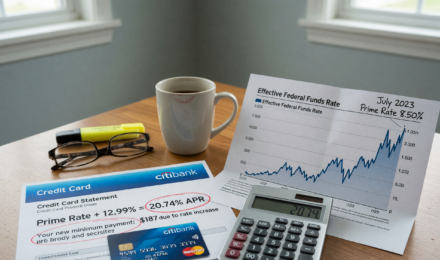
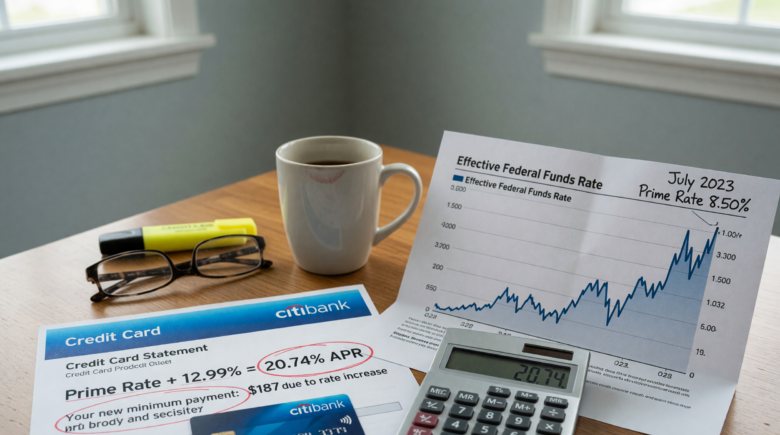
Your credit card APR is built from two components: the prime rate (the index) plus a margin based on your personal risk profile and the card’s features, with the margin where your credit score, payment history, income, existing debt, and card type all factor in. Credit card issuers set that margin using several borrower factors, where borrowers with excellent credit (740+) might see margins of 11 to 12 percentage points higher over prime, good credit (660 to 739) often lands margins around 14 to 15 percentage points, and fair or subprime credit (below 660) can push margins to 19 to 23 percentage points. With the current prime rate at 6.75%-07-16, a card advertising a variable APR range of 19.99% to 29.99% reflects margins from roughly +13.24% for top-tier borrowers to +23.24% for higher-risk applicants, which is why average credit card rates sit far above the prime rate, and credit card contracts often have a maximum APR limit commonly around 29.99% which caps how high interest can climb. Different transaction types carry different margins, with purchase APR, balance transfer APR, and cash advance APR all tied to the prime rate but using separate spreads, and cash advances typically carrying the highest margin and no grace period. Here is a quick comparison of three hypothetical card offers all assuming a 6.75% prime rate where a low-rate card for excellent credit might charge Prime plus 10.25% for a total APR of about 17.00%, a cashback rewards card for good credit might sit at Prime plus 14.50% totaling roughly 21.25%, and a premium travel card loaded with perks might run Prime plus 18.00% landing near 24.75%, as rewards and perks cost money and card issuer economics pass that cost into higher margins.
| Credit Card Type | Margin Over Prime | Example APR |
|---|---|---|
| Low-Rate for Excellent Credit | +10.25% | 17.00% |
| Cashback for Good Credit | +14.50% | 21.25% |
| Premium Travel Card | +18.00% | 24.75% |
Are All Credit Cards Affected by Prime Rate Changes?
Variable interest rate credit cards primarily feel the effects of prime rate changes. Fixed interest rate cards do not adjust automatically when the prime rate moves. Truly fixed-rate credit cards remain rare today, with most products using variable APRs tied to the prime rate instead. An older fixed-rate card keeps its APR unchanged by prime movements, although the issuer could still propose a change after giving proper advance notice under federal law. Your personal margin over prime depends heavily on your credit score, payment history, and card type. Improving your credit can reduce your costs more than small movements in the prime rate ever will.
Consider using the debt avalanche method to prioritize paying off highest interest rate balances first or the debt snowball method to build momentum by tackling smallest balances, both of which can help manage the effects of rising rates on credit card debt.
Headlines often spotlight the prime rate and the federal reserve. Other factors frequently exert a bigger impact on the interest you actually pay though. Your credit score, credit card balance amount, payment behavior, and card type can each outweigh a quarter-point rate move. A 0.25% shift in prime changes your cost only slightly. Switching from a higher APR card to a lower one cuts your interest charges dramatically. Improving your credit score enough to qualify for a new credit card with better pricing achieves savings that dwarf any single prime rate change. Fixed-rate financing stays generally unaffected by prime rate changes, with fixed-rate loans remaining constant throughout the loan’s life. Not every card term shifts with prime rate fluctuations since fixed terms may stay unchanged.
How Do Changes in the Prime Rate Appear on Credit Card Statements?
A variable interest rate indexed to the prime rate applies to most credit cards today. After a Federal Reserve move that shifts the prime rate, the APR on your credit card usually adjusts automatically within one or two billing cycles. Credit card agreements permit issuers to update variable APRs based on index movements without the usual 45-day notice for other changes. Lenders must provide 45-day written notice for discretionary term changes, yet index-driven adjustments form a carve-out. As a result, credit card issuers may skip notifying you about prime-tied rate changes, and the new rate shows up on the next statement instead.
Only variable-rate credit cards see automatic adjustments when the prime rate moves, while fixed-rate cards remain unchanged unless the issuer provides proper notice for a change.
Consider a small shift in rates to see the effect. Suppose the federal funds rate rises by 0.25 percentage points and prime moves up by the same amount. A card with a 21.24% APR then jumps to 21.49%. On a $3,000 credit card balance, that translates to roughly $0.63 more in monthly interest charges. The amount seems small per month but compounds over time across multiple credit card accounts. Minimum monthly payments on credit cards often increase after a rise in the prime rate. Carrying a balance means more of each payment goes toward interest as rates rise. Rates rising make carrying a balance on credit cards more expensive, while decreases make it generally less expensive. Paying the full statement balance in full each month generally avoids interest charges on purchases, so prime rate changes will not materially affect those credit card payments.
What Do Past Prime Rate Movements Reveal About Credit Card Costs?
Dramatic swings have characterized the prime rate over the decades, dropping from over 20% in 1980 to as low as 3.25% after the 2008 financial crisis and again during the early COVID-19 period, yet average credit card APRs have remained relatively high throughout. The spread between the prime rate and average credit card interest rates has widened since the mid-1990s. Credit card rates tend not to fall as much when prime drops but rise in step when prime increases.
The Fed raised the federal funds rate 17 times from 2004 to 2006, causing prime to climb steadily with credit card APRs following suit. In contrast, during 2020 to 2021 when prime fell to 3.25% many card APRs stayed near or above 15% to 20%. Structural factors explain the pattern. Credit card debt is unsecured, charge-off risk is real, rewards programs need funding, and a few large banks dominate the market. Regulators including the CFPB periodically review card pricing practices. For you as a consumer, the most practical response involves managing balances, comparing offers, and improving creditworthiness rather than waiting for industry-wide changes.
How Can You Protect Yourself When the Prime Rate Changes?
Several Fed hikes occurred between 2022 and 2024 followed by a pause. The rate environment in mid-2026-07-22 keeps borrowing costs elevated. You cannot control the prime rate, yet you can control how much credit card interest you pay. Start with tactics such as paying more than the minimum every month to shrink the balance subject to compounding interest. Use the debt avalanche method which prioritizes paying off highest interest rates first to eliminate the most expensive balances quickly. The debt snowball method focuses on paying off smallest balances first and can build momentum. Direct windfalls like tax refunds or bonuses toward high-APR credit card debt before further prime rate increases show up in your interest charges.
Balance transfer cards offer 0% APR for a limited time typically 12 to 21 months though they usually charge a 3% to 5% transfer fee and require a good credit score to qualify, and you should avoid making new purchases on that card unless they also fall under the promotional rate.
Balance transfer cards offer 0% APR for a limited time although they usually charge a 3% to 5% transfer fee and require a good credit score to qualify. Avoid making new purchases on that card unless they also fall under the promotional rate because those purchases may immediately incur the standard variable APR. Debt consolidation loans combine multiple debts into one payment and convert variable-rate credit card debt into a predictable fixed interest rate installment. Pros include rate stability and easier budgeting. Cons include origination fees and the risk of running up new revolving balances on freed-up cards. Periodically compare your current credit card rates with new offers especially any time the federal reserve changes the federal funds rate and the prime rate shifts.
Cards with rich rewards programs or generous sign-up bonuses often come with higher credit card rates to compensate issuers. If you frequently carry credit card debt, weigh those perks against the cost of a high variable interest rate and consider switching to a lower-rate card, a 0% balance transfer card, or a fixed rate personal loan. Many variable-rate products including a home equity line of credit, small business loans, and some personal loans also use the prime rate as their index. An adjustable rate mortgage may use a different benchmark like SOFR. Many lines of credit for small businesses tie to the prime rate so a Fed rate hike can raise costs across multiple accounts at once. Fixed rate mortgage rates are not directly impacted by prime rate movements in the same way credit cards are.
Frequently Asked Questions
Do fixed-rate credit cards automatically follow prime rate movements?
Most credit cards use variable APRs tied to the prime rate, making truly fixed-rate credit cards rare today. An older fixed-rate card keeps its APR from changing automatically when the prime rate moves, though the issuer may still request a change with proper advance notice under federal law.
When the prime rate moves, how frequently do issuers update credit card APRs?
Variable APRs typically get adjusted by issuers whenever the prime rate changes, with the new rate taking effect in the next full billing cycle. Multiple rate moves in a single year become possible since the FOMC meets eight times a year, leading to several small APR changes on credit card accounts and monthly statements.
Can improving your credit score help counter the effects of a higher prime rate?
An existing card’s margin over prime does not shrink automatically when credit improves. A stronger credit score may qualify you for a new credit card or other products with a lower margin based on better creditworthiness. This effectively lets you refinance into lower-rate products even when prime rate increases are happening.
Do other loans and lines of credit also tie to the prime rate?
Many variable-rate products use the prime rate as their index, including a home equity line of credit, small business loans and some personal loans. An adjustable rate mortgage may use a different benchmark like SOFR. Many lines of credit for small businesses are tied to the prime rate so a Fed rate hike can raise costs across multiple accounts at once.
How can you check the latest prime rate and explore lower-rate borrowing options?
The current prime rate and recent changes appear on financial news outlets and on sites that track the rate. Such tools also provide ways to compare personal loans, business loans and credit cards. This lets you see pre-qualified rates to borrow money at lower costs without affecting your credit score.
In what ways do credit card rates differ from those on auto loans or personal loans due to the prime rate?
Auto loans are often offered at fixed rates that do not fluctuate directly with the prime rate. Some personal loans use variable rates tied to prime or other indexes. Credit card rates tend to be higher overall because they are unsecured revolving debt compared to secured auto loans or installment personal loans.
What practical steps reduce credit card costs amid prime rate increases?
Paying more than the minimum monthly payment and directing extra funds to high interest balances can reduce the principal faster. Shopping for balance transfer offers or consolidation loans with fixed rates can also provide stability when variable credit card interest rates increase due to prime rate adjustments.
Sources
- Board of Governors of the Federal Reserve System, Selected Interest Rates (H.15)
- Board of Governors of the Federal Reserve System, Consumer Credit (G.19)
- Federal Reserve Bank of St. Louis, Bank Prime Loan Rate
- Federal Reserve Bank of St. Louis, Historical Data on Prime Rate
- Federal Reserve, Prime Rate as Benchmark for Consumer Loans
- Federal Reserve, Revolving Credit Statistics
- FRED, Bank Prime Loan Rate Prior to 2022
- Federal Reserve System, Interest Rate Releases and Data