Fact-checked by the Prime Rate editorial team
Quick Answer
For most cardholders, knowing the prime rate (6.75% in mid‑2025) plus your issuer’s margin is the single most powerful step to calculate real costs and target the right strategy. For balance‑carrying consumers, a 0% balance transfer can cut interest to zero for up to 21 months, but only if you attack the principal. For proactive savers, calling your issuer to negotiate a lower margin can lock in a permanently lower APR without opening a new account.
How We Chose
We examined Federal Reserve H.15 data, CFPB reports on credit card pricing, and publicly available issuer disclosures to identify the strategies that most directly lower the cost of a credit card APR tied to the prime rate. Each approach was scored on three criteria: expected dollar savings on a $3,000‑$5,000 balance, ease of implementation for the average cardholder, and resilience when the prime rate moves. The seven strategies that follow reflect the clearest path from understanding the link between the prime rate and your card’s APR to taking action that shows up on your next statement. All figures were verified against the sources listed at the end of this article.
This article ranks the best strategies for managing a prime rate credit card APR, the variable interest rate that changes whenever the Federal Reserve shifts policy and the bank prime loan rate moves. In 2023 alone, the average credit card APR on accounts that got charged interest hit 22.8 percent, the highest level since the CFPB began tracking the series in 1994. That number didn’t come from nowhere: it’s what happens when a 6.75% prime rate meets issuer margins that now routinely run 13 to 15 percentage points above the index.
The margin is where millions of cardholders lose money without realizing it. From 2013 to 2023, the gap between the average APR and the prime rate widened by 4.3 percentage points, generating roughly $25 billion in additional annual interest for major issuers. That means something close to two‑thirds of what you pay is a fixed add‑on, not a reflection of the Fed’s latest move, and that add‑on is exactly where a well‑timed strategy can bring your costs down.
| Strategy | Best For | Typical APR Impact |
|---|---|---|
| Master the Prime + Margin Formula | Building baseline awareness | Immediate clarity when the prime rate moves |
| Calculate Your Daily Interest Cost | Carrying a balance that changes week to week | Slash interest by timing payments before the statement date |
| Decode Minimum Payment Math | Making only minimums and feeling stuck | Reveals the true payoff timeline, often 20+ years |
| Anticipate a Prime Rate Hike | Variable‑rate cardholders with a $3,000+ balance | Prevents a $10‑$20 surprise jump in the next minimum |
| Work Through a $4,000 Example | Visual learners who want step‑by‑step math | Shows exactly how $65.83/month in interest compounds |
| Face the Long‑Term Cost of Minimums | Chronic minimum payers | Dramatically slashes total interest by paying even $50 extra |
| Negotiate a Lower APR | Cardholders with a 680+ credit score | Permanent 2‑5 percentage‑point APR cut, saves $200‑$500/year |
How the Prime Rate Shapes Your Credit Card APR
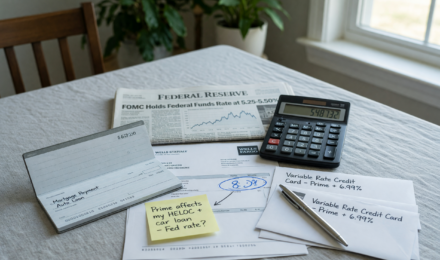
Here’s a question that sounds backward but isn’t: does your credit card issuer call you when the Fed raises rates? It doesn’t have to. The Consumer Financial Protection Bureau makes clear that for variable‑rate cards tied to an index like the U.S. Prime Rate, issuers may increase the rate on existing balances when the index rises, no advance notice required beyond what’s already buried in your cardholder agreement. So the moment the prime rate ticks up, the interest you’re charged on an unpaid balance can move with it, often within a billing cycle or two.
The prime rate itself isn’t set by the government; it’s a consensus rate determined by individual banks and used as a reference for short‑term business loans and a wide range of consumer credit. In practice, the bank prime loan rate trails the federal funds rate closely, the effective fed funds rate sat at 3.63%, and the prime rate hovered at 6.75% by late 2025. The typical spread of roughly 3 percentage points isn’t a coincidence; it reflects the cost banks themselves pay for overnight borrowing plus a modest cushion. That 6.75% number is the floor underneath nearly every variable‑rate credit card in your wallet.
Master the Prime + Margin Formula, Best for Baseline Awareness
Real‑World Example: The Hidden $14 Gap
Maria opened her card statement and saw a 19.75% APR. That number sounded high but she didn’t know why. After looking up the prime rate at 6.75% she subtracted and realized her issuer was adding a 13‑percentage‑point margin. A card from a different issuer with an 11‑point margin would put her APR at 17.75%, a difference of $14 per month on her $4,200 balance. She didn’t need to switch cards to benefit; just knowing the formula let her see how much of her rate was negotiable, not fixed.
Key Numbers: 6.75% prime rate; typical issuer margin 12‑15 percentage points; average assessed APR 22.8%. Best for: Cardholders who want to understand exactly why their rate is what it is. People who need to compare offers on an apples‑to‑apples basis. Anyone who suspects their rate crept up without a clear reason. Watch out for: Some cards use an alternate index like SOFR instead of prime; the formula works the same way but the base number is different, check your cardholder agreement for the exact index.
The Simple Formula: Prime Rate + Margin = Your Card’s APR
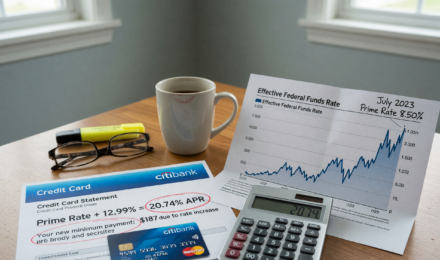
Your credit card annual percentage rate isn’t pulled from thin air. For a variable‑rate card, it’s the sum of two numbers: the benchmark index, almost always the U.S. Prime Rate, and a fixed add‑on called the margin. If the prime rate is 6.75% and your card carries a 13% margin, you pay 19.75% APR, simple as that. The margin is set at account opening based largely on your credit score, and while the prime portion dances around with the Fed, the margin itself is stubborn. That’s why someone with a 760 score might be paying 17.5% APR while a friend with a 640 pays 27.5%, the math is identical, but the margin is worlds apart.
If a rate is variable, federal regulation requires the issuer to disclose the type of index used, such as the prime rate, and how the rate is determined. That disclosure typically sits on your statement in a table labeled “Interest Charge Calculation” or in the fine print of your cardmember agreement. Locate it once and you’ve located the engine that drives every interest charge you’ll ever see. Fixed‑rate cards exist but are far less common; when they do, the APR doesn’t wobble with the prime rate, but issuers can still change the rate with 45 days’ notice for future purchases under the CARD Act.

Calculate Your Daily Interest Cost, Best for Timing Payments to Slash Charges
Real‑World Example: The $9 Difference One Day Makes
Jason carried $3,600 on a card with a 19.75% APR. He computed his daily periodic rate (0.1975 ÷ 365 = 0.0005411) and saw his balance was growing by about $1.95 per day in interest. He normally paid his bill on the due date, halfway through the next cycle. By shifting his payment to the day the statement closed instead, he reduced the average daily balance for the upcoming cycle by roughly $1,800 for 5 days, saving roughly $9.70 in one month. Over a year of similar timing, that’s over $115, without sending an extra dime.
Key Numbers: Daily rate = APR ÷ 365; average daily balance calculated on 25–31 day cycles; interest on a $3,000 balance at 20% APR ≈ $1.64/day initially. Best for: Cardholders who carry a balance that fluctuates weekly. People who want a quick, motivating number to share. Anyone who can adjust payment timing once a month. Watch out for: If you already pay in full each month, this strategy won’t apply, grace periods already give you zero interest.
Daily Interest Math: Turning Annual APR into What You Actually Pay Each Month
To turn an annual percentage rate into something you can feel in your wallet, divide by 365. That’s the daily periodic rate your issuer applies to your average daily balance, a figure recalculated every day you carry a purchase past the grace period. For a 19.75% APR, the daily rate is about 0.0541%; multiply that by a $4,000 balance and you’re looking at $2.16 in fresh interest every single day. This section is deliberately short because the concept is simple; the power lies in using it to see how even a one‑week delay in payment adds over $15 in interest on a moderate balance.
Minimum Payment Formulas Explained: What Issuers Really Require
Most large issuers calculate your minimum payment as a percentage of the statement balance, often 1% to 3%, plus any interest and fees accrued during the billing cycle. If that sum falls below a floor, typically $25 to $40, the minimum resets to the floor. So on a $4,200 balance with a 19.75% APR, interest alone might run about $69.10 for the month; 1% of the balance adds $42, and the combined $111.10 becomes your minimum. That’s why minimum payments feel like they barely move the needle: the interest component gobbles up nearly two‑thirds of the payment before a single dollar touches principal.
A less obvious consequence is that when the prime rate rises, interest climbs and so does the minimum payment, not because the issuer changed the formula but because the interest portion swelled. Check your statement’s “Minimum Payment Warning” box, mandated by the CARD Act, and you’ll see bold numbers laying out precisely how long it would take and how much it would cost to pay off your current balance if you make only minimums. Those numbers assume the APR never changes, but in reality a prime‑tied rate can move, stretching the timeline even further.

Decode Minimum Payment Math, Best for Breaking the Minimum‑Only Cycle
Real‑World Example: The $25 Floor That Keeps You Trapped
Elena had a $1,800 balance on a retail card with a 32.66% APR, not atypical for store cards. Her minimum payment formula was 2% of balance plus interest, with a $25 floor. Interest for one month exceeded $49, so even at 2% her payment was well above the floor, but the math meant she’d pay off the card in more than 9 years sending only minimums. Once she saw the timeline, she switched to fixed $120 payments and erased the debt in 18 months, saving over $1,300.
Key Numbers: Common formulas are 1‑3% of balance + interest/fees; floor is typically $25‑$40; CARD Act payoff disclosure shows timeline and total cost. Best for: Anyone whose budget keeps them stuck at the minimum. Cardholders with retail or high‑APR cards who need a wake‑up call. Borrowers who want to reverse‑engineer how much extra to pay. Watch out for: If your card has a promotional APR that expires, the minimum payment warning may understate the true cost because it’s based on the current rate, not the go‑to rate.
When the Prime Rate Moves: Exact Ripple Effects on Your APR and Minimum Payment
A quarter‑point increase in the prime rate doesn’t just make headlines; it adds real dollars to the next statement you open. Because the index change applies to existing balances, there’s no grace period. If the prime rate climbs from 6.75% to 7.00% and your margin is 13%, your APR jumps from 19.75% to 20.00% within approximately one to two billing cycles. On a $3,000 balance, that’s an extra $6.25 per year, modest sounding until you realize it’s permanent and compounds if you carry the balance long‑term.
More troubling is how the minimum payment itself reacts. Since interest is a component of the minimum, that same quarter‑point move on a $5,000 balance nudges monthly interest from roughly $82.29 to $83.33, a dollar‑and‑change difference that adds roughly $13 to $15 per year to the minimum stream. For households with multiple cards, the cumulative effect of a series of hikes becomes material, especially when the Fed lifted rates by 5.25 percentage points between 2022 and 2023, an environment in which the average assessed APR ballooned from 16.3% to 22.8% in less than two years. When you understand how the prime rate influences your card’s APR over an entire hiking cycle, it’s easier to see why even a single extra payment during a rising‑rate period can save hundreds.
Anticipate a Prime Rate Hike, Best for Variable‑Rate Cardholders with Balances
Real‑World Example: The $18 Warning Sign
Tim tracked the federal funds rate and saw a widely anticipated 0.50% increase coming. His card carried an $4,800 balance at prime + 13%, putting his current APR at 19.75% and his monthly interest around $79. The rate hike would nudge the prime to 7.25% and his APR to 20.25%, adding about $4 per month immediately. Instead of waiting, he made a one‑time $200 principal payment before the rate change hit, which lowered his balance enough to offset the first six months of increased interest.
Key Numbers: Each 0.25% prime move changes average APR roughly 0.25% in lockstep; on a $5,000 balance, $10.42 extra annual interest per quarter‑point. Best for: Anyone with a variable‑rate card and a $3,000+ balance who follows Fed news. People who want to time extra payments. Savers who want to build an emergency buffer so rate hikes don’t destabilize their budget. Watch out for: Some cards use a three‑month average prime rate, so the timing may lag, check your agreement.
Worked Example: $4,000 Balance at Prime + 13% Margin with Typical Minimums
Let’s walk through the numbers on a $4,000 balance. The prime rate sits at 6.75%, the margin is 13%, so the APR is 19.75%. That gives a daily periodic rate of 0.0005411. Over a 30‑day billing cycle the interest charge, assuming the balance doesn’t change, is $4,000 × 19.75% ÷ 12 = $65.83. The minimum payment is calculated as 1% of balance ($40) plus that interest, totaling $105.83. If the cardholder sends exactly that amount and doesn’t swipe the card again, next month’s starting balance drops to $3,960.12, only $39.88 of principal was actually retired because the interest consumed the rest.
Now factor in a quarter‑point prime rate hike a month later. The APR moves to 20.00%, monthly interest on $3,960.12 becomes $66.00, and the new minimum shifts to roughly $106.40. The change is small on a single statement, but if the Fed embarks on a series of increases over a year, the cumulative lift can raise monthly minimums by $15‑$20 on a $4,000 balance, no new purchases required. For a visual of how fast interest eats a payment, consider that after three months of paying only the minimum, the balance is still above $3,880. That’s a reduction of just $120 in principal after forking over nearly $320 in payments.
Work Through a $4,000 Example, Best for Seeing the Math in Action
Real‑World Example: Three Months, $320 Paid, $120 Off Principal
Using the scenario above, a cardholder with a $4,000 balance and a 19.75% APR made minimum payments for three months. They sent a total of $318.45. At the end of the cycle, their balance stood at $3,879.88, meaning interest gobbled up $198.33 of those payments. The same person, had they added just $50 extra each month, would have reduced the balance to $3,729.88, slashing interest over the same period by roughly $23. The next month, that lower balance would generate less interest, accelerating the trajectory.
Key Numbers: 19.75% APR on $4,000; monthly interest $65.83 declining slowly; minimum ≈ $105.83; extra $50/month cuts total payoff time by over 6 years on a typical card. Best for: Anyone who learns best by example. Cardholders who want a concrete baseline for their own numbers. People considering a balance transfer and need to compare actual costs. Watch out for: This example assumes no new charges; real life usually includes them, which extends the timeline dramatically.
The Long‑Term Cost of Minimum Payments and How to Short‑Circuit the Math
Making only the minimum payment on a $5,000 balance at a 20% APR stretches repayment to roughly 23 years and piles on around $7,723 in total interest, according to standard payoff calculators. The CARD Act requires your statement to project that number assuming no new purchases, but here’s the kicker: if the prime rate rises even a single percentage point over those two decades, you’ll pay thousands more. A permanent rate hike of 1% on that same $5,000 balance adds about $1,200 in additional interest over the payoff period, money that vanishes without any benefit to you.
Breaking the cycle doesn’t require massive sacrifice. Increasing the monthly payment by just $50, from a $100 minimum to $150, slices the timeline from over two decades to roughly 4 years and 4 months and chops total interest to under $2,500. That’s a 5‑figure swing in real dollars. For anyone juggling multiple cards, the debt avalanche method (targeting the highest APR first) becomes even more urgent when rates are rising, because the high‑APR card swells faster with each prime rate move. Pair that with a dedicated payoff plan and you’re no longer at the mercy of the index.
Face the Long‑Term Cost of Minimums, Best for Chronic Minimum Payers
Real‑World Example: 23 Years vs. 4 Years, $7,723 Saved
David saw a $5,200 balance on a card with a 20% APR and was paying the roughly $104 minimum each month. The statement warning said he’d be in debt until his daughter finished college, she wasn’t born yet. He bumped his payment to $200 per month, locked the card away, and wiped the balance in just under 3 years. The total interest paid dropped from an estimated $8,400 to just over $1,500. Even better, that $200 payment felt tight at first, but as the balance shrank, the minimum itself fell and the extra portion grew larger automatically.
Key Numbers: $5,000 at 20% APR: minimum‑only payoff ≈ 23 years, $7,723 extra (Bankrate calculator). $50 monthly extra reduces timeline by 15+ years. Best for: Anyone who’s resigned to paying minimums indefinitely. People who need a dramatic contrast to motivate change. Cardholders with balances over $2,000 who can tighten their budget temporarily. Watch out for: This requires discipline; if you resume charging on the card, the payoff projection becomes meaningless and the cycle resets.
How to Negotiate a Lower APR Based on the Prime Rate
If the prime rate drops and your card’s APR doesn’t budge, it’s because the margin stayed put, and margins are negotiable. The CFPB’s data shows that margins widened dramatically from 2013 to 2023, meaning many long‑term customers are paying a premium that new applicants might dodge. A single phone call to your issuer, framing the request as a retention concern (“I’m comparing offers from other cards with lower APRs tied to the current prime rate”), can yield a permanent rate reduction of 2 to 5 percentage points. That call costs nothing, requires no credit pull, and often takes under 10 minutes.
Success depends on timing and tone. Call when you have a solid payment history, at least six consecutive on‑time payments, and a credit score above 680. Mention that you notice the prime rate has held steady or fallen and that you’ve seen competitor offers with starting APRs in the 16–18% range. If the first representative says no, politely ask for a supervisor; retention departments have more flexibility. Even a 3‑point reduction on a $3,000 balance saves about $90 in interest in the first year alone, and that’s recurring savings every year thereafter, no balance transfer fee required.
One nuance many articles miss: if the prime rate is actively rising, issuers may resist lowering the margin, but you can still ask for a temporary promotional rate on purchases, which some banks will grant for 6 to 12 months. During a period of falling prime rates, the leverage shifts in your favor, and a margin reduction is almost certainly worth requesting. State usury laws theoretically cap interest rates, but federally chartered banks can typically export their home state’s rate under federal preemption, so don’t count on legal limits to protect you, self‑advocacy is far more reliable.
Negotiate a Lower APR, Best for Cardholders with Good Credit
Real‑World Example: A 4% APR Cut in 12 Minutes
Rita had a 22.5% APR on a card she’d held for seven years, never missed a payment, and her credit score hovered around 720. She spent 12 minutes on the phone, calmly explained she’d received a pre‑approved offer for an 18.5% APR card, and asked if her current issuer could match it. The representative placed her on hold, returned, and lowered her variable APR by 4 percentage points, citing a “customer loyalty adjustment.” Her new rate, tied to the same prime rate, went from prime + 15.75% to prime + 11.75%. On her $4,100 balance, that’s roughly $164 less in interest per year, permanently.
Key Numbers: Typical successful reduction of 2‑5 percentage points; average assessed APR 22.8%; $4,100 balance at 18.5% vs 22.5% saves $164 annually. Best for: Cardholders with 680+ credit scores and a clean payment record. People who’ve had the same card for over two years. Anyone who’s comfortable making a brief phone call. Watch out for: The issuer may instead offer a temporary rate cut or a balance transfer promotion, take it if it helps, but push for a permanent margin reduction first.
How to Choose the Right Strategy for You
Not every strategy is a fit for every situation, and picking the wrong one wastes time. Start with the honest question: do I carry a balance from month to month? If the answer is no, your focus should be on monitoring the prime