
Fact-checked by the Prime Rate editorial team
When you remarry and bring children from previous relationships into your household, estate planning stops being simple. A basic will that leaves everything to your spouse may seem loving, but it can accidentally cut your own children out of an inheritance entirely. A blended family irrevocable trust equal inheritance strategy changes that, locking in guarantees that every child, no matter which parent they came from, receives what you intend. Without it, the surviving spouse could remarry, rewrite a will, or simply spend down the assets, leaving your biological children with nothing.
The numbers make this urgent. According to the Pew Research Center, 17% of U.S. children under 18 live in a blended family. That’s more than one in six kids who could be affected by a poorly structured estate plan. And the wealth gap is stark: median net worth for households with children in blended families sits at $86,300, compared to $194,400 for households with children not in blended families. When assets are modest, every dollar of inheritance matters more, so a plan that leaks value through taxes, legal fights, or unintended distributions hurts deeply.
By the end of this article, you’ll understand exactly which irrevocable trust structures work for equal inheritance in blended families, how to fund them without losing control unnecessarily, and the specific drafting choices that prevent your children from being disinherited. You’ll also see where these trusts fall short, and how to plug those gaps with other financial moves, so you can walk into an attorney’s office knowing the right questions to ask.
Key Takeaways
- 17% of U.S. children under 18 live in blended families, facing substantial risk of unequal inheritance without proper planning.
- The median net worth gap of $108,100 between blended and non-blended family households makes precise estate distribution critical.
- QTIP trusts provide lifetime income to a surviving spouse while locking in equal remainders for all children, including stepchildren.
- Irrevocable bypass trusts funded up to the estate tax exemption (around $13.99 million per individual) remove assets from the surviving spouse’s taxable estate.
- Choosing an independent trustee dramatically reduces conflict, family member trustees often face misaligned incentives that can erode equal inheritance.
- Most irrevocable trusts do not receive a step-up in basis at the second death, which can reduce after-tax inheritance for children versus a revocable plan.
In This Guide
- Why Blended Families Need Specialized Trust Structures
- Key Differences Between Revocable and Irrevocable Trusts in Blended Family Plans
- Core Trust Structures: QTIP, Bypass, and AB Trusts for Equal Outcomes
- Drafting for True Equality: Beneficiary Designations and Distribution Rules
- Choosing Trustees and Avoiding Conflicts of Interest
- Funding, Timing, and Tax Considerations for Irrevocable Trusts
- Coordinating Irrevocable Trusts with Your Broader Financial Plan
- Common Mistakes That Derail Equal Inheritance Plans
- How to Talk to Your Family About the Trust
Why Blended Families Need Specialized Trust Structures
Estate plans that work for first marriages break down fast when stepchildren and multiple biological lines are involved. A standard joint revocable trust, where the surviving spouse gains full control and can change beneficiaries, can legally redirect assets solely to their own biological children or a new spouse. That’s not paranoia; it’s a documented outcome. As the First Citizens wealth planning team notes, without an irrevocable element, the surviving spouse may simply “decide they have no obligation to the children from your first marriage.”
Age gaps between spouses complicate things further. If one partner is significantly older, assets might flow to the younger spouse and then eventually to their own children, potentially leaving the older partner’s kids with nothing after decades of waiting. Even when both spouses want fairness, simple wills or revocable trusts can’t lock in those intentions. The solution is a structure that makes certain promises legally unbreakable, irrevocable trust provisions that prevent any one person from altering the distribution plan after the first death.
$86,300 median net worth for blended-family households versus $194,400 for non-blended households, meaning a wrong trust choice can divert a significantly larger share of total family wealth.
The Risk of Disinheritance Is Real, Not Hypothetical
Many couples assume their spouse will “do the right thing.” But grief, remarriage pressure, or simple forgetfulness can undo that assumption. Cases arise where a surviving spouse changed beneficiaries on a retirement account within weeks, cutting out stepchildren completely. An irrevocable trust removes that temptation and creates a binding obligation that survives both spouses.
How Family Dynamics Create Unequal Outcomes Even With Good Intentions
You might want to provide more for a child with special needs or give a larger share to a child who helped build your business. But these well-meaning adjustments can harden into resentment if not documented as part of a binding trust. A blended family irrevocable trust allows you to build in needs-based rules, for example, distributions only for education or health, while still treating all children equally in the overall allocation.
Key Differences Between Revocable and Irrevocable Trusts in Blended Family Plans
Revocable trusts give you flexibility; irrevocable trusts give you certainty. In a blended family, you often need both. A revocable trust lets you change your mind while you’re alive and keep control. But that same flexibility means the surviving spouse can also change it. An irrevocable trust, or an irrevocable portion of a trust that springs into effect at the first death, locks in the distribution to all children equally.
There’s a real tradeoff here. Assets in most irrevocable trusts don’t receive a step-up in capital gains basis at the second spouse’s death. That means children might owe more tax when they sell inherited property than they would under a fully revocable plan. Many families accept that cost because it guarantees equal inheritance. If you prioritize absolute protection over tax optimization, the irrevocable structure wins. If you have more trust in your spouse and primarily worry about estate taxes, a revocable plan with built-in safeguards might work, but those safeguards are only as good as the trustee enforcing them.
The table below compares how the two trust types perform across the factors that matter most in blended family planning.
| Factor | Revocable Trust | Irrevocable Trust |
|---|---|---|
| Surviving spouse can change beneficiaries | Yes | No (locked at first death) |
| Step-up in income-tax basis at second death | Yes | No |
| Included in surviving spouse’s taxable estate | Yes | No (bypass trust assets) |
| Marital deduction at first death | Yes | Yes (QTIP structure) |
| Protection from surviving spouse’s creditors | No | Yes |
| Typical drafting cost | $1,500–$3,500 | $3,000–$8,000 |
| Annual professional trustee fee (% of assets) | Not applicable while both spouses alive | 0.5%–1.5% |
| Capital gains tax on $80,000 unrealized gain at distribution | $0 (after step-up) | Up to $16,000 (at 20% rate) |
| Protection if surviving spouse remarries | None | Full (terms cannot be altered) |
| State estate tax planning (e.g., MA, OR thresholds at $2M) | Limited | Effective at any exemption level |
Core Trust Structures: QTIP, Bypass, and AB Trusts for Equal Outcomes
If your goal is a blended family irrevocable trust equal inheritance outcome, three trust tools do the heavy lifting: QTIP trusts, bypass trusts, and AB trusts. They’re often combined, and the right mix depends on your asset size, the age gap between spouses, and how many children come from each prior marriage.
QTIP Trusts: Lifetime Benefits, Guaranteed Remainder
A Qualified Terminable Interest Property (QTIP) trust qualifies for the unlimited marital deduction, meaning no estate tax is due at the first death, but directs assets to your chosen beneficiaries after your spouse dies. Typically, the surviving spouse receives all trust income for life, and when they pass, the remaining principal goes equally to all children from both marriages. The First Citizens wealth planning team describes this structure as giving you the ability to benefit your spouse during their life while ensuring your own children benefit from what you’ve built once your spouse passes. That’s the core of equal inheritance: you don’t have to choose between your spouse and your kids.
Bypass or AB Trusts: Protecting Prior-Marriage Children
A bypass trust (also called a credit shelter trust) is funded at the first death up to the current estate tax exemption amount, around $13.99 million per individual in 2026. This trust removes those assets from the surviving spouse’s estate completely. The spouse can receive income and even principal under an ascertainable standard, but the remainder passes to your designated heirs, typically children from a prior marriage. This structure is especially useful when there are substantial assets and you want to guarantee that a specific portion reaches your biological children without any risk of the surviving spouse redirecting it. It also uses the first spouse’s exemption before it expires.
If your net worth is well under the estate-tax threshold, you can fund the bypass trust with a smaller amount, say, half the combined assets, and let the rest flow through a QTIP. That balances access and lockdown.
Combining Sub-Trusts for a Balanced Plan
Most blended-family estate plans use multiple sub-trusts. A common setup: a revocable trust while both spouses are alive, which splits into a bypass trust for the first spouse’s children, a QTIP trust for the surviving spouse’s benefit with remainder to all children, and possibly a separate trust for a special-needs child. This layering gives you precision. You can allocate specific assets to specific sub-trusts to equalize what each child receives. For example, if one child will inherit a family business through a different vehicle, you can adjust the trust shares so the total inheritance picture is balanced.

Drafting for True Equality: Beneficiary Designations and Distribution Rules
Equal inheritance isn’t automatic. The words you use in the trust document determine whether children from different marriages actually end up with the same amount. Too many trusts use language like “to my descendants, per stirpes” without specifying that stepchildren are included as descendants. That omission alone can create bitter litigation.
Per Stirpes vs. Per Capita: What It Means for Stepchildren
Per stirpes means if a child dies before you, their share passes to their own children. Per capita means the share goes equally to all surviving beneficiaries at that level. In a blended family, you might choose a modified per stirpes or per capita at each generation to ensure that stepchildren and biological children are treated identically. Get specific: name each child in the trust, and state that the term “children” includes both biological and legally adopted stepchildren. Without this, the default in many states is to exclude stepchildren unless formally adopted.
Age Milestones and Needs-Based Adjustments Without Favoring One Side
You can add conditions that don’t undermine equality. For instance, all children receive their share outright at age 25, but if one has a documented disability, a supplemental needs trust holds that share. This treats everyone equally in percentage but accounts for practical differences. Write these exceptions so they can’t be manipulated by a trustee who favors one side of the family. Use objective criteria: a doctor’s certification, government disability status, or an independent review panel.
Contingent Beneficiaries and Remarriage: Preventing Unintended Shifts
What if a child dies before you and they have no children of their own? Without a contingent beneficiary clause, that share might pass to your spouse, which could mean it eventually goes only to the spouse’s biological children. Name contingent beneficiaries for every share, and consider a clause that if a child dies without issue, the share is redistributed among your other named children, including stepchildren. This keeps the inheritance inside the pan-blended group.
In many states, stepchildren not formally adopted have no legal inheritance rights unless specifically named in a will or trust. Even a 30-year parental relationship doesn’t change that default.
Choosing Trustees and Avoiding Conflicts of Interest
The trustee is the person who will carry out your equal inheritance plan. Pick the wrong one, especially a family member, and your careful drafting can evaporate.
Why Independent Trustees Often Save Blended Families From Litigation
A surviving spouse as sole trustee of a QTIP trust has a built-in conflict: they’re supposed to preserve principal for the children, but they may be tempted to draw more income or even invade principal for their own needs. An independent trustee, a professional fiduciary, a bank trust department, or an unbiased third party, acts as a buffer. They follow the trust’s distribution rules without emotional entanglement. The First Citizens estate planning team emphasizes how important it is to account for the emotional complexities of a couple’s feelings toward all their children, precisely the kind of complexity an independent trustee sidesteps entirely. Professional trustee fees typically run $3,000–$7,000 annually, which most families find modest compared to a $50,000 lawsuit over unequal distributions.
Powers Granted to Trustees: Balancing Flexibility and Restriction
You can grant the trustee the power to make unequal distributions for health, education, or maintenance, but only if a clear standard is written into the trust. Some families add a trust protector: an outside party who can replace the trustee if they stray. This adds a layer of oversight that can prevent power abuse. Avoid giving any trustee the ability to change beneficiaries or redistribute shares; that should remain fixed after the first death.
Successor Trustee Planning
Name multiple successors and require that at least one is an independent trustee when the time comes. If your trust currently names your spouse as initial trustee, add a co-trustee or a trigger: upon the first spouse’s death, an independent trustee joins or replaces the surviving spouse. This single drafting change can cut the risk of later disputes substantially, and costs nothing to include at the drafting stage.
Funding, Timing, and Tax Considerations for Irrevocable Trusts
An irrevocable trust isn’t funded by magic. You must transfer assets during your life (inter vivos) or trigger the funding at death through your will or revocable trust. There are immediate tax and cash-flow consequences to weigh.
Lifetime Gifting vs. Testamentary Funding
Funding an irrevocable trust today removes assets from your estate and can reduce future estate taxes, but you lose access. Many families fund a bypass trust at the first death via a pour-over provision in a revocable trust, which preserves flexibility while you’re both alive. If you have a taxable estate, above the $13.99 million individual exemption in 2026, you might accelerate funding with lifetime gifts that use your exemption now, before it potentially drops in future legislation.
Estate and Income Tax Consequences in 2026
Assets in an irrevocable bypass trust won’t be included in the surviving spouse’s estate, so they escape a second round of estate tax. However, they don’t get a step-up in income-tax basis at the second death. This matters if you hold highly appreciated stock or real estate. For example, a $100,000 asset bought for $20,000 has an $80,000 gain. If held in a revocable trust that receives a step-up upon the surviving spouse’s death, the children inherit it with a basis of $100,000 and pay no capital gains tax on the first $100,000 of sale. In an irrevocable trust, the basis stays at $20,000, and the children would owe tax on the $80,000 gain when they sell. At 20% capital gains rates, that’s a $16,000 tax hit that an equal inheritance plan must account for. Many families intentionally allocate assets expected to appreciate less rapidly to the irrevocable side, or use life insurance to cover the tax differential, which we’ll explore in the next section.
Funding an irrevocable trust with assets that have large unrealized gains can penalize trust beneficiaries compared to assets left through a revocable trust. Always compare the after-tax outcome, not just the pre-tax inheritance value.
Coordinating Retirement Accounts and Life Insurance
Retirement accounts like IRAs and 401(k)s pass by beneficiary designation, they don’t automatically flow into your trust. To integrate them into an equal inheritance plan, you often name the trust as the beneficiary for the benefit of your children, with special “see-through” trust language to preserve the stretch-out of required minimum distributions. Life insurance proceeds can be directed into the irrevocable trust to create a pool of cash that equalizes what each child receives, especially when other assets are hard to split. For instance, if one child inherits a rental property worth $200,000 and the trust can’t split it, a life insurance death benefit paid to the trust can give other children an equal amount in cash.

Coordinating Irrevocable Trusts with Your Broader Financial Plan
An irrevocable trust doesn’t exist in a vacuum. It changes your liquidity, your tax picture, and even your retirement drawdown strategy. An equal inheritance plan is, at its core, a personal finance plan with legal documents on top.
Liquidity and the Danger of Over-Funding the Trust
Transferring a large portion of your assets into an irrevocable trust during life can leave you short on cash if a health crisis hits. Before funding, ensure you have an emergency reserve of at least six months’ expenses outside the trust, ideally in a high-yield savings account you can access easily. Couples who put their entire brokerage account into a trust and then scramble when they need $30,000 for a new roof are more common than you’d expect. A realistic monthly budget should flag how much you can safely transfer without threatening your own standard of living.
Community property states like California and Texas have special rules: assets acquired during marriage are jointly owned. Funding an irrevocable trust with community property requires both spouses’ consent and careful titling, otherwise, the transfer can be challenged.
Roth Conversions to Equalize After-Tax Inheritance
Because irrevocable trusts forgo the step-up in basis, one way to reduce the tax disparity is to leave Roth IRA assets to the trust beneficiaries instead of traditional IRA assets. Roth distributions are tax-free, so the lack of step-up doesn’t matter. If you’re in a blended family, consider converting some traditional retirement funds to a Roth over several years, especially if your current tax bracket is lower than your children’s expected brackets. Use the trust as the Roth’s beneficiary to ensure the proceeds are distributed equally. This strategy aligns with Roth IRA conversion planning and can significantly boost the after-tax value reaching your kids. A $50,000 Roth IRA that grows to $100,000 delivers the full $100,000 tax-free to the trust and then to children, no capital gains issue.
Real Estate and Business Assets: Special Handling
If you own a family business or real estate that can’t be divided, the trust can hold ownership interests that pass proportionally to all children, or it can mandate a sale and equal distribution of proceeds. To avoid forcing the sale of a beloved cabin, some families use a life insurance trust to provide equalizing cash while keeping the property intact for one child. This approach requires a professional valuation and periodic updates, since property values change.
Common Mistakes That Derail Equal Inheritance Plans
Even the best trust draft can fail if you overlook a few practical details. Here are the errors that repeat most often.
Leaving Beneficiary Designations Outdated
You might have a brilliant trust, but if your 401(k) beneficiary form still names your ex-spouse or only your current spouse, that account passes outside the trust and directly to that person. It’s the single most common slip-up. After finalizing your trust, pull every account, retirement plans, life insurance, bank PODs, and update them to point to the trust for the benefit of your children, or to the trust directly. Review your 401(k) beneficiary designations at least once a year, and especially after a divorce, remarriage, or birth.
Funding the Trust Incorrectly
A trust is just paper until assets are titled in its name. If you want the irrevocable trust to hold your investment account, you must retitle the account to the trust’s name and EIN. Families sometimes believe they’ve “set up a trust” but everything remains in their personal names, so the trust does nothing. Work with your estate attorney to complete a full funding checklist before you consider the plan done.
Not Accounting for State Estate Taxes
While the federal exemption is high, many states have separate estate taxes with much lower thresholds. Massachusetts and Oregon, for example, tax estates over $2 million. If you live in one of these states, an irrevocable bypass trust might save significant state estate tax even if you’re nowhere near the federal limit. Failing to account for this can leave your blended family with a six-figure tax bill that eats into equal inheritance.
28% of Black children under 18 live in blended families, the highest share among racial/ethnic groups. Estate plans that don’t address specific family structures can disproportionately amplify the wealth gap.
How to Talk to Your Family About the Trust
For many blended families, the hardest part isn’t drafting the trust, it’s telling the kids. Silence breeds suspicion. A structured family meeting, planned carefully, works far better than an offhand conversation.
What to Say, and What to Leave to the Trustee
You don’t need to disclose every dollar amount. Instead, explain the philosophy: “We’ve set up a trust that ensures each of you, whether you’re my child, my stepchild, or our child together, will receive an equal share after both of us are gone. An independent trustee will manage the details so no one has to fight about it.” This frames the trust as a protector, not as a sign of distrust. If you want to name a child as a co-trustee later, do it at an age when they can handle the role, and always pair them with a professional.
Regular Review Triggers
Life changes, a new marriage, a grandchild’s birth, a child’s bankruptcy, can require trust updates. Set a recurring calendar event to review the trust every two years with your attorney. And if a major asset is sold or you move to a different state, call your attorney immediately. A trust that worked in a common-law property state may not work the same way in a community property state.
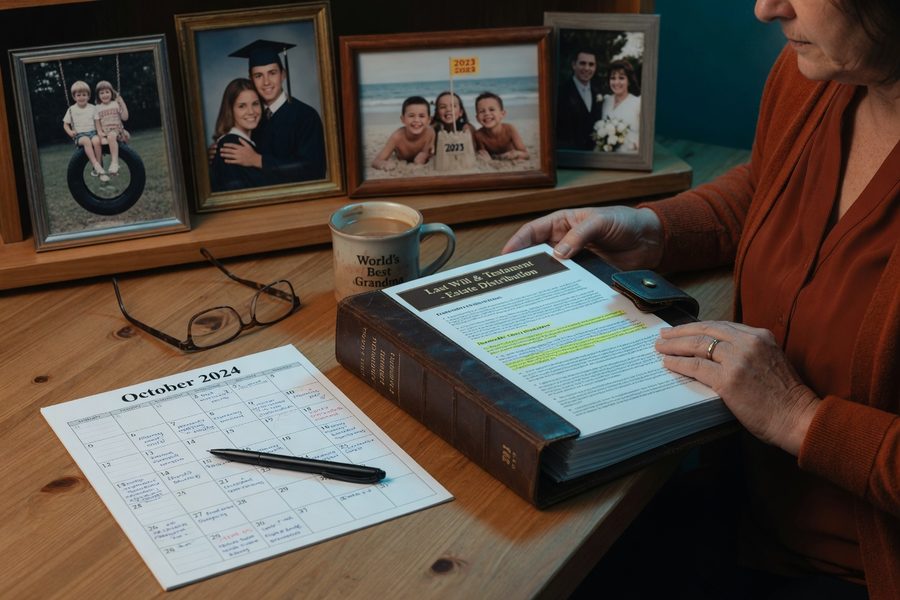
Your Action Plan
-
Map your family tree and assign equal shares explicitly.
Write down each child’s name, biological relationship, and any special needs. Decide whether all children will receive exactly equal shares or whether a needs-based adjustment applies. This becomes the starting point your attorney uses to draft the trust.
-
Choose at least one independent trustee for post-first-death administration.
Research professional trustees, bank trust departments, or a trusted family advisor who is not a beneficiary. Ask for a fee schedule and confirm they’ll serve as a successor trustee when the time comes.
-
Decide on your core trust structure with an estate planning attorney.
Schedule a consultation and present your family map. Discuss whether a QTIP, bypass, or combination best fits your assets and goals. Get a draft that includes detailed distribution language addressing per stirpes, contingencies, and stepchildren.
-
Identify which assets will fund the irrevocable trust, and which stay liquid.
Separate your assets into three buckets: those to transfer into the trust upon first death (via pour-over), those that remain accessible for living expenses, and retirement accounts that will pass by beneficiary designation. Ensure you retain enough cash outside the trust for emergencies.
-
Update all beneficiary designations to align with the trust.
Contact your 401(k) plan administrator, IRA custodian, and life insurance companies. Complete new beneficiary forms naming the trust for the benefit of your children, using the exact trust name and date. File copies with your estate planning documents.
-
Integrate Roth conversions to offset the step-up disparity.
Work with a CPA to model whether converting traditional retirement accounts to Roth over several years makes sense for your tax situation. If it does, execute conversions methodically and name the irrevocable trust as the beneficiary of the Roth.
-
Hold a family meeting, without dollar figures, and schedule your first review.
Explain the equal inheritance structure in principle, introduce the independent trustee concept, and let the children know that the plan locks in fairness. Set a calendar reminder for two years from now to revisit the plan with your attorney.
Frequently Asked Questions
Can a blended family irrevocable trust be changed after the first spouse dies?
No. That’s the whole point. Once the trust becomes irrevocable, typically at the first death, the terms that provide for equal inheritance to all children are locked in. The surviving spouse cannot change beneficiaries or redirect shares. Some trusts include a limited power of appointment that lets the spouse shift assets among the children but not to anyone outside that group, but that’s rare and must be drafted carefully.
What’s the difference between a QTIP trust and a bypass trust for blended families?
A QTIP trust qualifies for the marital deduction and gives the surviving spouse all income for life, with the remainder going to all children equally after the spouse’s death. A bypass trust is funded up to the estate tax exemption and removes those assets from the spouse’s estate entirely, often with restrictions on how much income or principal the spouse can take. Both can coexist, often, the bypass trust protects a specific amount for prior-marriage children, while the QTIP provides flexibility for the spouse.
Do all children really get the same amount under these trusts?
Only if the trust document says so. You can set any distribution scheme, equal shares, proportional shares, or needs-based. The key is to explicitly name all children and define them as “children of the grantor, including legally adopted stepchildren,” and then use clear per stirpes or per capita language that treats them identically. Absent that language, a court might interpret “children” narrowly to mean only biological children.
How much does it cost to set up a blended family irrevocable trust?
Fees vary widely by region and complexity, but expect to pay $3,000 to $8,000 for a comprehensive plan that includes multiple sub-trusts and detailed distribution language. Ongoing trustee fees for professional administration after death typically run 0.5% to 1.5% of trust assets per year. That cost is often less than the legal fees from a contested inheritance.
Do irrevocable trusts avoid probate?
Yes, assets properly titled in the name of an irrevocable trust bypass probate entirely. But remember, assets that aren’t transferred into the trust will still go through probate unless they pass by beneficiary designation or joint ownership. So funding is critical.
Can a surviving spouse be removed as trustee if they try to favor their own children?
If the trust document includes a provision for removal, often by a trust protector or by majority vote of the adult beneficiaries, yes. That’s a strong reason to include a trust protector and an independent trustee succession plan. Without that language, you’d need to go to court, which is costly and adversarial.
Will the 2026 tax law changes affect these trusts?
The estate and gift tax exemption is around $13.99 million per individual, adjusted for inflation. Current law had the exemption scheduled to drop significantly after 2025, but recent legislation extended the higher exemption through 2026. Congress could change this further, so review your plan annually. Even if the exemption drops, bypass trusts remain effective at the lower amount.
What happens if a child predeceases me, does their share go to their spouse or back into the trust?
Your trust can specify. Draft it so that if a child dies before you, their share passes to their own descendants (per stirpes) and, if none, to the other named children. Do not let it default to the child’s estate, which could send the inheritance to a spouse outside your blended family.
Sources
- Pew Research Center, 5 Facts About U.S. Children Living in Blended Families
- First Citizens Wealth, Estate Planning for Blended Families
- IRS, Estate Tax
- IRS, Retirement Topics, Beneficiary
- Cornell Law School, Credit Shelter Trust (Bypass Trust)
- IRS Publication 590-B, Distributions from Individual Retirement Arrangements (IRAs)