Fact-checked by the Prime Rate editorial team
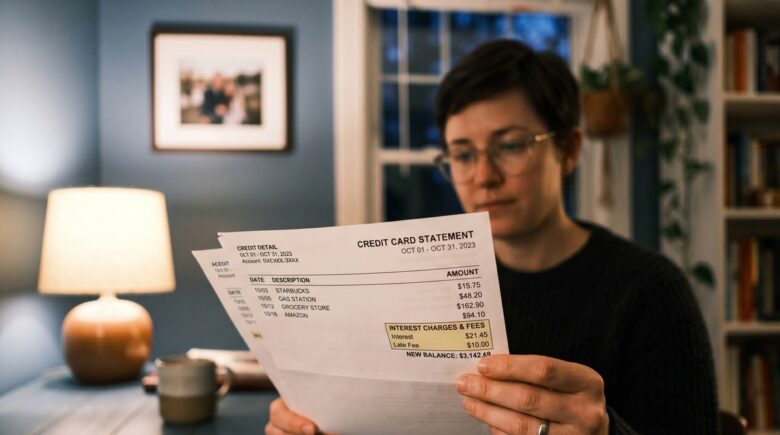
Most people who carry a credit card balance don’t think of themselves as being in debt trouble. They’re keeping up with payments, the account is in good standing, and the balance is manageable, maybe $400, maybe $1,200. It doesn’t feel like a problem. But the carrying credit card balance cost is almost never as small as the balance itself suggests, and the gap between what people think they’re paying and what they’re actually paying can run into the thousands of dollars over just a few years.
As of Q3 2024, the average APR on credit card accounts actively accruing interest hit 23.37%, a record high, according to Federal Reserve data reported by Experian. At that rate, a $3,000 balance sitting untouched costs roughly $630 in interest over a single year, even if you make no new purchases. And that’s before accounting for what happens to new purchases once you’ve lost your grace period, which most cardholders don’t realize is gone the moment they roll a balance forward.
By the end of this guide, you’ll understand exactly how credit card interest compounds against you, why your minimum payment is working against you, what losing the grace period really costs, and what to do starting this month to stop it.
Key Takeaways
- The average APR on accounts actively accruing interest reached 23.37% in Q3 2024, the highest rate ever recorded, meaning even modest balances generate significant interest charges.
- Nearly 46% of U.S. credit card owners carried a balance at least once in the prior 12 months, per the Federal Reserve’s 2024 SHED report, carrying a balance is common, not a personal failing, but still costly.
- Carrying even $1 into the next billing cycle eliminates your grace period entirely, meaning every new purchase begins accruing interest from the transaction date rather than the statement close date.
- The average cardholder who revolves a balance carries $6,730 month to month, and paying only the minimum on a similar balance at today’s rates can take 18 years and cost over $9,000 in interest.
- Credit utilization accounts for approximately 30% of your FICO score and is reported at statement close, not the due date, so a carried balance can suppress your score and raise rates on unrelated loans like mortgages.
- A $200/month interest payment redirected into an investment account at a 7% annualized return over 10 years would grow to roughly $34,600, money that goes to a card issuer instead when you revolve a balance.
In This Guide
- What “Carrying a Small Balance” Actually Means
- How Credit Card Interest Is Actually Calculated
- The Grace Period You Silently Lose
- The Minimum Payment Trap
- The Real Total Cost: Interest, Grace Period, and Credit Score
- The Opportunity Cost Nobody Talks About
- When Carrying a Balance Is Actually the Right Call
What “Carrying a Small Balance” Actually Means
A revolving balance is any portion of your statement balance that you don’t pay in full by the due date and roll into the next billing cycle. Even $1 qualifies. You don’t have to be struggling, you just have to pay less than the full statement amount once, and suddenly you’re a “revolver” in the language of card issuers.
This matters because nearly half of all U.S. cardholders are in that situation. The Federal Reserve’s 2024 Survey of Household Economics and Decisionmaking found that 46% of credit card owners carried a balance at least once in the prior 12 months. That’s not a group of people in financial crisis, it’s a group of people who probably intended to pay in full, got squeezed one month, and then found themselves in a cycle that’s hard to exit.
The Credit Score Myth That Will Not Die
One reason people don’t rush to pay off a balance is a persistent myth: that keeping a small balance on your card helps your credit score. This is false, and it’s expensive to believe.
“The cockroach of credit scoring myths, the one that just will not seem to die, is that carrying a balance on your credit card helps boost your credit score. It’s just not true.”
Credit bureaus record your payment history, whether you paid on time, regardless of whether you carried a balance. There is no scoring benefit to paying interest. None. Carrying a balance only costs you money and can actually hurt your score by raising your credit utilization ratio, which we’ll cover in detail later.
How Credit Card Interest Is Actually Calculated
Most cardholders see a percentage, say, 22% APR, and don’t think much about what that number produces in real dollars each month. The actual calculation is a bit mechanical, but walking through it once makes the cost concrete and hard to ignore.
The Average Daily Balance Method
Credit card issuers typically use the average daily balance method. Here’s how it works: take your APR and divide by 365 to get your daily periodic rate. Multiply that by your average daily balance over the billing cycle. Multiply that result by the number of days in the cycle.
Example: You have a $2,000 balance that sits steady for a 30-day billing cycle at 22% APR.
- Daily periodic rate: 22% ÷ 365 = 0.0603%
- Daily interest: $2,000 × 0.000603 = $1.205
- Monthly interest: $1.205 × 30 = $36.16
That’s $36 on a $2,000 balance in a single month. Over a year at the same balance, you’d pay roughly $434 in interest, for the privilege of owing money you already spent. Bump the balance to $6,730 (the average for revolvers as of Q3 2024) and that annual interest cost climbs to around $1,465.
How Compounding Makes It Worse
Once you carry a balance, the following month’s interest is charged on a balance that already includes last month’s interest charges. The CFPB’s Know Before You Owe resource explains that credit card interest compounds daily on all balances, causing a carried balance to grow more rapidly than most people expect. This is why making minimum payments can feel like running on a treadmill, the balance barely moves.
Americans collectively owed $1.17 trillion in credit card debt as of Q3 2024, a record high, and 8.1% higher than a year prior, according to the Federal Reserve Bank of New York.
The Grace Period You Silently Lose
This is the mechanic that most articles treat as a footnote, and it’s one of the most expensive things a cardholder can misunderstand.
Your grace period is the window between your statement close date and your due date, typically 21 to 25 days, during which you owe no interest on new purchases if you pay your previous statement balance in full. It’s what makes a credit card a free payment tool. The moment you carry even $1 forward into the next cycle, that grace period disappears entirely. Every new purchase starts accruing interest from the transaction date, not the statement close date. Your card is now costing you money on every swipe.
Trailing Interest: The Charge You Didn’t Expect
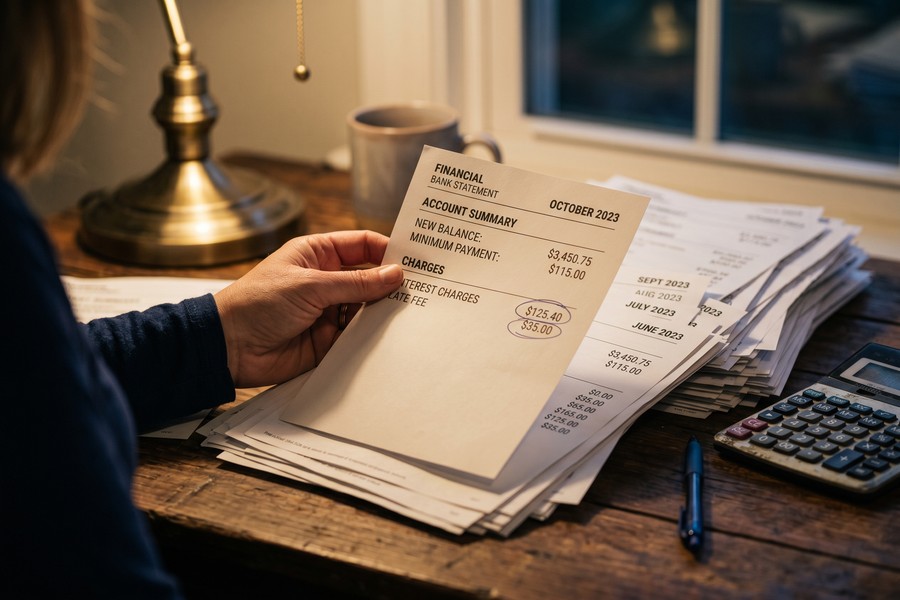
There’s a related charge that trips people up constantly: trailing interest. Say you’ve been carrying a balance and you finally send in a payment for the full amount shown on your statement. You assume you’re done. Then your next statement arrives with an interest charge. That’s trailing interest, days of accrued interest between your last statement close and the date your payment actually posted.
The CFPB notes that once a card company begins charging interest on a carried balance, it continues to charge interest until payment is received, meaning a payoff payment doesn’t stop the clock retroactively. This surprise charge is one of the main reasons people feel like they can never fully escape a balance. It’s not a glitch; it’s how the billing cycle works.
How Long It Takes to Get the Grace Period Back
Restoring your grace period isn’t instant. Most issuers require two consecutive billing cycles of full statement-balance payments before the grace period returns. So the cost of skipping one full payoff extends well beyond that single month. You’re effectively paying extra interest on new spending for two full cycles after the fact.
Once you lose your grace period, every new purchase begins accruing interest from the transaction date, meaning your card’s stated APR is effectively applying to 100% of your spending, not just the rolled-over balance.
The Minimum Payment Trap
Minimum payments feel like a reasonable fallback. They’re not. They’re a profit mechanism, and understanding their history makes that clear.
In the 1970s, standard minimum payments were roughly 5% of the outstanding balance. Over subsequent decades, card issuers systematically reduced minimums to around 1–2% of the balance. That shift wasn’t about consumer convenience. It extended repayment timelines dramatically and increased the total interest collected per account. The minimum payment is a product design choice, not a repayment guide.
What Minimum Payments Actually Do to Your Balance
At 1–2% of balance per month, a minimum payment on a $5,000 balance at roughly 21% APR covers barely more than the interest charge itself. The principal barely moves. Bankrate’s calculator estimates it would take 18 years to pay off a similar balance on minimums alone, resulting in more than $9,000 in total interest, more than the original balance itself.
Here’s a quick comparison that shows the difference a fixed payment makes:
| Payment Strategy | Monthly Payment | Time to Pay Off | Total Interest Paid |
|---|---|---|---|
| Minimum Only (~2%) | Starts ~$100, decreases | 18+ years | $9,000+ |
| Fixed $200/month | $200 | ~3 years 4 months | ~$1,900 |
| Fixed $350/month | $350 | ~18 months | ~$820 |
The balances and terms above are based on a $5,000 starting balance at 21% APR. The numbers shift at current rates, but the pattern is consistent: fixed payments above the minimum cut repayment time by years and save thousands in interest. The minimum payment exists to keep you paying as long as possible, not to help you become debt-free.
Millions of cardholders set autopay to “minimum payment” thinking it keeps their account in good standing. It does, for the issuer. It perpetuates the balance, eliminates your grace period, and guarantees maximum interest collection. Set autopay to the “statement balance” option instead, not the minimum and not the current balance.
The Real Total Cost: Interest, Grace Period, and Credit Score
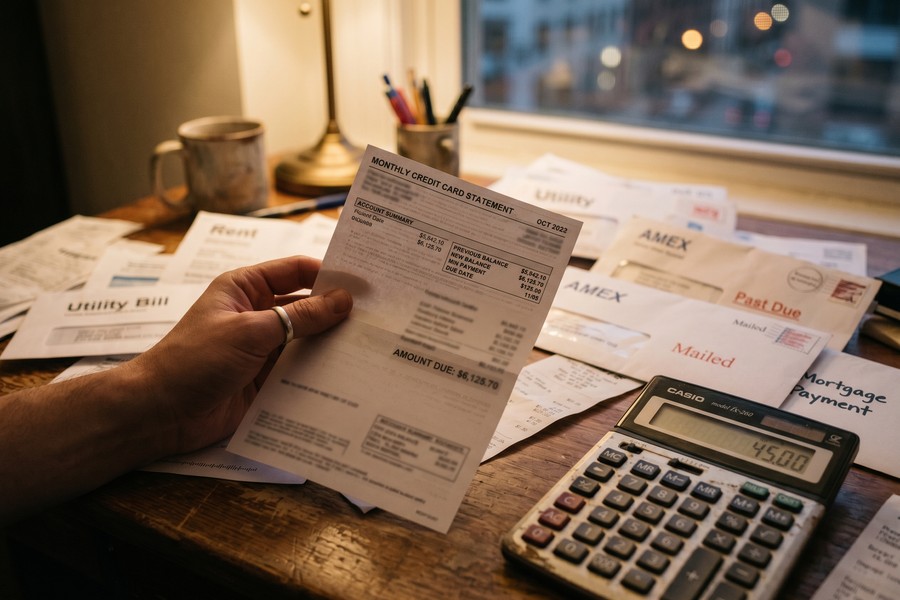
The stated interest rate is only part of the cost. When you stack together the explicit interest charges, the hidden cost of immediately-accruing interest on new purchases, and the downstream credit score damage, the total is considerably higher than most people calculate.
Credit utilization, how much of your available credit you’re using, makes up approximately 30% of your FICO score, and it’s reported at statement close, not on your payment due date. So a cardholder who pays in full by the due date but carried a high balance mid-cycle may still show elevated utilization to the bureaus. A lower score from high utilization can push you into a worse rate tier when you apply for a mortgage or auto loan. A single rate tier difference on a 30-year mortgage can cost tens of thousands of dollars in extra interest over the life of the loan, far more than the credit card interest that caused the utilization spike in the first place.
“By identifying the true cost of credit, this new tool can help consumers devise a plan to manage the cost of carrying a credit card balance.”
The Federal Reserve’s own research illustrates how the costs stack: a $3,000 balance at 13% APR (a rate well below today’s average) paid on minimums alone could take 16 years and generate $2,812 in interest. At the current average APR of over 23%, the outcome on a similar balance is considerably worse. If you want to understand your own credit standing before tackling a balance, our guide to what constitutes a good credit score and what it gets you is a useful starting point.
The Opportunity Cost Nobody Talks About
Stop thinking about interest payments as a fixed cost of modern life. They are foregone investments, and the math on what that money could have done is genuinely striking.
Every dollar you send to a card issuer at 23% APR is a dollar that cannot compound elsewhere. At a historical average stock market return of roughly 7% annualized, a $200 monthly interest payment redirected into an investment account over 10 years would grow to approximately $34,600. The cardholder who pays that $200 perpetually to an issuer instead ends up with exactly zero from those payments, no asset, no return, nothing.
Federal Reserve research found that accounts carrying a balance month to month generate approximately 80% of overall credit card profitability for issuers. Revolvers are not the exception, they’re the business model.
This opportunity cost is especially significant if you’re also not contributing the maximum to a retirement account. Paying 23% interest while leaving tax-advantaged retirement space unused is one of the most expensive financial decisions a household can make. Our overview of IRA contribution limits can help you see exactly how much tax-advantaged space you might be leaving on the table.
Once you pay off a balance, redirect that exact payment amount, minimum or otherwise, into a high-yield savings account or retirement contribution immediately. You’re already used to it leaving your account. Keep that habit; just change the destination.
When Carrying a Balance Is Actually the Right Call
There are legitimate situations where carrying a balance is the rational choice. A genuine 0% introductory APR card used deliberately, with a concrete payoff plan before the promotional period ends, can make an expensive purchase manageable without any interest cost at all. An unavoidable emergency with no liquid savings is another case where a balance might be the least-bad option available, particularly compared to a payday loan or missed bill. A one-time large purchase being paid down on an explicit timeline with a clear end date is different from a normalized monthly balance.
The distinction that matters is intentional use versus passive drift. One deliberate carry with a payoff schedule is a financial tool. A balance that persists because you always pay the minimum and never think about it is the behavior that quietly costs thousands. Knowing your credit card’s prime rate connection can also help you time these decisions, how the prime rate affects your credit card interest rates explains why card APRs move when the Fed does and why timing matters if you’re planning a balance transfer.
The average revolver carries $6,730 in credit card debt as of Q3 2024, up 3.5% from a year prior, and at a record-high average APR, that balance costs more in interest today than at any point in modern data history.
Your Action Plan
-
Switch your autopay to “statement balance” right now
Log into your card account today and change your autopay setting from “minimum payment” or “current balance” to “statement balance.” This one change eliminates the behavior that keeps most people in the balance cycle. It also begins the clock on restoring your grace period, which requires two consecutive full-balance payments to reinstate.
-
Calculate what your current balance is actually costing you each month
Take your balance, multiply by your APR, divide by 12. That’s approximately what you’re paying in interest per month. Write it down. Seeing a dollar figure, not a percentage, changes how the balance feels. A $4,000 balance at 23% APR costs about $77 every month, going nowhere except to the issuer.
-
Make at least one fixed payment above the minimum this month
If you can’t pay the full statement balance immediately, pick a fixed dollar amount above the minimum, even $50 more, and commit to it every cycle. Every dollar above the minimum goes directly toward principal. Review our guide on the snowball versus avalanche payoff methods to choose the approach that fits your situation. If you have multiple balances, the avalanche method, highest-rate balance first, is mathematically optimal.
-
Evaluate a 0% balance transfer card if the math works
A balance transfer to a 0% introductory APR card can buy you 12–21 months of interest-free paydown time. Factor in the 3–5% transfer fee and compare it to what you’d pay in interest over the same period at your current rate. On a $4,000 balance at 23% APR, a 3% transfer fee ($120) is typically far less than 18 months of interest at the current rate (roughly $1,200). Make sure you have a concrete payoff plan before the promotional rate expires.
-
Build a small cash buffer so emergencies don’t send you back to the card
One reason balances restart is a gap in liquid savings, a car repair or unexpected bill goes on the card because there’s no cash available. Even $500–$1,000 in a separate account breaks that cycle. Our guide on what an emergency fund is and how much to save walks through the right target for your situation.
-
Redirect freed-up interest payments toward savings or retirement
Once your balance is paid off, don’t absorb that payment amount back into spending. Route it directly into a retirement account or a high-yield savings account instead. This is where the compounding math works in your favor rather than the issuer’s, and you’re already accustomed to the money leaving your account each month.
Frequently Asked Questions
Does carrying a small balance help your credit score?
No. This is one of the most persistent myths in personal finance. Credit bureaus track whether you pay on time, but carrying a balance doesn’t generate any scoring benefit. In fact, a balance raises your credit utilization ratio, which can hurt your score. You pay interest for zero scoring return.
What happens to my grace period if I carry a balance?
It disappears entirely for that billing cycle. Any new purchases start accruing interest from the day you make them, not from the statement close date. The grace period restores only after you make two consecutive full statement-balance payments, so a single skipped payoff extends your cost exposure by two full billing cycles.
What is trailing interest and why did I get an interest charge after paying off my balance?
Trailing interest is interest that accrued between your last statement close date and the date your payoff payment was processed. Even if you pay the full statement balance shown on your bill, interest has continued to accumulate in the days before your payment posted. The CFPB confirms this is standard, issuers charge interest until payment is received, not until your due date arrives. To avoid it, call your issuer and ask for a payoff quote that accounts for accrued interest, rather than relying only on the statement balance.
How is credit card interest calculated?
Most issuers use the average daily balance method. Your APR is divided by 365 to get a daily periodic rate. That rate is multiplied by your average daily balance and then by the number of days in the billing cycle. At 22% APR on a $2,000 steady balance over 30 days, you’d pay approximately $36 in interest that month, and the following month’s interest is charged on a balance that already includes that $36.
Is it ever smart to carry a credit card balance?
Yes, in specific, intentional circumstances. A 0% introductory APR card with a defined payoff plan is the clearest example, you’re using the interest-free window as a bridge, not as permission to avoid payment. A genuine emergency with no liquid savings is another case. The key difference is deliberate use with an explicit timeline versus letting a balance persist passively month after month. The latter is where the real cost accumulates.
How much does the average American owe in credit card debt?
Among consumers who carry a balance, the average is $6,730 as of Q3 2024, according to Experian’s analysis. Collectively, Americans owe $1.17 trillion in credit card debt, a record high as of Q3 2024. At an average APR above 23%, the interest generated by that collective balance runs into the hundreds of billions annually.
How do minimum payments work and why are they so low?
Minimum payments are typically set at 1–2% of your outstanding balance, which barely covers the monthly interest charge. In the 1970s, standard minimums were around 5% of the balance. Issuers reduced those percentages over subsequent decades, a documented industry shift that extended repayment timelines and increased the total interest collected per account. Minimum payments are not a neutral repayment tool; they’re a product design that maximizes issuer profit. A fixed payment well above the minimum is the only way to meaningfully reduce principal.
What does carrying a credit card balance do to my credit score?
Credit utilization, the percentage of your available credit in use, accounts for roughly 30% of your FICO score. Carrying a balance raises that ratio, and the ratio is reported to bureaus at statement close, not on the due date. A higher utilization score can suppress your credit rating and push you into higher rate tiers on mortgages, auto loans, or personal loans. The downstream cost of a lower credit score on a 30-year mortgage can dwarf the original credit card interest many times over. If you’re working on improving your score, our guide on building credit from scratch covers the fundamentals that apply even for existing cardholders rebuilding after high utilization.
The largest 25 credit card issuers charged APRs 8–10 percentage points higher than smaller banks and credit unions, according to CFPB research, costing consumers with a $5,000 average balance an extra $400–$500 per year compared to what they’d owe at a community bank or credit union.
Sources
- Experian, State of Credit Cards: Average APR and Balance Data, Q3 2024
- Federal Reserve, 2024 Survey of Household Economics and Decisionmaking (SHED): Banking and Credit
- CNBC, Credit Card Debt Hits Record $1.17 Trillion, New York Fed Finds
- Consumer Financial Protection Bureau, Know Before You Owe: Credit Cards
- Consumer Financial Protection Bureau, Can a Card Company Charge Interest After I Pay the Balance?
- Federal Reserve FEDS Notes, Credit Card Profitability
- Consumer Financial Protection Bureau, Small Issuers Offer Lower Rates: Credit Card Data Research
- The Spokesman-Review, Survey: Half of American Cardholders Now Carry Credit Card Debt