Fact-checked by the Prime Rate editorial team
The Verdict
Acting on consecutive prime rate cuts is worth it if you carry a large prime-linked balance, particularly a HELOC over $50,000, where cumulative savings are real and automatic. It is not worth waiting on if your variable debt is primarily credit cards, where back-to-back cuts historically move the needle by less than $70 per year on a $10,000 balance, and direct negotiation or a balance transfer will outperform years of Fed relief.
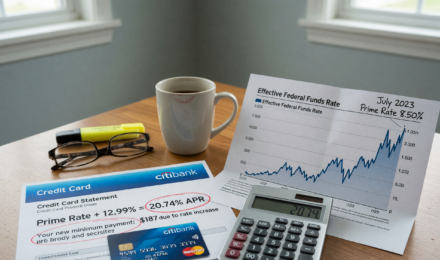
The single factor that determines whether consecutive prime rate cuts actually change your financial picture is the type of variable-rate debt you carry. The U.S. Prime Rate now stands at 6.75%, down from a peak of 8.50% in July 2023 after five Federal Reserve cuts totaling 1.75 percentage points since September 2024. For a borrower with an $80,000 HELOC, that cumulative drop has already generated roughly $1,400 in annual savings, automatically. For a borrower carrying a $10,000 credit card balance, the same rate cycle has saved less than $30 a year.
This matters right now because the cutting cycle may be nearly over. The April 2026 FOMC vote was 8-4 to hold rates, the most divided Fed policy decision since October 1992, and core PCE inflation remains at 2.8%, still above the Fed’s 2% target. If you are holding variable-rate debt and waiting for cuts to do the heavy lifting, the question is whether you are waiting on relief that has already largely arrived.
| Factor | Reasons to Stay Variable / Act on Cuts | Reasons Not to Wait on Cuts Alone |
|---|---|---|
| HELOC savings, $80K balance | Cumulative 1.75-point cut already saves ~$1,400/year with no action required | Rates still sit around 7.24%–8.50%, well above pre-2022 levels near 3.50% |
| Credit card relief | Prime-linked APR floors do decline when the Fed cuts | A full 1.0-point Fed cut in H2 2024 lowered average card APR by only 0.23% |
| Adjustment speed | HELOCs reprice within one billing cycle, often 30 days | Some lenders delay repricing 30–60 days past the Fed announcement date |
| ARM benchmark | Pre-2020 ARMs linked to prime benefit directly from each cut | Post-2020 ARMs almost universally use SOFR; a prime cut may not apply at all |
| Fixed-rate certainty | Premium for fixed home equity loan over variable HELOC is ~0.13 points today | Only 1–2 more quarter-point cuts are priced in for all of 2026 |
| Savings account trade-off | Lower HELOC payments improve monthly cash flow immediately | Same cuts compress HYSA and CD yields, reducing returns on cash savings |
Key Takeaways
- Staying variable on a HELOC makes sense if your outstanding balance is at least $50,000 and you expect at least one more Fed cut in 2026, since each 0.25% cut saves roughly $125/year at that balance level.
- Consider a fixed home equity loan conversion if the rate premium over your current HELOC variable rate is 0.50 points or less, which today represents unusually cheap protection against rate reversal.
- Do not rely on rate cuts alone to lower your credit card APR. The average rate is 21.52% and a 0.25% cut saves under $25 per year on a $10,000 balance; negotiation or a 0% balance transfer is a faster path.
- Check your ARM loan documents before assuming you benefit. If your ARM was originated after 2020, its rate almost certainly adjusts to SOFR, not the prime rate, and a Fed prime cut may have no direct effect on your payment.
- Verify your lender actually passed through the rate cut by comparing your current statement rate against the published WSJ Prime Rate plus the margin disclosed in your loan agreement.
- If you hold both a HELOC and a high-yield savings account, you are simultaneously gaining on the debt side and losing on the savings side. At 2–3 more quarter-point cuts priced in, the window to lock in a higher CD rate before yields erode further is narrow.
- For credit card holders, the more effective move is to aggressively pay down principal while rates are marginally lower, rather than waiting for future cuts. Paying an extra $200/month on a $10,000 balance eliminates the debt roughly 40 months faster than minimum payments.
What “Consecutive Prime Rate Cuts” Actually Means, and Why the Second One Is Different
The second cut in a row is categorically different from the first one, and the distinction is worth understanding before you make any debt decision. The prime rate is simply the federal funds rate plus 3 percentage points, so when the Federal Reserve cuts its target rate, prime moves in lockstep. The first cut after a tightening cycle signals that the Fed might be pivoting. A second consecutive cut confirms a directional trend, which shifts the practical question for borrowers from “will rates go lower?” to “how far and how fast, and should I lock in now or keep riding the decline?”
From its peak of 8.50% in July 2023, the prime rate has fallen through five cuts totaling 1.75 percentage points, arriving at the current 6.75%. That is a meaningful cumulative shift for anyone with a large balance tied directly to prime. The challenge is that the pace of cuts has slowed sharply. Markets currently price in only one to two additional quarter-point reductions for the remainder of 2026, which means the bulk of this easing cycle’s relief has probably already been delivered.

HELOCs: The One Debt Type That Feels Every Cut Immediately
If you carry a HELOC, consecutive cuts translate to real, automatic savings that show up within one billing cycle. Most home equity lines of credit are priced at prime plus a margin of 0.5% to 2.0%, and they reprice on the next statement date after a Fed move. That repricing is the sharpest and most direct transmission of monetary policy to household debt of any loan type.
The math is concrete. Each 0.25% cut saves roughly $200 per year on an $80,000 outstanding HELOC balance. The full 1.75-point cut cycle since September 2024 has therefore saved a borrower with that balance approximately $1,400 annually, without any phone call to a lender. On a $100,000 balance, annual interest at the 8.50% prime peak cost $9,500; at 6.75% today, that same balance costs $7,750. The $1,750 annual saving required zero action from the borrower, which is the case for staying variable when the trend is clearly downward.
There is an honest caveat here, and it matters. Even with five cuts already delivered, aggregate HELOC balances reached $434 billion across 13.2 million lines of credit in Q4 2025, and the average rate on those lines still sits in the 7.24%–8.50% range depending on margin. That is roughly double the sub-3.50% HELOC rates available in 2020 and 2021. Consecutive cuts are meaningful relief, but they are not a return to cheap money, and you should budget accordingly.
One detail most borrowers miss: the “look-back date” or “index adjustment date” in your specific loan agreement determines when your lender reprices your rate. Some lenders adjust on the first of the month following a Fed decision; others wait for the next statement cycle. This gap can mean 30 to 60 days where you are still paying the pre-cut rate. Pull out your HELOC agreement and find that language, then verify your current statement rate equals the WSJ Prime Rate plus your disclosed margin. If it does not match, document the discrepancy in writing before calling your lender. For more on how home equity products respond to rate changes, understanding how the prime rate affects your mortgage and home equity loan is a good place to start.
Credit Cards: Why Consecutive Cuts Barely Move the Needle
For credit card debt, consecutive prime rate cuts deliver much less relief than most coverage implies, and the structural reason is one almost no article explains clearly. When the Fed cut rates by a full 1.0 percentage point in the second half of 2024, the average credit card APR on accounts actively accruing interest fell by only 0.23%, settling near 19.8% by early 2025 before climbing back above 21%. By Q1 2026, the average stands at 21.52%. That is a strikingly small transmission of a large rate cut.
The reason is structural, not accidental. Credit card issuers price at prime plus a margin, and that margin is not fixed. Per a 2024 Consumer Financial Protection Bureau report, card issuers widened their prime-plus margins to record highs even as the Fed began cutting. The result is an asymmetric system: issuers raised rates aggressively on the way up, then protected their margins on the way down. Two more quarter-point cuts in 2026 would bring the projected average APR from roughly 19.8% to perhaps 19.1%, a drop that saves a borrower carrying a $10,000 balance approximately $70 per year.
Penalty APRs add a separate layer of disconnection. A cardholder on a penalty rate of 29.99% does not benefit from Fed moves at all until making six consecutive on-time payments, a provision that insulates the highest-rate borrowers from exactly the relief they need most.
The practical takeaway is blunt: do not wait for rate cuts to solve a credit card balance. Call your issuer and negotiate directly, or pursue a 0% balance transfer promotional offer, which typically runs 15 to 21 months today. Either path outpaces years of incremental Fed relief. For a structured payoff strategy, the debt avalanche versus snowball comparison will serve you better than watching the Fed meeting calendar. For those carrying large balances, a detailed step-by-step credit card payoff plan is a more actionable starting point than any Fed rate projection.
Adjustable-Rate Mortgages: The Benchmark Split Almost Nobody Mentions
Whether a prime rate cut affects your adjustable-rate mortgage depends entirely on which benchmark your specific loan uses, and most articles skip this entirely. ARMs originated before roughly 2020 may reference the prime rate directly in their adjustment clauses. Virtually all ARMs originated after 2020 use SOFR (Secured Overnight Financing Rate) instead, following the industry-wide transition away from LIBOR. If your ARM uses SOFR, a prime rate cut has no direct mechanical effect on your adjustment. Your rate moves with SOFR, which is related to the federal funds rate but is not the same as prime.
Check your adjustment notice or loan agreement for the phrase “index rate” and the specific benchmark named beside it. This one data point determines whether this entire conversation applies to you. Do not assume; the consequences of the wrong assumption run in both directions.
Even for prime-linked ARMs, adjustment timing creates a lag. Most ARMs reprice once per year on a scheduled anniversary date, unlike HELOCs which update monthly or quarterly. Two consecutive cuts that fall between your ARM’s annual adjustment dates may not appear in your payment for six to twelve months. Meanwhile, the 30-year fixed-rate national average was 6.53% as of the week ending May 28, 2026, per Freddie Mac’s Primary Mortgage Market Survey. That rate tracks the 10-year Treasury yield, not prime, which is why the Fed can cut prime by 1.75 points while 30-year fixed rates barely move.

The Savings Account Trade-Off Nobody Mentions in Rate-Cut Coverage
Consecutive prime rate cuts are a two-sided event for any household that carries variable-rate debt and also holds cash in a high-yield savings account or CD. The same Fed action that lowers your HELOC payment compresses the yield on your HYSA, and this dual impact is almost entirely absent from mainstream rate-cut commentary.
High-yield savings rates and CD rates have already drifted down from their 2023–2024 peaks above 5% toward the 3% range in mid-2026, and each additional cut narrows that yield further. If you are holding significant cash savings while simultaneously carrying HELOC debt, the net effect of a rate cut is smaller than it looks. Your borrowing cost drops, but so does your return on idle cash. The question worth asking is whether the cash you are keeping in a HYSA should instead be applied to a high-rate balance.
There is a narrow but real window to lock in yield before it erodes further. With markets pricing only one or two more quarter-point cuts for all of 2026, the drop from current HYSA rates to their post-cut level is not large, but it is predictable. Locking in a longer-term CD now captures the remaining yield before it falls. For a direct comparison of where those rates stand today, the comparison of CD rates versus high-yield savings is worth reviewing before you decide where to park cash in this environment. You might also check current CD rate rankings for 2026 to see what terms are still available before the next cut lands.
Fixed vs. Variable: The Decision Framework for Right Now
The honest answer on fixed versus variable in May 2026 is that the insurance premium for locking in is unusually cheap, but the case for staying variable is not irrational. A fixed home equity loan today prices at roughly 7.37% in many markets, while the average variable HELOC sits around 7.24%. The premium for rate certainty is approximately 0.13 percentage points, which is historically narrow. In normal environments, that spread runs 0.50 to 1.50 points. At today’s spread, locking in is cheap protection against the possibility that the cutting cycle stalls or reverses.
The argument for staying variable rests on the consensus that one or two more cuts arrive before year-end 2026. If that happens, a $100,000 HELOC balance would save an additional $250 to $500 annually, and you would have paid nothing for the privilege of capturing those savings. The problem with that argument is its dependence on a Fed consensus that is already fracturing. The April 2026 FOMC vote was 8-4 to hold, and core PCE at 2.8% gives hawkish committee members legitimate grounds to resist further cuts.
For SBA borrowers and HELOC holders considering a fixed conversion, the decision comes down to a break-even calculation. At a 0.13-point premium, you need rates to stay flat or rise by more than 0.13 points to justify locking in on pure economics. That is not a high bar. What it does not protect you from is the behavioral risk of assuming you will act on a future rate reversal quickly enough to matter, most borrowers do not.
Who Should and Who Should Not
Good candidates
Acting on consecutive cuts is most valuable for borrowers whose debt is large, prime-linked, and in a product that reprices automatically.
- HELOC holders with balances above $50,000 who are already receiving automatic rate reductions and want to model whether to lock in a fixed home equity loan at today’s unusually narrow spread.
- Homeowners with a pre-2020 prime-linked ARM who have an adjustment date in the next six months and want to verify their new rate is correct before the repricing occurs.
- Small business owners with SBA variable-rate loans, which are directly prime-linked and often carry six- or seven-figure balances where each 0.25% cut produces significant annual savings.
- Borrowers with both a HELOC and cash savings who want to weigh the net benefit of rate cuts across both sides of their balance sheet before deciding whether to prepay debt or hold cash.
Who should skip it
For these borrowers, consecutive prime rate cuts are largely irrelevant to the actual financial decision they face.
- Credit card holders whose primary goal is reducing interest costs, the math of a $70/year saving on $10,000 at 21.52% APR means direct negotiation or a balance transfer is far more impactful than waiting on Fed policy.
- Borrowers with post-2020 ARMs indexed to SOFR, where a prime rate cut has no direct mechanical effect on their payment and the relevant benchmark to watch is the SOFR forward curve, not the Fed funds announcement.
- Homeowners with 30-year fixed-rate mortgages, whose rate is governed by 10-year Treasury yields, not prime, and who gain nothing directly from a prime rate cut.
- Borrowers who are planning to pay off their HELOC within 12 months regardless of rate moves, for whom the difference between staying variable and converting to fixed is less than $100 in total interest.
Frequently Asked Questions
Does a second consecutive prime rate cut automatically lower my HELOC payment?
Yes, in almost all cases, but the timing depends on your lender’s repricing schedule. Most HELOCs adjust within one billing cycle of a Fed rate change, but the exact “look-back date” is in your loan agreement. Check your current statement rate against the current prime rate of 6.75% plus your disclosed margin to confirm the cut was passed through.
Why didn’t my credit card rate drop much after the Fed cut rates?
Credit card issuers are not required to pass through Fed cuts dollar-for-dollar and frequently do not. When the Fed cut rates by 1.0 point in H2 2024, average credit card APRs fell by only 0.23%. Issuers widen their prime-plus margins as rates fall, which is why the average APR remains above 21% even after five consecutive cuts.
Does my adjustable-rate mortgage benefit from a prime rate cut?
It depends on your loan’s benchmark. If your ARM was originated after 2020, it almost certainly uses SOFR as its index rate, not prime, and a prime rate cut has no direct effect on your payment. Check your adjustment notice for the phrase “index rate” and the specific benchmark named there before assuming any benefit.
Should I lock in a fixed home equity loan now or wait for more cuts?
The case for locking in is stronger now than it has been in years, because the premium for a fixed rate over a variable HELOC is only about 0.13 percentage points, historically narrow. With only one or two additional cuts priced in for 2026 and the April FOMC vote showing significant internal disagreement, waiting captures modest upside while accepting real downside risk if cuts stall.
How much money does a 0.25% prime rate cut actually save me?
It depends entirely on your balance and debt type. On an $80,000 HELOC, each 0.25% cut saves roughly $200 per year. On a $10,000 credit card balance at an average APR of 21.52%, the same cut translates to under $25 annually, because issuers do not fully pass through Fed reductions. The savings ratio between HELOC and credit card debt is approximately 8 to 1 at those balance levels.
What happens to my high-yield savings account when the prime rate is cut?
HYSA and money market rates decline alongside Fed cuts, though not always at the same pace or magnitude. Accounts that were offering above 4% in 2023 and 2024 have already drifted into the 3% range in mid-2026. Each additional cut compresses yields further, which is why borrowers who hold both variable-rate debt and HYSA balances need to evaluate the net impact on their full financial picture, not just the debt side.
Sources
- Bankrate, Current U.S. Prime Rate and Credit Card Interest Rates
- LendingTree / Federal Reserve G.19, Average Credit Card Interest Rate in America
- Freddie Mac, Primary Mortgage Market Survey (30-Year Fixed Rate)
- HEL News / Federal Reserve Bank of New York, HELOC Outstanding Balances Study 2025
- Federal Reserve, G.19 Consumer Credit Report
- Federal Reserve, FOMC Meeting Calendars and Statements