Fact-checked by the Prime Rate editorial team
Quick Answer
The prime rate is what banks charge their best customers, currently 7.50%, while the discount rate is what the Federal Reserve charges banks directly. The prime rate is always roughly 3 percentage points above the federal funds rate and directly affects your credit card APR, HELOC, and personal loan rates. The discount rate never touches consumer borrowers at all.
Understanding the difference between the prime rate vs discount rate can save you real money on nearly every loan you carry. The U.S. prime rate sits at 7.50%, a direct result of the Federal Reserve holding its benchmark federal funds rate in the 4.25%–4.50% target range established by the Fed’s Open Market Committee. Most borrowers have no idea there are actually two separate “official” rates driving their debt costs, and that distinction determines whether a rate change will ever affect them personally.
The Federal Reserve’s rate decisions are dominating financial headlines in 2025. Whether the Fed cuts, holds, or hikes rates, the ripple effects hit consumers differently depending on which rate moves and how. Understanding the prime rate vs discount rate relationship gives you a concrete edge in timing loan decisions, refinancing, and even where you keep your savings.
This guide is for borrowers, savers, and anyone trying to decode financial news and make smarter money decisions. By the end, you will know exactly how each rate works, who it affects, and how to use that knowledge to your advantage in the current rate environment.
Key Takeaways
- The prime rate is currently 7.50%, according to The Wall Street Journal’s Money Rates table, and it moves in lockstep with Fed decisions.
- The discount rate (primary credit rate) is set at 5.50% by the Federal Reserve and applies only to banks borrowing directly from Fed “discount windows”, not to consumers.
- The prime rate is always approximately 3 percentage points above the federal funds rate, a relationship that has held consistently since the early 1990s, per Federal Reserve H.15 historical data.
- Average credit card APRs exceeded 21% in early 2025, almost entirely because card issuers peg rates to the prime rate, according to Federal Reserve G.19 consumer credit data.
- The discount rate has three tiers, primary, secondary, and seasonal credit, but none of these directly affect the interest rates consumers pay on loans or credit cards.
- A single 0.25 percentage point Fed rate cut translates to roughly $25 in annual savings per $10,000 of variable-rate debt tied to the prime rate, making rate-tracking a concrete personal finance tool.
In This Guide
- What exactly is the prime rate and how is it set?
- What is the discount rate and who actually uses it?
- How is the prime rate vs discount rate actually different in practice?
- How does the prime rate affect my credit card, HELOC, and personal loan rates?
- How do I track Fed rate changes and know when my loan rate will move?
- How should I adjust my debt strategy when the prime rate changes?
- Frequently Asked Questions
Step 1: What exactly is the prime rate and how is it set?
The prime rate is the benchmark interest rate that U.S. commercial banks use as a starting point for pricing loans to their most creditworthy customers, typically large corporations. It is not set by a government body. It is a market rate that major banks independently publish, though in practice all major U.S. banks set it identically.
How the Prime Rate Is Determined
The prime rate is calculated as the federal funds rate target set by the Federal Open Market Committee (FOMC) plus exactly 3 percentage points. When the Fed holds its target rate at 4.25%–4.50%, banks universally price the prime rate at 7.50%.
The Wall Street Journal prime rate, the most widely cited version, is reported when at least 23 of the 30 largest U.S. banks change their posted rate. This consensus mechanism means the prime rate effectively tracks Fed decisions with near-perfect precision.
What to Watch Out For
Banks are not legally required to use the prime rate as their base for lending. Smaller community banks may use different benchmarks, particularly for commercial loans. Always ask your lender specifically which index your loan rate is tied to, since “prime-based” is common but not universal.
The prime rate has been exactly 3 percentage points above the federal funds rate target since the early 1990s. Before that, the spread varied. The Federal Reserve’s own H.15 Selected Interest Rates release documents this history going back decades.
Step 2: What is the discount rate and who actually uses it?
The discount rate is the interest rate the Federal Reserve charges commercial banks when they borrow money directly from the Fed through what is called the “discount window.” It applies exclusively to bank-to-Fed transactions. There is no direct connection to the rates consumers see on personal loans, credit cards, or mortgages.
How the Discount Window Works
The Fed operates three discount window programs, each with a different rate. Primary credit is available to financially sound banks at a rate currently set at 5.50%, according to the Federal Reserve’s discount window rates page. Secondary credit is available to banks not qualifying for primary credit, at a slightly higher rate. Seasonal credit serves smaller banks with predictable seasonal funding needs.
Banks typically treat discount window borrowing as a last resort. The Fed designed it as a “lender of last resort” mechanism to prevent bank failures during liquidity crises, not as a routine funding source. Banks prefer to borrow from each other at the federal funds rate, which is generally lower.
What to Watch Out For
Financial media sometimes uses “discount rate” loosely as a synonym for the federal funds rate or even the prime rate. This is technically incorrect. When a news headline says “the Fed changed its discount rate,” pay close attention, it may mean the federal funds rate target, which has far broader consumer implications.
Do not confuse the Federal Reserve’s discount rate with the “discount rate” used in corporate finance and investing (the rate used to calculate present value of future cash flows). They share a name but are entirely different concepts used in completely different contexts.
Step 3: How is the prime rate vs discount rate actually different in practice?
The core difference between the prime rate vs discount rate is who the borrower is: the prime rate affects businesses and consumers, while the discount rate affects only banks borrowing from the Federal Reserve. That distinction tells you immediately which rate changes will impact your wallet.
The Structural Relationship Between All Three Rates
Think of the three rates as a hierarchy. The federal funds rate (currently 4.25%–4.50%) is the overnight rate banks charge each other. The discount rate (5.50%) sits above it, acting as a ceiling that discourages routine Fed borrowing. The prime rate (7.50%) sits above that, forming the base for consumer and business lending.
All three typically move together when the FOMC acts. Only the prime rate, however, directly transmits to your loan statements. The discount rate shift is largely a technical adjustment that maintains the proper spread between Fed lending rates.
How to Do This
Use this comparison to quickly assess any news story about rate changes. Ask yourself: “Did the FOMC change the federal funds rate target?” If yes, your variable-rate debts will move. If the headline only mentions the discount rate changing in isolation (which is rare), your consumer loan rates are almost certainly unaffected. For a deeper look at how rate changes ripple into your specific accounts, see our guide on what happens to your savings when the prime rate rises.

| Feature | Prime Rate | Discount Rate |
|---|---|---|
| Current Rate | 7.50% | 5.50% (primary credit) |
| Set By | Major commercial banks (follows FOMC) | Federal Reserve Board of Governors |
| Who Pays It | Businesses and consumers (indirectly) | Commercial banks borrowing from the Fed |
| Affects Your Credit Card? | Yes, directly indexed to prime rate | No, no direct consumer impact |
| Affects Your HELOC? | Yes, most HELOCs = prime + margin | No |
| Affects Your Fixed Mortgage? | No, fixed mortgages use different benchmarks | No |
| Relationship to Fed Funds Rate | Always Fed funds rate + 3.00% | Always Fed funds rate + 1.00% |
| Updated How Often | After each FOMC rate decision | Set by Fed Board, can change independently |
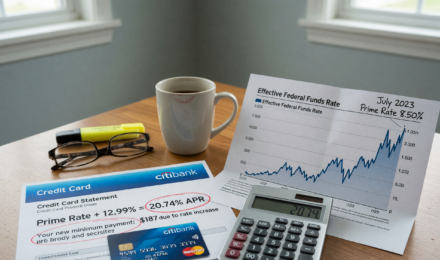
Between March 2022 and July 2023, the Federal Reserve raised rates 11 times, pushing the prime rate from 3.25% to 8.50%, a 5.25 percentage point increase that added roughly $525 per year in interest costs for every $10,000 of variable-rate debt, according to Federal Reserve FOMC historical data.
Step 4: How does the prime rate affect my credit card, HELOC, and personal loan rates?
The prime rate directly sets the floor for most variable-rate consumer debt. When it rises, your credit card APR, home equity line of credit rate, and many personal loan rates rise with it, automatically, within one to two billing cycles.
How Each Loan Type Is Affected
Credit cards are the most direct connection. Your card’s APR is typically expressed as “prime rate + margin.” If your card reads “prime + 14.99%,” your current APR is 22.49% (7.50% + 14.99%). This is why average credit card rates exceeded 21% in early 2025, per Federal Reserve G.19 consumer credit data, a direct result of the 2022–2023 rate hiking cycle.
Home equity lines of credit (HELOCs) are almost universally variable-rate products tied to the prime rate. A typical HELOC might be priced at “prime + 0.50%,” meaning your current rate would be 8.00%. For a $50,000 HELOC balance, a 0.25% rate cut saves you roughly $125 per year. For more on this relationship, see our detailed breakdown of how the prime rate affects your mortgage and home equity loan.
Personal loans are more complex. Many personal loans are fixed-rate, meaning the prime rate at the time of origination influences your rate but future changes do not affect you. Variable-rate personal loans do exist, however. Check your loan documents for the phrase “variable rate” or “adjustable rate” to know your exposure. Our guide on how the prime rate affects personal loan rates walks through this in more detail.
What to Watch Out For
Fixed-rate mortgages do NOT move with the prime rate. They follow the 10-year Treasury yield, which is a separate benchmark. Adjustable-rate mortgages (ARMs) may be tied to SOFR (Secured Overnight Financing Rate) or to the prime rate, check your loan documents. Never assume your mortgage is affected by a prime rate change without verifying your loan terms first.
According to Greg McBride, CFA, Chief Financial Analyst at Bankrate, consumers often misread rate news: when the Fed moves, the prime rate follows immediately, but whether that matters to any individual borrower depends entirely on whether their debt is variable or fixed. Most people do not know which category their debts fall into until they are already paying more.
Log into each of your loan accounts and search your statements or disclosures for the phrase “index.” If it says “Wall Street Journal Prime Rate” or “Prime Rate as published in…” your rate is variable and moves with Fed decisions. If it says “fixed” or lists only a single rate with no index, you are protected from future Fed hikes.
Step 5: How do I track Fed rate changes and know when my loan rate will move?
Tracking prime rate changes is straightforward once you know where to look. The Federal Reserve holds eight scheduled FOMC meetings per year, and any rate decision triggers an immediate update to the prime rate, typically the same day.
How to Do This
The three most reliable sources for real-time prime rate data are the Wall Street Journal Money Rates page, the Federal Reserve H.15 Selected Interest Rates release, and the CME Group’s FedWatch Tool, which shows market-implied probabilities for future rate changes. Bookmark the FOMC calendar, published annually on the Federal Reserve’s website, so you know exactly when to expect potential rate movements.
When the FOMC announces a rate change, your variable-rate loan will typically adjust within one to two billing cycles. Credit card issuers are required by the Truth in Lending Act (TILA) and the CARD Act of 2009 to notify you of rate changes, though for prime-indexed cards no advance notice is required since the change is based on a published index.

What to Watch Out For
The FOMC can also hold emergency meetings and make unscheduled rate decisions, as it did in March 2020 during the COVID-19 financial crisis. These emergency decisions are announced immediately and affect the prime rate just like a scheduled decision. Set a Google Alert for “Federal Reserve rate decision” to catch unscheduled moves.
The CME FedWatch Tool updates in real time and shows you the percentage probability of a rate cut, hold, or hike at the next FOMC meeting. When the market shows a greater than 70% probability of a cut, it is often worth waiting to take out a new variable-rate loan rather than locking in a higher rate weeks before a potential cut.
Step 6: How should I adjust my debt strategy when the prime rate changes?
Knowing the prime rate vs discount rate difference is only valuable if you act on it. When the prime rate is falling or expected to fall, variable-rate debt becomes more manageable. Strategic timing and debt restructuring can amplify those savings significantly.
How to Do This
In a rising rate environment, the priority is to convert variable-rate debt to fixed-rate alternatives before each FOMC meeting. Balance transfer credit cards with fixed promotional APRs, fixed-rate personal loans, and fixed-rate HELOCs are all worth exploring. Our step-by-step guide on how to pay off credit card debt walks through the mechanics of balance transfers in detail.
When rates are falling, variable-rate debt becomes cheaper automatically. You can capture more savings by accelerating payoff before rates stabilize. Every dollar of prime-indexed debt you eliminate locks in the current lower cost permanently. Focus extra payments on high-margin cards (those with the largest spread above prime) first.
For savings accounts and money market accounts, the dynamic is reversed. A rising prime rate environment often brings higher yields on high-yield savings accounts and CDs. Explore the best high-yield savings accounts of 2026 to see which institutions are currently passing rate changes through to depositors most aggressively.
What to Watch Out For
Do not over-optimize for rate timing at the expense of financial fundamentals. Carrying high-interest variable-rate debt is costly regardless of rate direction, and paying it down is almost always the right move. Rate timing is a secondary strategy, not a substitute for eliminating debt.
As Tendayi Kapfidze, Chief Economist at LendingTree, has noted, every 25-basis-point move by the Fed should prompt consumers to look at their variable-rate balances. On a $20,000 HELOC, each quarter-point shift is $50 a year. Four cuts add up to $200, real money for real households.

American households held $1.17 trillion in revolving credit card debt as of Q1 2025, according to the New York Federal Reserve’s Household Debt and Credit Report. With nearly all of that balance prime-indexed, a single 0.25% Fed cut reduces aggregate U.S. consumer interest costs by roughly $2.9 billion per year.
Frequently Asked Questions
What is the current prime rate vs discount rate as of 2025?
The U.S. prime rate is 7.50% and the Federal Reserve’s primary credit discount rate is 5.50%. The prime rate is set by major commercial banks at exactly 3 percentage points above the federal funds rate (currently 4.25%–4.50%). The discount rate is set independently by the Fed’s Board of Governors, typically at 1 percentage point above the federal funds rate target ceiling.
Does the prime rate vs discount rate change affect my credit card APR?
Only the prime rate affects your credit card APR, the discount rate has no direct impact on consumer debt. Your credit card APR is typically expressed as “prime rate + a fixed margin,” so every time the FOMC raises or cuts the federal funds rate, your credit card APR adjusts by the same amount within one to two billing cycles. For a full breakdown, see our guide on how the prime rate affects credit card interest rates.
Why is the prime rate higher than the discount rate?
The prime rate is higher than the discount rate because it includes a profit margin for commercial banks and reflects the additional risk of lending to businesses and consumers compared to banks borrowing from the Fed with collateral. The discount rate at 5.50% represents a nearly risk-free, collateralized loan from the central bank. The prime rate at 7.50% incorporates credit risk, operating costs, and bank profit margin on top of that base funding cost.
Can the Fed change the discount rate without changing the prime rate?
Yes, technically the Fed can adjust the discount rate independently. In practice, this almost never happens without a corresponding federal funds rate change. When the two move together (as they almost always do), the prime rate adjusts automatically because it is anchored to the federal funds rate. An isolated discount rate change would be unusual enough to make major financial news.
How does the prime rate vs discount rate difference affect my HELOC?
Your HELOC rate is almost certainly tied to the prime rate, not the discount rate. Most HELOC agreements are written as “prime rate + a fixed margin.” A typical structure might be prime + 0.50%, putting your current rate at 8.00%. When the Fed cuts rates, your HELOC rate drops by the same amount the following billing cycle, reducing your minimum payment and total interest cost automatically.
Should I wait for a Fed rate cut before taking out a variable-rate loan?
Waiting for a rate cut can make sense if a cut is highly probable within the next 30–60 days, but it is rarely worth delaying a necessary loan for months. Use the CME FedWatch Tool to check market-implied probabilities. If there is less than a 50% chance of a cut at the next FOMC meeting, the expected savings do not justify the delay for most borrowers. If you need the funds urgently, a fixed-rate loan eliminates rate uncertainty entirely.
Does the discount rate affect savings account and CD rates?
The discount rate does not directly set savings account or CD rates, but the federal funds rate (which moves alongside the discount rate) strongly influences them. Banks price deposit products partly based on their funding costs, which track the federal funds rate. When the Fed raises rates, high-yield savings accounts and CDs tend to follow, though banks are often faster to raise loan rates than deposit rates. Our CD rates forecast for 2026 covers what savers can expect this year.
What happens to the prime rate if the Fed cuts rates in 2025?
If the Federal Reserve cuts the federal funds rate by 0.25 percentage points at any FOMC meeting in 2025, the prime rate will drop from 7.50% to 7.25% on the same day. Every major U.S. bank will update its published prime rate within hours of the Fed’s announcement. Your variable-rate credit card, HELOC, and any other prime-indexed loans will adjust on your next billing cycle after the change takes effect.
Is the Wall Street Journal prime rate the same as the federal prime rate?
There is no single “federal prime rate.” The prime rate is a private sector rate set by banks, not the government. The Wall Street Journal prime rate is the most widely cited benchmark and is reported when at least 23 of the 30 largest U.S. banks have changed their posted rate. It has effectively become the industry standard. The Federal Reserve tracks and publishes it in the H.15 release, but the Fed does not set it directly.
How do the prime rate and discount rate affect inflation?
The Federal Reserve uses the discount rate and federal funds rate as monetary policy tools to control inflation. When the Fed raises rates, borrowing costs increase, which reduces consumer spending and business investment, slowing the economy and bringing inflation down. The prime rate transmits this effect to households directly through higher credit card, HELOC, and variable loan rates. Higher borrowing costs reduce demand, that is the core mechanism by which rate hikes fight inflation.
Sources
- Federal Reserve, Open Market Operations and Federal Funds Rate Target
- Federal Reserve, H.15 Selected Interest Rates (Historical Data)
- Federal Reserve, G.19 Consumer Credit Statistical Release
- Federal Reserve Discount Window, Current Discount Rates
- The Wall Street Journal, Money Rates (Prime Rate)
- Federal Reserve Bank of New York, Household Debt and Credit Report
- Consumer Financial Protection Bureau, Credit Card Market Trends
- Federal Reserve, FOMC Historical Materials and Meeting Dates
- Consumer Financial Protection Bureau, Credit Card Rate Change Protections (CARD Act)