Fact-checked by the Prime Rate editorial team
Quick Answer
The prime rate is a commercial lending benchmark set by private banks, currently 7.50%. The discount rate is the Federal Reserve’s rate charged directly to banks for emergency borrowing, currently 5.50%. The prime rate typically runs about 3 percentage points above the federal funds rate, while the discount rate is set independently by the Fed.
Understanding the prime rate vs discount rate distinction matters most to people carrying variable-rate debt. Tracked by the Wall Street Journal’s Money Rates table, the prime rate at 7.50% is what banks charge their most creditworthy commercial customers. That number flows directly into the rates consumers pay on credit cards, home equity lines, and many personal loans.
With the Federal Reserve holding rates steady through mid-2025, borrowers trying to anticipate their next move have been watching both benchmarks closely. Both reflect the same underlying policy stance, but they work through entirely different mechanisms. Mixing them up leads to bad predictions about borrowing costs.
Key Takeaways
- The prime rate is 7.50%, set by commercial bank consensus and tracked by the Wall Street Journal.
- The Federal Reserve’s primary credit (discount) rate is 5.50%, set directly by the Board of Governors, per the Fed’s discount rate page.
- The prime rate sits exactly 3 percentage points above the federal funds rate by longstanding convention, as confirmed by the Fed’s H.15 statistical release.
- Average credit card APRs exceeded 21% in 2024, a direct consequence of prime rate increases since 2022, according to the Federal Reserve’s G.19 Consumer Credit report.
- The FOMC cut rates by 100 basis points in late 2024, pulling both benchmarks lower together, per FOMC historical actions.
- Between 2022 and 2023, the prime rate changed 11 times during the Fed’s hiking cycle, adjusting the same day as each FOMC decision, per the New York Fed’s rate history.
What Exactly Is the Prime Rate?
A short-term interest rate that U.S. commercial banks use as a baseline for lending to their most creditworthy customers, the prime rate is not officially set by any government body. Instead, it moves in lockstep with the federal funds rate target set by the Federal Open Market Committee (FOMC).
By convention, the prime rate equals the federal funds rate plus 3 percentage points. When the FOMC held the federal funds rate to a target range of 4.25%–4.50% following its 2024 decisions, major banks including JPMorgan Chase, Bank of America, and Wells Fargo adjusted their prime rates accordingly. The Wall Street Journal publishes the consensus prime rate whenever at least 23 of the 30 largest U.S. banks change their posted rate.
How the prime rate affects consumers
Millions of consumer financial products are directly tied to the prime rate. Variable-rate credit cards, home equity lines of credit (HELOCs), and many personal loans use prime as their index rate. As our deeper analysis of how the prime rate affects your credit card interest rates explains, a single Fed rate hike can translate immediately into higher minimum payments for cardholders.
Rate changes also anchor personal loan rates and home equity loan pricing, making the prime rate one of the most consequential numbers in household finance.
One limitation worth acknowledging: tracking the prime rate only tells you the direction of your borrowing cost, not the full picture. Your actual APR depends on the margin your lender adds on top of prime, which varies by creditworthiness, loan type, and institution. Two borrowers can face very different rates even when the prime rate is identical for both of them.
Key Takeaway: At 7.50%, the prime rate sits 3 percentage points above the federal funds rate by longstanding convention, directly determining the cost of variable-rate credit cards and HELOCs for millions of U.S. borrowers. See the Federal Reserve’s H.15 statistical release for real-time rate data.
What Is the Discount Rate and Who Controls It?
Charged by the Federal Reserve to commercial banks and other depository institutions for short-term loans taken directly from a Federal Reserve Bank, the discount rate is set administratively by the Fed’s Board of Governors, not derived from market forces or a formula.
Three discount window programs exist. The most commonly cited is the primary credit rate, currently set at 5.50% as of mid-2025, according to the Federal Reserve’s discount rate page. The secondary credit rate, for banks in weaker financial condition, runs 50 basis points higher. Seasonal credit is reserved for smaller institutions with predictable funding needs.
The discount window stigma
Banks rarely use the discount window under normal conditions. Borrowing from the Fed carries an implicit signal of financial stress, an effect economists call “discount window stigma.” During the 2008 financial crisis and again during the 2023 regional banking turmoil involving Silicon Valley Bank, the Fed took active steps to encourage discount window usage to stabilize the system.
Because the discount rate sits above the federal funds rate, banks won’t pay more in the interbank market than they would pay to borrow directly from the Fed. That relationship makes the discount rate a practical ceiling on overnight interbank borrowing costs, even when direct Fed borrowing is rare. The Federal Reserve has been explicit about this dynamic in its official communications. For a full explanation, see the Fed’s official discount rate resource.
At 5.50%, the discount rate is set directly by the Federal Reserve Board of Governors and functions as an emergency lending backstop for banks. Because of discount window stigma, most banks prefer overnight borrowing in the interbank market. Learn more at the Fed’s official discount rate resource.
How Do the Prime Rate and Discount Rate Compare?
The core prime rate vs discount rate difference comes down to who sets it, who pays it, and what it signals. One is a tool of monetary policy, controlled exclusively by the Federal Reserve. The other is a market convention, determined by competing commercial banks responding to Fed signals.
| Feature | Prime Rate | Discount Rate |
|---|---|---|
| Set By | Commercial banks (consensus) | Federal Reserve Board of Governors |
| Current Rate (July 2025) | 7.50% | 5.50% (primary credit) |
| Borrowers | Banks’ most creditworthy customers | Depository institutions (banks) |
| Linked To | Federal funds rate + 3% | Set independently by FOMC/Board |
| Consumer Impact | Credit cards, HELOCs, personal loans | Indirect, through bank liquidity costs |
| Usage Frequency | Daily (constant lending activity) | Infrequent (emergency backstop) |
| Published By | Wall Street Journal (consensus) | Federal Reserve (official) |
While the prime rate responds automatically to FOMC decisions, the discount rate can be adjusted on a separate schedule. In practice, both tend to move together because the federal funds rate anchors both. When the FOMC cut rates by 100 basis points in late 2024, both benchmarks fell in tandem.
At current levels, the prime rate vs discount rate gap stands at 2 percentage points (7.50% vs. 5.50%). Consumers feel the prime rate directly through variable-rate loans. The discount rate affects them only indirectly through bank funding costs. Both moved together after the Fed’s 100 basis points of cuts in late 2024, per FOMC historical actions.
How Does the Prime Rate vs Discount Rate Affect What You Pay?
Variable-rate credit cards are the clearest example of prime rate exposure. Most issuers set their annual percentage rate (APR) as prime plus a fixed margin, for instance, prime plus 14.99%. When the prime rate rises from 5.50% to 7.50%, the cardholder’s APR rises by the same 2 percentage points automatically. According to the Federal Reserve’s G.19 Consumer Credit report, average credit card interest rates exceeded 21% in 2024, a direct result of prime rate increases since 2022.
For someone carrying a $10,000 balance, a 2-point APR increase adds roughly $200 in annual interest charges. That showed up on statements across the country during the 2022 to 2023 hiking cycle.
HELOCs and home equity exposure
Home equity lines of credit deserve particular attention because balances tend to be larger than credit card debt. Most HELOCs are indexed to the prime rate, meaning a homeowner with a $50,000 outstanding HELOC balance saw their interest costs rise by approximately $1,000 per year for every 2-percentage-point increase in the prime rate during that cycle.
Unlike fixed-rate home equity loans, HELOCs reset with each prime rate change. There is no lag, no grace period, and no option to wait it out. Borrowers who opened HELOCs when the prime rate was below 4% in 2021 found themselves paying substantially more just 18 months later. Our guide on home equity loan pricing covers this in more detail.
Savings accounts and the rate environment
Rising prime and discount rates also create opportunity for savers. As explored in our guide on what happens to your savings when the prime rate rises, high-yield savings accounts and money market accounts tend to pay more when these benchmarks climb. Our best high-yield savings accounts rankings for 2026 show APYs still exceeding 4.50% at several online banks.
For borrowers carrying variable-rate debt, tracking the prime rate vs discount rate relationship helps anticipate cost changes before they appear on a statement.
Between March 2022 and July 2023, the prime rate climbed by 525 basis points, pushing average credit card APRs past 21%, per the Federal Reserve’s G.19 report. Consumers with variable-rate debt feel prime rate changes immediately. The discount rate affects them only indirectly through bank funding costs.
What Is the Federal Funds Rate’s Role in All of This?
A third key rate ties this system together: the federal funds rate. It is the overnight rate at which banks lend reserves to each other, and the FOMC sets a target range for it at each policy meeting. Understanding it clarifies the prime rate vs discount rate relationship completely.
Structurally, the federal funds rate sits between the discount rate and the rates banks charge customers. The discount rate acts as a ceiling (banks won’t pay more to other banks than they would pay the Fed), and the interest on reserve balances (IORB) rate acts as a floor. The prime rate, by convention, floats 3 points above the federal funds rate midpoint.
How the three rates interact
Think of the three rates as a ladder. At the bottom, the federal funds rate governs interbank lending. The discount rate sits above it, providing emergency access. The prime rate stands higher still, reflecting the bank’s profit margin on loans to customers.
When the FOMC adjusts the federal funds rate, the other two typically follow, though on their own schedules and by their own mechanisms. This is why monitoring all three matters when evaluating savings vehicles. Our CD rates forecast for 2026 breaks down how FOMC projections ripple into certificate of deposit yields.
Currently targeted at 4.25%–4.50%, the federal funds rate anchors both the prime rate and discount rate. The prime rate equals the funds rate plus 3 percentage points by convention, and changes flow from the FOMC through the interbank market to consumer loan rates, as documented by the Fed’s open market operations history.
How Have These Rates Moved Over Time?
The relationship between the prime rate and discount rate has been remarkably stable in structure, even as absolute levels have swung dramatically. That historical pattern helps set realistic expectations about where rates go from here.
During the low-rate era following the 2008 financial crisis, the federal funds rate sat near zero for years. The prime rate bottomed at 3.25% during that period, reflecting the same 300-basis-point spread it has always maintained. The discount rate tracked nearby, providing an emergency floor that banks almost never needed to access.
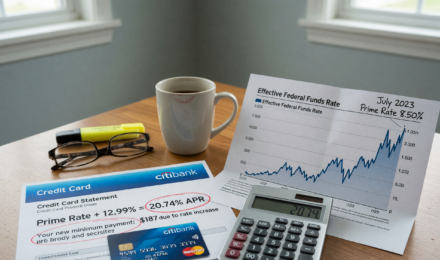
The 2022 to 2023 hiking cycle was the most aggressive in four decades. Across 11 decisions, the Fed raised the federal funds rate by 525 basis points, lifting the prime rate from 3.25% to 8.50% at the peak. Consumers with variable-rate credit felt the full force of that move, often within a single billing cycle. The discount rate rose in parallel, from 0.25% to 5.50%, maintaining its traditional relationship to the funds rate.
The 2024 rate cuts and where things stand
Three rate cuts in late 2024 totaled a cumulative 100 basis points. That pulled the federal funds rate target down to its current range of 4.25%–4.50%, the prime rate back to 7.50%, and the primary credit rate to 5.50%. Both benchmarks moved the same day as each FOMC announcement, following their standard pattern.
From a borrower’s perspective, the cuts provided modest relief. A 100-basis-point reduction lowered the APR on a variable-rate credit card by the same amount, which translates to roughly $100 less per year in interest for every $10,000 carried. Meaningful, but not transformative for borrowers who accumulated debt when rates were at their peak.
After bottoming at 3.25% during the post-2008 low-rate era, the prime rate climbed to a peak of 8.50% in 2023 before falling back to 7.50% after 100 basis points of cuts in late 2024. The 300-basis-point spread between the prime rate and the federal funds rate has held constant throughout, per the Fed’s H.15 statistical release.
Which Rate Actually Matters to You?
For most consumers, the prime rate is the number worth tracking. Carrying a balance on a variable-rate credit card, holding an outstanding HELOC, or servicing a variable-rate personal loan all mean your borrowing cost moves directly with the prime rate. The discount rate is several steps removed from your monthly statement.
Broader bank system health is where the discount rate earns attention. When the Fed adjusts discount window terms, it signals something about bank liquidity conditions, which eventually feeds into credit availability. A bank that can cheaply access emergency funding is more willing to lend. A bank paying a premium for that access may tighten standards.
Savers benefit from tracking both. High-yield savings accounts and money market funds respond to the overall rate environment shaped by all three benchmarks. Our best high-yield savings accounts rankings for 2026 show APYs still exceeding 4.50% at several online banks, reflecting the Fed’s still-elevated policy stance even after the 2024 cuts.
Business borrowers face a different calculus
Small business owners should watch the prime rate closely. Commercial lines of credit, equipment financing, and many Small Business Administration loans are indexed to prime. A company drawing on a $500,000 line of credit at prime plus 2% pays 9.50% at current rates. If the FOMC cuts by another 50 basis points, that drops to 9.00%, saving roughly $2,500 annually on a fully drawn line.
The discipline here is simple: know your loan’s index, know your margin, and monitor FOMC meeting dates. The prime rate changes the same day as a Fed decision, with no delay to watch for.
Consumers with variable-rate debt should track the prime rate. Business borrowers with prime-indexed credit lines face the same direct exposure. The discount rate matters most as a signal of Fed policy intentions and bank system health, with consumer effects arriving only indirectly. For FOMC meeting schedules, see the Fed’s open market operations page.
Frequently Asked Questions
What is the current prime rate vs discount rate in 2025?
, the prime rate is 7.50% and the Federal Reserve’s primary credit (discount) rate is 5.50%. Both rates reflect the FOMC’s federal funds rate target of 4.25%–4.50%, which has held steady since late 2024.
Is the prime rate the same as the federal funds rate?
No. The prime rate is consistently 3 percentage points higher than the federal funds rate. The federal funds rate is what banks charge each other for overnight loans. The prime rate is what banks charge their best commercial customers.
Does the discount rate directly affect my mortgage rate?
Not directly. Fixed mortgage rates follow the 10-year Treasury yield, not the prime or discount rate. Adjustable-rate mortgages (ARMs) and home equity lines of credit (HELOCs) are often tied to the prime rate. The discount rate influences mortgage availability only through broader credit conditions.
Why is the prime rate always higher than the discount rate?
Commercial banks price in credit risk and profit margin when lending to customers. The discount rate represents what the Fed charges banks for emergency funds, a wholesale cost. The prime rate reflects what banks charge their best business customers, which must cover that funding cost plus operating expenses and profit.
How often does the prime rate change?
The prime rate changes every time the FOMC adjusts the federal funds rate, which happens at scheduled meetings roughly 8 times per year. Banks typically update their prime rate the same day the FOMC announces a rate decision. Between 2022 and 2023, the prime rate changed 11 times during the Fed’s aggressive hiking cycle.
What happens to my credit card rate when the prime rate changes?
Variable-rate credit card APRs adjust automatically when the prime rate moves, usually within one to two billing cycles. If your card’s APR is “prime plus 18%,” a 0.25% drop in the prime rate would reduce your APR by the same amount. Review your cardholder agreement for the specific index and margin your issuer uses.
Can the prime rate and the federal funds rate diverge?
In practice, they don’t. The 3-percentage-point spread has held so consistently that it qualifies as a defining convention, not merely a guideline. Technically, banks are free to post a different prime rate, but no major institution has broken from the spread in decades. If the FOMC moves, the prime rate follows the same day.
Is the discount rate the same as the prime rate?
No, and conflating them is a common mistake. The discount rate is what the Federal Reserve charges banks directly; the prime rate is what banks charge their best customers. At current levels, the discount rate is 5.50% and the prime rate is 7.50%, a gap of 2 full percentage points.
Who benefits most from tracking the prime rate vs discount rate?
Borrowers carrying variable-rate debt benefit most from following the prime rate, since their costs move in direct proportion to it. Business owners with prime-indexed credit lines face the same exposure. The discount rate is more relevant to people watching bank sector health or trying to understand the Fed’s broader liquidity stance.
Does a lower discount rate mean cheaper loans for consumers?
Only indirectly. A lower discount rate reduces the ceiling on interbank borrowing costs, which can make banks more willing to extend credit and may ease lending standards over time. But your credit card APR or HELOC rate responds to the prime rate, not the discount rate. A Fed cut that lowers both simultaneously is what actually delivers relief on your statement.
Sources
- Federal Reserve, Discount Rate and Discount Window
- Federal Reserve, H.15 Selected Interest Rates (Statistical Release)
- Federal Reserve, G.19 Consumer Credit Report
- Federal Reserve, Open Market Operations and FOMC Actions
- Wall Street Journal, Money Rates (Prime Rate Consensus)
- Federal Reserve Bank of New York, Effective Federal Funds Rate