Fact-checked by the Prime Rate editorial team
Quick Answer
When inflation rises, the Federal Reserve raises the federal funds rate, which directly pushes the prime rate higher — currently 7.50% as of July 2025. This increases borrowing costs on credit cards, HELOCs, and personal loans almost immediately. A 1% rise in the prime rate can add hundreds of dollars annually to variable-rate debt.
The inflation prime rate relationship is one of the most direct connections in personal finance. When the Federal Reserve’s Federal Open Market Committee raises its benchmark federal funds rate to fight inflation, banks respond by raising the prime rate by the same amount, typically within days. The prime rate historically sits exactly 3 percentage points above the federal funds target rate.
After an aggressive rate-hiking cycle that pushed the prime rate to a two-decade high, millions of borrowers are carrying variable-rate debt that costs significantly more than it did in 2021. Understanding how this mechanism works, and which debt responds fastest, is essential for managing your finances in a high-rate environment.
Key Takeaways
- The prime rate is pegged exactly 3 percentage points above the federal funds rate, so every Fed hike flows through immediately, per Federal Reserve H.15 data.
- The U.S. prime rate stood at 7.50% as of mid-2025, near its highest level in two decades, as tracked by The Wall Street Journal’s Money Rates page.
- The average credit card APR reached 21.47% in early 2025, roughly 8 percentage points higher than the average in 2021, according to Federal Reserve G.19 data.
- A $5,000 credit card balance costs approximately $400 more per year in interest compared to pre-hike 2021 rates, based on the same Federal Reserve consumer credit data.
- High-yield savings accounts offered APYs between 4.50% and 5.25% during 2024–2025, more than 12 times the national average savings rate of 0.41%, per FDIC national rate data.
- Carrying a $10,000 credit card balance at 21.47% APR costs over $2,100 per year in interest alone, per CFPB consumer credit trend data.
How Does Inflation Directly Affect the Prime Rate?
Inflation causes the Federal Reserve to raise short-term interest rates, and the prime rate moves in lockstep with those decisions. The Fed raises rates to make borrowing more expensive, which slows consumer spending and cools price growth. That is the core logic of monetary tightening, and it has a predictable, mechanical effect on what banks charge their best customers.
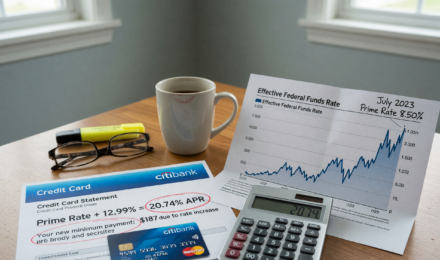
The prime rate is not set by law or regulation. It is a market convention maintained by major U.S. banks, anchored to the federal funds rate. When the Fed funds rate rises by 25 basis points, the prime rate rises by exactly 25 basis points. According to The Wall Street Journal’s Money Rates page, the prime rate stood at 7.50% in mid-2025, reflecting the cumulative rate hikes that began in March 2022.
The Transmission Mechanism
The Fed targets inflation using the Consumer Price Index (CPI) and its preferred measure, the Personal Consumption Expenditures (PCE) index. When either metric climbs well above the Fed’s 2% target, rate hikes follow. Each hike feeds directly into the prime rate, which then reprices variable consumer debt almost immediately.
The speed of transmission matters. Credit card APRs can reset within one to two billing cycles. HELOC rates often reprice at the start of the next statement period. That is why variable-rate borrowers feel the squeeze so quickly after a Fed announcement, while their neighbors with 30-year fixed mortgages feel nothing at all.
Key Takeaway: The prime rate rises by exactly the same amount as Fed rate hikes. With the current prime rate at 7.50%, borrowers with variable-rate debt are paying near the highest rates in two decades, per Federal Reserve data.
How This Hiking Cycle Compares Historically
Context helps here. The prime rate sat at just 3.25% from March 2020 through March 2022, reflecting the emergency rate cuts made during the COVID-19 pandemic. The Fed held rates near zero to support a recovering economy. For borrowers, that era meant cheap credit cards, low HELOC rates, and favorable personal loan terms.
That changed abruptly. Starting in March 2022, the Fed executed one of the most aggressive tightening cycles in its modern history, raising the federal funds rate by a cumulative 525 basis points across 11 separate hikes. By July 2023 the federal funds rate target range reached 5.25% to 5.50%, and the prime rate followed to 8.50% before modest cuts brought it back to 7.50% by mid-2025, per Federal Reserve H.15 data.
For borrowers who took on variable-rate debt in 2020 or 2021, the shift was dramatic. A HELOC that carried a rate of 4% in 2021 was repriced above 8% at the cycle’s peak. That kind of increase does not happen in the background; it shows up directly in monthly payments.
Why the 2% Inflation Target Matters So Much
The Fed’s 2% inflation target is not arbitrary. It reflects a deliberate balance: enough inflation to prevent the economy from sliding into deflation, but low enough to keep purchasing power stable. When the Consumer Price Index or the PCE index runs persistently above that threshold, the Fed views it as a signal that the economy is overheating. Rate hikes are the primary tool to bring it back down.
The downstream effect on the prime rate, and therefore on consumer debt, is not a side effect. It is the intended mechanism. Making borrowing more expensive reduces the demand for goods and services, which takes pressure off prices. Borrowers pay more so that inflation falls.
Key Takeaway: The prime rate rose from 3.25% in early 2022 to a cycle peak of 8.50% before easing to 7.50% by mid-2025, per Federal Reserve H.15 data. That 525-basis-point swing is one of the largest in modern Fed history and has repriced virtually every variable-rate product in the consumer credit market.
How Does the Inflation Prime Rate Cycle Affect Credit Card Debt?
Credit card interest rates are the most immediate casualty of a rising inflation prime rate environment. Nearly all credit cards carry variable APRs tied directly to the prime rate, so every Fed hike translates into a higher rate on your existing balance, often within one to two billing cycles.
The average credit card APR reached 21.47% in early 2025, according to Federal Reserve Consumer Credit data. That figure is roughly 8 percentage points higher than the average seen in 2021, before the Fed’s hiking cycle began. For a cardholder carrying a $5,000 balance, the difference amounts to roughly $400 more in annual interest charges.
The math compounds. If you carry a $10,000 balance and make only minimum payments, the cost of a rate increase measured over 12 months is not trivial. At 21.47% APR, that balance generates over $2,100 in annual interest. At 13%, the pre-hike figure, the same balance cost around $1,300. The difference finances a week of groceries every month.
For a deeper look at the direct mechanics, see our guide on how the prime rate affects your credit card interest rates. If you are managing existing balances, our breakdown of how to pay off credit card debt outlines a step-by-step approach that accounts for today’s elevated APRs.
Key Takeaway: The average credit card APR hit 21.47% in 2025, a direct result of Fed rate hikes tied to inflation. Borrowers carrying balances should prioritize payoff before any future rate increases, as each 0.25% hike adds cost immediately per Federal Reserve G.19 data.
Which Loan Types Are Most Affected by Inflation and the Prime Rate?
Not all debt responds to the inflation prime rate cycle equally. Variable-rate products reprice almost instantly, while fixed-rate loans are insulated once locked in. Understanding this distinction is critical for managing borrowing costs during inflationary periods.
| Loan Type | Rate Structure | Effect of +1% Prime Rate Hike |
|---|---|---|
| Credit Cards | Variable (Prime + margin) | APR rises ~1% within 1–2 billing cycles |
| HELOC | Variable (Prime-based) | Monthly payment rises ~$83 per $100,000 balance |
| Personal Loans (variable) | Variable (Prime + margin) | Rate adjusts per loan terms, often quarterly |
| Personal Loans (fixed) | Fixed at origination | No change on existing loans |
| Auto Loans (new) | Fixed at origination | New loans priced higher; existing unaffected |
| Mortgages (30-yr fixed) | Fixed at origination | No change on existing loans |
| ARM Mortgages | Variable after fixed period | Resets higher at adjustment date |
Home equity lines of credit (HELOCs) are particularly sensitive because they are priced directly at prime or prime plus a small margin. The average HELOC rate was approximately 8.70% in mid-2025. For more detail on how mortgage and home equity products respond, see our guide on how the prime rate affects your mortgage and home equity loan.
Personal loans with variable rates follow similar logic. Our analysis of how the prime rate affects personal loan rates covers strategies for locking in fixed terms before the next rate move.
Key Takeaway: Variable-rate products like HELOCs and credit cards reprice within weeks of a Fed hike, while fixed-rate loans are immune once locked in. The average HELOC rate reached approximately 8.70% in 2025, according to Bankrate’s HELOC rate tracker.
HELOCs Under Rate Pressure: What the Numbers Actually Mean
A HELOC is often the loan borrowers underestimate. Because the draw period requires only interest payments, the monthly obligation can feel manageable even as rates rise. The reality is more complicated.
On a $100,000 HELOC balance, a 1% increase in the prime rate adds roughly $83 per month in interest. That sounds modest until you consider that the prime rate rose by 525 basis points between March 2022 and July 2023. A borrower who held a $100,000 HELOC balance throughout that cycle was paying approximately $438 more per month in interest by the time the Fed paused. Over 12 months, that is more than $5,200 in additional interest cost on a single line of credit.
Converting a HELOC balance to a fixed-rate home equity loan is worth evaluating if you carry a large balance and rates are not expected to fall quickly. Fixed home equity loan rates are priced differently from HELOCs, and locking in a rate eliminates future repricing risk. Whether that trade-off makes sense depends on the spread between current fixed and variable rates, and on your read of the rate outlook.
ARM Mortgages: A Slower Fuse
Adjustable-rate mortgages do not reprice immediately, but they do reprice. A 5/1 ARM adjusts once a year after the initial five-year fixed period. Borrowers who originated 5/1 ARMs in 2018 or 2019 at rates below 4% saw those loans reset well above 7% when their adjustment dates arrived. The Fed’s hiking cycle did not spare them simply because the reset was delayed.
If you have an ARM with a reset date approaching within the next 12 to 18 months, it is worth modeling the payment at current market rates now, not when the notice arrives. Refinancing into a fixed-rate product while rates are still below the cycle peak may reduce long-term interest cost, depending on how long you plan to hold the loan.
Key Takeaway: HELOC borrowers who held $100,000 balances through the full 2022–2023 hiking cycle faced over $5,200 in additional annual interest at the peak, based on the 525-basis-point rate increase tracked by Federal Reserve H.15 data. ARM borrowers face a similar but delayed repricing risk at each adjustment date.
What Does the Inflation Prime Rate Environment Mean for Your Savings?
Rising rates from the inflation prime rate cycle are not entirely negative. Higher benchmark rates also push up yields on savings vehicles, rewarding depositors who move cash into the right accounts.
High-yield savings accounts (HYSAs) and money market accounts at online banks were offering APYs between 4.50% and 5.25% during the elevated rate environment of 2024–2025, compared to the national average savings rate of just 0.41% at traditional banks, per FDIC national rate data. That gap represents real money for savers who act on it.
The arithmetic is straightforward. On a $50,000 cash balance, the difference between 0.41% and 5.00% is roughly $2,295 per year in additional interest income. Traditional banks have been slow to pass rate increases on to depositors, which is why moving to a high-yield account is one of the few ways a rising-rate environment directly benefits ordinary savers.
Savings Products That Benefit Most
Certificates of deposit (CDs) also benefit during rate-tightening cycles. Locking in a CD before the Fed begins cutting rates can preserve elevated yields for months or years. Our CD rates forecast for 2026 outlines when that window may close. For a side-by-side comparison, our CD rates vs. high-yield savings guide helps you decide which vehicle fits your timeline.
One distinction worth keeping in mind: high-yield savings accounts are variable, meaning their APY will fall as the Fed cuts rates. CDs lock in a fixed rate for the full term. If rates are expected to decline, a CD often delivers better total return over the same holding period, even if its current APY is slightly lower than the best savings rate.
Key Takeaway: While inflation raises borrowing costs, it also lifts savings yields. High-yield savings accounts offered up to 5.25% APY in 2024–2025, more than 12 times the national average, rewarding savers who moved cash to higher-yield accounts per FDIC rate data.
How the Rate Cycle Affects New Borrowing Decisions
The impact of a high prime rate is not limited to existing debt. New borrowing decisions made during an elevated-rate environment carry long-term consequences that are easy to underestimate at the point of application.
Auto loans are a clear example. New vehicle loans are fixed at origination, so the rate environment at signing determines cost for the life of the loan. The average new vehicle loan rate climbed significantly during the 2022–2023 tightening cycle, adding hundreds of dollars per year in interest cost for buyers who financed at the peak compared to those who locked in rates in 2020 or early 2021.
Small business borrowers face a similar calculation. Many small business lines of credit and SBA loans are tied to the prime rate. A business that was managing a $250,000 variable-rate credit line at 5% in 2021 was paying $12,500 annually in interest. At a rate of 8.50% at the cycle peak, that same balance carried an interest burden of $21,250, per the rate data tracked in Federal Reserve H.15 releases. For a small business operating on thin margins, that difference is not abstract.
Student Loans and the Federal Rate Environment
Federal student loans carry fixed rates set annually by Congress, based partly on 10-year Treasury yields. They are not directly tied to the prime rate. However, private student loans often carry variable rates that do respond to Fed moves. Borrowers with private variable-rate student debt should assess refinancing options with the same urgency as credit card and HELOC holders.
The distinction matters because federal and private student loans behave very differently in a rising-rate environment. Federal borrowers with existing loans are fully insulated. Private variable-rate borrowers are not.
Key Takeaway: New borrowing made at prime rate highs locks in elevated costs for the loan’s life on fixed products, or leaves borrowers exposed to ongoing repricing on variable ones. The same $250,000 variable-rate business line cost $8,750 more annually at the 2023 rate peak than at 2021 rates, based on Federal Reserve H.15 data.
What Should Borrowers Do in a High Inflation Prime Rate Environment?
The most effective responses fall into two categories: reducing variable-rate exposure and locking in fixed rates where possible.
Borrowers with significant credit card balances should prioritize aggressive payoff using the avalanche method, targeting the highest-APR debt first, to minimize interest paid during a high-rate period. Those with HELOCs may consider converting balances to fixed-rate home equity loans if their lender offers that option.
Budgeting Under Rate Pressure
Higher borrowing costs compress household budgets in ways that often do not show up in a single line item. Monthly debt service rises, discretionary spending shrinks, and the cost of any financial emergency increases because credit is more expensive to access. Building or maintaining an emergency fund becomes more important in this environment, not less. Our guide on how to build a six-month emergency fund provides a practical framework for 2026.
Revisiting your monthly spending plan is also worth the time. Most households have not fully recalculated their debt service costs since rates began rising, and the aggregate effect across a credit card, a HELOC, and a variable personal loan can be significant.
- Pay down high-APR variable debt first (credit cards, variable personal loans).
- Consider refinancing variable-rate loans to fixed terms before the next rate move.
- Move idle cash to high-yield savings or CDs to offset higher borrowing costs elsewhere.
- Avoid taking on new variable-rate debt unless the rate environment shifts significantly.
None of these steps requires sophisticated financial planning. They require knowing which of your debts are variable, what rates they currently carry, and what a 25-basis-point move costs you in real dollars. Most borrowers have never done that calculation explicitly.
Key Takeaway: In a high inflation prime rate environment, the priority is reducing variable-rate debt exposure. Carrying a $10,000 credit card balance at 21.47% APR costs over $2,100 per year in interest alone, per CFPB consumer credit trend data.
When Does the Rate Cycle Turn, and What Happens to Borrowers Then?
Rate cuts do not arrive on a fixed schedule, and the timing is less predictable than many borrowers expect. The Fed begins easing only when it is confident inflation is sustainably returning toward its 2% target and that labor market conditions justify the shift. That determination typically follows a lag of several months after inflation data improves, during which rates remain elevated even as price pressures ease.
When cuts do come, the prime rate drops by the same increment as each Fed reduction. Variable-rate debt reprices downward on the same timeline it reprices upward: credit cards within a billing cycle or two, HELOCs at the next statement period. Fixed-rate products see no change.
The asymmetry here is worth noting. Borrowers who locked in fixed-rate debt at elevated levels do not benefit from rate cuts, while those who stayed on variable rates will see their costs fall as the Fed eases. That trade-off depends on how long you expect to hold the debt and how quickly you expect rates to decline. There is no universally correct answer, but there is a clearly correct question: what does your current rate structure cost you under each scenario?
Refinancing Timing and the Rate Lock Decision
Borrowers who refinanced fixed-rate mortgages or personal loans at cycle highs may eventually have the opportunity to refinance again at lower rates. Whether that makes sense depends on the spread between your current rate and the new available rate, the remaining loan term, and the cost of refinancing. A commonly used threshold is a rate reduction of at least 1 percentage point with a break-even period under 24 months, though individual circumstances vary considerably.
The broader point is that a declining rate environment creates its own set of decisions, and being positioned to act on them requires knowing your current debt structure in detail.
Key Takeaway: When the Fed cuts rates, variable-rate borrowers benefit quickly while fixed-rate holders see no change. Rate cuts follow inflation data with a lag of months, per FOMC policy guidance. Knowing your current rate structure before the cycle turns determines how much you benefit when it does.
Frequently Asked Questions
What is the current prime rate in 2025?
The U.S. prime rate is 7.50% as of mid-2025. It is set at 3 percentage points above the Federal Reserve’s federal funds rate target. The prime rate changes whenever the Fed adjusts its benchmark rate.
How does inflation cause the prime rate to rise?
When inflation rises above the Fed’s 2% target, the Federal Reserve raises the federal funds rate to slow economic activity and reduce price pressure. Because the prime rate is pegged exactly 3 points above the federal funds rate, it rises by the same amount with each Fed hike.
Does a higher prime rate affect my existing fixed-rate mortgage?
No. A fixed-rate mortgage locks in your rate at closing, so Fed hikes have no effect on your existing payment. However, if you are shopping for a new mortgage or have an adjustable-rate mortgage (ARM) approaching its reset date, you will see the impact directly.
How much does a 1% prime rate increase add to my credit card costs?
A 1% increase in the prime rate adds approximately $100 per year in interest for every $10,000 carried on a variable-rate credit card. The more you carry, the greater the cost. Balances paid in full each month are unaffected by rate changes.
When does the prime rate go back down after inflation falls?
The Fed begins cutting rates once it is confident inflation is sustainably returning toward its 2% target and labor market conditions justify easing. Rate cuts typically follow a lag of several months after inflation data improves. The prime rate then drops by the same increment as each Fed cut.
Is the prime rate the same as the federal funds rate?
No. The federal funds rate is the rate banks charge each other for overnight lending and is set by the Federal Reserve. The prime rate is a bank lending rate, conventionally set at 3 percentage points above the federal funds rate, and is used to price consumer and small business loans.
Sources
- Federal Reserve — Federal Open Market Committee (FOMC)
- Federal Reserve — Selected Interest Rates (H.15 Release)
- Federal Reserve — Consumer Credit (G.19 Release)
- The Wall Street Journal — Money Rates (Prime Rate)
- Bankrate — Current HELOC Rates
- Consumer Financial Protection Bureau (CFPB) — Consumer Credit Trends
- U.S. Bureau of Labor Statistics — Consumer Price Index (CPI)
- U.S. Bureau of Economic Analysis — Personal Consumption Expenditures (PCE) Price Index