Fact-checked by the Prime Rate editorial team
Quick Answer
The prime rate during COVID-19 dropped from 4.25% to 3.25% in March 2020, the lowest level since 2008, after the Federal Reserve made two emergency rate cuts totaling 150 basis points. As of May 2025, the prime rate stands at 7.50%, reflecting the full post-pandemic tightening cycle.
In just 11 days during March 2020, the Federal Reserve slashed its federal funds target rate to near zero, pulling the U.S. prime rate down from 4.25% to 3.25% in the most dramatic collapse in modern history. That floor held for nearly two years before the central bank reversed course with historic speed. The full arc of that cycle is now visible: emergency cuts, a prolonged hold, and then the most aggressive tightening campaign since the 1980s.
According to the Federal Reserve’s Federal Open Market Committee (FOMC) records, the two emergency cuts in March 2020, executed outside the normal meeting schedule, were the first such unscheduled actions since the 2008 financial crisis (Federal Reserve, 2020). Speed and scale combined to send ripple effects across every interest-rate-sensitive product: credit cards, home equity lines of credit (HELOCs), personal loans, and adjustable-rate mortgages all shifted within weeks.
This guide provides a precise, year-by-year breakdown of how rates moved from 2020 through 2024, what drove each change, and what those changes meant for borrowing costs, savings yields, and financial planning. You will also find a concrete action plan for applying these historical lessons to your finances today.
Key Takeaways
- Rates dropped 150 basis points in 11 days (March 3 and March 15, 2020), falling from 4.25% to 3.25% after two emergency Federal Reserve cuts (Federal Reserve, 2020).
- A record-low 3.25% held from March 2020 through March 2022, a period of 24 consecutive months without a single rate change (Federal Reserve FOMC transcripts, 2022).
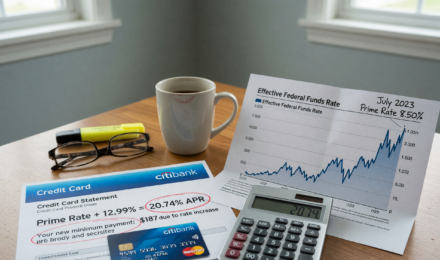
- Starting in March 2022, the Federal Reserve raised the federal funds rate 11 times, pushing the prime rate from 3.25% to a peak of 8.50% by July 2023 (Federal Reserve, 2023).
- Average credit card APRs tracked the prime rate closely, rising from roughly 14.5% in 2021 to over 21% by late 2023, according to Federal Reserve G.19 Consumer Credit data (Federal Reserve, 2024).
- Three rate cuts in late 2024, in September, November, and December, reduced the prime rate from 8.50% to its current level of 7.50% (Federal Reserve, 2024).
- Homeowners with HELOCs saw their borrowing costs move in near-perfect lockstep with changes in rate, because most HELOC agreements are priced at prime plus a margin (Consumer Financial Protection Bureau, 2023).
In This Guide
- What Is the Prime Rate and How Does It Connect to the Federal Reserve?
- What Was the Prime Rate Before COVID-19 Hit?
- What Happened to the Prime Rate in 2020 During the Pandemic Shock?
- Why Did the Prime Rate Stay at 3.25% Through All of 2021?
- How Did the Prime Rate Change in 2022 as Inflation Surged?
- When Did the Prime Rate Peak and What Drove It There?
- Did the Prime Rate Come Down in 2024?
- How Did Prime Rate Changes During COVID-19 Affect Consumers?
- What Financial Lessons Can Borrowers Take From the COVID-19 Rate Cycle?
What Is the Prime Rate and How Does It Connect to the Federal Reserve?
A benchmark lending rate that U.S. commercial banks charge their most creditworthy corporate customers, the prime rate moves in direct lockstep with the federal funds rate set by the Federal Reserve. Specifically, it sits almost always exactly 3 percentage points (300 basis points) above the upper bound of the federal funds target range, a convention that has held reliably since the 1990s.
When the FOMC votes to raise or lower the federal funds rate, every major U.S. bank, including JPMorgan Chase, Bank of America, Wells Fargo, and Citibank, adjusts its prime rate within days, sometimes within hours. This makes the prime rate a near-real-time transmission mechanism for Federal Reserve monetary policy into the consumer credit market.
Why the Prime Rate Matters for Everyday Borrowers
Millions of consumer financial products are directly pegged to the prime rate. These include most HELOCs, many credit cards, small business loans, and some personal loans. When the rate fell to 3.25% in March 2020, variable-rate borrowers saw immediate relief. When it surged to 8.50% by 2023, those same borrowers faced some of the highest carrying costs in a generation.
Understanding how these movements unfolded during COVID-19 helps explain why your credit card minimum payment may have increased sharply between 2022 and 2024, or why a HELOC that felt affordable in 2021 became a financial strain just two years later. For a deeper look at how this mechanism works on credit cards specifically, see our guide on how the prime rate affects your credit card interest rates.
The prime rate has tracked exactly 3 percentage points above the federal funds rate upper bound for every single Federal Reserve adjustment since the mid-1990s. This mechanical relationship means consumers can predict prime rate changes the moment the Fed announces its decision.
What Was the Prime Rate Before COVID-19 Hit?
Before the pandemic, the prime rate stood at 4.75% at the start of 2019, having risen through a steady tightening cycle that began in December 2015. Rates had been gradually normalizing after the prolonged near-zero era that followed the 2008 financial crisis, and by late 2018 the prime rate had climbed as high as 5.50%.
Three cuts in 2019, made in response to global growth concerns and trade-war uncertainty, reversed that course. By the time 2020 began, the prime rate had already declined to 4.75%, then dropped to 4.25% following an additional cut in October 2019.
The Pre-Pandemic Baseline at a Glance
| Date | Federal Funds Rate (Target Range) | U.S. Prime Rate |
|---|---|---|
| January 2018 | 1.25% – 1.50% | 4.50% |
| December 2018 | 2.25% – 2.50% | 5.50% |
| August 2019 | 2.00% – 2.25% | 5.25% |
| October 2019 | 1.50% – 1.75% | 4.75% |
| February 2020 | 1.50% – 1.75% | 4.75% |
| March 1, 2020 (pre-cuts) | 1.50% – 1.75% | 4.75% |
This baseline matters as context. Entering the COVID-19 crisis, the Federal Reserve had relatively limited room to cut rates, unlike pre-2008, when the funds rate sat above 5%. That constraint shaped the magnitude and pace of emergency action that followed.
What Happened to the Prime Rate in 2020 During the Pandemic Shock?
No single month since the 2008 financial crisis saw a sharper drop in the prime rate than March 2020, when two emergency cuts totaling 150 basis points hit within 12 days. This was the Federal Reserve’s most aggressive emergency monetary response in over a decade, taken in direct response to the economic shutdown triggered by the coronavirus pandemic.
The March 3 Emergency Cut
On March 3, 2020, with markets in freefall and the World Health Organization days away from declaring a pandemic, the FOMC voted to cut the federal funds rate by 50 basis points, lowering it from 1.50%–1.75% to 1.00%–1.25%. According to the Federal Reserve’s official press release, the committee cited “evolving risks” to the economic outlook as the rationale. Rates dropped immediately from 4.75% to 4.25%.
The March 15 Emergency Cut, Bringing Rates to Zero
Just 12 days later, on March 15, 2020, a second emergency move arrived: a cut of 100 basis points, the largest single cut since 1984, and a new target range of 0%–0.25%. Rates fell from 4.25% to 3.25%, where they would remain for the next two years. The Fed also announced a $700 billion quantitative easing program alongside the rate cut, per the Federal Reserve’s March 15 press release.
The Federal Reserve cut rates by a combined 150 basis points in just 12 days in March 2020, the fastest two-cut sequence since emergency actions taken during the 2008 financial crisis (Federal Reserve, 2020).
For borrowers with variable-rate debt, the impact was immediate and significant. A HELOC borrower carrying a $100,000 balance at prime plus 1% would have seen their rate fall from 5.75% to 4.25%, a monthly interest saving of approximately $125.

Why Did the Prime Rate Stay at 3.25% Through All of 2021?
Flat at 3.25% for all 12 months of 2021, the prime rate reflected the Federal Reserve’s decision to maintain near-zero interest rate policy as the U.S. economy emerged from the acute pandemic shock but remained fragile. The FOMC repeatedly signaled that it would not raise rates until the labor market had fully recovered and inflation had sustainably exceeded 2% for a meaningful period.
The Fed’s “Transitory” Inflation Stance
Throughout 2021, Federal Reserve Chair Jerome Powell and other FOMC members described rising inflation as “transitory,” a temporary byproduct of supply chain disruptions and reopening demand. This view shaped the decision to keep rates unchanged even as the Consumer Price Index (CPI) began climbing sharply. By December 2021, CPI had reached 7.0% year-over-year, the highest reading since 1982, according to Bureau of Labor Statistics CPI data.
At the November 2021 FOMC press conference, Powell acknowledged that inflation was “running well above 2 percent” and imposing “significant hardship, especially on those least able to meet the higher costs of essentials like food, housing, and transportation” (Federal Reserve, November 2021). Even so, the committee held rates steady, judging that a premature hike posed greater risk than waiting for more data. Many economists argued this was a mistake, and in hindsight, the “transitory” call proved incorrect. Holding rates through December 2021 likely contributed to the severity of the tightening that followed.
For borrowers in 2021, however, the low rate meant historically cheap access to credit. Savers faced the opposite problem: deposit account yields near zero made cash feel like a liability. Our analysis of what happens to your savings when the prime rate rises explains this dynamic in detail.
The 2021 Mortgage and Housing Boom
One clear beneficiary of the extended low-rate environment was the housing market. The 30-year fixed mortgage rate averaged just 2.96% in 2021, according to Freddie Mac’s Primary Mortgage Market Survey. This rate tracks the 10-year Treasury yield rather than the prime rate directly, but the broader low-rate environment reinforced buyer demand and a record refinancing wave.
In 2021, U.S. homeowners refinanced a record $2.8 trillion in mortgage balances, taking advantage of the historically low rate environment created in part by the Federal Reserve’s pandemic-era monetary policy (Mortgage Bankers Association, 2022).
How Did the Prime Rate Change in 2022 as Inflation Surged?
No year since 1980 saw rates rise faster than 2022. Seven hikes during the year pushed the prime rate from 3.25% in February to 7.50% by December, a gain of 425 basis points in under 10 months. Inflation reaching a 40-year high of 9.1% in June 2022 drove the urgency, per Bureau of Labor Statistics CPI release data.
Month-by-Month Rate Hikes in 2022
| FOMC Meeting Date | Rate Hike (Basis Points) | Prime Rate After Hike |
|---|---|---|
| March 16, 2022 | +25 bps | 3.50% |
| May 4, 2022 | +50 bps | 4.00% |
| June 15, 2022 | +75 bps | 4.75% |
| July 27, 2022 | +75 bps | 5.50% |
| September 21, 2022 | +75 bps | 6.25% |
| November 2, 2022 | +75 bps | 7.00% |
| December 14, 2022 | +50 bps | 7.50% |
June’s hike of 75 basis points was the largest single increase since November 1994. Four consecutive 75-basis-point moves followed, an extraordinary sequence that signaled the central bank’s commitment to restoring price stability even at the cost of economic growth.
Borrowers who took out HELOCs or variable-rate personal loans in 2020 or 2021 at prime-plus-margin rates saw their effective interest rates more than double within 18 months of the first 2022 hike. Anyone with a $50,000 HELOC balance at prime plus 0.50% would have seen their annual interest cost rise from approximately $1,875 to $4,000 between March 2020 and December 2022.
Rapid tightening had broad consequences for debt management. Strategies like the debt avalanche method, explained in our guide on how to pay off debt fast, became especially valuable tools for minimizing total interest paid during this period.
When Did the Prime Rate Peak and What Drove It There?
Rates peaked at 8.50% on July 27, 2023, following a final 25-basis-point hike by the Federal Reserve, the highest level since January 2001. After that meeting, the Fed held rates steady for the remainder of 2023, pausing to assess whether inflation was sufficiently under control before considering any easing.
Four More Hikes in the First Half of 2023
Entering 2023 with the prime rate at 7.50%, the FOMC delivered four additional hikes during February, March, May, and July, each of 25 basis points, before pausing after the July meeting. Measured from the pandemic-era floor, the entire 2022–2023 tightening cycle totaled 525 basis points, the steepest cumulative hike cycle in over four decades, according to Federal Reserve open market operations historical data.
At the August 2023 Jackson Hole Economic Symposium, Federal Reserve Chair Jerome Powell cautioned that the historical record “strongly argues against prematurely loosening policy,” adding that the Fed would “stay the course until the job is done” (Federal Reserve, August 2023). That commitment to holding rates at their peak defined the second half of the year.
The Federal Reserve raised rates a total of 525 basis points between March 2022 and July 2023, the most aggressive tightening cycle since Federal Reserve Chair Paul Volcker’s inflation-fighting campaign of the early 1980s (Federal Reserve, 2023).
What the Peak Rate Meant for Consumer Borrowing
At 8.50%, average credit card APRs surpassed 21% for the first time in Federal Reserve tracking history, per Federal Reserve G.19 data. Personal loan rates for borrowers with good credit averaged 11%–14% at major lenders, according to data aggregated by Bankrate. For borrowers seeking mortgages or home equity products, the peak rate environment made variable-rate instruments particularly expensive. Our detailed breakdown of how the prime rate affects your mortgage and home equity loan provides a practical framework for evaluating these costs.

Did the Prime Rate Come Down in 2024?
Yes. Cuts began in September 2024, with three reductions by year-end collectively lowering the prime rate from 8.50% to 7.50%. Core inflation moving closer to the Fed’s 2% target and a labor market showing signs of cooling from its post-pandemic highs both supported the shift.
The Three 2024 Rate Cuts
September 18, 2024 brought the most notable action: a 50-basis-point reduction, larger than the standard 25-basis-point move, signaling that the Fed was shifting decisively into an easing posture. The FOMC followed with 25-basis-point cuts at its November and December meetings, ending 2024 with the prime rate at 7.50%, according to Federal Reserve FOMC calendar and historical decisions.
Rates have remained at 7.50% since December 2024, with the Fed pausing further cuts while monitoring inflation and labor market data. Savers who locked in high-yield CD rates in 2023 benefited from the peak rate environment. For context on what those rates looked like and what to expect going forward, our CD rates forecast for 2026 offers an up-to-date outlook.
The Federal Reserve’s September 2024 cut of 50 basis points was only the third time since 2000 that the Fed opened an easing cycle with a half-point move, the previous instances occurred in January 2001 and September 2007, both in response to emerging economic crises.
How Did Prime Rate Changes During COVID-19 Affect Consumers?
Three major consumer borrowing categories felt the full force of the COVID-era rate cycle: credit cards, home equity products, and personal loans. The magnitude of that impact varied by product type and whether the rate was fixed or variable, but for millions of households, the swing from 3.25% to 8.50% and back represented one of the most significant cost-of-borrowing shifts in modern personal finance history.
Credit Cards
Most credit cards carry variable APRs tied directly to the prime rate. When the prime rate stood at 3.25% in 2021, average credit card APRs hovered around 14.5%, according to Federal Reserve G.19 Consumer Credit data. By late 2023, with the prime at 8.50%, average APRs had climbed above 21%, a difference of roughly 6.5 percentage points that translated to hundreds of dollars in additional annual interest for cardholders carrying balances. Our complete guide on how to pay off $10,000 in credit card debt walks through strategies tailored to high-rate environments.
HELOCs and Home Equity Loans
HELOCs (Home Equity Lines of Credit) are almost universally priced as prime plus a margin set by the lender. A borrower with a HELOC at prime plus 0.50% paid an effective rate of 3.75% in 2021 and 9.00% in 2023, a 525-basis-point increase on the same debt. For a $150,000 HELOC balance, that represented a shift in annual interest cost from approximately $5,625 to $13,500.
Personal Loans
Fixed-rate personal loans are less directly tied to the prime rate, but lenders use it as a pricing benchmark. New originations became significantly more expensive as rates rose. Average personal loan interest rates for borrowers with good credit climbed from roughly 9%–11% in 2020–2021 to 12%–15% by 2023, per Bankrate’s annual rate tracking surveys. For insight into how this relationship works mechanically, see our guide on how the prime rate affects personal loan rates.
What Financial Lessons Can Borrowers Take From the COVID-19 Rate Cycle?
Few historical periods compressed so much rate volatility into such a short window. Emergency cuts, a prolonged hold, historic tightening, and gradual easing all occurred within five years, exposing borrowers to dynamics that would normally play out across two decades of normal economic conditions.
Lesson 1: Variable-Rate Debt Carries Real Risk
Millions of borrowers who took on HELOCs and variable-rate products in 2020 and 2021 found their monthly costs rising sharply and without warning starting in 2022. The lesson is not to avoid variable-rate products entirely, but to stress-test your budget against rate increases of 3–5 percentage points before committing to a product pegged to the prime rate. Variable rates carry a genuine tradeoff: they can save money in a falling-rate environment, but that benefit reverses quickly when conditions change.
Lesson 2: Savers Benefited From the Peak Rate Environment
While borrowers suffered, savers who moved cash into high-yield savings accounts and CDs in 2022 and 2023 captured some of the best risk-free yields in 15 years. High-yield savings accounts were offering 5.00%–5.50% APY in 2023, compared with near-zero yields in 2021. Building an emergency fund during a high-rate period locks in better returns, a strategy covered in our guide on how to build a 6-month emergency fund.
Lesson 3: Rate Cycles Move Faster Than Expected
Virtually no mainstream economic forecast in January 2022 anticipated that the Federal Reserve would raise rates by 425 basis points within a single calendar year. Building a financial plan that accounts for rapid rate-environment changes, through fixed-rate debt, rate-matched savings vehicles, and cash flow buffers, proved to be the most resilient approach across this cycle.
If you currently carry variable-rate debt, calculate the impact on your monthly budget if the prime rate rose by 200 basis points from today’s level. If that scenario would strain your cash flow, prioritize paying down or refinancing to a fixed rate before the next tightening cycle begins.
Real-World Example: How the COVID-19 Rate Cycle Affected One Homeowner’s HELOC
Consider the situation of David, a 48-year-old homeowner in Ohio who opened a $120,000 HELOC in June 2020 at prime plus 0.50%, an effective rate of 3.75% at the time. In 2020 and 2021, David’s monthly interest-only payment on his full balance was approximately $375. He used the HELOC for a home renovation, intending to repay it over 7–10 years at what he expected to remain a low rate.
By January 2023, with the prime rate at 7.50%, David’s effective rate had risen to 8.00% and his monthly interest payment had climbed to $800, more than double what he had budgeted. By July 2023, at the prime rate peak of 8.50%, his payment reached $900 per month. Over the full 2022–2023 tightening cycle, David paid approximately $7,200 more in interest than he would have if rates had remained at 2020 levels.
David’s response: in early 2024, he refinanced the remaining $105,000 HELOC balance into a fixed-rate home equity loan at 8.25% APR, locking in predictable payments of $1,285 per month over 10 years and eliminating his exposure to future prime rate movements.

Your Action Plan
-
Map your rate-sensitive debt
List every debt product you hold and identify whether its rate is fixed or variable. For each variable-rate product, find the specific language in your agreement showing how the rate is calculated (e.g., “prime plus 1.50%”). This is the foundation for understanding your exposure to future rate changes.
-
Stress-test your variable-rate exposure
Using today’s prime rate of 7.50%, calculate what your monthly payments would look like if the prime rose by 200 basis points (to 9.50%). If that scenario would push your debt-to-income ratio above 36%, the threshold used by most mortgage lenders, per the Consumer Financial Protection Bureau, prioritize paying down or converting those balances.
-
Check current high-yield savings rates before the next cut
Visit Bankrate’s high-yield savings account comparison tool to find current APYs. With the prime rate still at 7.50%, competitive high-yield savings accounts are offering meaningful returns. Compare these options alongside our ranked list of the best high-yield savings accounts for 2026.
-
Evaluate CD rate lock-in opportunities now
If further Federal Reserve cuts are anticipated, locking in a CD rate today at above-historical-average yields preserves those returns regardless of future cuts. Visit the FDIC’s weekly national rate survey for benchmarks, then compare against our current rankings for the best CD rates in 2026.
-
Review and refinance high-rate variable debt
If you have a HELOC, variable-rate personal loan, or other prime-linked debt with a balance above $10,000, get at least three fixed-rate refinance quotes from competing lenders. Use the Consumer Financial Protection Bureau’s Loan Estimate comparison tool at consumerfinance.gov to evaluate offers against standardized criteria.
-
Optimize your credit score before your next major borrowing event
Because interest rate offers vary dramatically by credit tier, often by 3–6 percentage points on personal loans, improving your FICO Score before applying for new credit can offset much of the impact of a high prime rate environment. Check your credit report for free at AnnualCreditReport.com, where Experian, TransUnion, and Equifax each provide free weekly access.
-
Build or replenish your emergency fund at today’s rates
An emergency fund held in a high-yield savings account currently earns materially more than it did in 2020 or 2021. Target 3–6 months of essential expenses. The tax-advantaged savings vehicles and timing strategies in our guide on what an emergency fund is and how much to save are directly applicable to today’s rate environment.
-
Monitor the Federal Reserve’s FOMC meeting schedule
The FOMC meets approximately 8 times per year. Bookmark the Federal Reserve’s FOMC meeting calendar and set a reminder to review your rate-sensitive financial products within one week of each decision date. This simple habit ensures you are never caught off guard by a rate change that affects your monthly costs.
Frequently Asked Questions
What was the prime rate during COVID-19 at its lowest point?
At its lowest, the prime rate hit 3.25% on March 16, 2020, after the Federal Reserve cut the federal funds rate to a target range of 0%–0.25%. That level held for exactly 24 months until the first post-pandemic rate hike in March 2022.
How many times did the Federal Reserve cut rates in March 2020?
Two emergency rate cuts occurred in March 2020: one on March 3 (50 basis points) and one on March 15 (100 basis points). Both were unscheduled actions taken outside the normal FOMC meeting calendar, totaling a reduction of 150 basis points combined.
How high did the prime rate go after COVID-19?
Rates peaked at 8.50% on July 27, 2023, following the Federal Reserve’s final hike in the post-pandemic tightening cycle. This was the highest prime rate since January 2001, representing a total increase of 525 basis points from the pandemic-era low of 3.25%.
Did the prime rate affect mortgage rates during COVID-19?
Fixed-rate mortgages are not directly tied to the prime rate; they track the 10-year Treasury yield instead. Adjustable-rate mortgages (ARMs) and HELOCs, however, are directly linked to the prime rate. The 30-year fixed mortgage rate averaged just 2.96% in 2021, driven by broader Federal Reserve bond-buying programs rather than the prime rate mechanism itself.
When did the Federal Reserve start raising rates after COVID-19?
Rate hikes began on March 16, 2022, with an initial increase of 25 basis points. This ended the 24-month hold at near-zero rates and launched the most aggressive tightening cycle since the 1980s, raising the prime rate by 525 basis points over the following 16 months.
How did prime rate changes during COVID-19 affect credit card interest rates?
Because most credit card APRs are variable and tied directly to the prime rate, average credit card rates fell to roughly 14.5% in 2021 when the prime was at 3.25%. By late 2023, when the prime peaked at 8.50%, average credit card APRs exceeded 21%, the highest level ever recorded in Federal Reserve tracking history.
Is the prime rate back to normal after COVID-19?
Rates have normalized from pandemic-era emergency lows but remain above pre-pandemic levels. Currently at 7.50%, compared with 4.75% in February 2020, whether this represents a “new normal” depends significantly on where inflation and labor market conditions settle over the next 12–24 months.
Did the COVID-19 prime rate changes affect savings account yields?
Yes, significantly. High-yield savings account APYs collapsed from around 1.5%–2.0% pre-pandemic to near 0.50% in 2020–2021 as the prime rate hit its floor. They then surged to 5.00%–5.50% in 2023 as the prime rate peaked, offering savers some of the best risk-free yields in 15 years.
What is the prime rate based on?
By longstanding convention, the U.S. prime rate equals the upper bound of the federal funds target range plus 3 percentage points (300 basis points), a formula set by the Federal Reserve’s Federal Open Market Committee. This relationship has remained consistent across every rate change since the mid-1990s.
How does the prime rate affect personal loans?
Variable-rate personal loans move directly with the prime rate, while fixed-rate personal loans are priced at origination using current market conditions, meaning new fixed-rate loans become more expensive when rates are high. During the 2022–2023 tightening cycle, new personal loan APRs for creditworthy borrowers rose by approximately 3–5 percentage points compared with 2020–2021 offers.
Why did the Federal Reserve wait so long to raise rates after inflation started rising in 2021?
The FOMC held rates through 2021 because it judged rising prices to be “transitory,” meaning a short-term byproduct of pandemic-related supply chain disruptions rather than a structural inflation problem. In hindsight, that judgment was incorrect. By the time the Fed began hiking in March 2022, CPI had already reached 7.9%, and the delayed response meant the subsequent tightening had to be faster and larger to catch up.
Could the prime rate drop back toward its COVID-19 lows again?
A return to 3.25% would require a severe economic downturn comparable to the 2008 financial crisis or the acute COVID-19 shock, neither of which can be ruled out but neither of which represents a base case. Most rate cycles end well above their prior floor. Borrowers planning around variable-rate products should treat the 2020 low as an exceptional event rather than a repeatable baseline.
Our Methodology
This article was researched using primary sources including the Federal Reserve’s official press releases and FOMC statement archive, Federal Reserve G.19 Consumer Credit statistical release data, Bureau of Labor Statistics CPI historical data, Freddie Mac Primary Mortgage Market Survey historical records, FDIC weekly national rate surveys, and Bankrate rate tracking compilations. All prime rate figures cited are derived directly from the federal funds rate decisions published in FOMC official statements, applying the standard 300-basis-point formula. All consumer rate averages represent national averages across multiple lenders and may differ from rates available to any individual borrower based on creditworthiness, loan amount, and lender-specific criteria. Rate data is current as of May 2025. This article is reviewed and updated following each Federal Reserve FOMC rate decision.
Sources
- Federal Reserve, March 3, 2020 Emergency Rate Cut Press Release
- Federal Reserve, March 15, 2020 Emergency Rate Cut Press Release
- Federal Reserve, FOMC Meeting Calendar and Historical Decisions
- Federal Reserve, Open Market Operations Historical Data
- Federal Reserve, G.19 Consumer Credit Statistical Release
- Bureau of Labor Statistics, Consumer Price Index Historical Data
- Freddie Mac, Primary Mortgage Market Survey
- Consumer Financial Protection Bureau, Home Loan Options and Comparison
- Bankrate, High-Yield Savings Account Rate Comparison
- Federal Reserve, Federal Open Market Committee Overview
- Bureau of Labor Statistics, CPI Press Release Historical Archive
- AnnualCreditReport.com, Free Credit Report Access (Experian, TransUnion, Equifax)