
Quick Answer
To stop living paycheck to paycheck, start by tracking your net income and every expense for 30 days, then build a $1,000 starter emergency fund in a high-yield savings account. As of March 24, 2026, 61% of Americans still live paycheck to paycheck — but a structured budget, automated savings, and strategic debt payoff can break the cycle within 60–90 days.
Fact-checked by the Prime Rate editorial team
You work hard. You get paid. And somehow, before the next paycheck even lands, the money is already gone. If that cycle sounds familiar, you’re not doing something wrong — but you are stuck in a pattern that’s costing you more than you realize. Learning how to stop living paycheck to paycheck isn’t about willpower or deprivation. It’s about building a system that works even when life gets messy.
The numbers are sobering. According to a Bankrate survey on emergency savings, more than half of Americans say they couldn’t cover a $1,000 emergency from savings alone. That means one car repair or one medical bill can send an entire household into debt — not because of reckless spending, but because there’s no financial cushion. The Consumer Financial Protection Bureau (CFPB) has consistently flagged this lack of liquid savings as one of the most significant drivers of household financial fragility in the United States.
In this guide, you’ll get a realistic, step-by-step plan to break the paycheck-to-paycheck cycle for good. No vague advice about “spending less coffee money.” Just clear, practical strategies — from tracking your cash flow to building your first real savings buffer — that you can start this week.
Key Takeaways
- More than 50% of Americans live paycheck to paycheck at some point, regardless of income level.
- A $1,000 starter emergency fund can break the debt cycle for most unexpected expenses.
- The 50/30/20 budget rule gives you a simple framework — 50% needs, 30% wants, 20% savings and debt.
- Automating savings — even just $25 per paycheck — builds the habit before the temptation hits.
- Subscription creep and lifestyle inflation are two of the biggest invisible drains on monthly cash flow.
- Households that write down financial goals are 42% more likely to achieve them, according to research by Dr. Gail Matthews.
In This Guide
- Why the Paycheck-to-Paycheck Cycle Happens
- Know Your Numbers Before You Do Anything Else
- Build a Budget That Actually Sticks
- Cut the Invisible Budget Leaks First
- Build Your First Financial Buffer
- Tackle Debt Strategically, Not Emotionally
- Increase Your Income Without Burning Out
- Protect Your Progress Long-Term
Why the Paycheck-to-Paycheck Cycle Happens
Most people assume the paycheck-to-paycheck trap is a low-income problem. But research tells a different story. People earning six figures often find themselves just as cash-strapped as those earning far less — because spending tends to rise with income. The Federal Reserve’s annual Report on the Economic Well-Being of U.S. Households has documented this pattern year after year, showing that financial stress cuts across nearly every income bracket.
This is called lifestyle inflation, and it’s one of the sneakiest forces in personal finance. You get a raise, you upgrade your apartment, your car payment grows, and suddenly you’re spending just as much as you earn — again. If you want to understand how this works and what to do about it, our piece on the hidden cost of lifestyle inflation breaks it down in detail.
It’s a System Problem, Not a Willpower Problem
The real issue is that most people have no financial system at all. They spend reactively — paying bills as they come in, buying what they want when they have money, and hoping the math works out. It rarely does.
Without a clear picture of income versus expenses, even a modest salary can feel impossibly tight. The fix isn’t discipline — it’s structure. Once you have a system, the cycle starts to break on its own. Institutions like Chase and SoFi have built entire product lines around this insight, offering automated savings tools and real-time spending dashboards precisely because structure — not willpower — is what changes behavior.
A 2023 LendingClub report found that 61% of Americans were living paycheck to paycheck — including 36% of those earning over $100,000 per year.
The Psychology Behind the Pattern
There’s also a mental component at play. When money feels scarce, the brain shifts into short-term thinking. You make decisions to relieve stress now — a takeout meal, a small online purchase — even when those decisions make things harder later.
Understanding this doesn’t mean you’re weak. It means you’re human. The strategies in this guide are designed to work with your psychology, not against it.
Know Your Numbers Before You Do Anything Else
You can’t fix what you can’t see. The very first step to stopping the paycheck-to-paycheck cycle is getting an honest, detailed picture of your money — income, expenses, and everything in between.
This step feels uncomfortable for a lot of people. But it’s not about judgment. It’s about information. Tools from the CFPB — including its free budgeting worksheets — can help you organize the data quickly and without cost.
Calculate Your True Monthly Income
Start with your net income — the amount that actually lands in your bank account after taxes and deductions. If your income varies, average the last three months. Include all sources: your job, side work, freelance income, or any other consistent cash coming in.
Most people budget against their gross salary. That’s a mistake. The number that matters is what you actually spend — and you can only spend net income.
Track Every Expense for 30 Days
Next, track every dollar you spend for one full month. Use a free app like Mint or YNAB, export your bank statements, or even use a notebook. The method doesn’t matter — the data does. Many people find that pulling statements from a Chase checking account or a credit card issued by a major FDIC-insured bank gives them the clearest picture, since every transaction is timestamped and categorized automatically.
You’ll almost certainly be surprised. Most people underestimate their spending in at least one category. Common culprits include dining out, subscription services, and small impulse purchases that add up fast.
The average American household spends $3,267 per year on dining out, according to the U.S. Bureau of Labor Statistics — that’s more than $272 every month.
Build a Budget That Actually Sticks
The word “budget” makes people cringe. It sounds restrictive. But a good budget isn’t a cage — it’s a plan. It tells your money where to go instead of wondering where it went.
The goal is to find a budgeting method that fits your life. If you want a flexible system that holds up when things go off-script, our guide to the budget method that works when life gets messy is a great starting point.
The 50/30/20 Rule as a Starting Point
The 50/30/20 rule is one of the most practical frameworks for beginners. It splits your take-home pay into three buckets: 50% for needs (rent, food, utilities), 30% for wants (entertainment, dining, hobbies), and 20% for savings and debt repayment.
You don’t have to follow it perfectly. Think of it as a starting template — a way to check whether your current spending is wildly out of proportion in any category. Your debt-to-income ratio (DTI) — a metric closely watched by lenders including SoFi and traditional banks — will naturally improve as you bring your needs spending under control and redirect more toward debt payoff.
Zero-Based Budgeting for More Control
Zero-based budgeting is a more hands-on approach. Every dollar of income gets assigned a job at the start of the month — bills, groceries, savings, fun — until you reach zero leftover. Nothing is unaccounted for.
It takes more effort upfront but gives you complete awareness of your cash flow. Many people who feel like they’re always broke discover they had money all along — it was just going to undefined “miscellaneous” categories.
Schedule a 15-minute “money date” each week to review your spending against your budget. Catching overspending early is far easier than fixing it at the end of the month.
Cut the Invisible Budget Leaks First
Before you try to earn more, make sure you’re not silently bleeding money in ways you’ve never noticed. Most households have hundreds of dollars per month in spending that delivers almost no value.
These aren’t luxuries you’ve consciously chosen. They’re forgotten subscriptions, auto-renewals, and small recurring charges that fly under the radar.
The Subscription Audit
Log into your bank account or credit card statement and look for every recurring charge. Write them all down. Now ask yourself: did I use this in the last 30 days? Would I miss it if it disappeared tomorrow?
You may be surprised how many services you’re still paying for after free trials expired, or after you stopped using them months ago. Our post on subscription creep and how small charges drain your budget can help you spot every hidden charge.
The “Pay Yourself First” Reframe
After cutting leaks, redirect that money immediately. Don’t let it sit in your checking account where it’ll get absorbed into vague spending. Move it to savings or debt repayment right away.
This reframe — treating savings as a non-negotiable bill — is one of the most powerful mental shifts in personal finance. You stop saving what’s “left over” (usually nothing) and start spending what’s left after saving. It’s a principle endorsed by the CFPB in its financial well-being guidance and echoed consistently in Federal Reserve consumer research.
The average American pays for 4.5 streaming subscriptions simultaneously, according to a 2023 Deloitte Digital Media Trends survey — a number that has grown steadily each year.
| Spending Category | Average Monthly Cost | Potential Annual Savings if Reduced 50% |
|---|---|---|
| Streaming Services | $61 | $366 |
| Dining Out | $272 | $1,632 |
| Unused Gym Membership | $58 | $348 |
| Impulse Online Shopping | $150 | $900 |
| Coffee Shops | $92 | $552 |
Build Your First Financial Buffer
Here’s the core problem with living paycheck to paycheck: there’s no margin for error. One unexpected expense — a flat tire, a medical copay, a broken appliance — and you’re in debt. The solution is a financial buffer.
You don’t need three months of expenses saved before this helps. A $500 to $1,000 starter emergency fund changes the game dramatically. It’s enough to handle most common emergencies without touching a credit card — and without taking a hit to your FICO Score, which rises when you keep credit utilization low and avoid new delinquencies.
Where to Keep Your Emergency Fund
Your emergency fund should be accessible but not too accessible. A high-yield savings account (HYSA) is ideal — separate from your checking account so you’re not tempted to dip into it, but easy to transfer when a real emergency hits. All deposits up to $250,000 in an FDIC-insured account are federally protected, whether you bank with a traditional institution or an online lender like SoFi.
HYSAs also earn meaningfully more interest than traditional savings accounts. If you’re not sure whether they’re still worth it in today’s rate environment, check out our breakdown of high-yield savings accounts in 2026.
How to Build It Fast Without Feeling Deprived
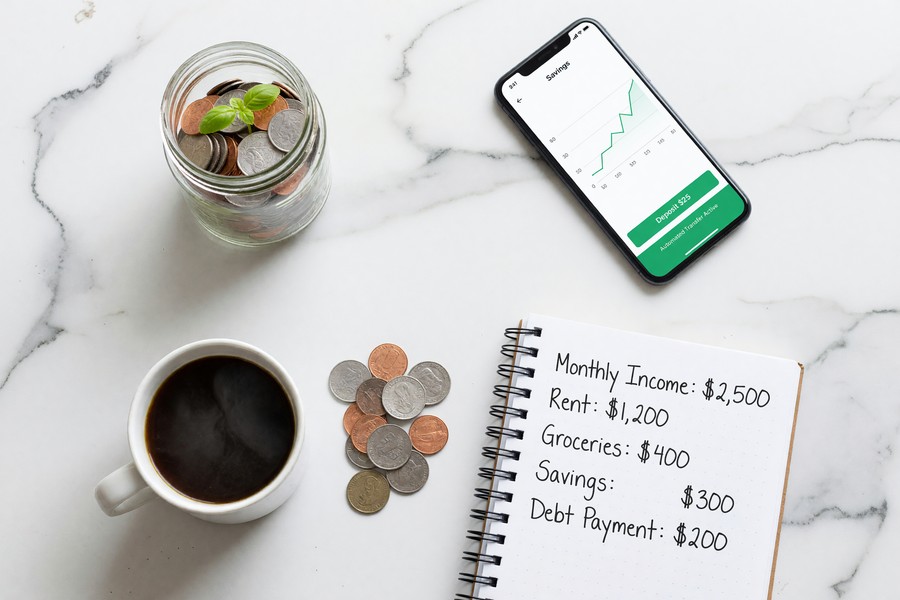
Start small. Even $25 per paycheck, automated, adds up. Set up an automatic transfer the day your paycheck hits — before you have a chance to spend it. Treat it like a bill you can’t skip.
If you get a tax refund, a work bonus, or any unexpected cash, put a portion directly into this fund. One lump-sum deposit can shortcut weeks of slow progress. The IRS even allows you to split your federal tax refund directly into multiple accounts at the time of filing — a simple way to route your refund straight to savings before it ever touches your checking account.
“Financial security doesn’t come from earning more — it comes from building systems that protect what you earn. A small emergency fund isn’t a luxury. It’s the foundation everything else is built on.”
Tackle Debt Strategically, Not Emotionally
Debt is often the engine keeping the paycheck-to-paycheck cycle running. Minimum payments eat a significant chunk of your income each month — and high APR (annual percentage rate) means you’re paying for yesterday’s spending with tomorrow’s money. The Federal Reserve has reported that the average credit card APR has hovered near historic highs in recent years, making high-interest debt one of the most expensive financial burdens a household can carry.
Stopping the cycle means attacking debt with a clear strategy, not just throwing random amounts at it whenever you have extra cash.
Avalanche vs. Snowball: Choosing Your Method
The debt avalanche method targets the highest-interest debt first. It saves the most money in interest over time. The debt snowball method targets the smallest balance first — building momentum through quick wins.
Both work. The best method is the one you’ll actually stick with. If you need motivational momentum, snowball. If you want to minimize total interest paid, avalanche. Either way, make minimum payments on all other debts while directing extra money at your target debt. Your FICO Score will also benefit over time as balances drop and your overall debt-to-income ratio (DTI) improves — two factors that lenders like Chase, SoFi, and other major creditors weigh heavily when evaluating loan applications.
When to Consider Consolidation
If you’re juggling multiple high-interest accounts, debt consolidation may help you simplify payments and reduce your APR in one move. A personal loan or balance transfer card can roll several debts into one manageable payment. Lenders including SoFi offer personal loans specifically designed for debt consolidation, and credit bureaus like Experian provide free tools to help you understand how consolidation might affect your FICO Score before you apply.
This works best when you qualify for a meaningfully lower rate — and when you commit to not adding new debt. For a deep look at your options, see our guide to the best debt consolidation loans in 2026. You might also want to explore strategies for getting out of debt without burning out, especially if you’re feeling overwhelmed by the process.
Consolidating debt only helps if you stop accumulating new debt. Rolling balances into a new loan and then charging up the old cards again is one of the most common — and costly — financial mistakes people make.
Increase Your Income Without Burning Out
Cutting expenses has a floor. You can only reduce spending so far before it starts hurting your quality of life. Income, on the other hand, has no ceiling. Even modest increases can dramatically accelerate your progress.
The goal isn’t to work yourself to exhaustion. It’s to find sustainable ways to bring in more money — even temporarily — while you build your financial foundation.
Negotiate Your Salary First
The highest-return financial move most people never make is negotiating their salary. According to the U.S. Department of Labor, workers who negotiate their pay can gain thousands of dollars per year — money that compounds over an entire career.
Research what your role pays in your market using sites like Glassdoor or the Bureau of Labor Statistics Occupational Outlook Handbook. Then make the ask. Most employers expect it. Even a modest salary bump reduces your DTI — a ratio that Experian and other credit reporting agencies note is one of the first things mortgage and auto lenders evaluate when you apply for financing.
Side Income That Actually Fits Your Life
Not everyone has time for a second job. But many people can find an extra $200-$500 per month through freelance work, selling unused items, or monetizing an existing skill.
The key is to direct this income with intention. Don’t let it disappear into your checking account — assign it a specific job (emergency fund, debt payoff) the moment it arrives.
A 10% raise on a $55,000 salary adds $5,500 per year — enough to fully fund a starter emergency fund and make a significant dent in consumer debt within 12 months.
Protect Your Progress Long-Term
Breaking the paycheck-to-paycheck habit is one thing. Staying out of it is another. Progress is fragile, especially in the early months. One financial setback — a job loss, a health issue, a major repair — can feel like it wipes out everything you’ve built.
The goal is to build systems that are resilient enough to handle those moments without sending you back to square one. If you’ve faced a setback recently, our guide on how to handle a financial setback without resetting your entire plan walks you through exactly what to do.
Automate Everything You Can
The less your financial progress depends on willpower, the more durable it becomes. Automate your savings transfers, your bill payments, and even your investment contributions. Set it up once and let the system do the work. Most FDIC-insured banks — from large national institutions like Chase to online-first lenders like SoFi — allow you to schedule recurring transfers between accounts in minutes.
When saving happens automatically, you don’t miss the money. You adapt your lifestyle to what’s left — which is exactly how wealthy people think about money.
Set Goals That Don’t Fall Apart
Vague goals (“I want to save more”) fail. Specific goals with deadlines and dollar amounts succeed. Write down exactly what you’re working toward, when you want to get there, and how much you need to save each week to make it happen.
Research by psychologist Dr. Gail Matthews at Dominican University found that people who write down their goals are 42% more likely to achieve them. That’s a significant edge — and it costs nothing. For help building goals that survive real life, see our guide to financial goals that don’t fall apart after a month.
“The secret to building lasting wealth is boring: automate savings, live below your means, and stay consistent longer than feels comfortable. The math always catches up.”
Keep Building Beyond the Basics
Once you have a buffer and your debt is under control, start thinking about the next layer of financial health. That means building a full three-to-six-month emergency fund, contributing to retirement accounts, and putting money to work through investments. Monitoring your FICO Score through a free service like Experian‘s free credit monitoring can help you track the downstream benefits of your progress — better scores unlock lower APRs on future loans, saving thousands over time.
These aren’t distant dreams — they’re the natural next steps once you stop living paycheck to paycheck and start directing your money with intention.

Workers who contribute even 1% of their salary to a 401(k) immediately — and increase contributions by 1% each year — can accumulate six figures more at retirement than those who wait until they “can afford it.”
Your Action Plan
-
Calculate your real net monthly income
Add up every dollar that hits your bank accounts in a typical month. Include your paycheck after taxes, side income, and any other consistent sources. This is the only number that matters for budgeting — not your gross salary.
-
Track every expense for 30 days
Use your bank app, a spreadsheet, or a free budgeting tool to log every purchase. Don’t change your spending yet — just observe. At the end of the month, categorize your expenses and look for surprises. Most people find at least one category where spending is significantly higher than expected.
-
Do a full subscription and recurring-charge audit
Pull up your last two months of bank and credit card statements. Circle every recurring charge. For each one, ask whether you used it in the last 30 days and whether you’d miss it. Cancel everything that doesn’t pass both tests — today, not “eventually.”
-
Build a simple budget using the 50/30/20 framework
Assign your net income to three buckets: 50% for needs, 30% for wants, and 20% for savings and debt. If your needs are over 50%, that’s your first problem to solve — either reduce fixed expenses or increase income. Use this as a starting point, not a rigid rule.
-
Open a high-yield savings account and automate a small transfer
Set up a separate savings account specifically for your emergency fund at an FDIC-insured institution — whether that’s a traditional bank like Chase or an online lender like SoFi. Then create an automatic transfer — even $25 or $50 per paycheck — scheduled for the day you get paid. Small and consistent beats large and sporadic every time.
-
Pick one debt and attack it strategically
Choose either your highest-APR debt (avalanche) or your smallest balance (snowball). Make minimum payments on everything else and direct any extra money at your target debt each month. Don’t try to pay down everything at once — focus wins.
-
Explore at least one income-increasing opportunity
Research the market rate for your position and consider asking for a raise at your next performance review. Alternatively, identify one skill or asset you can monetize for extra income — even temporarily. Direct every dollar of new income to your emergency fund or debt payoff goal.
-
Set a written financial goal with a specific deadline
Write down exactly what you want to achieve (e.g., “Save $1,000 emergency fund by September 1”) and the weekly savings amount you need to get there. Keep it somewhere visible. Review your progress weekly. Adjust the approach if needed — but don’t change the goal.
Frequently Asked Questions
How long does it take to stop living paycheck to paycheck?
It depends on your income, expenses, and existing debt — but most people start to feel a meaningful difference within 60 to 90 days of implementing a real budget and cutting key expenses. The first $500 to $1,000 in savings is the hardest part. After that, momentum builds quickly.
Don’t expect overnight transformation. Expect steady, compounding progress. The cycle took time to build — and it takes time to break. But every week you stick to the plan, your financial foundation gets stronger.
Can I stop living paycheck to paycheck on a low income?
Yes — though it requires more creativity and patience. On a tight income, small expenses matter more, so every cut counts. Prioritize building even a tiny savings cushion first. A few hundred dollars can prevent a setback from becoming a crisis.
It’s also worth exploring income-boosting options: overtime, a part-time gig, or programs that reduce your fixed costs (like utility assistance or income-based repayment for student loans). The CFPB maintains a directory of nonprofit financial counseling services that can help you identify assistance programs you may qualify for. Even modest income gains can create significant breathing room.
What’s the fastest way to build an emergency fund?
The fastest approach combines cutting expenses and adding income at the same time. Cancel unused subscriptions, reduce discretionary spending temporarily, and direct everything — including any windfalls like tax refunds or bonuses — into your emergency fund.
Automate the transfer so it happens without thought. Even if progress feels slow, avoid dipping into the fund for non-emergencies. Once it reaches your target, the sense of financial security changes how you approach every other money decision.
Is it better to save or pay off debt first?
Both matter, but the order depends on interest rates. Build a small starter emergency fund ($500 to $1,000) before aggressively paying down debt. Without a buffer, any surprise expense will put you right back on a credit card — negating your progress.
Once you have that buffer, focus on high-APR debt (above 7% or so) before building further savings. After high-interest debt is gone, shift toward growing your emergency fund to three to six months of expenses and contributing to retirement accounts.
How do I stop overspending even when I know I shouldn’t?
Overspending is rarely purely a logic problem — it’s often emotional. Stress, boredom, and social pressure all drive impulse purchases. The most effective tool is creating friction: unsubscribe from retail emails, remove saved card information from shopping sites, and implement a 48-hour rule before any non-essential purchase over $50.
Also give yourself a small, guilt-free spending allowance in your budget. Budgets that allow zero fun fail. Ones that include a realistic “personal spending” category tend to stick.
What if my partner and I don’t agree on money?
Money disagreements are one of the top sources of stress in relationships. The key is to approach the conversation as teammates, not opponents. Start with shared goals — what do you both want your life to look like in five years? — and work backward to the budget that supports those goals.
Consider a “yours, mine, and ours” account structure. Each person keeps a small personal spending account with no questions asked, while shared expenses come from a joint account. This respects individual autonomy while maintaining shared financial responsibility.
Should I use a budgeting app or do it manually?
Either works — the best method is the one you’ll actually use consistently. Apps like YNAB, Mint, or Copilot connect to your accounts and categorize spending automatically, which reduces friction. A spreadsheet or even a notebook works just as well if you prefer a hands-on approach.
The important thing is to review your budget weekly. An app you check once a month is less useful than a notebook you look at every Sunday morning.
How do buy now, pay later services affect the paycheck-to-paycheck cycle?
Buy now, pay later (BNPL) services can make the problem worse if used without discipline. They let you spend tomorrow’s money today — which is exactly the pattern you’re trying to break. If you lose track of multiple BNPL installments, you can end up with “phantom bills” that hit your account unexpectedly. The CFPB has issued formal guidance on BNPL risks, noting that missed installments can trigger fees and, increasingly, negative marks on credit reports tracked by bureaus like Experian.
That said, some people use BNPL strategically for budgeting purposes — spreading a necessary expense across a few paychecks without interest. If you go this route, track every installment carefully. For a balanced breakdown of the risks and benefits, read our article on buy now, pay later: smart tool or long-term risk?
What’s the difference between a budget and a financial system?
A budget tells you where your money goes each month. A financial system is the broader set of habits, automation, and structures that keep your money on track without constant effort. A system includes your budget, but also your automatic savings transfers, your debt payoff strategy, your account structure, and your monthly review process.
Budgets alone often fail because they require ongoing willpower. Systems are self-sustaining. If you want to go deeper on this distinction, our guide to how to build a personal financial system (not just a budget) is worth reading next.
When should I start investing if I’m still paycheck to paycheck?
If your employer offers a 401(k) match, contribute at least enough to capture the full match — even while paying off debt. That’s a 50% to 100% return on your contribution, which beats almost any debt paydown math.
Beyond that, prioritize your emergency fund and high-APR debt before putting extra money into investments. Once those are handled, even investing small amounts consistently creates meaningful long-term growth. The earlier you start, the more time your money has to compound. The Federal Reserve’s compound interest data consistently shows that starting even two to three years earlier can add tens of thousands of dollars to retirement balances over a 30-year horizon.
Sources
- Bankrate — Annual Emergency Savings Report
- U.S. Bureau of Labor Statistics — Consumer Expenditure Survey
- U.S. Bureau of Labor Statistics — Occupational Outlook Handbook
- U.S. Department of Labor — Equal Pay and Pay Transparency
- Deloitte — Digital Media Trends Survey
- LendingTree — Living Paycheck to Paycheck Statistics
- Consumer Financial Protection Bureau (CFPB) — Emergency Financial Assistance
- Federal Reserve — Report on the Economic Well-Being of U.S. Households
- Dominican University — Dr. Gail Matthews Goals Research Summary
- IRS — Tax Planning and Refund Information