
Fact-checked by the Prime Rate editorial team
The Verdict
Keeping variable-rate law firm debt makes sense if your current prime-plus margin puts you above 6.5% and the Fed still has room to cut. Refinancing to fixed is smarter if you cannot absorb a 1–2 percentage point reversal without cutting your draw. Solo attorneys with tight cash flow should lock in; those with a funded reserve can afford to wait.
Most solo attorneys treat their operating line of credit as background noise until a rate notice arrives. That instinct is understandable, but variable-rate law firm debt is wired directly to the Federal Reserve’s decisions, and right now those decisions are moving slowly. The U.S. bank prime rate sits at 6.75%, down 0.75 points from a year earlier, with FOMC projections pointing to at most one more cut in 2026 and one in 2027.
For a solo practitioner averaging around $140,000 in annual compensation, a few hundred dollars in monthly debt-service relief is real money. The question is whether that relief is durable enough to build a strategy around, or just a reason to delay the harder conversation about fixed versus floating.
| Factor | Reasons to Keep Variable-Rate Debt | Reasons to Refinance to Fixed |
|---|---|---|
| Rate direction | Prime dropped 0.75% in the past year; further cuts still projected | Fed dot-plot shows at most 1 more cut in 2026; cuts may stall |
| Monthly payment | Payments fall automatically with each prime rate drop | Fixed payment is predictable regardless of Fed moves |
| Extra principal paydown | Every extra dollar reduces principal at a declining rate, compounding benefit | Prepayment may carry a penalty; savings are capped at origination rate |
| Cash flow volatility | Lower payments help during slow billing months or contingency delays | Contingency-fee timing makes variable resets hard to plan around |
| Refinancing cost | No closing costs; stay on current line | Origination fees of 1–3% add to break-even timeline |
| Rate-reversal risk | Risk is manageable with a 4–6 month operating reserve | Fixed rate eliminates upside risk if inflation rebounds in late 2026 |
Key Takeaways
- Your effective rate on a variable line is currently at or above 9.5% (prime plus a 2.75–4 point margin), meaning meaningful savings are possible but only while the Fed keeps cutting.
- You have a funded operating reserve covering at least 4 months of firm overhead, including debt service, so a rate reversal would not force you to cut your draw.
- Your variable-rate balance is $100,000 or more; at that size, even a 0.50% cut saves roughly $500 per year, enough to justify active management rather than passive renewal.
- Your billing cycle is irregular (contingency fees, quarterly retainers) and a rate reset month does not reliably coincide with a collection spike, meaning you’ve stress-tested the mismatch.
- You’ve confirmed with your lender that no contractual floor prevents the full prime rate drop from passing through to your line.
- Closing costs on a fixed-rate refinance would take more than 24 months to recoup at current rate projections, making the variable option the better hold for now.
- You are current on all bar-association ethics obligations regarding firm operating accounts and have not commingled personal draw advances with client trust funds under IOLTA rules.
What Does Variable-Rate Debt Actually Look Like for Solo Attorneys?
Solo attorneys almost never get the same loan structures that big firms do. A BigLaw firm’s credit facility might carry a margin of prime plus 1 to 1.5 points; a solo practitioner typically sees prime plus 2.75 to 4 points, putting their effective APR in the 9.5–10.75% range as of mid-2026. That spread reflects the lender’s view of concentration risk: one attorney, one book of business, one health event away from a collections cliff. Banks such as Chase, Wells Fargo, and smaller regional lenders that serve professional practices all price this risk into the margin they quote at origination.
The most common product is a revolving operating line of credit, usually $50,000 to $250,000, used to smooth payroll, cover malpractice premiums, or bridge the gap between case settlement and personal draw. According to the Federal Reserve Bank of Kansas City, variable-rate lines of credit constituted roughly 89% of total small business credit line usage in Q4 2024. Law firms are no exception. The FDIC’s quarterly banking profile confirms that floating-rate commercial credit remains the dominant structure for small business lending nationally.
What makes this structure particularly tricky for solos is the timing mismatch. Contingency-fee practices may go months without a settlement, then receive a large lump sum. A quarterly rate reset might land in month three of a billing drought. That mismatch, not the rate level itself, is what turns a manageable line into a stressful one. Understanding how the prime rate affects your borrowing costs is the first step toward managing that exposure deliberately.

How a Prime Rate Cut Actually Reaches Your Monthly Payment
Not immediately, and sometimes not in full. Most small business lines of credit reset monthly or quarterly, indexed to the Wall Street Journal prime rate or to SOFR (the Secured Overnight Financing Rate). When the Federal Open Market Committee cuts the federal funds rate, the prime rate follows within days, but your specific loan adjusts on its next scheduled reset date, which might be four to six weeks out.
There is a second, less-discussed problem: lender margin creep. Some banks quietly widen the spread above prime when they renew a line, effectively recapturing part of the rate reduction. Others have contractual floors, minimum interest rates that prevent the line from dropping below, say, 8%, regardless of where prime goes. Read the loan agreement before celebrating a Fed announcement. The Consumer Financial Protection Bureau (CFPB) requires that variable-rate commercial lenders disclose reset terms and any applicable floors in the loan agreement, so the information is there if you know where to look.
Here is a concrete example. Assume a solo attorney carries a $150,000 balance on an operating line at prime plus 3%, currently at 9.75%. A 0.50% prime rate cut would bring that rate to 9.25%, saving $750 per year (0.50% × $150,000) or roughly $62.50 per month. That is not transformative on its own, but across two cuts totaling 0.75% over 18 months, annual savings reach about $1,125, enough to cover a month of professional liability insurance or fund a partial principal paydown that compounds the benefit further. For more on how prime rate changes cascade across different debt products, the pattern is consistent: the savings are real, but modest at this stage of the cutting cycle.
Recalculating Solo Practice Cash Flow When Payments Drop
A $62 monthly payment reduction does not sound like much. But for a solo attorney drawing a salary from an S-corp or single-member LLC, the decision of where that savings goes matters more than the dollar amount itself.
The wrong move is treating it as discretionary income. Solo law firm owners average $140,000 in annual compensation, but only about one-third exceed $250,000. That income spread means most solos are running tighter debt-service coverage ratios (DSCR) than the 1.5x benchmark lenders prefer. A freed-up $60–$200 per month is better deployed into an operating reserve than folded into a personal draw increase. Lenders including Bank of America and SoFi routinely cite a borrower’s DSCR alongside their FICO Score when underwriting a line renewal, so maintaining that ratio has practical implications beyond month-to-month budgeting.
A practical target: build a reserve covering 4 to 6 months of firm fixed costs, including minimum debt service on the line. Variable-rate exposure makes this reserve non-optional. When rates were rising in 2022 and 2023, solos without reserves faced the choice between cutting marketing spend or cutting their own salary. Neither is recoverable quickly. If you need a framework for structuring that reserve, understanding how much to hold in an emergency fund applies directly to a solo practice’s operating cushion.
The second allocation question is principal paydown. On a variable-rate line, paying down principal is more efficient during a rate-cut cycle than on fixed debt, because each dollar you eliminate earns interest at a rate that may keep falling. Directing even $300 per month in extra principal payments on a $150,000 line at 9.75% would save roughly $1,900 in interest over the first year, compounding further as the balance drops.
Should You Refinance to Fixed or Stay Variable?
Stay variable if your reserve is funded and the Fed’s trajectory still points down. Refinance to fixed if a 1–2 point rate reversal would force you to cut your draw or miss a payroll cycle.
The break-even math on refinancing is straightforward but often ignored. A typical fixed-rate refinance for a solo attorney carries origination fees of 1–3% of the loan amount. On a $150,000 balance, that is $1,500 to $4,500 in upfront cost. If a fixed rate saves you $100 per month over your current variable rate, you need 15 to 45 months just to recoup the closing cost, and that assumes the variable rate stays exactly where it is today. Given the Fed’s current dot-plot (at most one more cut in 2026), the variable rate could drop further, making the fixed refinance look worse in hindsight. Online lenders like SoFi and Funding Circle have made fixed-rate term loans more accessible to solo professionals, but their pricing still reflects the same fundamental trade-off: certainty costs money.
Some attorney-specific lenders and credit unions offer hybrid products: a variable rate with a contractual cap of 2 percentage points above origination. These products are worth asking about specifically. They give downside protection without the full cost of a fixed refinance, and they are more available to licensed professionals than to general small businesses. Esquire Bank, which focuses exclusively on law firm lending, is one institution where this conversation is worth having directly.
One angle most refinancing guides miss: the state bar ethics dimension. Using a variable-rate operating line to fund personal draws during lean months is common but not always clean. If draws are advancing from the same account that temporarily holds unearned retainers, IOLTA trust account rules in most states require strict separation. A line of credit secured against firm assets is fine; one that creates even momentary commingling with client funds is not. Check your state bar’s ethics opinion on operating account structure before pledging firm assets as collateral for a refinance.
Stress-Testing the Debt If Rates Reverse
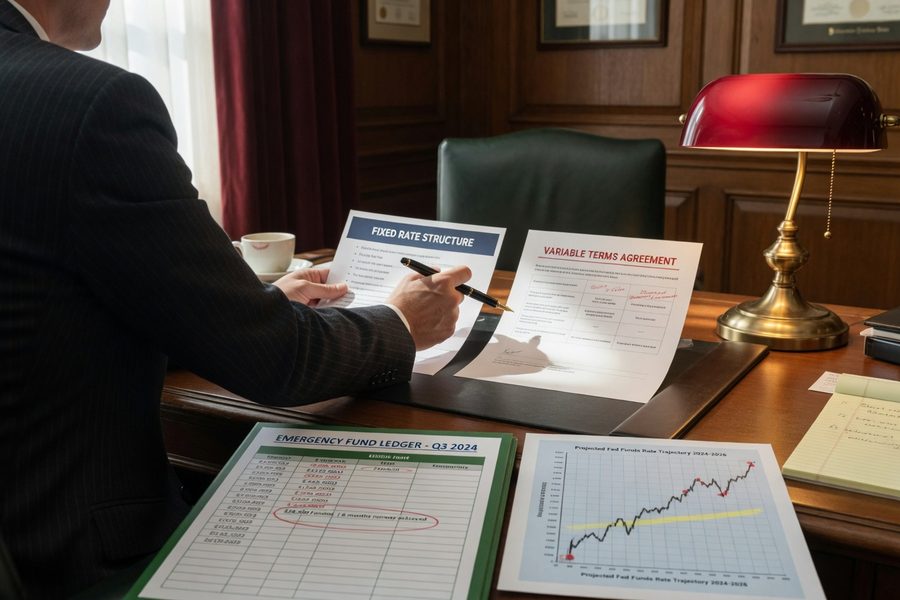
The scenario most solos skip: what happens if the Fed pauses cuts, or hikes, in late 2026? Energy prices, a supply shock, or a resurgence in core services inflation could all force the FOMC’s hand. The Fed held the federal funds rate at 3.50–3.75% through early 2026; a reversal to 4.25–4.50% within 18 months is not outside historical norms.
Model it before it happens. A 1-point rate increase on a $150,000 balance adds $1,500 per year, or $125 per month, to your debt service. On a $250,000 line, it is $2,500 annually. At solo income levels, that is a meaningful hit, especially if it arrives during a slow quarter. Understanding what happens to your finances when the prime rate rises is as important as tracking the cuts.
Exit ramps worth knowing: a partial principal paydown now, funded from the savings the current cut cycle is generating, reduces the principal on which any future rate hike compounds. Revenue-based financing from legal-practice-focused lenders like Esquire Bank or specialty credit unions in your state is another option; repayments scale with collections rather than on a fixed calendar, which suits contingency-fee practices better than standard amortizing loans. Some attorneys also explore Small Business Administration (SBA) 7(a) loan products as a fixed-rate alternative, though the paperwork burden and SBA underwriting timeline are real costs to factor in.
The honest caveat to this whole analysis is that rate forecasting is unreliable. The Fed dot-plot has been wrong enough times that planning around a single scenario is itself a risk. The correct approach is to build a debt-management posture that is tolerable across at least two scenarios, continued cuts and a pause, rather than optimizing for just one.
Who Should and Who Should Not Stay Variable
Good candidates
These solo attorneys are positioned to benefit from staying on a variable-rate line through the current cycle.
- Attorneys with a funded reserve of 4+ months of overhead who can absorb a rate reversal without cutting their draw or payroll.
- Contingency-fee or volume litigation practices with predictable annual settlement cycles, they can time extra principal payments to coincide with large collections.
- Solos carrying balances under $100,000 where refinancing costs would take more than 30 months to recoup at current rate projections.
- Attorneys whose current margin is prime plus 2.75% or less and whose lender has no contractual floor, meaning they capture the full benefit of each cut.
Who should skip it
These attorneys are better served by refinancing to a fixed product now.
- Solos whose debt-service coverage ratio is below 1.2x, a single rate hike of 0.50% would push monthly payments to levels that require draw cuts.
- Attorneys with irregular billing patterns and no reserve, where a quarterly rate reset in a slow month creates genuine cash-flow risk.
- Practices carrying prime plus 4% or higher margins that have not been renegotiated in two or more years, those lenders have already captured the rate environment; a fixed refinance elsewhere at a lower all-in rate is likely better.
- Solo attorneys within 5 years of retirement or wind-down who want predictable overhead and have no appetite for rate volatility in the final phase of practice.
Frequently Asked Questions
Is it worth refinancing attorney law firm variable rate debt to a fixed rate right now?
Only if you cannot service a 1–2 point rate increase without cutting your draw. The Fed projects at most one more cut in 2026, so the remaining variable-rate savings are modest, and locking in today’s fixed rates is not cheap, with origination fees typically running 1–3% of the loan amount. For most solos with an adequate reserve, staying variable is defensible through at least mid-2027.
How quickly does a Fed rate cut show up in my law firm line of credit payment?
Expect a lag of one billing cycle, usually 30 to 45 days, after the FOMC announcement. Your line resets on its scheduled date, not the day of the cut. Some lenders also have contractual floors that prevent a full pass-through, so confirm your loan terms before counting on the full savings.
What margin above prime should a solo attorney expect on a law firm operating line?
Most solo practitioners see prime plus 2.75% to 4%, compared to prime plus 1% to 1.5% for larger law firm facilities. The wider spread reflects concentration risk. If your current margin is above 4%, it is worth shopping, especially with a clean credit history and two or more years of tax returns showing consistent firm income. Lenders will also pull your personal FICO Score and examine your debt-to-income (DTI) ratio when pricing a renewal.
Can I use a variable-rate line of credit to cover personal draws during a slow month?
Yes, but with a compliance check first. IOLTA trust account rules in most states require strict separation between client funds and operating accounts. Drawing from a line of credit that is commingled with unearned retainer funds is an ethics violation in several states. Keep the operating line in a dedicated firm account, and confirm the structure with your state bar before drawing on it for personal compensation. You can also review strategies for accelerating debt payoff to reduce reliance on the line over time.
Should I use rate-cut savings to pay down principal or build a reserve?
Build the reserve first, then redirect to principal. A 4-to-6-month operating cushion insulates you from the rate reversal risk that makes variable debt dangerous. Once that reserve is funded, extra principal payments on a variable-rate line are unusually efficient during a cutting cycle: each dollar you eliminate earns interest at a rate that may continue falling.
Sources
- Federal Reserve Bank of Kansas City, Small Business Loan Demand Increases Despite Year-Over-Year Decreases in New Small Business Lending and Tightening Credit Standards
- Lendio, How the Federal Reserve Affects Your Business Loan
- LeanLaw, A Guide to Setting Your Own Salary as a Solo Law Firm Owner: The 2025 Data-Driven Approach
- Federal Reserve, FOMC Projections Table, March 2025
- Federal Reserve, Selected Interest Rates (H.15), Bank Prime Loan Rate
- U.S. Small Business Administration, SBA 7(a) Loans
- FDIC, Quarterly Banking Profile, Commercial Loan Data
- Consumer Financial Protection Bureau (CFPB), Understanding Loan Disclosures and Variable-Rate Terms
- The Wall Street Journal, Money Rates, Prime Rate
- Federal Reserve Bank of New York, Secured Overnight Financing Rate (SOFR)
- American Bar Association, IOLTA and Client Trust Account Resources
- Fundera, Average Small Business Loan Interest Rates by Lender and Loan Type
- Bankrate, Small Business Loan Rates and Current Market Benchmarks
- Nolo, Financial Management for Solo and Small Law Firms