Fact-checked by the Prime Rate editorial team
Quick Answer
To build a 6-month emergency fund in 2026, calculate your monthly essential expenses, multiply by six, and save that total in a high-yield savings account earning 4.50–5.00% APY. The average American needs roughly $18,000–$30,000 in emergency reserves, depending on household size and location.
Building an emergency fund is the single most impactful financial move most Americans can make right now. Nearly 57% of U.S. adults cannot cover a $1,000 unexpected expense from savings alone, according to Bankrate’s annual emergency savings report (Bankrate, 2026). That number has barely moved in five years, despite rising wages and historically high savings rates on deposit accounts.
The Federal Reserve’s Report on the Economic Well-Being of U.S. Households found that 37% of adults would struggle to cover a $400 emergency using cash or its equivalent (Federal Reserve, 2025). With consumer debt at record levels and layoff announcements rising across the tech, finance, and retail sectors through early 2026, a six-month cushion is no longer a luxury, it is a baseline necessity.
This guide gives you a concrete, step-by-step plan to calculate your target number, choose the right savings vehicle, accelerate contributions, and sustain the fund over time. Every recommendation is backed by data, and every step is actionable starting today.
Key Takeaways
- Nearly 57% of Americans cannot cover a $1,000 emergency from savings (Bankrate, 2026), making an emergency fund the highest-priority financial goal for most households.
- A fully funded 6-month emergency fund requires saving 3–6 times monthly essential expenses; for the median U.S. household spending $3,200/month on essentials, that equals $19,200–$38,400 (Bureau of Labor Statistics, 2025).
- High-yield savings accounts are currently offering 4.50–5.00% APY from online banks, meaning a $20,000 fund earns approximately $900–$1,000 per year in interest (FDIC, 2026).
- Automating savings contributions increases the likelihood of reaching a savings goal by 2–3 times compared to manual transfers, according to behavioral finance research (Vanguard, 2025).
- The median time to build a 6-month emergency fund, saving $500/month, is approximately 36–38 months for the average household, but can drop to 18 months with targeted expense cuts and income additions (Bureau of Labor Statistics, 2025).
- Emergency fund assets held in FDIC-insured accounts are protected up to $250,000 per depositor, per institution, ensuring your savings are safe regardless of bank failure (FDIC, 2026).
In This Guide
- Why Is a 6-Month Emergency Fund the Right Target in 2026?
- How Much Do You Actually Need in Your Emergency Fund?
- Where Should You Keep Your Emergency Fund in 2026?
- How Can You Build Your Emergency Fund Faster?
- How Do You Automate Emergency Fund Contributions?
- What If You Have Debt, Should You Save or Pay It Off First?
- How Do You Track Progress and Stay Motivated?
- When Should You Actually Use Your Emergency Fund?
- How Do You Replenish Your Emergency Fund After Using It?
Why Is a 6-Month Emergency Fund the Right Target in 2026?
Six months is the evidence-based standard because it covers the average U.S. job search duration, which reached 22.4 weeks in early 2026 (Bureau of Labor Statistics, 2026). A three-month fund is no longer sufficient for most working adults in today’s labor market.
The traditional three-month target has been undermined by structural shifts in employment. Layoffs in 2025–2026 concentrated heavily in white-collar and salaried roles, precisely the workers who historically felt most financially secure.
What Has Changed in the 2026 Economic Environment?
Average unemployment duration has climbed steadily since 2023. The Bureau of Labor Statistics reports that average weeks unemployed rose to 22.4 weeks as of Q1 2026, compared to 19.8 weeks in Q1 2023 (BLS, 2026). A three-month fund lasts only 13 weeks, far short of that average.
The Federal Reserve held its benchmark federal funds rate at a restrictive level through most of 2025, keeping borrowing costs elevated. If your emergency fund runs dry and you need to borrow, the average personal loan APR now exceeds 12.5% for borrowers with good credit (Federal Reserve, 2026). A funded emergency reserve eliminates that cost entirely.
The average U.S. job search in early 2026 lasted 22.4 weeks, nearly six months. A three-month emergency fund covers only 58% of that window (Bureau of Labor Statistics, 2026).
Who Needs More Than Six Months?
Self-employed individuals, freelancers, and commission-based workers should target 9–12 months of expenses, given income volatility. Single-income households with dependents also benefit from the longer runway.
Workers in industries with historically high layoff rates, such as technology, real estate, and finance, should lean toward the higher end of the range. Those with highly specialized skills and short average job search timelines may reasonably stop at four months.
How Much Do You Actually Need in Your Emergency Fund?
Your target emergency fund amount equals your total essential monthly expenses multiplied by six. Essential expenses include only non-discretionary costs: housing, food, utilities, transportation, insurance, and minimum debt payments, not entertainment, dining out, or subscriptions.
How to Calculate Your Essential Monthly Expenses
Start by listing every recurring, non-negotiable cost. The Bureau of Labor Statistics Consumer Expenditure Survey found the average U.S. consumer unit spent $3,231 per month on essential categories in 2024, including $1,784 on housing, $557 on food, and $534 on transportation (BLS, 2025).
Use the following framework to calculate your personal target. Be conservative, use your actual spending from the last three months, not an estimate.
| Expense Category | U.S. Average (Monthly) | Your Amount |
|---|---|---|
| Housing (rent/mortgage + utilities) | $1,784 | $___ |
| Food (groceries only) | $557 | $___ |
| Transportation (car payment, fuel, insurance) | $534 | $___ |
| Health insurance & out-of-pocket medical | $230 | $___ |
| Minimum debt payments | $320 | $___ |
| Basic personal care & household supplies | $120 | $___ |
| Total Monthly Essentials | $3,545 | $___ |
| 6-Month Target (multiply by 6) | $21,270 | $___ |
The national average suggests most households need between $18,000 and $30,000 in emergency reserves, depending on family size, housing market, and debt load. High cost-of-living metro areas like New York, San Francisco, or Boston may push that figure to $40,000 or more.
Housing costs have risen 23.4% cumulatively since 2021 according to the Consumer Price Index, meaning emergency fund targets set before 2022 are likely underfunded by $3,000–$6,000 for the average renter (Bureau of Labor Statistics, 2026).
Should You Adjust for Irregular Income?
Variable income requires a different baseline. Rather than using your average monthly earnings, base your calculation on your three lowest-earning months of the past year. That ensures the fund covers a worst-case scenario, a slow income period coinciding with an unexpected expense.
Freelancers and gig workers should also factor in self-employment tax obligations, since losing a client or contract means losing an employer’s contribution to those costs immediately.
Where Should You Keep Your Emergency Fund in 2026?
The best place to keep your emergency fund is a high-yield savings account (HYSA) at an FDIC-insured online bank, where current rates range from 4.50% to 5.00% APY. This keeps your money liquid, safe, and growing.
Traditional brick-and-mortar bank savings accounts pay an average of only 0.46% APY as of early 2026, according to the FDIC’s National Rates and Rate Caps data (FDIC, 2026). Parking $20,000 in a big-bank savings account instead of a HYSA costs you roughly $900 per year in lost interest. That is a real cost, not a theoretical one.
Comparing Emergency Fund Storage Options
| Account Type | Typical APY (2026) | Liquidity | FDIC Insured | Best For |
|---|---|---|---|---|
| High-Yield Savings (Online) | 4.50–5.00% | 1–3 business days | Yes (up to $250K) | Primary emergency fund |
| Money Market Account | 4.25–4.75% | Same day to 1 day | Yes (up to $250K) | Large fund, check access needed |
| Traditional Savings Account | 0.46% | Same day | Yes (up to $250K) | Not recommended for emergency fund |
| Treasury Bills (T-Bills) | 4.80–5.10% | 4–13 weeks to maturity | U.S. Government backed | Supplemental fund (months 4–6) |
| Certificates of Deposit (CDs) | 4.50–5.25% | Locked until maturity | Yes (up to $250K) | Not recommended, illiquid |
| Brokerage / Investment Account | Variable (market) | 3 business days | No (SIPC protected) | Not suitable for emergency fund |
Online banks such as Marcus by Goldman Sachs, Ally Bank, and SoFi have consistently offered top-tier HYSA rates throughout 2025–2026. For a deeper comparison of current rates, see our guide to high-yield savings accounts in 2026.
The case for a HYSA is straightforward: liquidity within one to three business days, FDIC protection, and a rate that outpaces inflation. The main drawback is that transfers are not instant, if you need cash on a Sunday, you may wait until Tuesday. Keep a small buffer in your checking account ($500–$1,000) to cover the gap.
Should You Use a CD Ladder for Part of Your Fund?
A CD ladder, splitting your fund across multiple CDs with staggered maturity dates, can slightly boost returns but introduces meaningful liquidity risk. For emergency fund purposes, the trade-off is rarely worth it.
A practical compromise: keep three months of expenses in a HYSA for immediate access, and place months four through six in short-duration Treasury Bills (4-week or 13-week), which currently yield around 4.80–5.10% (U.S. Treasury, 2026). This structure maximizes return while preserving access to roughly half your fund within one business day.

How Can You Build Your Emergency Fund Faster?
The fastest path is to combine expense reduction, income addition, and lump-sum injections at the same time rather than relying on monthly savings alone. Each approach independently shortens the timeline; using all three together can cut your savings window in half.
Identifying Spending Leaks
The average American household wastes $348 per month on unused or underused subscriptions and services, according to a 2025 consumer spending audit by C+R Research (C+R Research, 2025). A single subscription audit can free up $100–$300 per month with no real lifestyle impact. Our article on subscription creep and hidden digital charges walks through the exact process.
Beyond subscriptions, the three spending categories with the highest short-term reduction potential are dining and food delivery (average savings: $150–$400/month), discretionary shopping ($100–$300/month), and entertainment and streaming ($80–$150/month).
Run a “No Spend Month” challenge, restrict spending to only essential categories for 30 days. The average participant saves $400–$700 in a single month, according to financial wellness platform YNAB (You Need a Budget, 2025). Deposit those savings directly into your HYSA on day one of the following month.
Accelerating with Income Additions
Adding even a part-time income stream specifically earmarked for emergency savings dramatically shortens the timeline. Freelance platforms, gig economy apps (DoorDash, Instacart, Uber), and selling unused items on Facebook Marketplace or eBay represent the lowest-friction options.
A worker earning an extra $500/month from side income and redirecting it entirely to savings will fund a $20,000 emergency fund in 40 months at zero current savings rate, but only 22 months if they are also saving $400/month from their primary income.
Using Windfalls Strategically
Tax refunds represent the single largest windfall for most American households. The IRS reports that the average federal tax refund was $3,138 in the 2025 filing season (IRS, 2025). Depositing the full refund into a HYSA immediately covers 10–17% of a typical 6-month target in a single transaction.
Other windfall sources worth earmarking: annual work bonuses, inherited funds, proceeds from selling a vehicle or household items, and cash gifts. The habit of treating windfalls as savings deposits rather than spending opportunities is one of the highest-impact shifts in personal finance behavior, and it costs nothing to adopt.
How Do You Automate Emergency Fund Contributions?
Automating transfers to your emergency fund is the single most reliable strategy for consistent savings. Behavioral research from Vanguard found that employees with automatic savings enrollment were 2–3 times more likely to maintain savings contributions than those managing transfers manually (Vanguard, 2025).
Setting Up Automatic Transfers
The simplest setup: schedule a recurring ACH transfer from your primary checking account to your HYSA for the day after each paycheck deposits. Even $200 per month adds up to $2,400 per year, enough to build a meaningful buffer within 12–18 months alongside other strategies.
Most online banks, including Ally, Marcus, and SoFi, allow you to create automated savings rules, such as “round-up” features that transfer the difference between each debit card transaction and the next dollar, or percentage-of-deposit rules that automatically save 10% of every direct deposit.
The “pay yourself first” principle, saving before spending rather than saving what is left over, is endorsed by the Consumer Financial Protection Bureau (CFPB) as one of the most effective emergency savings behaviors. Households that automate savings accumulate 35% more in liquid reserves over a 3-year period than those who save manually (CFPB, 2024).
Choosing the Right Savings Cadence
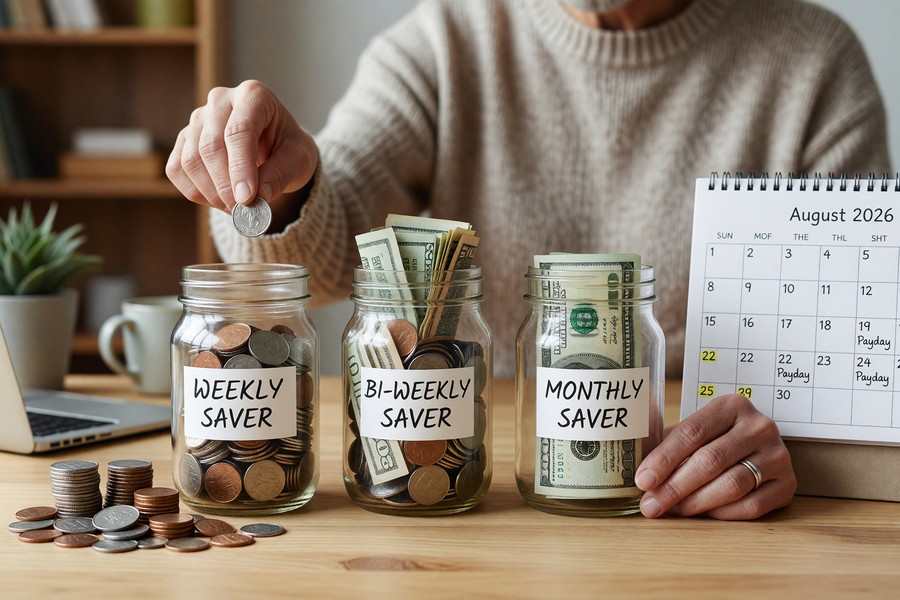
Weekly savers show higher total balances than monthly savers at the 12-month mark, even with identical total amounts. Smaller, more frequent deposits reduce the temptation to spend a full paycheck before a once-a-month transfer fires.
Biweekly is the most common cadence and aligns naturally with the 52% of American workers who are paid biweekly (ADP Research Institute, 2024). A biweekly transfer of $250 produces $6,500 per year in emergency savings, enough to fully fund a minimal emergency reserve in under two years for a low-cost-of-living household.
What If You Have Debt, Should You Save or Pay It Off First?
Carrying high-interest consumer debt above 8% APR calls for a hybrid approach: build a starter emergency fund of $1,000–$2,000 first, then aggressively pay down debt, then return to building the full 6-month fund. Choosing one exclusively over the other creates problems in either direction.
The math for debt payoff is compelling when interest rates exceed HYSA yields. A credit card charging 22.99% APR versus a savings account earning 4.75% APY means every dollar in savings costs you a net 18.24% annually. That said, carrying zero emergency savings while aggressively paying debt is fragile, one unexpected expense forces new debt at high rates, erasing months of payoff progress.
The Hybrid Approach in Practice
Financial planner Ramit Sethi popularized the concept of a “starter fund” before debt payoff, which has since been validated by CFPB research showing that households with even a small emergency buffer are less likely to miss debt payments during income disruptions (CFPB, 2024).
The recommended sequence: (1) save $1,000–$2,000 as a starter emergency fund, (2) eliminate all high-interest debt above 8% APR using the avalanche or snowball method, (3) return to building the full 6-month emergency fund. For help with step two, our guide on getting out of debt without burning out provides a structured framework.
Do not count available credit card balance or a home equity line of credit (HELOC) as your “emergency fund.” Using debt in an emergency increases your total cost by 15–25% compared to using cash savings, and adds financial stress during an already difficult period (CFPB, 2024). Credit availability is not an emergency fund.
What About Student Loan Debt?
Federal student loans carry fixed rates generally between 4.99% and 8.05% (Federal Student Aid, 2026), which puts them in a gray zone. Given that HYSA rates currently approach or exceed lower federal loan rates, building the emergency fund alongside standard loan payments is financially justified, unlike high-interest credit card debt, where payoff urgency is clearer.
Borrowers with private student loans at rates above 9% should treat those similarly to credit card debt and follow the hybrid approach above. For those considering consolidating high-rate debt, our analysis of debt consolidation loans in 2026 compares current rates and lenders.
How Do You Track Progress and Stay Motivated?
Tracking progress toward an emergency fund target works best when broken into milestone-based benchmarks rather than a single distant goal. Research in behavioral economics shows that intermediate rewards and visible progress significantly increase goal completion rates.
Setting Milestone Checkpoints
Divide your total target into four milestones: 25%, 50%, 75%, and 100%. For a $24,000 target, those milestones are $6,000, $12,000, $18,000, and $24,000. Each checkpoint represents a meaningful increase in financial security, at $6,000, you can cover most short-term emergencies; at $12,000, you can weather two to three months of unemployment.
Assign a small, intentional reward to each milestone. Keep the reward proportionate and non-financial, a dinner out, a free weekend activity, or a day off. This ties the savings behavior to a concrete positive outcome, which reinforces it.
“People who set sub-goals and celebrate interim wins are significantly more likely to complete long-term savings goals than those who focus only on the final number.”
Breaking your emergency fund into quarterly milestones and treating each one as its own finish line applies this principle directly. The behavioral economics research on sub-goals is consistent: visible progress toward a nearer target produces higher completion rates than tracking a single large number.
Tools for Tracking Emergency Fund Progress
Free tools that make progress visible include Personal Capital (now Empower) for net worth and savings tracking, YNAB (You Need a Budget) for goal-based savings categories, and the native savings goal features built into Ally Bank and Marcus by Goldman Sachs HYSA dashboards.
Review progress monthly, not daily. Daily checking encourages anxiety and second-guessing; monthly reviews allow meaningful measurement. A calendar reminder on the first of each month to log your balance and calculate your percentage toward the goal takes about three minutes and keeps the habit intact.
When Should You Actually Use Your Emergency Fund?
Use your emergency fund only for true emergencies: unexpected job loss, essential medical expenses, critical car or home repairs that are required for safety or work access, and sudden family crises. It is not a travel fund, a discount opportunity fund, or a supplement for lifestyle inflation.
Qualifying vs. Non-Qualifying Emergencies
A useful test: ask whether the expense is both unexpected and necessary. Car registration renewal is expected and necessary, it belongs in your regular budget. A transmission failure is unexpected and necessary, that qualifies. A sale on a TV you wanted is neither unexpected nor a necessity, that does not qualify.
A 2025 Pew Charitable Trusts study found that 60% of households that dipped into emergency savings in the prior 12 months used funds for expenses that could have been anticipated with proper budget planning, such as car maintenance, medical co-pays, or home appliance replacement (Pew Charitable Trusts, 2025). These are planning failures, not true emergencies.
Creating a separate “sinking fund”, a dedicated savings bucket for anticipated irregular expenses like car maintenance, medical deductibles, and home repairs, prevents 60% of premature emergency fund withdrawals, according to Pew Charitable Trusts research (Pew, 2025). A sinking fund is a complement to, not a replacement for, your emergency fund.
Psychological Barriers to Spending the Fund
Some savers develop an over-attachment to their emergency fund and resist using it even in genuine emergencies, turning to credit cards instead. This defeats the purpose entirely. Job loss with a mortgage due and no income coming in, that is precisely why the fund exists. Use it without guilt.
A useful reframe: the fund is not “your savings.” It is insurance you have prepaid. Using it as intended is the return on that investment.
How Do You Replenish Your Emergency Fund After Using It?
After drawing down your emergency fund, replenishment follows the same process as the initial build, but with greater urgency. Treat restoration as a temporary top-priority goal that supersedes discretionary spending until you return to at least 50% of your target balance.
The Replenishment Protocol
Return to automatic transfers immediately, even at a reduced amount. Keeping the savings habit active matters as much as the dollar total in the early weeks. A fund depleted by job loss should see resumed contributions as soon as income restarts, even before your budget is fully stabilized.
Significant depletion, more than three months of expenses, warrants the same multi-lever approach used during the initial build: temporary income additions, windfall deposits, and a 60-day spending freeze on discretionary categories. The practical goal is restoring at least one month of expenses within the first 30–60 days of renewed income.
Understanding how to handle the broader financial disruption of an emergency is equally important. Our article on how to handle a financial setback without resetting your entire plan covers the psychological and practical steps for financial recovery.

Households that replenish their emergency fund within 6 months of a withdrawal are 73% less likely to carry revolving credit card debt 12 months later, compared to households that delay replenishment (Federal Reserve Bank of St. Louis, 2025).
Real-World Example: From $0 to $21,600 in 30 Months
Marcus, 31, a marketing manager in Atlanta, had zero emergency savings in January 2024. His monthly essential expenses totaled $3,600 (rent: $1,650, car payment and insurance: $680, groceries: $450, utilities: $180, health insurance: $240, minimum debt payments: $400). His 6-month target was $21,600.
Step one: Marcus opened a Marcus by Goldman Sachs high-yield savings account earning 4.75% APY and set a $600/month automatic transfer on the 15th, his payday. That alone contributed $7,200 annually.
Step two: Marcus conducted a subscription audit, eliminating $210/month in unused services (three unused streaming platforms, a gym membership he had forgotten, and two SaaS tools from a former side project). He redirected $150 of that to savings, bringing his monthly contribution to $750.
Step three: Marcus’s 2025 federal tax refund totaled $3,050. He deposited the full amount into his HYSA on the day the IRS direct deposit arrived.
By July 2026–30 months after starting, Marcus had accumulated $21,740, slightly exceeding his $21,600 target. Of that total, approximately $1,740 was earned as interest at 4.75% APY. His monthly contribution never exceeded $750, and he made no dramatic lifestyle sacrifices. He now maintains his emergency fund and redirects the $750/month toward his Roth IRA.
Your Action Plan
-
Calculate your exact monthly essential expenses using three months of bank statements
Pull your actual spending from the past 90 days using your bank’s transaction history or a free tool like Empower (formerly Personal Capital) or Mint. Categorize and total your non-discretionary costs, then multiply the average by six to establish your specific emergency fund target. Write this number down and post it somewhere visible.
-
Open a dedicated high-yield savings account at an FDIC-insured online bank
Compare current rates at Bankrate’s HYSA comparison tool, which updates rates daily. Target accounts offering at least 4.50% APY with no monthly fees and no minimum balance requirement. Keep this account separate from your primary checking account to reduce temptation to spend it.
-
Automate a recurring monthly transfer the day after your paycheck arrives
Set up the transfer through your checking account’s online bill pay or directly through your new HYSA’s ACH settings. Start with whatever amount is sustainable, even $100/month, and schedule an increase of $50 every 90 days. Consistency beats optimal contribution amounts in the long run.
-
Conduct a subscription audit and redirect savings to your emergency fund
Use a service like Rocket Money (formerly Truebill) or Privacy.com to identify all recurring charges. Cancel any subscription you have not actively used in the past 30 days. Transfer the freed-up amount directly to your HYSA. The average audit yields $100–$350 in monthly savings (C+R Research, 2025).
-
Commit your next tax refund, work bonus, or windfall entirely to the emergency fund
Update your tax refund direct deposit destination to your HYSA through your IRS account at irs.gov. The average refund of $3,138 covers 10–17% of a typical 6-month target in a single deposit (IRS, 2025). Do this before the temptation to spend arrives.
-
Add a side income stream and earmark 100% of it for the emergency fund
Pick one platform, DoorDash, Instacart, Fiverr, Upwork, or Facebook Marketplace, and spend 5–10 hours per week on it for six months. Even $300–$500/month in side income accelerates your timeline by 12–18 months. Transfer every payment directly to your HYSA before it reaches your checking account.
-
Set four milestone checkpoints and assign a non-financial reward to each
Divide your target by four to identify your 25%, 50%, 75%, and 100% benchmarks. Assign a specific, planned reward to each milestone, write it on the same paper as your goal. Use YNAB, the Empower app, or a simple spreadsheet to track your balance monthly. Review on the first of each month, not daily.
-
Establish written rules for when you will and will not use the fund
Write a short personal policy: “I will use this fund only for job loss, medical emergencies, critical vehicle repairs, or essential home repairs.” Post it near the account login. Create a parallel “sinking fund” in a second savings bucket for anticipated irregular expenses, so your emergency fund stays intact for true crises. When you do use the fund, begin replenishment within 30 days of restored income.
Frequently Asked Questions
How much should I have in my emergency fund in 2026?
Most financial experts recommend three to six months of essential expenses. For the average U.S. household spending $3,231/month on essentials, a 6-month target is approximately $19,000–$21,000 (BLS, 2025). Self-employed individuals, single-income households, and those in volatile industries should target nine to twelve months.
Is a high-yield savings account the best place for an emergency fund?
Yes, for most people. A high-yield savings account at an FDIC-insured online bank combines safety, liquidity, and meaningful returns, currently 4.50–5.00% APY (FDIC, 2026). It outperforms traditional savings accounts by roughly $900/year on a $20,000 balance, while keeping funds accessible within one to three business days.
Should I invest my emergency fund in the stock market for better returns?
No. Emergency fund money should never be invested in equities. Stock markets can decline 20–40% in short periods, and the worst market conditions often coincide with economic crises, exactly when you need your emergency fund most. Capital preservation and liquidity take priority over return maximization for this specific account.
How long does it take to save a 6-month emergency fund?
The timeline depends entirely on your monthly savings rate. Saving $500/month toward a $21,000 target takes approximately 38–40 months; saving $750/month reduces that to 26–28 months; saving $1,000/month plus a $3,000 tax refund can achieve it in roughly 18 months. Using multiple acceleration strategies at the same time is the most effective approach.
Can I count my Roth IRA contributions as an emergency fund?
Roth IRA contributions (not earnings) can be withdrawn at any time without penalty, making them technically accessible. However, using retirement accounts for emergencies disrupts long-term compound growth, withdrawing $10,000 from a Roth IRA at age 30 costs an estimated $76,000 in retirement wealth at a 7% average return over 35 years. Maintain a separate, dedicated emergency fund.
What qualifies as an emergency for using the fund?
True emergencies are unexpected and necessary: sudden job loss, major medical expenses, essential car repairs required for work access, or critical home repairs affecting habitability. According to Pew Charitable Trusts, 60% of emergency fund withdrawals in 2025 were for expenses that could have been planned for in a regular budget (Pew, 2025). Discretionary spending, travel, electronics, clothing, never qualifies.
Does inflation reduce the value of my emergency fund over time?
Yes, but current HYSA rates largely offset inflation’s impact. With HYSA APYs at 4.50–5.00% and the Federal Reserve’s 2026 PCE inflation estimate at 2.6% (Federal Reserve, 2026), savers in top-yield accounts are achieving a real (inflation-adjusted) return of approximately 1.9–2.4%. This makes 2026 an unusually favorable environment for emergency savers.
Should I stop contributing to my 401(k) to build my emergency fund faster?
Only reduce 401(k) contributions if you are not receiving an employer match. Contribute at least enough to capture the full match first, that match represents an immediate 50–100% return on those dollars. Below the match threshold, the 401(k) outperforms emergency savings. Above it, redirect temporarily to your emergency fund if needed.
What happens to my emergency fund if my bank fails?
An emergency fund held at an FDIC-insured institution is protected up to $250,000 per depositor, per bank (FDIC, 2026). In the event of a bank failure, the FDIC typically makes insured deposits available within one to two business days. Choose only banks with FDIC insurance, verifiable at the FDIC’s official bank search tool.
How does building an emergency fund affect my credit score?
Building an emergency fund does not directly affect your FICO Score, since savings account balances are not reported to Equifax, Experian, or TransUnion. Having emergency reserves does indirectly protect your credit by reducing the likelihood you will miss payments during income disruptions, and payment history represents 35% of your FICO Score (FICO, 2025). For more on credit scoring factors, see our guide to building credit fast in 2026.
How do I avoid raiding my emergency fund for non-emergencies?
Keep your emergency fund at a separate bank from your checking account, friction is your friend here. A transfer that takes one to two business days gives you time to reconsider. Writing a short personal policy defining what qualifies as an emergency (and posting it near your account login) makes the boundary concrete. A parallel sinking fund for anticipated irregular expenses, car maintenance, medical deductibles, appliance replacement, handles the spending that otherwise bleeds into emergency reserves.
Is $1,000 enough of a starter emergency fund before paying off debt?
For most households, yes, $1,000 to $2,000 is the right starter target before shifting focus to high-interest debt payoff. That amount covers the majority of common single-event emergencies (car repair, ER visit, appliance failure) without requiring new debt. CFPB research confirms that households with even a small liquid buffer are less likely to miss debt payments during income disruptions (CFPB, 2024). Once high-interest debt is cleared, return to building the full 6-month reserve.
Our Methodology
This article was researched and written using data from government agencies, federal regulators, and major financial research institutions, including the Bureau of Labor Statistics Consumer Expenditure Survey (2024–2025), the Federal Reserve’s Report on the Economic Well-Being of U.S. Households (2025), the FDIC National Rates and Rate Caps database (verified early 2026), and Bankrate’s annual emergency savings poll (2026).
High-yield savings account rates cited reflect the competitive range observed among the top-10 FDIC-insured online banks as of early 2026. Rates are subject to change and should be independently verified before opening an account. No financial institution paid for placement, endorsement, or favorable mention in this article. All savings timelines and projections are illustrative estimates based on stated contribution rates and assume no withdrawals, compounding monthly at the midpoint of the stated APY range.
Sources
- Bankrate, Annual Emergency Savings Report 2026
- Federal Reserve, Report on the Economic Well-Being of U.S. Households (SHED), 2025
- Bureau of Labor Statistics, Average Weeks Unemployed, 2026
- Bureau of Labor Statistics, Consumer Expenditure Survey, 2024–2025
- FDIC, National Rates and Rate Caps, Deposit Insurance Information, 2026
- Federal Reserve, Selected Interest Rates (H.15), Personal Loan and Benchmark Rates, 2026
- FICO, What’s In Your Credit Score: Score Factor Weighting, 2025
- Federal Reserve Bank of St. Louis, Emergency Savings, Credit Behavior, and Financial Resilience Research, 2025